EM · Mandatory reporting and child protection
Mandatory reporting and child protection in the emergency department
Also known as Child abuse recognition · Non-accidental injury · Child maltreatment · Mandatory reporting · Safeguarding referral · Forensic chain of custody · Child sexual abuse examination · Fabricated or induced illness
Mandatory reporting and child protection in the emergency department — recognition of child abuse through the sentinel injuries (bruising in a non-mobile infant, the inconsistent or changing history, delay in presentation, fractures of different ages, the classic metaphyseal lesion and posterior rib fractures, and abusive head trauma with the subdural–retinal–encephalopathy triad), the validated TEN-4-FACESp bruising clinical decision rule (Pierce 2021, sensitivity 95.6 percent), child sexual abuse recognition with the STI screen, the time-windowed forensic examination and post-exposure prophylaxis (ceftriaxone, azithromycin, metronidazole, levonorgestrel, HIV PEP), the differential distinguished from accidental injury, cultural practices and fabricated or induced illness, the mandatory reporting legal duty and its reasonable-belief threshold, the forensic chain of custody, and the safeguarding referral. ACEM-primary, globally tagged.
On this page & tools
Your progress
Saved locally on this device.
5 MCQs with explanations
Target exams
Red flags
Related topics
- Consent, capacity and the medico-legal framework in the emergency department
- Paediatric trauma — the modified approach
- Breaking bad news and communication in the emergency department — the SPIKES framework
- Paediatric fever and serious bacterial illness (the febrile child in the emergency department)
- Mental health and behavioural emergencies
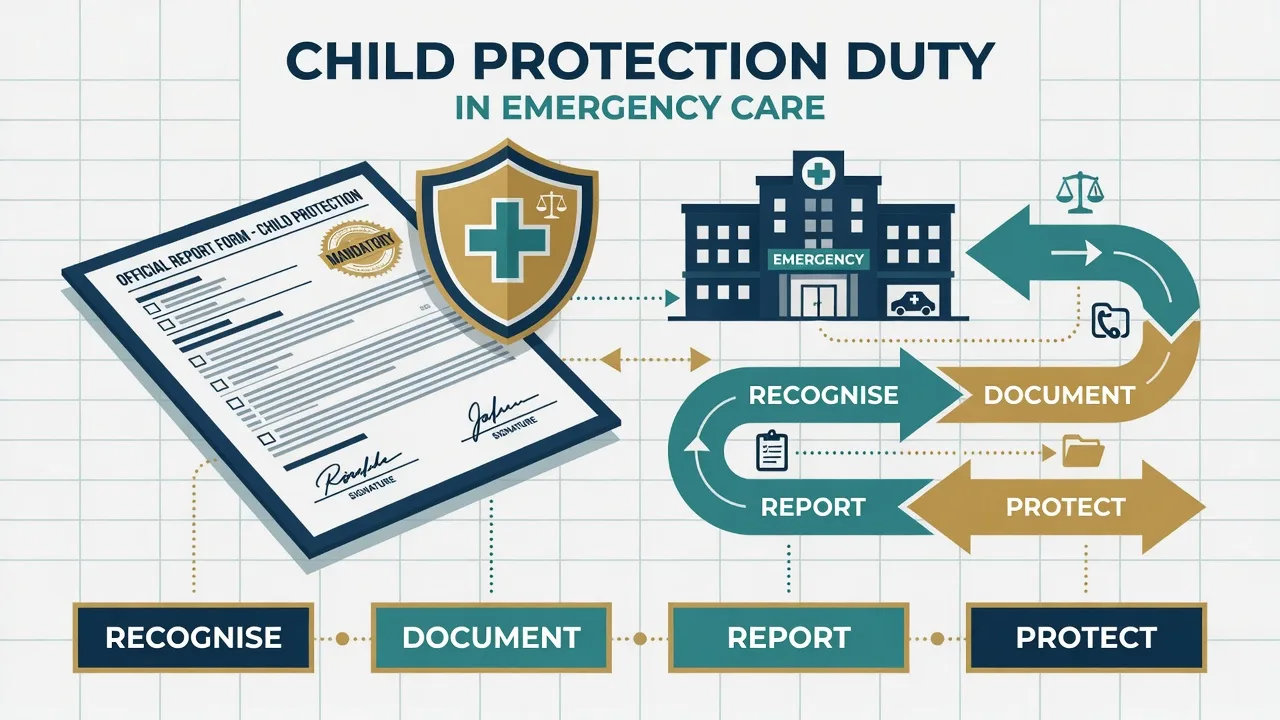
Mandatory reporting and child protection sit at the junction of clinical medicine, law, and ethics, and they are examined directly in the Fellowship OSCE communication station, in safeguarding SAQs, and as the medico-legal thread that runs through every paediatric presentation. The emergency clinician is frequently the first — and sometimes the only — professional to see an abused child, and the window for recognition is narrow: the injuries of inflicted trauma evolve, the history is rehearsed, and the missed case is the one who re-presents dead. The work rests on three duties held in tension at every bedside. The duty to recognise abuse through its sentinel injuries, the duty to respond through the safeguarding referral and the mandatory report, and the duty to the child's future evidence through the unbroken forensic chain. Each duty is examined in its own right, and a candidate who masters the recognition but mishandles the legal response — or vice versa — fails the station. [1]
Definition and scope
Child maltreatment is the abuse and neglect of a child under 18 and is conventionally divided into four overlapping forms. Physical abuse is the intentional or recklessly inflicted physical injury. Sexual abuse is any involvement of a child in sexual activity they cannot consent to or comprehend, including contact and non-contact acts. Emotional abuse is the persistent denigration, terrorising, or rejection that damages emotional development. Neglect is the persistent failure to meet the child's basic physical, medical, educational, or emotional needs. Fabricated or induced illness (formerly Munchausen syndrome by proxy, also termed medical child abuse) is a distinct pattern in which a caregiver falsifies or induces illness in a child to gain medical attention. Mandatory reporting is the statutory duty, imposed on defined clinicians (and in some jurisdictions on every adult), to report to the child-protection authority a reasonable belief that a child is suffering, or is at significant risk of suffering, abuse or neglect. The safeguarding referral is the clinical act that activates the multidisciplinary child-protection response, and the forensic chain of custody is the auditable continuity that makes physical evidence admissible. Scope in the emergency department is wide: any child 0 to 17 years may be the subject of concern, and the duty arises whenever the clinician forms the requisite belief — at triage, during resuscitation, on the ward round of a mental-health presentation, or at the discharge of a sibling. [1]
Epidemiology and risk factors
Maltreatment is most common and most lethal in the youngest children. Infants under one year of age have the highest rates of both non-accidental injury and abuse-related death, and the non-mobile infant is the child in whom any injury is most likely to be inflicted rather than accidental, because the child cannot generate the mechanism independently. Risk concentrates around a recognisable cluster: prematurity and low birth weight, disability and chronic illness, a young or single parent, parental mental illness, substance misuse, intimate partner violence, social isolation, housing instability, and a prior child-protection or safeguarding history. A previous unexplained infant death in the family and a history of the parents themselves having been abused raise recurrence. Presentation is often delayed and the history often inconsistent, and the single highest-risk sentinel is an injury the child is developmentally unable to sustain — the central reason that the clinician must always weigh the injury against the developmental stage, and the reason the validated bruising rule was built for children younger than four years. [1]
Recognising physical abuse — the sentinel injuries
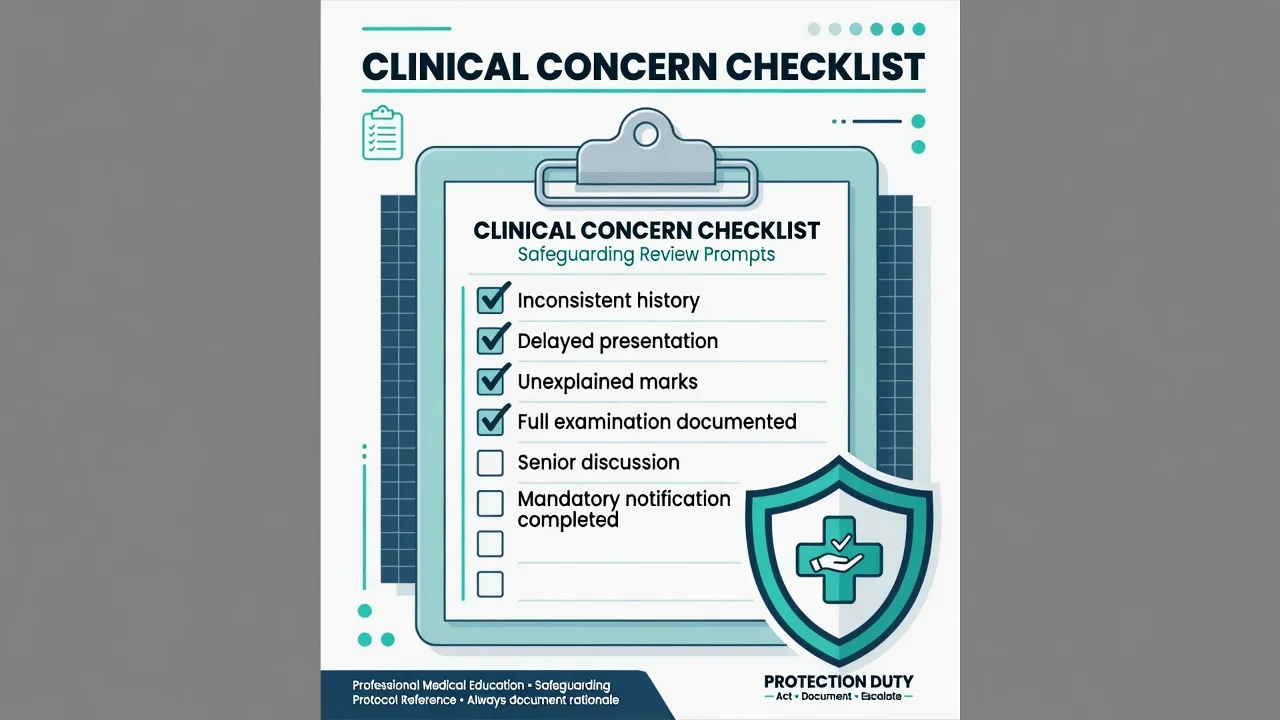
Physical abuse is recognised through a small number of high-yield sentinel findings, each of which the Fellowship examiner can test. The first is bruising in a non-mobile infant. The maxim "those who do not cruise rarely bruise" captures the principle: a child who is not yet mobile cannot generate the knocks that produce accidental bruising, so any bruise in a non-mobile infant, and any bruise at all in an infant four months of age or younger, is abnormal and demands explanation.[1][2] The location and pattern matter: bruises over bony prominences in an ambulant child are common, whereas bruises on the torso, the ear, the neck, the frenulum, the angle of the jaw, the fleshy cheek, the eyelid, or the subconjunctiva, and any patterned bruise (a slap, a grab, a loop-mark from a ligature), are high-risk. The validated TEN-4-FACESp clinical decision rule formalises these into a screening tool for children younger than four years.
The second sentinel is the inconsistent or changing history. The mechanism offered is incompatible with the developmental stage (a two-month-old "rolling off the bed"), it changes between caregivers or between tellings, it is vague for a serious injury, or the presentation is delayed beyond what the injury and the parent's stated concern would predict. Burns are a particular trap: an immersion burn with a sharp demarcation and a sparing of the flexure creases is inflicted, whereas a spill scald is irregular and shallow. The third sentinel is the fracture pattern. The systematic review of skeletal fractures in child abuse established the relative specificity of each fracture type.[3] Classic metaphyseal lesions (corner or bucket-handle fractures, produced by shearing at the growth plate), posterior rib fractures (from squeezing), and fractures of the scapula, sternum, and spinous processes carry high specificity for abuse. Multiple fractures of different ages and any fracture in a non-mobile infant are highly suspicious; a skull fracture, a long-bone fracture, and a healing rib fracture in the same infant is diagnostic until proven otherwise.
The fourth sentinel is abusive head trauma (shaken baby syndrome). The systematic review of features distinguishing inflicted from non-inflicted brain injury identifies the clinical triad of subdural haematoma, retinal haemorrhages, and hypoxic-ischaemic encephalopathy in an infant with an inadequate history, often accompanied by apnoea, seizures, and the posterior rib fractures of a grab.[5] Retinal haemorrhages that are extensive, multilayered, and extending to the periphery are particularly discriminating, and their documentation requires an ophthalmologist's dilated fundoscopy. Abusive head trauma is the leading cause of abuse-related death, and the infant often presents without a history of trauma, appearing septic or seizing, which is why a full cutaneous and skeletal examination is performed on every acutely encephalopathic infant.
Recognising sexual abuse — STI screening and the forensic examination
Sexual abuse is recognised through disclosure (most often delayed), behavioural change, and the physical findings on the anogenital examination. The emergency clinician's role is to screen for sexually transmitted infection, to perform or arrange the forensic examination within its time window, to give post-exposure prophylaxis, and to safeguard — not to determine whether assault occurred, which is the forensic and legal question. STI screening is guided by the pubertal status, the assault history, and the local prevalence. In the post-pubertal adolescent, specimens are taken from each penetrated site (vaginal or endocervical, rectal, pharyngeal) for Neisseria gonorrhoeae and Chlamydia trachomatis nucleic-acid amplification, with Trichomonas vaginalis testing, a baseline serology for syphilis, HIV, and hepatitis B and C, a pregnancy test, and a wet mount where indicated.[4]
The interpretation of a positive STI in a prepubertal child is itself a recognition skill. Neisseria gonorrhoeae and Treponema pallidum in a child beyond the neonatal period are diagnostic of sexual abuse, because perinatal acquisition of gonorrhoea clears within months. Trichomonas vaginalis in a prepubertal child is strongly suggestive. Chlamydia trachomatis is suggestive in a child older than three years, because perinatally acquired infection may persist to two to three years. HIV and hepatitis acquired outside the perinatal period, and any genital lesion of herpes simplex in a child, similarly imply abuse. The clinician therefore treats a positive STI as both a clinical finding and a forensic finding, documenting it within the chain of custody.[4]
Model answer — what to do when a child discloses sexual assault
Differential diagnosis — the mimics distinguished
The discipline of child protection is to recognise abuse without falsely accusing the family of a cultural practice or missing a treatable medical mimic. The differential of a suspicious injury is therefore enumerated and each mimic is distinguished by its specific features. [1]
Accidental injury
- A single, well-described mechanism that matches the developmental stage and the injury severity
- Bruising over bony prominences in an ambulant child; a consistent history told the same way by each caregiver
- Prompt presentation appropriate to the injury
- A radiological pattern consistent with a single event — no fractures of different ages
Cultural practices
- Cupping (circular erythematous marks), coining or gua sha (linear petechial streaks from repeated rubbing), and moxibustion burns — applied for healing
- The marks are patterned in a benign distribution (back, chest), the caregiver describes the practice openly, and the child is otherwise well
- Distinguished by the history and the location; if any doubt remains, or the child is otherwise unsafe, the safeguarding pathway still applies
Congenital dermal melanocytosis (Mongolian blue spot)
- A blue-grey macular discolouration over the sacrum, buttocks, or back present from birth — mistaken for bruising
- No evolution through the colour stages of a bruise, and present at a documented well-child check
- Distinguished by the fixed appearance and the birth history
Bleeding disorder or osteogenesis imperfecta
- Haemophilia, immune thrombocytopenia, and von Willebrand disease produce true bruising; osteogenesis imperfecta produces multiple fractures
- Distinguished by a bleeding history, a family history, the coagulation screen, and in osteogenesis imperfecta the blue sclera, dentinogenesis imperfecta, and a characteristic fracture pattern
- A bleeding disorder does not explain a posterior rib fracture, a classic metaphyseal lesion, or a patterned bruise — the diagnosis of abuse is not excluded by a co-existing condition
Sepsis and purpuric rash
- Meningococcaemia and Henoch-Schonlein purpura produce purpuric lesions that may be mistaken for inflicted bruising
- Distinguished by the acutely unwell child, the fever, the distribution (HSP on the lower limbs and buttocks), and the bloods
- A petechial or purpuric rash over the ears and neck still triggers the TEN-4-FACESp screen, and both pathways may need to run in parallel
Fabricated or induced illness (medical child abuse)
- A caregiver falsifies symptoms, contaminates samples, or directly induces illness (suffocation, poisoning, insulin) to secure medical attention
- The hallmarks are a child whose presentation is inexplicable or incongruent, a caregiver who is unusually attentive and medically knowledgeable, and symptoms that resolve when the caregiver is absent
- Distinguished by the careful corroboration of the history, the medical record across settings, and a low threshold to involve the child-protection team before confronting the family
The clinician holds two truths at once: a true mimic must be diagnosed and treated, and a plausible-sounding explanation does not exclude abuse. A child with osteogenesis imperfecta can also be abused, and the co-existence of a cultural practice does not protect a child from concurrent harm. [1]
Bedside assessment and investigations
The bedside assessment of the suspected abused child is a complete, documented, head-to-toe examination performed by a senior clinician, ideally with a chaperone and a second staff member as witness. The clinician records the developmental stage against the injury, the growth parameters (failure to thrive accompanies neglect), the skin in its entirety (undress the child fully, roll to examine the back, document every lesion on a body map with measured size and colour), the scalp and fontanelle, the fundi (clouding or haemorrhage raises abusive head trauma), the mouth (a torn frenulum from a forced feed or a blow), the ears (pinna bruising is highly specific), and the anogenital region only when sexual abuse is suspected, by a trained examiner. [1]
Investigations are guided by the pattern and the child's age. A skeletal survey — not a single babygram but a full set of dedicated radiographs, with a repeat at 11 to 14 days to reveal fractures that were occult acutely — is obtained in every child younger than two years with suspected physical abuse, and selectively in the older child; the yield of occult fractures is highest in the youngest, the pre-mobile, and the child with a sentinel fracture or bruise, which is why the survey is universal under two years.[3][9] A coagulation screen and full blood count exclude a bleeding diathesis. CT brain is the acute modality for the encephalopathic infant (subdural, oedema, hypoxic-ischaemic change), followed by MRI brain and spine to date bleeds and detect subtle injury. A dilated retinal examination by an ophthalmologist documents retinal haemorrhages. Liver enzymes and lipase screen for occult abdominal injury, and a urine toxicology screen is sent when poisoning or fabricated illness is suspected. The STI and forensic specimens are collected within the time window below, and every specimen is logged into the chain of custody the moment it is taken.
Management — resuscitation, the safeguarding referral and the forensic examination
Management runs in three parallel streams, none of which is allowed to delay another. The resuscitation stream is ordinary emergency medicine: the abused child with a subdural bleed, a fractures-compartment syndrome, or a visceral injury is resuscitated by ABCDE, and the life-threatening injury is treated first — forensics never delays stabilisation. The safeguarding stream activates the child-protection response: a senior clinician is informed early, the paediatric and social-work teams are contacted, and a strategy discussion (a multidisciplinary meeting of the ED, paediatrics, social work, child protection and, where appropriate, police) decides the plan — admission to a place of safety, the timing of the examination, and the safety of siblings. The child is not discharged until the safety plan is in place. [1]
The forensic and prophylaxis stream applies in suspected sexual abuse, and it is time-windowed. The acute forensic medical examination, performed by a trained examiner using the sexual assault kit, yields the most evidence when performed within 72 hours of the assault; after that window, the examination for injury, the STI screen, and prophylaxis still apply, but forensic yield falls. Post-exposure prophylaxis in the post-pubertal patient covers the common sexually transmitted organisms, pregnancy, and HIV.[4]
Mandatory reporting — the legal duty
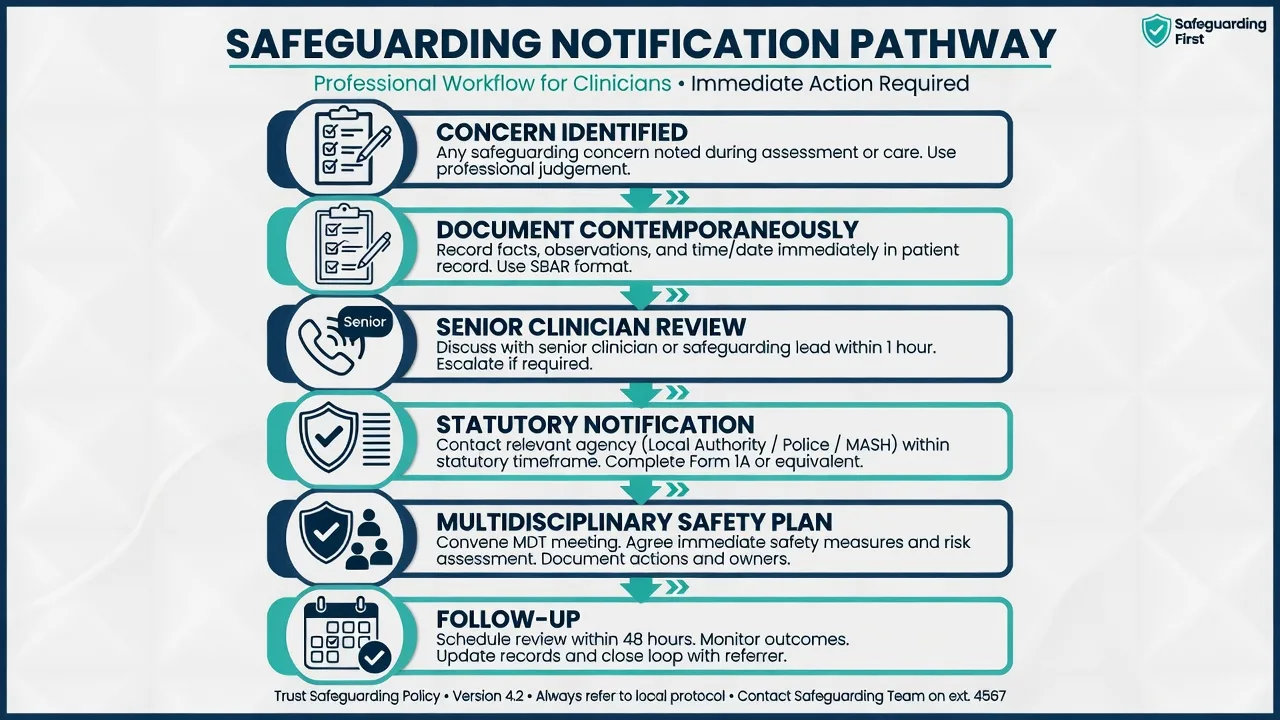
Mandatory reporting is the statutory obligation to notify the child-protection authority when the clinician forms a reasonable belief that a child is suffering or is at significant risk of suffering abuse or neglect. Three features are the substance of the duty and each is examinable. The threshold is a reasonable belief — a genuine, held suspicion based on the clinical findings — and it is emphatically not a requirement for certainty, proof, or even a confirmed diagnosis; the investigation is the authority's task, not the clinician's. The consent of the family is not required, and seeking it or warning the suspected perpetrator may place the child at risk, so the report is made on the clinician's own belief and the family is informed only when the safety plan permits. The report is protected: a report made in good faith attracts qualified privilege and cannot be the basis of a defamation or breach-of-confidence action, and the legislation typically provides an explicit civil and criminal immunity. The report is made promptly, by phone to the statutory authority followed by the written form within the statutory time, and the clinician documents the report — to whom, when, and the information given — in the medical record. Failure to report, where a mandatory reporter held the requisite belief, is itself an offence and a disciplinary matter. [1]
The forensic chain of custody
The forensic chain of custody is the auditable, unbroken record of who held each piece of evidence, from the moment of collection to its production in court. Its purpose is to demonstrate that the specimen has not been altered, contaminated, or substituted, so that the evidence is admissible. Each item — clothing, a swab, a condom, a hair — is collected, placed in a labelled, sealed container, the seal and label signed and dated by the collector, and every subsequent transfer to another person (a nurse, a police officer, a laboratory) recorded on a chain-of-custody form signed by both parties. Seals are broken only by the next authorised handler, the storage conditions are specified (refrigeration for biological samples), and the documentation is contemporaneous. A single unexplained break — a swab handed over without a signature, a seal opened outside the chain — can render the evidence inadmissible and collapse the forensic case, which is why the discipline is applied to every specimen in every case, however minor. The clinician who collects evidence but cannot account for its handling has done the child no favour. [1]
The four forms of maltreatment — distinguishing features at the bedside
The four conventional forms of maltreatment overlap in the same child and are distinguished by their sentinel features, which the Fellowship candidate must enumerate in any safeguarding SAQ. The same injured child may carry signs of more than one form, and the recognition of one obliges the search for the others. [1]
Physical abuse
- Bruising in a non-mobile infant; patterned bruising (slap, grab, loop ligature); bruises of the torso, ear, neck, frenulum, angle of jaw, cheek, eyelid, subconjunctiva — the TEN-4-FACESp positive sites
- Burns: a sharply demarcated immersion scald with flexure sparing, a cigarette burn (a punched-out circular lesion), a contact burn in the shape of an object
- Fractures of high specificity: classic metaphyseal lesion, posterior rib, scapula, sternum, spinous process; fractures of different ages; any fracture in a non-mobile infant
- Abusive head trauma: subdural haematoma, retinal haemorrhages, encephalopathy; the torn frenulum and the pinna bruise
Sexual abuse
- Disclosure (often delayed), behavioural change (sexualised play, regression, withdrawal, sleep disturbance, school decline), and the anogenital findings
- STI in a prepubertal child: gonorrhoea, syphilis, Trichomonas vaginalis beyond perinatal acquisition are diagnostic; chlamydia suggestive beyond 3 years
- Pregnancy in a child or adolescent; genital herpes simplex in a child
- Acute anogenital injury, blood-stained underwear, or the torn posterior fourchette; pain, discharge, or dysuria without another explanation
Emotional abuse
- The persistent denigration, terrorising, rejection, or humiliation that damages the emotional development
- Developmental delay, especially of language and social interaction; regression of milestones; the withdrawn, frozen-watchful, or overly-compliant child
- Failure to thrive without an organic cause where the neglect of emotional stimulation (the non-organic failure to thrive) coexists
- The diagnosis is largely historical and behavioural — the physical signs are few, and corroboration across settings (school, health visitor) is decisive
Neglect
- The persistent failure to meet basic physical, medical, educational, or emotional needs — the most common and the most easily missed form
- Failure to thrive: weight falling across centiles, weight below the 0.4th centile, or a Body Mass Index below the 0.4th centile; the wasted glutei and the sparse subcutaneous fat
- Medical neglect: the missed immunisations, the unmet insulin or anticonvulsant need, the late presentation of a treatable illness (the septic child, the fractured limb)
- Chronic untidiness, severe and untreated nappy rash, severe dental caries (early childhood caries), persistent infestations (scabies, head lice), and the unwitnessed or unaccompanied child
Sentinel injuries in the non-mobile infant — the complete inventory
Because the non-mobile infant cannot generate the mechanism of an accidental injury, every injury in this child is a potential sentinel and is examined against the developmental stage. The inventory extends well beyond the bruise and is the set of findings the Fellowship examiner tests with a photograph or a vignette. [1]
[1]The torn frenulum deserves its own emphasis. A torn upper labial frenulum is produced by a forced feed, a direct blow, or a shaking impact across the mouth, and in the non-mobile infant it is not explained by a fall. The systematic review of intra-oral injuries in child abuse established that the torn frenulum, a lingual injury, and dental trauma in a pre-mobile child are high-specificity markers of inflicted injury and warrant skeletal survey and safeguarding referral.[7]
The ear pinch and the pinna bruise are highly specific because accidental bruising of the ear is rare — the ear is protected, and a bruise on the pinna or behind the ear reflects a grab or a slap. The apparently isolated skull fracture in a young infant is itself a sentinel: the ExSTRA study showed that infants under one year with a seemingly isolated skull fracture harbour occult abusive injuries in a measurable minority, justifying the full skeletal survey and the child-protection workup even when the fracture appears to be the only finding.[8]
Fractures ranked by specificity for abuse
The skeletal fracture is the most concrete marker of inflicted injury, and the systematic review of fracture patterns in child abuse ranks each fracture by its specificity for abuse — the basis for the skeletal survey and the dating of injuries.[3]
High specificity for abuse
- Classic metaphyseal lesion (corner or bucket-handle) — a shearing injury through the immature metaphysis, not produced by a fall
- Posterior rib fracture (near the costovertebral junction) — produced by the anteroposterior squeeze of a grab
- Scapular, sternal, and spinous-process fractures — produced by direct blunt force or wrenching
- Digital fractures (phalangeal) in a non-mobile infant, and vertebral body compression fractures
Moderate specificity
- Multiple fractures of different ages (callus at one site, a fresh fracture at another)
- Epiphyseal separation, vertebral body, and pelvic fractures
- Any fracture in a non-mobile infant, even a long-bone shaft fracture, raises the index of suspicion
- Skull fracture, especially complex, multiple, or wide, in the absence of a credible high-energy mechanism
Common but low specificity (do not dismiss)
- Single long-bone shaft fracture (femur, tibia, humerus) — common in both accidental and inflicted injury; the specificity rises with the younger age and the non-mobile status
- Clavicular and supracondylar fractures — common accidental patterns but still require the developmental check
- A linear parietal skull fracture from a short fall is plausible but must be weighed against the history; occult fractures found on survey reclassify the case
- Low specificity does not exclude abuse — the fracture is read in the context of the whole child
The ED workup of the suspected non-accidental injury
The ED workup runs as a fixed sequence in which no step delays the resuscitation, the safeguarding referral, or the forensic collection. The sequence is examined directly and the candidate who runs it out of order — confronting the family before the referral, or discharging before the survey — fails the station. [1]
Resuscitate by ABCDE first — a subdural, a compartment-threatening fracture, or a visceral injury is treated as ordinary emergency medicine; forensics never delays stabilisation
Take the history from each caregiver separately and verbatim — record the mechanism offered, the developmental milestones, the time of injury, the time of presentation, and the inconsistencies between accounts
Examine the child fully undressed, head to toe, with a chaperone and a second staff witness — measure and plot the weight, length, and head circumference on the centile charts, and document every lesion on a body map with size and colour
Record the developmental stage against the injury — a two-month-old does not roll, a six-month-old does not cruise, a non-mobile infant does not generate a bruise; the mismatch is the sentinel
Notify the senior clinician early and convene or request the strategy discussion with paediatrics, social work, and child protection; do NOT confront or accuse the family
Investigate by pattern — skeletal survey (a full set of dedicated films, NOT a babygram) and a repeat at 11 to 14 days in any child under two years; coagulation screen and FBC; CT brain for the encephalopathic infant followed by MRI brain and spine; liver enzymes and lipase for occult abdominal injury; urine toxicology if poisoning or fabricated illness is suspected; ophthalmology for the dilated fundal exam
Make the mandatory report to the statutory child-protection authority by phone, followed by the written form within the statutory time — the reasonable belief threshold, no parental consent required
Plan the disposition and the safety — admit to a place of safety if any risk on discharge, examine the siblings, and document the entire encounter contemporaneously for the court record
The acute forensic examination of the sexually assaulted child — the time window
The forensic examination is a multidisciplinary, time-windowed procedure that the ED coordinates but a trained examiner performs. The yield of forensic evidence is highest in the first 72 hours, after which the swabs degrade and the local injury heals; the medical evaluation, prophylaxis, and safeguarding proceed regardless of the elapsed time. [1]
Believe the child, thank them for telling you, and avoid leading questions; record the disclosure verbatim and in the child's own words
Assess and treat medical urgency first — active bleeding, pain, intoxication, or the medical consequences of the assault take precedence
Establish the time window — if within 72 hours of the assault, arrange the acute forensic examination by a trained paediatric sexual offence examiner or forensic nurse using the sexual assault kit
Obtain consent (and the assent of the child) within the limits of the jurisdiction — a mature minor may consent; in the absence of consent for the forensic exam, the medical screen and prophylaxis still proceed
Collect the forensic specimens — clothing, swabs from each penetrated site (vaginal/endocervical, rectal, pharyngeal), the fingernail clippings, the pubic hair combings, and the photographic documentation of injury — every item into the labelled, sealed, signed chain of custody
Screen for STI — nucleic-acid amplification for Neisseria gonorrhoeae and Chlamydia trachomatis at each penetrated site, Trichomonas testing, a wet mount, the baseline serology (syphilis, HIV, hepatitis B and C), and a pregnancy test for the post-pubertal patient
Give the post-exposure prophylaxis — pregnancy prevention (levonorgestrel 1.5 mg, ideally within 72 hours), STI cover (ceftriaxone 500 mg IM, azithromycin 1 g, metronidazole), hepatitis B vaccine and immunoglobulin if non-immune, and HIV PEP (a 28-day three-drug regimen) within 72 hours of a risk-assessed exposure
Make the mandatory report and the safeguarding referral, arrange the follow-up (repeat serology at the window period, counselling, the forensic and paediatric review), and document within the chain of custody
Trial cards — the evidence base
Pierce — TEN-4-FACESp bruising clinical decision rule (JAMA Network Open 2021)
JAMA Network Open
PMID 33852003
Key finding
A multicentre, prospective derivation-and-validation study of 2161 children younger than four years with bruising, comparing the TEN-4-FACESp rule against the criterion standard of the child-protection-team determination of abuse. The rule (bruising on the Torso, Ear, or Neck; any bruise in an infant Four months or younger; Frenulum, Angle of jaw, fleshy Cheek, Eyelid, Subconjunctiva; and a Patterned bruise) had a sensitivity of 95.6 percent and a specificity of 87.1 percent for abuse.
Practice change
TEN-4-FACESp is the modern validated screen that operationalises the maxim 'those who do not cruise rarely bruise'. A positive screen escalates to the full safeguarding workup; it is a screen to act on, not a diagnostic test, and a negative screen does not override other sentinel findings.
Kemp — patterns of skeletal fractures in child abuse, systematic review (BMJ 2008)
BMJ
PMID 18832412
Key finding
A systematic review of 32 studies of fractures in child abuse that established the relative specificity of each fracture type. Classic metaphyseal lesions, rib fractures (especially posterior), and fractures of the scapula, sternum, and spinous processes carried the highest specificity for abuse; a femoral fracture in a pre-mobile infant and a humeral fracture in a child under three carried the highest likelihood ratios among the long-bone fractures.
Practice change
Provides the ranked fracture-specificity data that underpin the skeletal survey and the dating of multiple injuries; the foundation for the modern recommendation that any fracture in a non-mobile infant prompts the abuse screen.
Maguire — clinical features distinguishing inflicted from non-inflicted brain injury, systematic review (Arch Dis Child 2009)
Archives of Disease in Childhood
PMID 19531526
Key finding
A systematic review identifying the clinical features that discriminate inflicted from non-inflicted brain injury. The combination of subdural haematoma, hypoxic-ischaemic encephalopathy, and retinal haemorrhages that are extensive, multilayered, and extending to the periphery was highly discriminating; apnoea, seizures, and rib fractures were strongly associated, and an absent or inconsistent history was a defining feature.
Practice change
Establishes the subdural-retinal-encephalopathy triad and the discriminating retinal-haemorrhage pattern as the basis for the diagnosis of abusive head trauma and the mandatory dilated fundoscopy in every encephalopathic infant.
Deye / ExSTRA — occult abusive injuries in infants with apparently isolated skull fractures (J Trauma Acute Care Surg 2013)
Journal of Trauma and Acute Care Surgery
PMID 23694887
Key finding
A secondary analysis of the Examining Young Children with Skull Fractures (ExSTRA) multicentre cohort of infants with apparently isolated skull fractures, evaluated by the child-abuse paediatrician and the skeletal survey. A clinically important proportion of infants harboured occult abusive fractures elsewhere, and the rate was highest in the youngest infants, confirming that the apparently isolated skull fracture is itself a sentinel.
Practice change
Any skull fracture in an infant under two years warrants the full skeletal survey, the repeat film, the ophthalmology review, and the child-protection assessment — the apparently isolated fracture is not isolated until the workup is complete.
Adams — updated guidelines for the medical assessment of the sexually abused child (J Pediatr Adolesc Gynecol 2016)
Journal of Pediatric and Adolescent Gynecology
PMID 26220352
Key finding
An updated consensus guideline of the medical assessment and care of children who may have been sexually abused, covering the timing of the forensic examination, the STI screen by pubertal status and site, the interpretation of a positive STI in the prepubertal child, the post-exposure prophylaxis, and the documentation within the chain of custody.
Practice change
The reference standard for the ED management of the sexually abused child; defines the diagnostic weight of each STI (gonorrhoea, syphilis, Trichomonas diagnostic beyond perinatal; chlamydia suggestive beyond three years) and the time-windowed forensic and prophylaxis protocol.
Kellogg / AAP — the evaluation of sexual abuse in children (Pediatrics 2005)
Pediatrics
PMID 16061610
Key finding
The American Academy of Pediatrics clinical report on the evaluation of sexual abuse in children, defining the indications for the examination, the role of the forensic kit, the STI screening strategy, and the prophylaxis — the foundational document that the 2016 update extends.
Practice change
Established the structured approach to the sexually abused child that the emergency clinician inherits: believe the child, examine within the window, screen by site and pubertal status, prophylax, and report.
Wood — utility of skeletal surveys for occult fractures in young injured children (Acad Pediatr 2019)
Academic Pediatrics
PMID 30121318
Key finding
A multicentre study of the yield of the skeletal survey in young injured children, demonstrating that the survey detects occult fractures in a substantial minority of infants under two years with a concerning injury, and that the yield is concentrated in the youngest, the pre-mobile, and those with a sentinel fracture or bruise. The repeat survey at 11 to 14 days added further occult fractures.
Practice change
Supports the universal skeletal survey in every child under two years with suspected physical abuse, the repeat film at 11 to 14 days, and a low threshold to survey the older child with a sentinel finding.
Safety planning and disposition — the non-accidental injury pathway
The disposition of the suspected abused child is governed by the safety of the child and the safety of the siblings, never by the pressure to free a bed. The non-accidental injury (NAI) pathway is the institution's pre-agreed multidisciplinary route that the ED activates the moment the suspicion forms, and it determines who sees the child, in what order, and where the child goes from the ED. [1]
[1] [1] [1] [1]The TEN-4-FACESp bruising rule for the child under four years
TEN-4
Bruising on the torso (chest, abdomen, back, buttocks, genitalia) in a child under four years
Bruising of the ear — the pinna or behind the ear — a high-specificity grab site
Bruising of the neck, a site rarely injured accidentally in a young child
Any bruise at all in an infant four months of age or younger — abuse until proven otherwise
The FACES facial bruising sites of the rule
FACES
The torn or bruised upper labial frenulum — a forced-feed or a blow marker
Bruising at the angle of the jaw — the slap site
Bruising of the fleshy cheek, over the parotid, a grab or slap site
Bruising of the eyelid — rarely accidental in a young child
A subconjunctival or scleral haemorrhage — a slap or a raised-venous-pressure injury
Documentation for the court record
The medical record of the suspected abused child is, from the moment of suspicion, a court document, and the discipline of forensic documentation applies throughout. The clinician records the history verbatim in the words used by each caregiver, with the time of the injury, the time of the presentation, the mechanism offered, and the inconsistencies between accounts; the examination findings on a body map with each lesion measured, its colour recorded, and the photographs taken with a scale and a colour reference; the developmental assessment against the centile charts and the milestone history; the investigations requested and their results; the safeguarding actions — the senior notified, the strategy discussion convened, the report made (to whom, when, and what was said), and the disposition decided; and the chain of custody for every specimen. The documentation is contemporaneous, legible, and signed, and it is written with the knowledge that it will be read aloud in a courtroom years later. The undocumented finding is, for the court, a finding that did not occur. [1]
[1]Common errors and pitfalls
The recurring errors cluster around the recognition, the response, and the family. In recognition, the commonest miss is the injury attributed to a plausible-sounding mechanism without checking the developmental stage — the non-mobile infant's bruise called a birthmark, the torn frenulum called a feeding injury. The opposite error is the over-investigation of a clearly accidental injury, which traumatises the family and consumes resources. In response, the worst errors are the failure to report because the clinician was not certain, the delayed report while awaiting the full workup, and the breach of the chain of custody that renders the evidence useless. Confronting or accusing the parents directly, or interviewing the alleged perpetrator, destroys the relationship and may compromise the criminal investigation; the clinician shares concern without accusation and lets the authority investigate. Missing a treatable mimic — sepsis, a bleeding disorder, osteogenesis imperfecta — harms the child and exposes the clinician. Forgetting the siblings, who are at the same risk, is an avoidable recurrence. And poor documentation — undocumented findings, an unrecorded history, an unrecorded report — leaves the child unprotected when the case reaches court. [1]
Evidence and regional guidelines
The validated TEN-4-FACESp bruising rule, built on the original TEN-4 discriminators, is the modern evidence base for the bruised child and the rule the Fellowship examiner now expects.[1][2] The fracture-specificity data come from the systematic review of skeletal fracture patterns in child abuse.[3] The clinical features distinguishing inflicted from non-inflicted brain injury, including the discriminating retinal-haemorrhage pattern, are established by the systematic review of inflicted brain injury.[5] The medical assessment of the sexually abused child, the STI screen, and the post-exposure prophylaxis are set out in the updated American Academy of Pediatrics guidance.[4] The statutory overlay — who must report, the threshold, the protection, and the penalty — is regional and is summarised below.
ANZ practice note. Each Australian state and territory has its own children-and-young-persons legislation: in New South Wales the Children and Young Persons (Care and Protection) Act 1998 makes reporting mandatory for defined professionals (doctors, nurses, teachers, police) who form a reasonable belief that a child is at risk of significant harm (the ROSH threshold), with the report made to the Child Protection Helpline; Victoria's Children, Youth and Families Act 2005 and Queensland's Child Protection Act 1999 provide parallel duties. New Zealand's Oranga Tamariki Act 1989 (the Children, Youth and Family Act) imposes reporting on certain professionals. The ACEM policy on the recognition and management of child abuse and neglect sets the professional standard for emergency clinicians in the region. Good-faith reports are protected, and failure to report by a mandated professional is an offence. [1]
Exam pearls
- Those who do not cruise rarely bruise — any bruise in a non-mobile infant, and any bruise in an infant four months of age or younger, is a TEN-4-FACESp positive screen.
- TEN-4-FACESp: Torso, Ear, Neck; any bruise in an infant Four months or younger; Frenulum, Angle of the jaw, fleshy Cheek, Eyelid, Subconjunctiva; and a Patterned bruise — sensitivity 95.6 percent, specificity 87.1 percent.[1]
- Classic metaphyseal lesion plus posterior rib fractures carry the highest specificity for abuse; multiple fractures of different ages are diagnostic until proven otherwise.[3]
- Abusive head trauma triad: subdural haematoma, extensive multilayered retinal haemorrhages, and hypoxic-ischaemic encephalopathy in an infant with an inadequate history.[5]
- Prepubertal gonorrhoea, syphilis, or Trichomonas (beyond perinatal acquisition) is sexual abuse until proven otherwise; chlamydia is suggestive beyond three years.[4]
- A mandatory report needs a reasonable belief of significant harm — neither parental consent nor diagnostic certainty is required, and good-faith reports are protected.
- Forensic yield is highest within 72 hours of a sexual assault; the chain of custody is auditable from collection to court, and a single unexplained break renders evidence inadmissible.
- Never accuse the parents or interview the alleged perpetrator — share concern without accusation, involve the multidisciplinary team early, and document everything.
SAQ — Suspected non-accidental injury in a non-mobile infant
10 minutes · 10 marks
A 9-week-old male infant is brought to the emergency department by his mother at 11 pm on a Sunday with a 2 cm bruise over the fleshy cheek. The mother states she found it after putting him down for a sleep five hours earlier. There are no other injuries on initial inspection. The infant is afebrile, feeding well, and the developmental history is normal. The mother is 22 years old, the partner is the biological father, and the family has no prior contact with child protection services.
SAQ — Child sexual abuse disclosure in the emergency department
10 minutes · 10 marks
A 14-year-old girl presents to the emergency department at 02:00 with her mother. She disclosed earlier in the evening that her stepfather had sexual intercourse with her three days ago. She is post-menarcheal, not on contraception, and has had no prior sexual contact. The mother is supportive and the stepfather is not in the hospital. The patient is haemodynamically stable, with no active bleeding, but reports lower abdominal pain and dysuria. There is no acute anogenital injury on inspection. She does not want her mother to be present during the examination.
Red flags
References
- [1]Pierce MC, Magana JN, Kaczor K, et al. Validation of a Clinical Decision Rule to Predict Abuse in Young Children Based on Bruising Characteristics JAMA Netw Open, 2021.PMID 33852003
- [2]Pierce MC, Kaczor K, Aldridge S, O'Flynn J, Lorenz LP. Bruising characteristics discriminating physical child abuse from accidental trauma Pediatrics, 2010.PMID 19969620
- [3]Kemp AM, Dunstan F, Harrison S, et al. Patterns of skeletal fractures in child abuse: systematic review BMJ, 2008.PMID 18832412
- [4]Adams JA, Kellogg ND, Farst KJ, Harper NS, Palusci VJ, Frasier LD, Levitt CJ, Shapiro RA, Moles RL, Starling SP. Updated Guidelines for the Medical Assessment and Care of Children Who May Have Been Sexually Abused J Pediatr Adolesc Gynecol, 2016.PMID 26220352
- [5]Maguire SA, Kemp AM, Lumb RC, Hunter RM, Harris SM, Mann DC, Sibert JR, Watts PO. Which clinical features distinguish inflicted from non-inflicted brain injury? A systematic review Arch Dis Child, 2009.PMID 19531526
- [6]Kellogg N, American Academy of Pediatrics Committee on Child Abuse and Neglect. The evaluation of sexual abuse in children Pediatrics, 2005.PMID 16061610
- [7]Maguire S, Hunter B, Hunter L, Sibert JR, Mann M, Kemp AM. Diagnosing abuse: a systematic review of torn frenum and other intra-oral injuries Arch Dis Child, 2007.PMID 17468129
- [8]Deye KP, Berger RP, Lindberg DM, ExSTRA Investigators. Occult abusive injuries in infants with apparently isolated skull fractures J Trauma Acute Care Surg, 2013.PMID 23694887
- [9]Wood JN, Henry MK, Berger RP, Lindberg DM, Anderst JD, Stafford MC, et al. Use and Utility of Skeletal Surveys to Evaluate for Occult Fractures in Young Injured Children Acad Pediatr, 2019.PMID 30121318