EM · Sexual assault and intimate partner violence
Sexual assault and intimate partner violence in the emergency department
Also known as Sexual assault · Rape · Sexual violence · Intimate partner violence · Domestic violence · Forensic medical examination · Sexual assault kit · Trauma-informed care · Post-exposure prophylaxis after sexual assault · Danger assessment
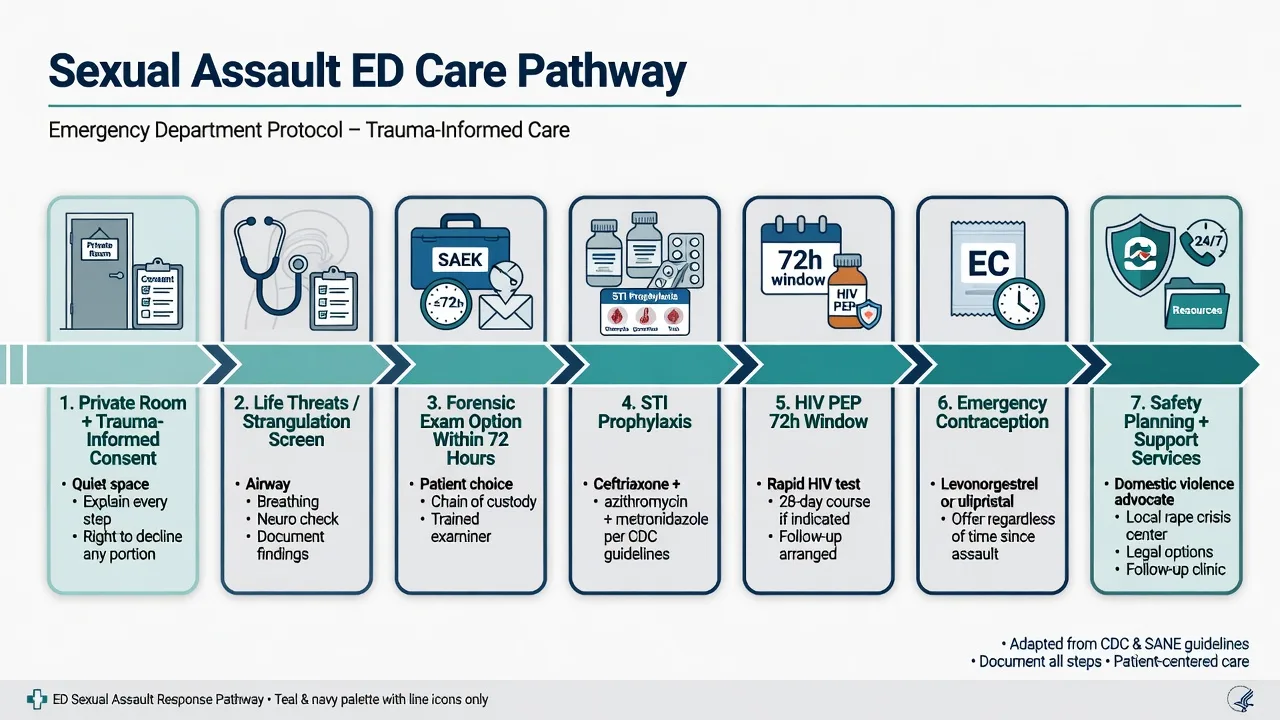
Sexual assault and intimate partner violence in the emergency department — the trauma-informed approach that governs the entire encounter, the patient-centred consent that runs throughout, the time-windowed forensic examination (the sexual assault kit and the chain of custody within 72 hours), the STI prophylaxis (ceftriaxone 500 mg IM, azithromycin 1 g PO, metronidazole 2 g PO), the HIV post-exposure prophylaxis within 72 hours, and the emergency contraception (levonorgestrel 1.5 mg PO or ulipristal 30 mg PO), the safety assessment and safety planning, the mandatory reporting considerations, and the differential distinguished from intimate partner violence. ACEM-primary, globally tagged.
On this page & tools
Your progress
Saved locally on this device.
Target exams
Red flags
Related topics
- Consent, capacity and the medico-legal framework in the emergency department
- Mandatory reporting and child protection in the emergency department
- Breaking bad news and communication in the emergency department — the SPIKES framework
- Deliberate self-harm and suicide risk assessment
- Antepartum haemorrhage
Sexual assault and intimate partner violence are among the commonest and most exacting presentations the emergency clinician encounters, and they are examined directly in the Fellowship OSCE communication station, in safeguarding SAQs, and as the medico-legal thread woven through every injured, pregnant, or suicidal patient. The emergency department is frequently the first — and sometimes the only — point of contact, and the encounter is governed by a single overriding principle: a trauma-informed, patient-centred approach in which the patient, having had their autonomy overridden by the assault, is returned to control of every decision that follows. The clinical work runs in parallel streams — stabilise injury, offer the time-windowed forensic examination, give prophylaxis against pregnancy and sexually transmitted infection including HIV, conduct the safety assessment, and discharge the legal duties — and no stream is allowed to override the patient's choices. The candidate who masters the medical management but mishandles the consent, the chain of custody, or the safety assessment fails the station.[4][7]
Definition and scope
Sexual assault is any sexual act carried out without the freely given consent of the recipient, including contact acts (rape, attempted rape, unwanted touching) and non-contact acts (forced viewing, coercion into pornography). The legal definitions of rape and sexual assault vary by jurisdiction, but the clinical encounter does not turn on the legal label: the clinician's role is to provide care, to offer forensic examination, and to safeguard — not to determine whether an offence occurred, which is the question for the courts. Consent is the operative concept: freely given, informed, specific, revocable, and given by a person with capacity who is free of coercion, intoxication to the point of incapacity, or fear. A person cannot consent while asleep, unconscious, severely intoxicated, or under threat, and consent to one act is not consent to another.[1]
Intimate partner violence (IPV), also termed domestic violence or domestic abuse, is any behaviour within an intimate relationship that causes physical, sexual, or psychological harm, including physical aggression, sexual coercion, psychological abuse, and controlling behaviours — collectively, coercive control. IPV is a co-traveller with sexual assault: a substantial proportion of sexual assault presenting to the emergency department is perpetrated by a current or former partner, and the clinician who treats the assault without recognising the abusive relationship misses the greater and ongoing danger. The scope of the emergency department's role is bounded and explicit: to recognise, to provide acute medical and forensic care, to offer prophylaxis and contraception, to assess and plan for safety, to discharge the legal duties, and to bridge the patient to the specialist sexual-assault and domestic-violence services that provide the sustained response.[3][6]
Epidemiology
Sexual violence is common and markedly under-reported. Globally, around one in three to one in five women experience sexual or physical intimate-partner violence in their lifetime, and a substantial minority of these present to healthcare. The emergency department sees the acute aftermath — injury, psychological distress, substance involvement, pregnancy concern, and the patient who attends days later with symptoms and an emerging disclosure. The perpetrator is known to the victim in the majority of cases — a current or former partner, an acquaintance, or a person in authority — and stranger assault, though over-represented in public perception, is the minority. Presentation is frequently delayed because of shame, fear, disbelief, intoxication at the time of the event, amnesia from drug-facilitated assault, or threat by the perpetrator. The emergency clinician therefore maintains a low threshold for direct, compassionate enquiry whenever a patient presents with unexplained injury, acute psychological distress, a somatic complaint that does not fit, a pregnancy concern, or a request for emergency contraception or a sexually transmitted infection check.[6]
The principle: trauma-informed care
Trauma-informed care is the framework that governs the entire encounter, and the Fellowship examiner tests it directly. The premise is that the patient who has been assaulted has experienced a profound loss of control, and every interaction either restores a measure of that control or compounds the harm. The systematic review of trauma-informed care interventions in emergency medicine confirms that structured, trauma-informed approaches improve engagement, reduce re-traumatisation, and increase the uptake of follow-up and prophylaxis.[4] Trauma-informed care rests on five principles — safety, trustworthiness, choice, collaboration, and empowerment — and four practical commitments, sometimes taught as the four R's.
The trauma-informed encounter — the four commitments
REAL
Realise that trauma is widespread and affects behaviour — the withdrawn, irritable, or uncooperative patient may be reacting to trauma, not to you
Explicitly acknowledge that the patient has had their control overridden, and that every step is now their choice — explain what you are doing and why, before you do it
Ask permission before any examination, touch, question, or procedure — and accept refusal without negotiation or pressure
Link the patient to specialist sexual-assault and domestic-violence services, a support person of their choosing, and follow-up — never leave the patient to navigate alone
The practical commitments translate into bedside conduct that is itself examinable. The clinician offers a private space, a same-sex chaperone and clinician where possible and where the patient wishes, a support person of the patient's choosing, and the explicit statement that the patient may stop, decline, or pause at any point. Questions are direct and non-judgemental, in plain language, and the patient's own words are recorded verbatim without interpretation. The clinician does not ask "why" questions that imply blame — why were you there, why did you drink, why did you go with him — and does not press a reluctant patient into an examination, a report, or a course of prophylaxis they have declined.[4]
Consent and the patient-centred encounter
Consent is the spine of the sexual-assault encounter, and it differs from ordinary consent in one decisive respect: it is sought and re-sought at every step, it is specific to each component, and it may be withdrawn at any time. The patient may consent to STI prophylaxis but decline the forensic examination, consent to the examination but decline police involvement, or consent to a report but decline to give a statement. Each decision is honoured without persuasion, and the decision and its reasoning are documented. Where the patient lacks capacity — through severe intoxication, head injury, or acute psychological collapse — the acute medical treatment proceeds under the doctrine of necessity, but the forensic examination and the non-urgent prophylaxis are deferred until capacity returns, because these interventions serve the patient's future interests and their consent, not an immediate medical emergency. [1]
[1]A specific consent question concerns the mature minor. An adolescent who has sufficient understanding of the examination, the prophylaxis, and their consequences may consent alone, and the Gillick competence test applies; confidentiality is preserved, and parental involvement is sought only with the young person's agreement unless a mandatory-reporting or child-protection duty arises. Where the assault involves a child, the safeguarding and mandatory-reporting pathway runs in parallel, and the forensic examination is performed by a specialist in paediatric forensic medicine.[1]
Clinical presentation and the atypical
The typical acute presentation is a patient, often distressed and sometimes accompanied, giving a history of a recent assault and seeking care, examination, or prophylaxis. The clinician documents, in the patient's own words, the time of the assault, the type of contact (vaginal, anal, oral, digital, object), the sites of ejaculation or contact, the use of a condom, the identity of and relationship to the assailant if known, the events between the assault and attendance (showering, douching, changing clothes, eating, brushing teeth, urinating, defecating), and any current symptoms — pain, bleeding, injury, dysuria, discharge. The general medical, sexual, contraceptive, and vaccination history (hepatitis B immunisation) and the mental-health and substance history complete the picture. [1]
The atypical presentations are the ones that catch the unwary. The drug-facilitated assault presents with amnesia for the event, a fragmented memory, or a vague account of waking up undressed and in pain — a urine toxicology screen is sent early, before alcohol, gamma-hydroxybutyrate, flunitrazepam, ketamine, and other substances clear. The delayed presentation arrives days or weeks later, with symptoms of infection, pregnancy concern, or an emerging disclosure prompted by distress or a trigger, and the forensic window may have closed though prophylaxis and care continue. The patient who minimises — "it wasn't that bad", "it was my fault" — is nevertheless taken seriously, because minimisation is a feature of trauma, not evidence of its absence. The strangulation presentation is the highest-acuity atypical: a patient assaulted with non-fatal strangulation may look well yet have carotid dissection, airway injury, intracranial venous congestion, or a delayed stroke, and a structured assessment of the airway, the nervous system, and the carotid vessels is mandatory. And the presentation that is not disclosed as assault at all — the unexplained injury, the anxiety, the pelvic pain, the pregnancy scare, the suicidal ideation — is uncovered only by a direct, compassionate question asked of a patient seen alone.[6]
Differential diagnosis — the mimics and the co-traveller distinguished
The differential of the sexual-assault and IPV presentation divides into the mimics of injury, the co-travelling conditions that must not be missed, and the differential cause of the presenting complaint itself. The clinician assigns each case to its pattern because the management and the safeguarding response differ, and the assignment is made from the history, the collateral, and the examination — never from the patient's demeanour alone. [1]
Acute sexual assault
- A disclosure or strong suspicion of non-consensual sexual contact within the forensic window (within 72 hours for maximal evidence yield)
- Offer the full pathway: forensic examination within the window, STI and HIV prophylaxis, emergency contraception, safety assessment, and specialist referral
- Consent is specific to each component and revocable; the chain of custody governs every specimen
- Mandatory-reporting and safeguarding duties are assessed, and police involvement is offered, not imposed, on a competent adult
Intimate partner violence (IPV)
- The co-traveller — patterned, central, or facial injury; injury inconsistent with the stated mechanism; a defensive posture; a controlling partner who will not leave and who answers for the patient
- Screen when the patient is alone; use a validated tool (HITS, HARK); a non-fatal strangulation event multiplies the subsequent homicide risk roughly seven-fold
- Conduct a structured danger assessment and safety plan; never require the patient to leave immediately; bridge to the domestic-violence service
- Mandatory reporting of adult IPV varies by region; the threshold and the recipient are jurisdiction-specific
Accidental or consensual injury
- A single, consistent mechanism matching the injury; a coherent history told the same way; a well, engaged patient
- Distinguished by the history, the injury pattern, and the collateral — but a plausible-sounding accidental mechanism does not exclude IPV, which is often concealed behind an offered explanation
- A low threshold for a direct, private enquiry is maintained in every injured patient
Consensual sexual activity with injury
- Consensual activity may produce genital or perineal injury that prompts attendance; the patient may seek pregnancy or infection prophylaxis
- Distinguished by the history of consent; routine STI screening and contraception advice apply
- Where consent is uncertain, capacity is impaired, or coercion is suspected, the full assault pathway and safeguarding apply
Drug-facilitated assault with amnesia
- Amnesia for the event, a fragmented memory, waking undressed, or a third-party account of suspected drink-spiking
- Send an early urine toxicology screen before substances clear; the patient may not know whether penetration occurred, and prophylaxis is offered on the worst-case assumption
- The forensic examination and the toxicology screen are time-sensitive and run together
Medical cause of altered mental state
- Intoxication, hypoglycaemia, sepsis, head injury, or post-ictal state may mimic or accompany the distressed or amnestic presentation
- Check glucose, examine for head injury, and exclude an organic cause before attributing the mental state to the psychological aftermath alone
- The doctrine of necessity covers acute medical treatment; forensic and non-urgent steps await recovered capacity
The clinician holds two truths at once: a plausible alternative explanation does not exclude assault or IPV, and a true medical or accidental cause must be diagnosed and treated in its own right. A patient with a genuine bleeding disorder can also be assaulted, and an assault presentation can also harbour a missed head injury or intoxication. [1]
Bedside assessment and investigations
The bedside assessment is sequential and consent-driven. The clinician first excludes or treats the life-threatening injury — airway, breathing, circulation, and catastrophic bleeding come before forensics in every case. A bedside glucose, a focused neurological and airway assessment for strangulation, and an assessment of capacity are performed early. Once the patient is stable, the history is taken in the patient's own words, and the general and forensic examinations proceed with explicit consent, a same-sex chaperone, and a support person if the patient wishes. The cutaneous examination documents every injury on a body map with measured size and location, paying particular attention to patterned injury, defensive wounds, and facial and central injury that suggest IPV. The anogenital examination is performed only when indicated and consented, ideally by a trained forensic examiner, and may be deferred to the specialist sexual-assault service. [1]
Investigations are tailored to the time window, the history, and the examination. A pregnancy test is performed on every potentially pregnant patient before emergency contraception is given. STI screening is taken from each site of penetration or contact — vaginal or endocervical, rectal, pharyngeal — for Neisseria gonorrhoeae and Chlamydia trachomatis nucleic-acid amplification, with Trichomonas vaginalis testing and a wet mount where indicated. Baseline serology for HIV, syphilis, hepatitis B (surface antigen and antibody), and hepatitis C is sent, and repeat serology is arranged at the follow-up interval because seroconversion takes weeks to months. A urine toxicology screen is sent early when drug-facilitation is suspected, and a blood alcohol and drug screen is collected within the statutory window if the case may proceed to court. Photographs of injury are taken with consent and stored within the chain of custody. Every specimen is labelled, sealed, and signed at the moment of collection.[1][7]
The forensic examination — the 72-hour window, the kit and the chain of custody
The forensic medical examination is performed to collect evidence that may support a future legal process, and it is time-windowed. Forensic yield is maximal within 72 hours of the assault, and the examination is ideally performed within that window by a trained clinician — a forensic medical officer, a sexual assault nurse examiner, or a clinician from the local sexual assault referral centre or crisis service. Beyond 72 hours, the examination for injury, the STI screen, and prophylaxis still apply, but the forensic yield from swabs falls steeply, and the specialist service may direct the timing on a case-by-case basis. The examination is never performed without consent, it is never performed on an anaesthetised or unconscious patient for forensic purposes alone, and it is never performed when the patient declines it — the patient who declines may still receive all the medical care and prophylaxis the encounter offers. [1]
The chain of custody is the auditable, unbroken record of who held each piece of evidence, from the moment of collection to its production in court. Its purpose is to demonstrate that the specimen has not been altered, contaminated, or substituted, so that the evidence is admissible. Seals are broken only by the next authorised handler, storage conditions are specified — refrigeration for biological samples, a secure locked store for clothing — and the documentation is contemporaneous. The clinician who collects evidence but cannot account for its handling has done the patient no favour, and a break in the chain is among the commonest reasons a strong case collapses at court. [1]
[1]Immediate management — STI prophylaxis, HIV PEP and emergency contraception
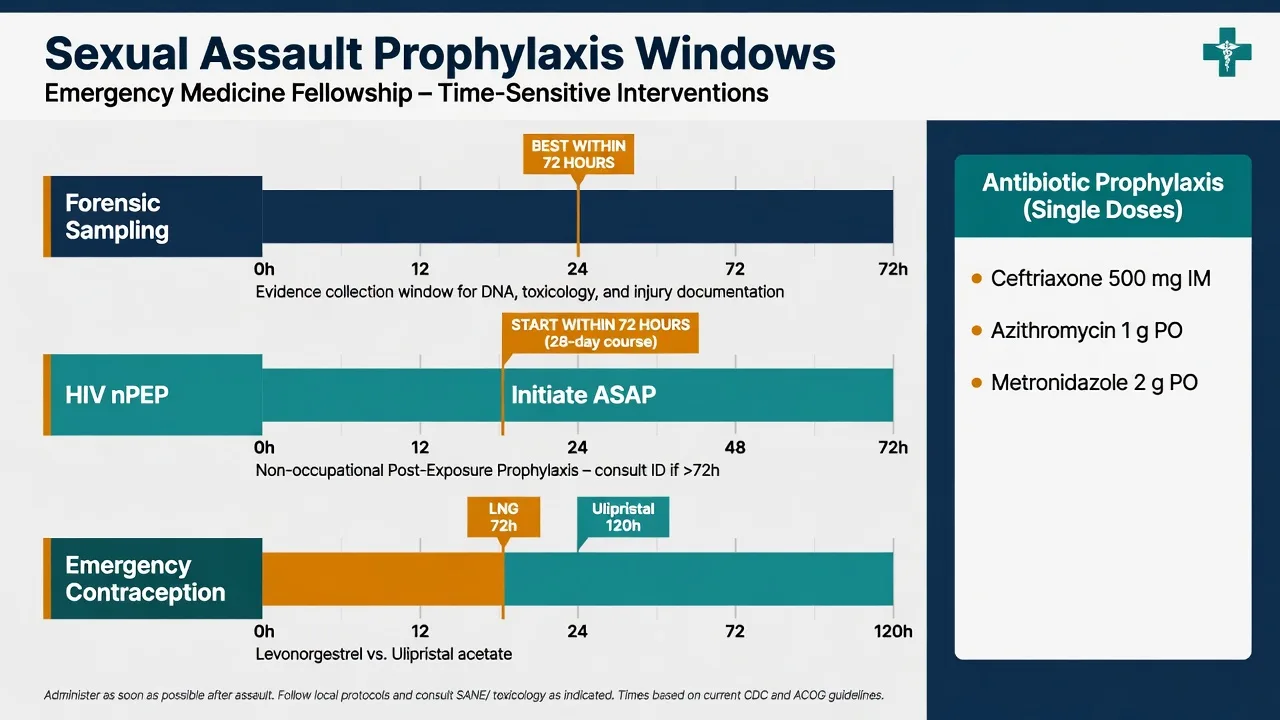
Immediate management runs in three prophylactic streams, each of which is offered to the appropriate patient with consent, and each governed by a time window and a precise regimen. The regimens below follow the CDC Sexually Transmitted Infections Treatment Guidelines for post-sexual-assault prophylaxis.[1]
Emergency contraception is offered to every potentially pregnant patient who is not already using reliable contraception. Levonorgestrel 1.5 mg orally as a single dose is effective within 72 hours, with declining efficacy to 96 hours, and is less effective in higher body weight and once ovulation has occurred. Ulipristal 30 mg orally is effective within 120 hours (5 days) and is more effective than levonorgestrel near the time of ovulation. The copper intrauterine device is the most effective form of emergency contraception and may be inserted within 5 days of the assault by a trained clinician, with the additional benefit of ongoing contraception; it is offered where feasible and acceptable. The Cochrane review of emergency contraception confirms that the ulipristal regimen is more effective than levonorgestrel in the 72 to 120-hour window, and that the copper device is the most effective method overall.[5]
HIV post-exposure prophylaxis is offered when the source is known or suspected to be HIV-positive, or when the assault carries a significant per-act risk — receptive anal or vaginal penetration with ejaculation, a known HIV-positive source, a source from a high-prevalence group, or genital trauma with blood exposure. The CDC nPEP guideline recommends a 28-day three-drug antiretroviral regimen started as soon as possible and within 72 hours of the assault.[2] A preferred regimen is tenofovir 300 mg with emtricitabine 200 mg once daily, plus an integrase inhibitor — raltegravir 400 mg twice daily or dolutegravir 50 mg once daily — and the patient is counselled on adherence, side effects, the need for completion, and the follow-up HIV testing at the recommended intervals. The decision to offer nPEP weighs the per-act transmission risk against the source's likelihood of HIV and the regimen's burden, and where uncertainty exists the regional HIV or sexual-health service is consulted urgently, because the 72-hour window cannot be recovered once passed.
Model answer — the prophylaxis offered after acute vaginal sexual assault
The safety assessment and safety planning
The safety assessment is the step that prevents the next presentation being a homicide, and it is performed with every patient in whom IPV is known or suspected, and re-visited with every patient who discloses assault by a current or former partner. The emergency clinician's task is not to predict with certainty but to assess the lethality risk, to safety-plan, and to bridge the patient to the specialist service that holds the sustained response. The danger assessment, developed by Campbell and validated over decades, is the structured tool that grades the risk of intimate-partner homicide from a set of historical and contextual factors, and it is the instrument the Fellowship examiner expects the candidate to know by name. The high-risk markers are a prior threat or attempt to kill, a firearm in the home, recent separation or impending separation, escalating frequency or severity of violence, non-fatal strangulation, forced sex, substance misuse by the perpetrator, stalking, and pregnancy — each of which independently raises the risk of lethal violence. [1]
The clinical response to a high-risk assessment is not to demand that the patient leave immediately, which can itself escalate the danger, but to plan in collaboration: an identified safe place to go, a packed bag, copies of key documents, a coded signal with a trusted person, the domestic-violence helpline number, and — where the risk is immediate and the patient consents — admission to a place of safety or activation of the crisis pathway. The patient who is not ready to leave is supported, safety-planned, given the contacts, and advised that the door remains open. The clinician documents the assessment, the plan, and the information given, and never discloses the plan or the patient's whereabouts to anyone — including the partner — without consent or lawful basis.[3][6]
[1]Mandatory reporting — the legal duty
The mandatory-reporting duties that surround sexual assault and IPV divide into the child duties, which are uniformly stringent, and the adult duties, which vary by region and by relationship. Where the victim is a child, the mandatory-reporting and child-protection pathway runs in full and without the parents' consent, exactly as it does in any other form of child abuse — a report is made on the basis of a reasonable belief of significant harm, the forensic examination is performed by a paediatric forensic specialist, and the safeguarding referral activates the multidisciplinary response. Where the victim is a vulnerable adult — older, cognitively impaired, or otherwise unable to protect themselves — many jurisdictions impose an analogous reporting or notification duty to the adult-safeguarding authority. [1]
For the competent adult victim, the default is confidentiality and patient autonomy: the decision to report to police is the patient's, and the clinician supports the patient in making it, offers the forensic examination that preserves the option, and does not report without consent unless a specific statutory duty applies. Specific statutory duties that override adult confidentiality recur across regions: the mandatory reporting of female genital mutilation in a girl under 18 (the specific UK duty), the notification of certain communicable diseases, the reporting of knife and gunshot wounds in jurisdictions that require it, and the disclosure necessary to prevent a serious and imminent threat to an identifiable person. The clinician faced with a reporting question identifies the legal basis before acting, documents it, and discloses only the minimum information necessary. A good-faith report made under a statutory duty is protected by qualified privilege, and the failure to report where a duty exists is itself an offence.[3]
Intimate partner violence — recognition, screening and response
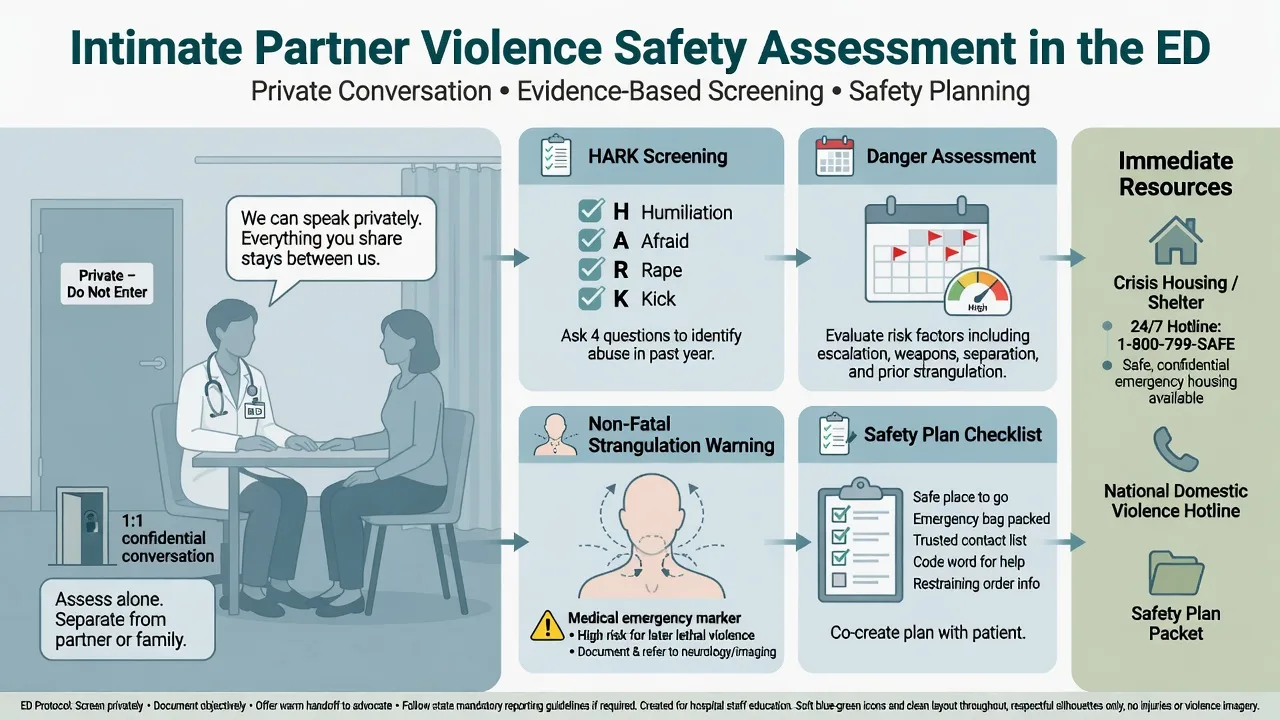
IPV is the co-traveller that the emergency clinician must actively seek, because it is common, it is under-disclosed, and it is lethal. The US Preventive Services Task Force recommends screening women of reproductive age for intimate partner violence, and the evidence supports that screening with a validated instrument is accurate, acceptable to patients, and associated with improved outcomes when paired with ongoing service referral.[3] The scoping review of the emergency-medicine role in IPV confirms that screening is feasible in the emergency department but that uptake, provider training, and the link to sustained services remain the barriers to impact.[6] The screening is conducted when the patient is alone, with a validated tool, and it is followed by a structured response — the danger assessment, the safety plan, and the bridge to the domestic-violence service.
The HARK intimate partner violence screening tool
HARK
Within the last year, have you been humiliated or emotionally abused in other ways by your partner or ex-partner?
Within the last year, have you been afraid of your partner or ex-partner?
Within the last year, have you been raped or forced to have any kind of sexual activity by your partner or ex-partner?
Within the last year, have you been kicked, hit, slapped, or otherwise physically hurt by your partner or ex-partner?
A positive screen triggers the danger assessment, the safety plan, and the referral — and a negative screen in a patient who later discloses does not close the door. The clinician maintains a low threshold to re-screen, to ask directly about strangulation and coercive control, and to involve the specialist service whenever the pattern fits, however the patient first presented. [1]
Special populations
Adolescents are managed with the mature-minor framework for consent and confidentiality, with a low threshold to involve child and adolescent services and to consider mandatory reporting where the assault involves a child or a person in authority. Male victims are at risk of under-recognition; the same pathway, the same prophylaxis, and the same trauma-informed approach apply, with attention to the anal and pharyngeal sites and the particular psychological barriers to disclosure. Patients who are pregnant receive emergency contraception guidance adjusted for an existing pregnancy (excluded before EC is given), and the assault is managed with attention to the added risk IPV poses in pregnancy — a known trigger for escalating violence and a marker of adverse obstetric outcome. Patients from culturally and linguistically diverse backgrounds, including Aboriginal and Torres Strait Islander peoples and other First Nations peoples, are offered a trained interpreter, a cultural support worker, and a culturally safe service, and the clinician is alert to additional barriers of language, migration status, and community. Patients with disability, cognitive impairment, or mental illness are supported in their autonomy wherever possible, with the capacity assessment applied to each decision, the doctrine of necessity reserved for the acute emergency, and the adult-safeguarding pathway engaged where the patient is vulnerable. Lesbian, gay, bisexual, transgender, and gender-diverse patients are offered a gender-appropriate clinician and chaperone, trauma-informed language, and a service trained in their specific needs; the clinician uses the patient's own words for anatomy and identity.[6]
Complications and pitfalls
The recurring errors are those the structured, trauma-informed approach is designed to prevent. Failing to offer the full pathway — omitting emergency contraception, the HIV PEP risk assessment, or the STI prophylaxis — leaves the patient exposed to preventable consequences. Missing the 72-hour window for the forensic examination or for HIV PEP, through delay or indecision, cannot be recovered once it passes. Breaching the chain of custody — an unsigned transfer, an unsealed container, a specimen stored outside the specified conditions — can render the evidence inadmissible and collapse the case. Pressuring the patient into an examination, a report, or a course of prophylaxis they have declined re-enacts the dynamics of the assault and is unethical. Excluding the partner from the room before screening is essential — the partner who insists on staying and answering is the single commonest reason IPV is missed. Missing the strangulation, by failing to examine the airway and the carotids in the well-looking patient, overlooks the highest lethality marker and the risk of delayed stroke. Reporting without lawful basis — disclosing to police or family without consent and without a statutory exception — breaches confidentiality and the trust. Conversely, failing to report where a duty exists — a child victim, a vulnerable adult, the specific FGM duty — is itself an offence and leaves the patient unprotected. Missing the co-traveller — treating the assault but not the abusive relationship, or the injury but not the IPV — abandons the patient to the ongoing danger. Discharging without the follow-up and the safety plan loses the patient to care, and forgetting the repeat serology at the follow-up interval misses the HIV, hepatitis, or syphilis that seroconverted after the baseline.[7]
Evidence and regional guidelines
The evidence base for emergency practice draws on the CDC Sexually Transmitted Infections Treatment Guidelines (the regimens for STI prophylaxis and the post-sexual-assault pathway),[1] the CDC antiretroviral postexposure prophylaxis guideline for non-occupational exposure (the HIV PEP regimen and window),[2] the US Preventive Services Task Force recommendation on IPV screening (the screening of women of reproductive age with a validated tool),[3] the systematic review of trauma-informed care interventions in emergency medicine (the framework that governs the encounter),[4] the Cochrane review of emergency contraception (the relative efficacy of levonorgestrel, ulipristal, and the copper device),[5] the scoping review of the emergency-medicine role in IPV (the screening, risk assessment, and provider training),[6] and the sexual-assault clinical-pathway study that demonstrates the value of a structured, EHR-integrated pathway in improving the completion of prophylaxis and follow-up.[7] The statutory overlay — mandatory reporting, the chain of custody, the police relationship, and the regional services — is jurisdiction-specific and is summarised below.
ANZ practice note. Each Australian state and territory and New Zealand has a dedicated sexual-assault service — the Sexual Assault Service in NSW (the NSW Health pathway), the South Eastern Centre Against Sexual Assault and equivalent services in Victoria, the Queensland Sexual Assault Service, and similar services elsewhere — staffed by forensic medical officers and counsellors, reachable 24 hours for advice and attendance. The forensic examination within 72 hours is performed by the forensic service with the patient's consent. Mandatory reporting of child sexual abuse is governed by the children-and-young-persons legislation of each state (the NSW Children and Young Persons (Care and Protection) Act 1998, reporting to the Child Protection Helpline). Reporting of adult sexual assault to police is at the patient's discretion. The Australasian College for Emergency Medicine publishes policy on the management of patients who have experienced sexual assault and family violence, emphasising the trauma-informed, patient-centred approach. Confidentiality is framed by the Australian Privacy Principles and the Health Records Act, and disclosure to police without consent requires a lawful basis. [1]
SAQ — Prophylaxis and the forensic examination after acute sexual assault
10 minutes · 10 marks
A 26-year-old woman presents to the emergency department 6 hours after a vaginal sexual assault by a man whose HIV status is unknown. She has no major physical injuries. The pregnancy test is negative. She consents to the prophylaxis and to the forensic examination.
SAQ — Intimate partner violence and the non-fatal strangulation
10 minutes · 10 marks
A 34-year-old woman presents to the emergency department with a facial laceration and the bruising to the neck. She gives a history of being struck and choked by her current partner two hours earlier. She is alert and her airway is intact, but she has a hoarse voice and reports a persistent headache.
Exam pearls
- Trauma-informed, patient-centred, consent at every step — the encounter is governed by the principle that the patient, having lost control, must regain it through every decision; safety, trust, choice, collaboration, empowerment.
- The 72-hour window governs both the forensic examination and HIV PEP — the sexual assault kit is performed within 72 hours for maximal yield by a trained examiner, and HIV PEP is a 28-day three-drug regimen started within 72 hours.
- STI prophylaxis is the three-drug single-dose regimen — ceftriaxone 500 mg IM, azithromycin 1 g PO, metronidazole 2 g PO, with hepatitis B vaccine and immunoglobulin if non-immune.
- Emergency contraception — levonorgestrel 1.5 mg PO within 72 to 96 hours, ulipristal 30 mg PO within 120 hours (preferred near ovulation), or a copper IUD within 5 days (most effective).
- Non-fatal strangulation multiplies the homicide risk roughly seven-fold — examine the airway, the nervous system, and the carotids, and escalate the danger assessment.
- Screen for IPV when the patient is alone — HARK or HITS, then the danger assessment and the safety plan; a controlling partner who will not leave is the cardinal red flag.
- Forensics never delays stabilisation — ABCDE first, the kit waits for a stable, capacitous, consenting patient.
- The chain of custody — collect, label, seal, sign, record every transfer — a single break renders the evidence inadmissible.
- Mandatory reporting divides sharply by age — child assault is reported on a reasonable-belief threshold without parental consent; competent adult reporting is the patient's choice unless a specific statutory duty (FGM, weapon injury, vulnerable adult) applies.
- Repeat serology at the follow-up interval — the baseline may be negative and the seroconversion of HIV, hepatitis, or syphilis takes weeks to months. [1]
Red flags
[1]References
- [1]Workowski KA, Bachmann LH, Chan PA, et al. Sexually Transmitted Infections Treatment Guidelines, 2021 MMWR Recomm Rep, 2021.PMID 34292926
- [2]Tanner MR, Dunville R, Barrios LC, et al. Antiretroviral Postexposure Prophylaxis After Sexual, Injection Drug Use, or Other Nonoccupational Exposure to HIV - CDC Recommendations, United States, 2025 MMWR Recomm Rep, 2025.PMID 40331832
- [3]US Preventive Services Task Force. Screening for Intimate Partner Violence and Caregiver Abuse of Older or Vulnerable Adults: US Preventive Services Task Force Recommendation Statement JAMA, 2025.PMID 40553450
- [4]Brown T, Messman-Moore T, Ginter C, et al. Trauma-informed Care Interventions in Emergency Medicine: A Systematic Review West J Emerg Med, 2022.PMID 35679503
- [5]Shen J, Gemzell-Danielsson K, Godfrey EM, et al. Interventions for emergency contraception Cochrane Database Syst Rev, 2019.PMID 30661244
- [6]Ziola EA, McCoy ME, McConnell JR, et al. The Role of Emergency Medicine in Intimate Partner Violence: A Scoping Review of Screening, Survivor Resources, and Barriers Trauma Violence Abuse, 2024.PMID 39049479
- [7]Yang DH, Aluisio AR, Heins A, et al. An Electronic Health Record-Integrated Clinical Pathway Improves Care of Sexual Assault Survivors Acad Emerg Med, 2026.PMID 41147845