EM · Mental Health Act and compulsory treatment
The Mental Health Act and compulsory treatment in the emergency department
Also known as Mental Health Act · Involuntary detention · Compulsory treatment · Statutory schedule · Sectioning · Community treatment order · Police powers and the mentally ill
The Mental Health Act and compulsory treatment in the emergency department — the statutory framework separate from capacity law that authorises detention and treatment of a person with a mental illness who meets defined criteria (mental illness of nature or degree warranting treatment, risk to health or safety or to others, refusal or inability to consent, and no less-restrictive alternative). Covers the assessment by two clinicians, the statutory schedule or section, the duration of detention and the tribunal review, police powers, the duration of each order, and the appeals machinery. Distinguishes capacity versus the Mental Health Act, and informal versus formal admission. Includes the pharmacological management of the dangerous detained patient. ANZ state and territory Acts (NSW Schedule 1, Victoria Assessment and Temporary Treatment Orders, Queensland authorities), UK Mental Health Act 1983 Sections 2, 3, 4, 5, 135 and 136, US state statutes. ACEM-primary, globally tagged.
On this page & tools
Your progress
Saved locally on this device.
Target exams
Red flags
Related topics
- Consent, capacity and the medico-legal framework in the emergency department
- Mental health and behavioural emergencies
- Deliberate self-harm and suicide risk assessment
- Acute agitation and rapid tranquillisation
- Delirium in the elderly
- Breaking bad news and communication in the emergency department — the SPIKES framework
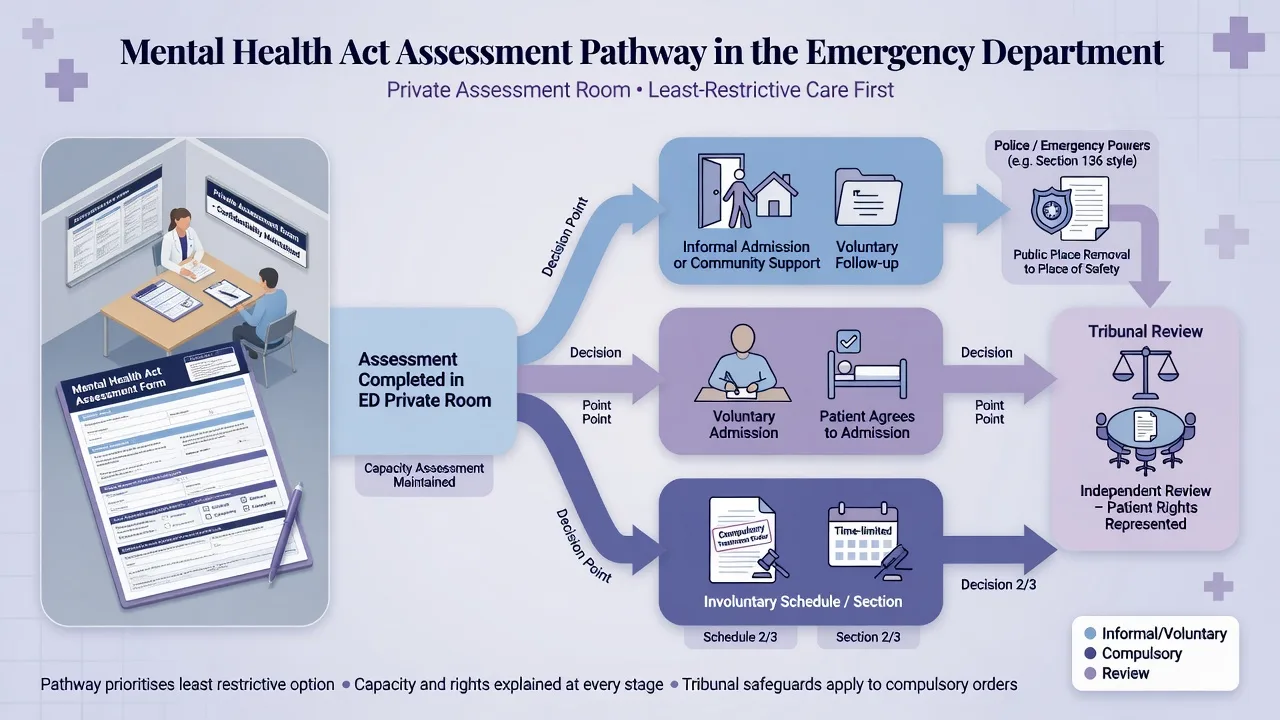
The Mental Health Act is the statutory framework that authorises the detention, assessment and treatment of a person with a mental illness who meets defined criteria, and it is examined directly in Fellowship SAQ and OSCE stations because every emergency department invokes it. The Act is a separate legal instrument from the common-law capacity framework, and the cardinal error — tested relentlessly — is to conflate the two. Capacity governs whether a patient can make any specific decision; the Mental Health Act governs whether a person with a mental illness may be treated for that illness despite refusal, where risk makes voluntary care unsafe. The emergency clinician’s task is to recognise the patient who meets the criteria, to complete or request the statutory documentation, to exclude the organic cause before a psychiatric label is applied, and to deliver safe disposition under the correct legal authority. The ethical and legal terrain of emergency psychiatry is governed throughout by the principle that restriction of liberty must be the least that achieves safe care, and that it must be lawful, necessary, documented and reviewable.[5]
Definition and scope
The Mental Health Act of a jurisdiction provides the legal authority to detain and treat a person with a mental illness or mental disorder who meets statutory criteria, separate from and additional to the capacity and guardianship law that governs medical treatment generally. It confers on authorised clinicians the power to detain, examine and treat over the patient’s objection, within defined time limits and subject to independent review. The Act distinguishes a mental illness — a clinically diagnosable disorder that significantly interferes with cognition, emotion, perception or judgement — from a mental disorder (a broader, sometimes transient disturbance), and most jurisdictions reserve involuntary powers for the former while allowing shorter detention for the latter where risk is acute. [1]
The Act covers three phases: assessment (a short, time-limited period to examine and formulate), treatment (a longer, renewable period to deliver care), and community treatment (compulsory treatment in the community under a community treatment order, with recall to hospital on relapse). Each phase has its own criteria, its own statutory document, its own duration and its own review mechanism. The emergency department sits at the gateway of the assessment phase: the ED clinician is frequently the first or the second assessor, completes or requests the schedule, and arranges transfer to an authorised mental-health service, all while providing the medical screening that excludes an organic cause and stabilises any co-existing medical illness. [1]
The governing principles
Every Mental Health Act is built on a set of principles that constrain how its powers are used, and these principles are themselves examinable. The least-restrictive-alternative principle holds that compulsory powers are exercised only when no less-restrictive means of providing safe care exists; voluntary treatment is always preferred, and a patient who will accept voluntary admission is admitted informally rather than detained.[4] The principle is not a soft aspiration but a legal threshold: if voluntary admission, community treatment, or support from family and services will achieve safe care, detention is not justified. The analysis of least-restrictive care in mental-health law identifies the principle as a proportionality test weighing the gravity of restriction against the clinical benefit, applied at every decision point rather than once at admission.[4]
Companion principles govern the exercise of power: detention is lawful only where the statutory criteria are met; the patient retains capacity for all decisions unrelated to the mental illness and consents to those in the ordinary way; the patient must be informed of the detention, the reasons, and the rights of review and representation; treatment given under the Act is the minimum necessary; and independent review by a tribunal or court is mandatory within a defined period. The emergency clinician documents the application of these principles in the contemporaneous record — the criteria, the least-restrictive reasoning, the rights explained, the organic exclusion. [1]
The criteria for involuntary detention
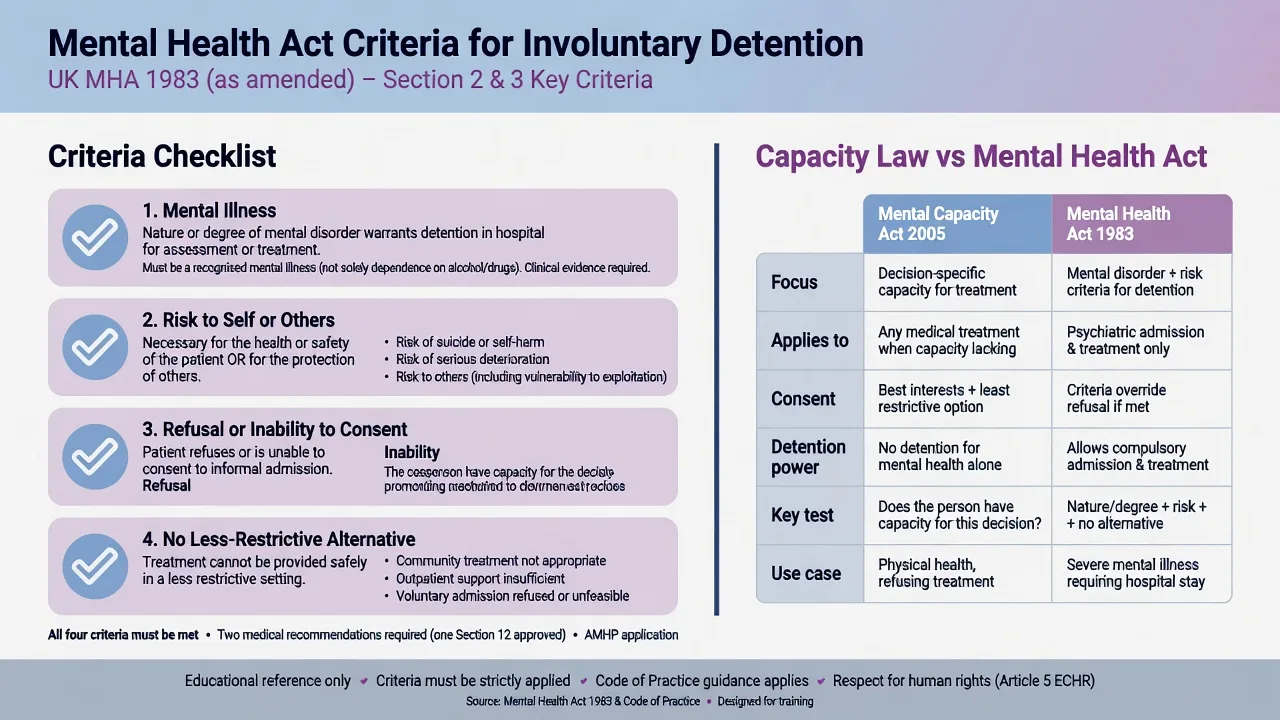
The criteria for involuntary detention are the heart of the Act and the most directly examined element. Across jurisdictions they converge on four limbs, all of which must be satisfied.[3][5]
[1]Two contested points recur. The first is the dangerousness threshold: some statutes require demonstrable risk of imminent harm, while others permit detention on the basis that the illness will deteriorate without treatment. The evidence is that laws requiring demonstrable dangerousness can delay the first treatment of psychosis and do not measurably reduce suicide or homicide, because the risk that drives detention is often the risk of untreated illness rather than of an immediate violent act.[1][2] The 2015 reforms to the New South Wales Act, analysed by Ryan and colleagues, illustrate the statutory calibration of these thresholds and the clinical impact of shifting them.[3] The second is that risk is judged clinically, not by a single score: the history of prior self-harm or violence, the current mental state (command hallucinations, persecutory delusions, hopelessness), the collateral, and the immediate behaviour in the department each contribute.
The statutory pathway — assessment and the schedule
Detention follows a statutory pathway documented on a prescribed form — called a schedule in much of Australasia, a section in the United Kingdom, an order or authority elsewhere. Most jurisdictions require assessment by two authorised clinicians who each independently examine the patient and complete a statutory recommendation, usually within a defined interval (often the two examinations must occur within a few days of each other). The emergency doctor may be the first assessor; the second is typically a psychiatrist or a credentialed mental-health clinician. A small number of jurisdictions allow an emergency single-clinician detention for a very short period (hours), with a mandatory second assessment before the detention may continue. [1]
[1]The completed schedule records the patient’s identity, the examining clinicians, the diagnosis and the criteria met, the proposed facility, and the duration of the authority. It is a legal document, completed accurately, signed and dated, served on the patient with a written statement of their rights in a language and form they can understand, and a copy placed in the record. From the moment the schedule takes effect the patient is formally admitted (detained), and their liberty is restricted only to the extent the Act permits. [1]
Duration of detention, review and appeals
Each order has a statutory maximum duration and a mandatory independent review, and knowing both is a Fellowship expectation. The assessment phase is short — typically a matter of days — and converts into a treatment order only after further assessment and, in many jurisdictions, a tribunal hearing. Treatment orders run for weeks to months and are renewable. The independent reviewer — a Mental Health Tribunal, a Mental Health Review Board, or a court — hears the case at defined intervals, hears the patient (who may be legally represented), and decides whether to discharge, vary or continue the order. [1]
The patient retains a set of appeal rights throughout detention: the right to apply to the tribunal for discharge at any time (with a statutory time within which the hearing must be held), the right to a second psychiatric opinion on the appropriateness of treatment, the right to legal representation and advocacy, and the right to information about the detention and the treatment. These rights are not theoretical: the emergency clinician states them to the patient at the point of detention, records that they were stated, and ensures the patient has access to an advocate and a lawyer. Exceeding the statutory time limit without renewal, or failing to arrange the tribunal review, renders the continued detention unlawful. [1]
Police powers under the Mental Health Act
The Act confers specific powers on police to deal with the person who appears mentally disordered and in need of care, and these powers are a common point of interface with the emergency department. Police may remove a person appearing to be mentally disordered or mentally ill from a public place to a place of safety — in the United Kingdom this is Section 136 of the Mental Health Act 1983, which permits removal to a place of safety (now typically a health-based setting rather than a police station) for up to 24 hours for assessment; patient-experience research documents both the distress and the perceived necessity of this intervention.[6] Police may also enter private premises under warrant (UK Section 135) to remove a person believed to need assessment. In Australia and New Zealand, equivalent provisions exist in each state and territory Act.
Police powers are a last-resort mechanism for the person who will not come voluntarily and whose illness places them at risk; they are not a substitute for clinical assessment, and the emergency department that receives a police-brought patient owes that patient the same medical screening, the same dignity and the same rights explanation as any other. The patient’s perspective research emphasises that the manner of the detention — restraint, transport, and the setting of assessment — shapes the trauma of the experience and the engagement with later treatment, so the least-restrictive principle applies to police powers as much as to clinical decisions.[6]
Differential — capacity, the Mental Health Act and the admission types
The most common and most serious error in this area is to treat capacity law and the Mental Health Act as interchangeable. They are not. A patient may have full capacity to refuse a blood transfusion and still be detained under the Mental Health Act for a mental illness; a patient may lack capacity entirely through delirium and yet not meet the Mental Health Act criteria, because delirium is a medical illness treated under the doctrine of necessity, not under mental-health legislation. The emergency clinician places each patient in the correct cell of a four-quadrant decision — capacity present or absent, Mental Health Act criteria met or not — and chooses the legal authority accordingly. [1]
Mental Health Act detention (criteria met)
- Mental illness of nature/degree warranting hospital treatment plus risk plus refusal plus no less-restrictive option
- The patient may be capacitous — capacity is not the test, the criteria are
- Authority is the Act: the schedule/section, two-clinician assessment, tribunal review
- Treatment of the mental illness is compelled; the patient still consents to unrelated treatment in the ordinary way
Informal (voluntary) admission
- The default for any patient who accepts admission and treatment
- Requires capacity for the admission decision; no statutory document is needed
- The patient may leave at any time unless and until they are assessed as meeting detention criteria
- Always the preferred pathway where it achieves safe care — the least-restrictive option
Doctrine of necessity / Mental Capacity Act (no MHA criteria)
- For the patient who lacks capacity and needs treatment for a condition that is not a mental illness (delirium, overdose, medical emergency)
- Authority is common law (Australia/NZ) or the Mental Capacity Act 2005 best-interests provisions (UK), not the Mental Health Act
- Delirium, intoxication, overdose and intracranial lesions are medical illnesses — never detain them under the MHA
- Re-assess capacity as the cause resolves; release restriction as soon as the patient recovers capacity
Guardianship / substitute decision-maker
- For the patient who lacks capacity for a decision, does not meet MHA criteria, and needs ongoing non-emergency treatment
- A guardian, a person responsible, or a lasting power of attorney consents in the patient’s best interests
- Distinct from both the MHA and emergency necessity; governed by guardianship legislation
- Used for the incapacitous patient with dementia, intellectual disability or chronic incapacity needing treatment that is not for a mental illness
The formal-versus-informal distinction is simple but consequential: an informal (voluntary) patient consents to admission and may leave; a formal (detained) patient is held under the Act and may not. A patient who arrives informal and then attempts to leave against advice is reassessed for the criteria: if met, the schedule is completed before they leave; if not, the capacitous refusal is honoured. [1]
Compulsory treatment in practice — management and emergency sedation
Treatment under the Act does not mean unrestrained medication; it means the legal authority to treat exists, and treatment is delivered by the least restrictive effective means. The detained patient who is dangerous to themselves or others and refuses medication is managed along the same graded ladder as any agitated patient, with the legal basis for the treatment now explicit in the record. Verbal de-escalation remains the first intervention — a calm environment, trained staff, engagement and the offer of oral medication — and succeeds in the majority. [1]
When de-escalation fails and the patient is an imminent danger, rapid tranquillisation is given under the Act’s authority. First-line for undifferentiated severe agitation is droperidol 5 to 10 mg intramuscularly, with cardiac monitoring for QT prolongation; for a primarily psychotic picture, haloperidol 5 mg intramuscularly often combined with promethazine 25 to 50 mg intramuscularly; for alcohol or sedative withdrawal, a benzodiazepine such as midazolam 5 to 10 mg intramuscularly or lorazepam 1 to 2 mg intramuscularly. Where oral is accepted, olanzapine 5 to 10 mg orally is effective and preferred. The intramuscular olanzapine and parenteral benzodiazepine combination is avoided because of additive respiratory depression. Post-administration monitoring is mandatory — pulse oximetry, blood pressure, respiratory rate, level of consciousness and a periodic ECG — with formal reassessment every 10 to 15 minutes until the patient is calm and rousable, never unconscious. Physical restraint, where unavoidable, is time-limited, documented, and released as sedation takes effect. [1]
Model answer — managing the dangerous detained patient who refuses medication
Common scenarios
The suicidal patient with capacity who refuses admission is the canonical station: the criteria, not capacity, decide detention, and a competent refusal does not prevent a lawful schedule where the illness and the risk are present. The acutely psychotic patient with persecutory delusions and command hallucinations meets the criteria on the mental-illness and protection limbs and is detained; first-episode psychosis is investigated for an organic cause before a schedule is completed. The intoxicated patient is reassessed as the level falls, because capacity and risk assessment are unreliable during intoxication; observation until sober is the safe default. The patient with delirium is never detained under the Mental Health Act — delirium is a medical illness, and the authority is the doctrine of necessity or the Mental Capacity Act while the cause is treated. The patient on a community treatment order who relapses is recalled to hospital under the order’s recall power, often without a new assessment. The adolescent is managed jointly with child and adolescent mental-health services, with a developmentally calibrated capacity assessment and attention to family, safeguarding and consent. The patient detained pending transfer remains the emergency department’s responsibility — medically screened, monitored, and accompanied — until physically handed over. [1]
Errors and pitfalls
The recurring errors are those the criteria and the pathway are designed to prevent. Conflating capacity with the Mental Health Act is the cardinal mistake — capacity is decision-specific and does not decide detention; the criteria do. Detaining without a mental illness — completing a schedule for delirium, intoxication or a personality crisis — misuses the Act and exposes the clinician; medical illness is treated under necessity or guardianship. Single-clinician documentation where two are required makes the detention unlawful. Failing to serve the document and state the rights denies the patient the protections the Act guarantees. Exceeding the time limit without renewal, or omitting the tribunal review, renders continued detention unlawful. Sedating and detaining without excluding an organic cause is the catastrophic error — the missed hypoglycaemia, sepsis, intracranial bleed or toxidrome kills the patient held on a psychiatric schedule. Discharging a high-risk patient because they 'have capacity' misapplies the test and leaves a dangerous illness untreated. Unnecessary or prolonged restraint, undocumented and unmonitored, is unsafe and unlawful. Breaching confidentiality — disclosing to family or police without consent or a lawful basis — compounds the harm. [1]
Evidence and regional guidelines
The evidence base for the statutory framework is largely legal and epidemiological rather than controlled-trial. The work of Large and colleagues demonstrates that mental-health laws requiring demonstrable dangerousness can delay the first treatment of psychosis — because the threshold for detention is set at the point of imminent risk rather than at the point of treatable illness — and that this shift in threshold has not measurably reduced suicide or homicide.[1][2] Ryan and colleagues analysed the impact of the 2015 reforms to the New South Wales Mental Health Act on clinical practice, documenting how statutory recalibration of the criteria changes bedside decision-making.[3] The least-restrictive principle is interrogated as a legal and conceptual standard by Duffy and colleagues, who frame it as a proportionality test applied at each decision.[4] Allen and colleagues set out the ethical framework for emergency psychiatry, in which safety, autonomy, beneficence and justice are held in tension at the bedside.[5] Patient-experience research on police detention under Section 136 documents both the necessity and the trauma of compulsory powers, reinforcing that the manner of detention shapes later engagement.[6]
ANZ practice note. Each Australian state and territory and New Zealand has its own mental-health Act. New South Wales — the Mental Health Act 2007 distinguishes a mentally ill person (detained on a Schedule 1 medical certificate) from a mentally disordered person (brief detention, up to three working days); two medical practitioners (or one doctor and an accredited person) complete the primary and secondary certificate; the Mental Health Review Tribunal reviews detention; the 2015 reforms are analysed by Ryan et al.[3] Victoria — the Mental Health Act 2014 uses an Assessment Order (short, one clinician), a Temporary Treatment Order (up to 28 days, two clinicians), and a Treatment Order made by the Tribunal. Queensland — the Mental Health Act 2016 uses an Assessment Authority and a Treatment Authority, with the Mental Health Review Tribunal. South Australia, Western Australia, Tasmania, the ACT and the Northern Territory each have their own Act with analogous assessment and treatment authorities and tribunals. New Zealand — the Mental Health (Compulsory Assessment and Treatment) Act 1992 uses section-based assessment and treatment orders heard by a District Court judge. Police powers exist in each Act (for example NSW sections for apprehension and transport; Victoria section 351). Capacity is assessed under the common law and state guardianship legislation; the emergency single-clinician provisions are short and require a second assessment within hours. ACEM and RANZCP publish guidance on mental-health presentations in the emergency department, emphasising recovery-oriented care, the exclusion of organic causes, and the emergency clinician’s role in assessment, stabilisation and referral.
Capacity assessment in the emergency department
Capacity is decision-specific, time-specific and domain-specific, and it is the gatekeeper for consent in every ED encounter that may become compulsory. The emergency clinician assesses capacity in two circumstances that the Mental Health Act brings into the department: first, to decide whether a patient who refuses admission may be allowed to leave (capacity present → honour the refusal, but apply the MHA criteria to risk; capacity absent → treat under necessity or the MHA), and second, to determine which legal authority governs treatment (the MHA for the mental illness where the criteria are met; necessity or the Mental Capacity Act for a medical illness in the incapacitous patient who does not meet the MHA criteria). Capacity is not global — a patient may lack capacity to refuse psychiatric medication yet retain capacity to consent to suturing of a laceration, to make a will, or to vote — and it is not static; it fluctuates with intoxication, agitation, pain and the resolution of delirium, and must be re-assessed as each changes. [1]
The functional test of capacity has four elements derived from the United Kingdom Mental Capacity Act 2005 (section 3) and a fifth — the ability to communicate the choice — that is functionally inseparable. The patient must be able to understand the information relevant to the decision (the nature, purpose and foreseeable effects of the proposed treatment, and the alternatives including no treatment), retain it long enough to weigh it, use or weigh it as part of the decision-making process (engaging with the pros and cons rather than being swept aside by a delusion or a compulsion), and communicate the choice by any means — speech, writing, sign, or an interpreter. A disturbance of the mind or brain (the diagnostic threshold) must be impairing that functioning. The emergency clinician tests each element explicitly and documents the failure: it is not enough to record "lacks capacity"; the record must state which element failed and why, and the underlying impairment. [1]
[1] [1] [1]UK Mental Capacity Act 2005 — the functional test
- Section 3: a person lacks capacity if, because of an impairment of, or a disturbance in the functioning of, the mind or brain, they are unable to understand, retain, use/weigh, or communicate the decision
- Section 1 principles: presume capacity; support the person to decide; a person is not to be treated as unable to make a decision merely because it is unwise; act in best interests; choose the least-restrictive option
- Best-interests checklist (section 4): the patient’s past and present wishes, beliefs and values; the views of family and carers; the least restrictive effective option; the avoidance of discrimination
- The MCA governs treatment of the incapacitous adult for conditions that are NOT a mental illness — delirium, overdose, medical emergency — and works alongside, not instead of, the Mental Health Act 1983
US Appelbaum criteria — the four abilities
- Communicating a choice (the ability to express a consistent preference, free of fluctuation)
- Understanding (the relevant information — diagnosis, proposed treatment, risks, benefits, alternatives)
- Appreciation (the situation and its consequences apply to oneself — the "it could happen to me" dimension that delusion erodes)
- Reasoning (the ability to manipulate the information rationally and reach a conclusion that follows logically) — operationalised by the MacArthur Competence Assessment Tool
ANZ common-law and statutory capacity
- Common law (Australia) and the statutory frameworks — the Queensland Capacity Act 2019, the state Guardianship and Administration Acts (NSW, Victoria), and the NZ Code of Health and Disability Services Consumers’ Rights
- The test: does the person understand the information? Do they believe it applies to them? Can they weigh it and communicate a choice?
- A substitute decision-maker (a person responsible, an enduring guardian, a statutory health attorney) consents for the incapacitous adult not meeting MHA criteria
- The doctrine of necessity authorises emergency treatment of the incapacitous adult where no substitute decision-maker is available and treatment cannot be safely delayed
The emergency department role — the structured pathway
The ED clinician’s role in the compulsory-treatment pathway is bounded and specific, and knowing the boundary is itself examinable. The emergency clinician does not ordinarily make the definitive psychiatric diagnosis, does not conduct the full tribunal-hearing case, and does not determine the long-term treatment plan; the ED role is to screen for and treat organic causes, assess capacity for the decisions in front of them, assess risk, complete or request the statutory documentation appropriate to the jurisdiction, safely manage the dangerous patient in the department, communicate and refer, and discharge or transfer with a plan that protects the patient and the public. The dangerousness is the trigger for the Act, but the medical screen is the trigger for the ED, and the two run in parallel — the patient is medically screened and psychiatrically assessed at the same time, not sequentially, because the patient held "medically cleared" on a psychiatric schedule without glucose, septic screen and CT dies on that schedule.[5]
[1] [1]The ED pathway for the patient who may need compulsory treatment
- Immediate safety — the parallel medical and risk screen. (a) Nurse the patient in a low-stimulus area with direct observation; remove ligatures and access to means (belts, cords, sharps, medications); ensure sufficient trained staff for restraint if needed. (b) The vital signs, a bedside glucose, the temperature and a focused examination are obtained immediately — hypoglycaemia, hypoxia, sepsis, head injury and toxidromes are the organic causes that masquerade as mental illness. (c) A bedside glucose is mandatory in every agitated or behaviourally disturbed patient; do not sedate and do not detain before the glucose is known.
- Assess capacity for the decisions in front of the patient. (a) Test capacity for the specific decision — to consent to or refuse investigation, to accept admission, to accept treatment — using the four-element functional test, documenting which element fails and the underlying impairment. (b) Where capacity is present and the patient refuses, honour the refusal for that decision but proceed to the MHA risk assessment. (c) Where capacity is absent and a medical illness is present, treat under necessity or the Mental Capacity Act. (d) Re-assess capacity as intoxication, agitation or delirium resolve.
- Exclude the organic cause — the "medical clearance" that is never a clearance. (a) The history (collateral from family, police, GP, and the patient’s own psychiatric record), the examination, and the targeted investigation: glucose, electrolytes, FBC, blood gases, drug and alcohol screen, septic markers, troponin where indicated, and CT head ± lumbar puncture where the presentation is a first psychiatric presentation, there is a new neurological sign, there is fever, there is head injury, or the mental state changes rapidly. (b) The negative screen does not "clear" — it lowers the probability of an organic cause to a level that makes psychiatric detention safe.
- Assess risk to self, to others, and from self-neglect. (a) The structured risk assessment covers the ideation, the plan, the means, the intent, the past attempts, the protective factors, the command hallucinations, the persecutory delusions, the hopelessness, the substance use, and the social situation. (b) Collateral is essential — the patient’s own account is necessary but never sufficient. (c) The risk assessment determines whether the MHA criteria are met, not whether the patient "wants" admission.
- Complete or request the statutory documentation. (a) In jurisdictions allowing an emergency single-clinician hold, the ED clinician completes the short form and requests the second (psychiatric) assessment within the statutory hours. (b) In jurisdictions requiring two assessors at the outset, the ED clinician arranges (and may be) the first assessor and requests the authorised psychiatrist or accredited person as the second. (c) The document is completed accurately — patient identity, clinician identity, diagnosis, the criteria met, the proposed facility, the duration — signed, dated, served on the patient with a written statement of rights, and a copy placed in the record.
- Safely manage the dangerous patient pending assessment and transfer. (a) Verbal de-escalation first, in a calm environment with trained staff. (b) Offer oral medication. (c) Rapid tranquillisation where imminent danger persists, with monitoring to calm-and-rousable. (d) Physical restraint as a last resort, time-limited, documented, with airway monitoring, and released as sedation takes effect. (e) Constant observation of the detained patient — never leave them alone with access to means of self-harm.
- Communicate, refer, and arrange safe disposition. (a) Hand over to the psychiatric team or the mental-health service with the assessment, the organic screen, the risk assessment, and the statutory documents. (b) Arrange the safe transfer to an authorised facility if required — escorted, monitored, with the documentation travelling with the patient. (c) Where the patient is discharged, arrange the community follow-up (the crisis team, the community mental-health team, the GP) within a defined interval, with a written safety plan and the means restricted.
Restraint in the emergency department — physical and chemical
Restraint is an intrusion on liberty that the law permits only where it is necessary, proportionate, the least restrictive effective means, time-limited, and documented. The detained patient under the Mental Health Act may be restrained under both the Act’s authority and the general law of necessity, but the threshold and the safeguards are high. Physical restraint — the manual holding of a patient to prevent harm — is a last resort, employed only where de-escalation has failed and there is imminent danger to the patient or others, performed by sufficient trained staff using approved techniques, for the shortest time possible, with continuous monitoring of the airway, breathing and circulation, and released as soon as sedation or de-escalation takes effect. Chemical restraint — the use of medication to control agitation or aggression — is given where physical restraint is unsafe, prolonged or insufficient, and follows the rapid-tranquillisation ladder. Both forms of restraint are documented contemporaneously — the indication, the technique, the staff, the duration, the monitoring, the complications, and the debrief.[4]
[1] [1] [1]Physical restraint
- A last resort, only where de-escalation has failed and there is imminent danger to the patient or others
- Performed by sufficient trained staff (typically five: one per limb and one for the head) using approved, humane techniques
- Time-limited to the minimum necessary; the patient is released as soon as sedation or de-escalation allows
- Complications: positional asphyxia (especially prone), rhabdomyolysis, thromboembolism, psychological trauma, sudden death — monitor the airway and breathing throughout
- Documented contemporaneously: indication, technique, staff, start and end time, monitoring, complications, debrief
Chemical restraint (rapid tranquillisation)
- Indicated where physical restraint is unsafe, prolonged, or insufficient, and the patient is an imminent danger
- Ladder: oral olanzapine 5 to 10 mg if accepted; IM droperidol 5 to 10 mg first-line for undifferentiated agitation (with ECG for QT); IM haloperidol 5 mg ± promethazine 25 to 50 mg for psychosis; IM midazolam 5 to 10 mg or lorazepam 1 to 2 mg for alcohol/sedative withdrawal
- Avoid IM olanzapine combined with a parenteral benzodiazepine — additive respiratory depression
- Monitor pulse oximetry, blood pressure, respiratory rate, conscious level, and a periodic ECG; reassess every 10 to 15 minutes to calm-and-rousable; have flumazenil, naloxone and airway equipment ready
The assessment process in detail — the approved clinician, the AMHP, the two-doctor rule
The statutory assessment that converts a person into a detained patient is performed by defined roles, not by any clinician who happens to be present, and the distinction is a frequent source of error. In the United Kingdom, the two clinical recommendations on a Section 2 or 3 are made by two doctors — one Section 12-approved (a doctor with special experience in the diagnosis and treatment of mental disorder), and one of whom should usually be the patient’s own GP or a doctor who knows them professionally, and they must have examined the patient independently — together with an application by an Approved Mental Health Professional (AMHP), the social-work-trained professional who coordinates the assessment, interviews the nearest relative, and makes the application. In Australasia, the equivalents are the authorised medical officer / accredited person and the independent authorised clinician or psychiatrist, with the mental-health service and its designated officers coordinating. In the United States, the number of clinicians (one or two) and the involvement of a designated examiner varies by state statute. [1]
[1] [1] [1]Discharge planning and the community treatment order
The disposition of the patient assessed under the Mental Health Act is not binary (admit-or-discharge) but a graded set of options that the least-restrictive principle selects between, and the ED clinician contributes to the choice even where the psychiatrist makes the final decision. The informal voluntary admission is the default for the patient who accepts treatment and has capacity. The compulsory inpatient treatment on a treatment order is for the patient who meets the criteria and cannot be safely managed in the community. The community treatment order (CTO) — known in the UK as a Community Treatment Order under Section 17A (for patients previously detained under Section 3), in NSW as a Community Treatment Order, in Victoria as a Community Treatment Order made by the Tribunal — is the statutory mechanism for compulsory treatment in the community, used where the patient can be safely managed at home with the structure of mandatory attendance, depot medication, and a recall-to-hospital power if they relapse or fail to comply. The discharge to community care without a CTO — with the crisis team, the community mental-health team (CMHT), the GP, and a written safety plan — is for the patient whose risk does not meet the threshold for compulsion but who needs close follow-up. [1]
[1] [1] [1]Community treatment order (CTO)
- Compulsory treatment in the community — depot medication, mandatory attendance, recall-to-hospital power
- UK Section 17A/17G (for patients previously on Section 3); NSW Community Treatment Order; Victorian CTO made by the Tribunal
- For the patient whose illness requires ongoing treatment, who can be safely managed at home with the structure of the order, and who has a history of relapse without treatment
- The recall power allows return to hospital without a new assessment if the patient relapses, fails to attend, or stops treatment
Crisis / home-treatment team follow-up
- Intensive community support, usually within 24 hours of ED discharge, for the patient at moderate risk who does not meet the threshold for compulsion
- The team visits at home, reviews medication, monitors risk, and can escalate to admission if the patient deteriorates
- The cornerstone of the "acute pathway" in the UK (Crisis Resolution and Home Treatment Teams) and the equivalent crisis teams in ANZ
- Provides a less-restrictive alternative to admission and a safety net for the discharged patient
GP and CMHT follow-up
- Routine community follow-up within one to two weeks for the lower-risk patient
- The GP manages the physical health, the medications, and the coordination of care
- The CMHT (or equivalent community mental-health service) provides the ongoing psychiatric review and psychological treatment
- The written safety plan, the restriction of means, and the explicit help-seeking instructions accompany every discharge
Evidence — the key studies and what they show
Large 2008 — dangerousness criteria and delay to first treatment of psychosis (Soc Psychiatry Psychiatr Epidemiol)
Design
Retrospective analysis of the relationship between the legal threshold for involuntary admission and the duration of untreated psychosis
Key finding
Mental-health laws that require demonstrable dangerousness for involuntary admission were associated with a longer duration of untreated psychosis, because patients are detained only at the point of imminent risk rather than at the point of treatable illness
Clinical implication
The threshold for compulsion shapes when treatment begins — a higher dangerousness bar delays the first treatment of schizophrenia, itself associated with a worse long-term outcome
Bottom line
The dangerousness requirement may protect liberty at the cost of timely treatment; the risk that justifies detention is often the risk of untreated illness, not of imminent violence
Large 2009 — did dangerousness criteria reduce suicide and homicide? (Soc Psychiatry Psychiatr Epidemiol)
Design
Population-level analysis of suicide and homicide rates before and after the introduction of 'dangerousness' and 'risk of harm' criteria into mental-health laws
Key finding
The introduction of dangerousness criteria did not produce a measurable reduction in suicide or homicide rates attributable to mental illness
Clinical implication
If the policy aim of the dangerousness threshold was to reduce suicide and homicide, the population-level evidence does not support it — while the threshold delays needed treatment
Bottom line
The dangerousness threshold buys no measurable public-safety benefit but delays care — argue for a threshold calibrated to treatable illness, not solely to imminent risk
Ryan 2017 — the 2015 NSW Mental Health Act reforms (Australas Psychiatry)
Design
Narrative analysis of the 2015 amendments to the New South Wales Mental Health Act 2007 and their impact on clinical practice
Key finding
The reforms recast the criteria and the principles — including the express inclusion of 'care and treatment' considerations and the strengthening of carer and family involvement — and changed the bedside decision-making of clinicians
Clinical implication
Statutory recalibration of the criteria flows directly into clinical practice; the ED clinician must know the current Act, not the version they trained under
Bottom line
Legislative reform is a recurring feature of mental-health law — track your jurisdiction’s current criteria, durations, and review points
Duffy 2023 — what does 'least restrictive' mean in mental-health law? (Am J Law Med)
Design
Conceptual and case-law analysis of the 'least restrictive' / 'less restrictive' principle as it appears in mental-health statutes and jurisprudence
Key finding
The principle is inconsistently defined and applied; the authors frame it as a proportionality test — weighing the gravity of restriction against the clinical benefit — applied at every decision point, not only at admission
Clinical implication
The least-restrictive principle is a legal threshold, not a soft aspiration; document the proportionality reasoning at each step — restraint, sedation, detention, transfer
Bottom line
At every restriction of liberty, ask and record: is there a less-restrictive means that achieves safe care? If yes, use it; if no, document why
Allen 2015 — ethical issues in emergency psychiatry (Emerg Med Clin North Am)
Design
Narrative review of the ethical framework governing the emergency psychiatric encounter
Key finding
The cardinal ethical tension is between autonomy (the patient’s right to refuse), beneficence (the duty to treat), non-maleficence (the harm of detention and restraint), and justice (the fair and lawful exercise of compulsory powers); these are held in tension at the bedside, not resolved by a single rule
Clinical implication
Every compulsory intervention must be justifiable against all four principles, documented as to the reasoning, and subject to the rights and review that the law provides
Bottom line
The lawful, necessary, least-restrictive, documented and reviewable detention is the ethical standard — and the standard against which the examiner marks
Sondhi 2018 — patient perspectives of detention under Section 136 (Med Sci Law)
Design
Qualitative study interviewing patients detained under Section 136 of the UK Mental Health Act 1983 (police removal from a public place) about their experience
Key finding
Patients described both the distress of restraint, transport, and the setting of detention, and the perceived necessity of the intervention when they were unwell; the manner of the detention shaped their later engagement with treatment
Clinical implication
The least-restrictive principle applies to the manner of detention as much as to the fact of it — dignity, communication, and a health-based (not police-station) place of safety reduce harm and improve engagement
Bottom line
Treat the police-brought or restrained patient with the same medical screening, the same rights explanation, and the same dignity as any voluntary patient — the manner of arrival does not diminish the duty of care
SAQ — A psychotic man brought in by police under Section 136
10 minutes · 10 marks
A 32-year-old man is brought to the emergency department by police at 02:00 under Section 136 of the United Kingdom Mental Health Act 1983 after being found shouting at traffic on a busy road, gesturing at passing cars, and attempting to climb a pedestrian barrier. On arrival he is agitated, dishevelled, and smells of alcohol. He is shouting that the cars are transmitting messages from a government agency and that he must ‘stop the signal’. Vital signs: BP 148/92, HR 118, RR 22, SpO2 97 per cent on room air, T 37.4°C, bedside glucose 6.1 mmol/L. GCS 14 (E3 V4 M7). He refuses to speak to the nurse and tries to leave. Collateral from his mother by telephone indicates three months of social withdrawal, paranoid ideation, poor self-care and one previous psychiatric admission for a similar presentation one year earlier, when he recovered on olanzapine. The on-call psychiatrist is in the next district and cannot attend for two hours.
SAQ — Capacity assessment in an elderly woman refusing treatment for urosepsis
10 minutes · 10 marks
An 84-year-old woman is brought to the emergency department from a residential aged-care facility with a 48-hour history of confusion, fever 39.1°C, hypotension 96/58, heart rate 112, respiratory rate 24, SpO2 94 per cent on room air, and a urinalysis strongly positive for leucocytes and nitrites. Her past history includes atrial fibrillation on warfarin, hypertension, mild cognitive impairment (MMSE 22/30 four months ago), and osteoarthritis. She is normally oriented to person but only intermittently to place. Her niece is the enduring guardian. On arrival the patient repeatedly says ‘I want to go home, I don’t want any needles, leave me alone’. When asked to explain what is happening she says ‘I have a urine infection, the nurses told me, but I don’t want treatment’. She is unable to recall what was said 30 seconds earlier. The niece arrives and asks the team to ‘do whatever is needed’.
Exam pearls
- The four criteria for involuntary detention: mental illness of nature or degree warranting hospital treatment, risk to health or safety or to others, refusal or inability to consent, and no less-restrictive option — all four, all documented.
- Capacity and the Mental Health Act are different statutes: a capacitous patient may be detained; an incapacitous patient may not meet the criteria. Apply the right test.
- Two assessors, two independent examinations, two signatures where the Act requires them; a single certificate is unlawful.
- The least-restrictive principle is a proportionality test applied at every decision, not just at admission — voluntary care is always preferred.
- Exclude the organic cause before detaining: delirium is medical, treated under necessity or the Mental Capacity Act, never under the MHA.
- Know your jurisdiction’s durations and review: NSW Schedule 1, Victoria’s Assessment and Temporary Treatment Orders, UK Section 2 (28 days) and Section 3 (6 months), and the tribunal that reviews them.
- State the rights at the point of detention: information, representation, appeal to the tribunal, second opinion.
- Police powers: UK Section 136 (public place, place of safety, 24 hours) and Section 135 (warrant); ANZ equivalents in each state Act.
- Emergency sedation of the dangerous detained patient: droperidol 5 to 10 mg IM first-line, haloperidol 5 mg IM ± promethazine, midazolam 5 to 10 mg IM for withdrawal, olanzapine 5 to 10 mg PO if accepted; avoid IM olanzapine with parenteral benzodiazepine; monitor to calm-and-rousable.
- Dangerousness criteria can delay needed treatment — the risk that justifies detention is often the risk of untreated illness, not of imminent violence.
- The capacity test is functional and four-elemented: understand, retain, use/weigh, communicate — the failure of any one element, caused by an impairment of mind or brain, establishes incapacity; the unwise decision of a capacitous person is not incapacity.
- Capacity is decision-specific and re-assessable: a patient may lack capacity to refuse psychiatric medication yet retain it to consent to suturing; re-assess as intoxication, agitation, delirium and sedation resolve.
- The ED clinician treats the emergency medical condition under necessity or the MCA regardless of consent — the airway, the hypoglycaemia, the sepsis and the overdose are managed under the correct authority while the psychiatric assessment proceeds in parallel.
- The ED role is bounded: screen for organic cause, assess capacity, assess risk, complete or request the statutory documentation, hold the patient safely, and refer to psychiatry for the definitive MHA assessment.
- The bedside glucose is mandatory in every agitated or behaviourally disturbed patient — do not sedate and do not detain before the glucose is known.
- Physical restraint is a last resort, prone restraint kills, and the endpoint of sedation is calm-and-rousable — monitor the airway, have flumazenil and naloxone available, avoid IM olanzapine plus a parenteral benzodiazepine.
- The two assessments must be independent (no countersigning) and, in the UK, it is the AMHP’s application — not the doctors’ recommendations alone — that brings the section into force.
- Police assistance is sought only where clinical resources are insufficient for safety; police act in support and do not replace the clinical duty of care, dignity and rights.
- Disposition is graded, not binary: informal admission, treatment order, community treatment order, or discharge with crisis-team/CMHT/GP follow-up and a written safety plan.
- The community treatment order carries a recall power — a relapsing CTO patient returns to hospital under the order, not by a fresh schedule.
- Discharge without a follow-up plan and means restriction kills — every discharge includes a defined interval to community care, a safety plan, and removal or securing of the means.
- Document the reasoning at every step — the criteria, the least-restrictive proportionality, the rights explained, the organic exclusion, the restraint indication and technique — because the contemporaneous record is the evidence the tribunal and the court rely on. [1]
Red flags
[1]References
- [1]Large MM, Ryan CJ, Nielssen O, Hayes RA. Mental health laws that require dangerousness for involuntary admission may delay the initial treatment of schizophrenia Soc Psychiatry Psychiatr Epidemiol, 2008.PMID 18060340
- [2]Large MM, Nielssen O, Ryan CJ, Hayes RA. Did the introduction of 'dangerousness' and 'risk of harm' criteria in mental health laws increase the incidence of suicide in the United States of America? Soc Psychiatry Psychiatr Epidemiol, 2009.PMID 19099169
- [3]Ryan CJ, Callaghan S, Peisah C, Large M, Nielsen O, Dunn L. The impact on clinical practice of the 2015 reforms to the New South Wales Mental Health Act Australas Psychiatry, 2017.PMID 27558219
- [4]Duffy J, Murphy N, McSherry B. What Does Least Restrictive or Less Restrictive Mean in Mental Health Law? Contradictions and Confusion in the Case of Queensland, Australia Am J Law Med, 2023.PMID 38344792
- [5]Allen NG, Adekoya O, Goldfrank L, Wittels K, McCormick M, Lee J. Ethical Issues in Emergency Psychiatry Emerg Med Clin North Am, 2015.PMID 26493529
- [6]Sondhi A, Williams A, Richa S, Grayson L, Onyena A, Keown P, Walsh J, Taylor J, Holloway F. Patient perspectives of being detained under section 136 of the Mental Health Act: Findings from a qualitative study in London Med Sci Law, 2018.PMID 29742992