EM · Toxicology and environmental emergencies (approach)
The toxidrome approach and the general management of the poisoned patient
Also known as Toxidromes · Poisoning approach · Poisoned patient management · Toxicological syndromes
The systematic recognition of the poisoning syndrome from the constellation of signs, and the general management of the poisoned patient. The seven toxidromes are covered in full — the anticholinergic (hot, dry, red, blind, mad), the cholinergic (SLUDGE from organophosphates and nerve agents), the sympathomimetic (cocaine, amphetamine, MDMA), the opioid, the sedative-hypnotic, the serotonin syndrome (clonus, hyperreflexia, hyperthermia), and the neuroleptic malignant syndrome. The general management follows — the ABCDE, decontamination (activated charcoal within one hour, whole bowel irrigation for iron, lithium and packets), enhanced elimination (haemodialysis for lithium, salicylate, metformin and the toxic alcohols), and the antidotes (naloxone, N-acetylcysteine, flumazenil, fomepizole, sodium bicarbonate, digoxin Fab) with drug doses. ACEM-primary, globally tagged.
On this page & tools
Your progress
Saved locally on this device.
8 MCQs with explanations
Target exams
Red flags
Related topics
- Opioid poisoning and the opioid toxidrome (emergency department diagnosis and management)
- Tricyclic antidepressant poisoning (emergency department diagnosis and management)
- Paracetamol poisoning
- Salicylate poisoning
- Toxic alcohol poisoning (methanol and ethylene glycol)
- Carbon monoxide poisoning
- Acute agitation and rapid tranquillisation
The poisoned patient is one of the commonest undifferentiated presentations in the emergency department — found down, agitated, fitting, or simply altered — and the toxidrome is the single most powerful early diagnostic tool available at the bedside. A toxidrome is a recognisable constellation of signs produced by a class of poisons acting on a shared physiological target, and identifying it narrows an enormous differential to a handful of agents within minutes, before any laboratory value returns. This topic is the framework: the systematic recognition of the seven toxidromes, the general approach to the poisoned patient, and the decontamination, enhanced-elimination and antidote strategies that follow from each. The Fellowship examiner tests whether a candidate can apply this method to any agitated, comatose, or haemodynamically unstable patient — and not mistake a sympathomimetic for a serotonin syndrome, or reach for flumazenil in the wrong patient. [1]
When to use the toxidrome framework, and the principles of the systematic approach
Apply the framework to every patient with an altered conscious state, unexplained respiratory or haemodynamic compromise, a seizure, hyperthermia, or any presentation where poisoning is plausible — the found-down patient, the agitated young adult after a rave, and the polypharmacy overdose alike.[2] Three principles govern it. First, resuscitation precedes diagnosis: airway, breathing and circulation are secured, and a bedside glucose is checked, before the toxidrome is ever named. Second, a toxidrome is recognised from a constellation of signs, never from a single sign — because individual signs overlap (miosis occurs in both opioid poisoning and the pontine lesion; tachycardia in both the sympathomimetic and the anticholinergic toxidromes). Third, the toxidrome is a hypothesis generator rather than a final diagnosis: it directs the early antidote, the decontamination, and the level request while the history, the directed drug levels, and the ECG confirm the agent. A mixed or atypical picture is the rule in polypharmacy and in late presentation, and the framework is most useful precisely when it is incomplete — the dominant toxidrome drives the first therapeutic move.
The core clinical examination — the toxidrome-driven physical signs
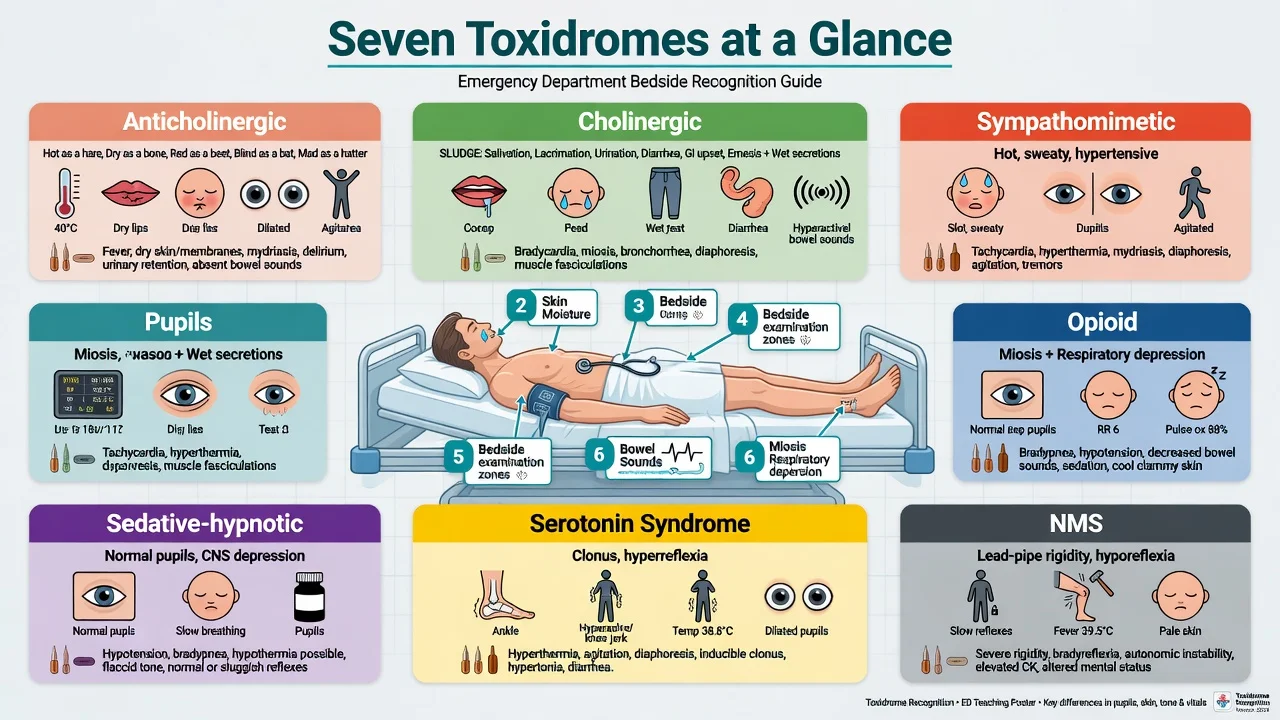
The recognition examination is brief, reproducible, and completed at the bedside in under a minute. Six compartments are examined in every poisoned patient: the vital signs (temperature, heart rate, blood pressure, respiratory rate and oxygen saturation), the pupils (size, reactivity, nystagmus), the secretions (salivation, lacrimation, bronchorrhoea, diaphoresis), the skin (dry, flushed, diaphoretic, or piloerection), the abdomen (bowel sounds — hyperactive in cholinergic poisoning, quiet or absent in anticholinergic and opioid toxicity), and the neuromuscular state (tone, reflexes, and inducible clonus). Two findings carry disproportionate weight. Inducible, sustained, lower-limb clonus is the single most specific sign of serotonin syndrome and separates it from the anticholinergic and sympathomimetic toxidromes, where reflexes are normal or depressed. Bowel sounds separate the wet toxidromes (cholinergic — sweaty with hyperactive sounds) from the dry ones (anticholinergic and opioid — the abdomen is quiet). The examination is repeated serially, because the toxidrome evolves: the sympathomimetic patient who develops rigidity and clonus has transitioned into serotonin syndrome. [1]
The six-compartment toxidrome examination
The seven toxidromes — the recognition patterns
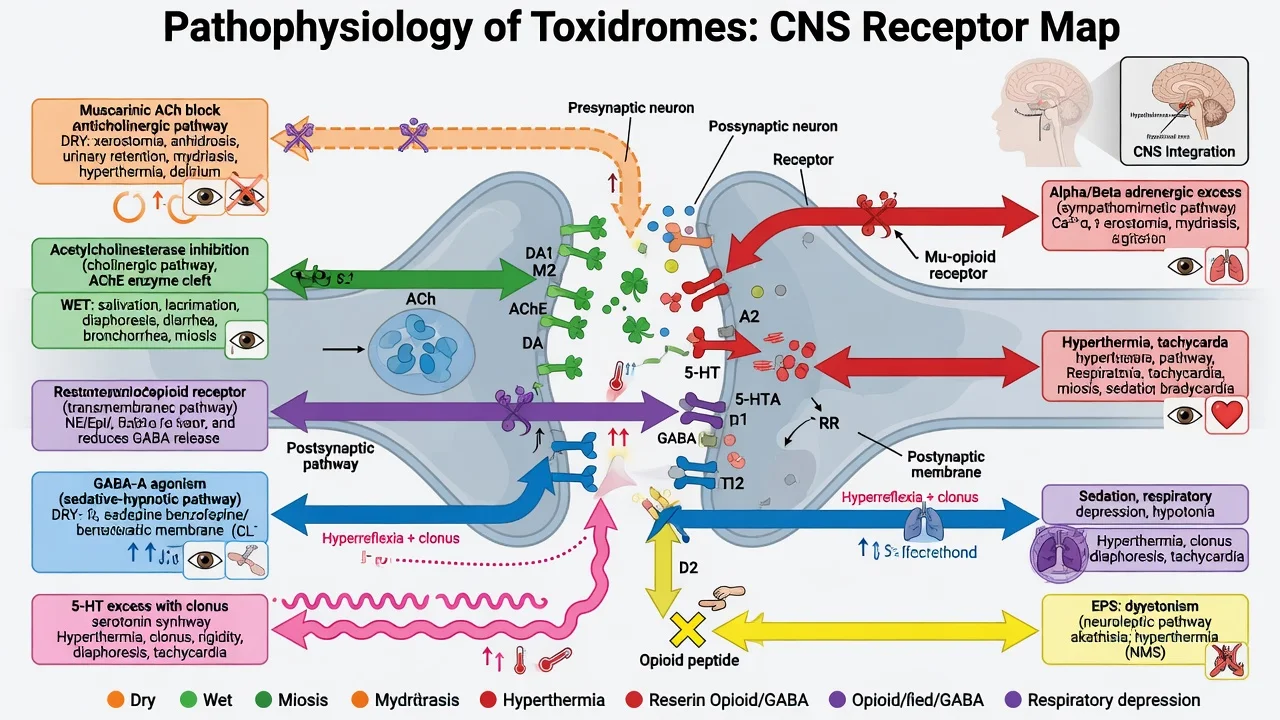
Seven toxidromes cover the majority of deliberate and accidental poisonings, and each is the signature of a distinct receptor action. Recognising the pattern is faster and more reliable than awaiting a drug level, and it directs the first antidote. [1]
The anticholinergic toxidrome
Anticholinergic poisoning follows muscarinic blockade by the tricyclic antidepressants, the antihistamines (diphenhydramine, promethazine), atropine, hyoscine, the antiparkinsonian agents, and the plant poisons (deadly nightshade, jimsonweed). The classic mnemonic captures the phenotype completely: hot as a hare, dry as a bone, red as a beet, blind as a bat, and mad as a hatter. The patient is hyperthermic, flushed, and anhidrotic with dry mucous membranes, a dry axilla, urinary retention, an ileus with absent bowel sounds, a tachycardia, mydriasis with cycloplegia (a blurred near vision), and an agitated, delirious, often hallucinating mental state. The skin is the key discriminator from the sympathomimetic patient: the anticholinergic patient is dry. [1]
Anticholinergic — the five classic findings
ANTICHOLINERGIC
Hyperthermia with anhidrosis — the thermoregulatory sweat glands are blocked
Dry skin, dry mouth, dry axilla, urinary retention, ileus
Flushed skin from compensatory vasodilation
Mydriasis and cycloplegia — blurred near vision and photophobia
Agitated delirium with hallucinations — central muscarinic blockade
The cholinergic toxidrome
Cholinergic poisoning results from acetylcholinesterase inhibition by the organophosphate and carbamate insecticides, the nerve agents (sarin, VX), and some mushroom poisons. Acetylcholine accumulates at the muscarinic, nicotinic, and central receptors, producing the SLUDGE picture — salivation, lacrimation, urination, defecation, gastrointestinal distress and emesis — to which the DUMBELS mnemonic (diarrhoea, urination, miosis, bradycardia/bronchorrhoea, emesis, lacrimation, salivation/seizures) is an alternative. The patient is wet: copious oral and bronchial secretions, profuse sweating, miosis, bradycardia, bronchospasm, and a hyperactive bowel. Nicotinic effects add muscle fasciculation, weakness, and eventually flaccid paralysis. Bronchorrhoea and bronchospasm are the immediate threats to life, and death is from respiratory failure. [1]
The sympathomimetic toxidrome
Sympathomimetic poisoning follows cocaine, amphetamine, methamphetamine, MDMA (ecstasy), the decongestants (pseudoephedrine, phenylpropanolamine), and caffeine or theophylline. The picture is one of pure adrenergic excess: hypertension, tachycardia, hyperthermia, mydriasis, diaphoresis, agitation, and tremor, with piloerection (gooseflesh) and brisk reflexes. The patient is hot and sweaty, which separates the syndrome from the hot-and-dry anticholinergic patient. The immediate dangers are the hypertensive emergency, the tachyarrhythmia, the hyperthermia, and the intracranial haemorrhage that accompanies severe hypertension, and the secondary rhabdomyolysis and disseminated intravascular coagulation of profound hyperthermia. [1]
The opioid toxidrome
Opioid poisoning produces the classic triad of central nervous system depression, miosis (pinpoint pupils), and respiratory depression — a reduced rate and a reduced tidal volume — through mu-receptor agonism at the medullary respiratory centre. Heroin, morphine, oxycodone, fentanyl, methadone and tramadol are the common agents. The skin, secretions and bowel sounds are unremarkable, and the diagnosis is confirmed by a rapid response to naloxone. The danger is hypoxia and aspiration, and the management trap is the long-acting opioid (methadone, sustained-release oxycodone, fentanyl patches), which re-narcotises after a single naloxone dose and demands an infusion. [1]
The sedative-hypnotic toxidrome
The benzodiazepines, the barbiturates, the non-benzodiazepine hypnotics (zolpidem, zopiclone), ethanol, and gamma-hydroxybutyrate produce central nervous system depression with normal pupils, normal vital signs (until the dose is large), and normal reflexes — ataxia, dysarthria, slurred speech, and a descending level of consciousness that culminates in respiratory depression. The syndrome is defined by what it lacks: there is no miosis, no mydriasis, no hyperthermia, and no autonomic sign, and this normality is itself the diagnostic clue. [1]
The serotonin syndrome
Serotonin syndrome is the potentially lethal consequence of excess central serotonergic activity, classically from the combination of two serotonergic agents — a selective serotonin reuptake inhibitor with tramadol, linezolid, a monoamine oxidase inhibitor, pethidine, dextromethorphan, or St John's wort.[5] The triad is the clinical key: clonus (spontaneous, inducible, or ocular), hyperreflexia (lower-limb predominant), and autonomic instability with hyperthermia and agitation. Onset is rapid, within hours of a dose change or a new agent. The clonus and the hyperreflexia are the features that separate it from the anticholinergic and sympathomimetic toxidromes, where reflexes are normal or reduced. Severe disease produces rigidity, a temperature above 38.5 degrees Celsius, seizures, and death.
The neuroleptic malignant syndrome
The neuroleptic malignant syndrome is an idiosyncratic reaction to the dopamine D2 antagonists — the antipsychotics (haloperidol, olanzapine, risperidone, clozapine) and the antiemetic metoclopramide — that develops over days to weeks of therapy or after a dose escalation. The tetrad is lead-pipe muscle rigidity, hyperthermia, an altered mental state (mutism, agitation, stupor), and autonomic instability with labile hypertension, tachycardia, and diaphoresis. Reflexes are reduced, not exaggerated, and there is no clonus — the features that distinguish it from serotonin syndrome. A raised creatine kinase, a leucocytosis, and a transaminitis accompany the syndrome. [1]
Differential diagnosis — the overlapping toxidromes and the non-toxic mimics
The toxidromes overlap, and several non-toxic conditions mimic them. The three highest-stakes distinctions are the dry versus the wet hyperthermic patient, the hyperthermic-rigidity trio, and the miotic-comatose patient. [1]
Anticholinergic
- Hot, RED, dry (anhidrosis, dry mouth, urinary retention, ileus)
- Mydriasis with cycloplegia; agitated delirium and hallucinations
- Tachycardia; normal or reduced reflexes; no clonus
- Causes: TCA, antihistamine, atropine, jimsonweed; treat with benzodiazepine and cooling; physostigmine in selected pure cases
Sympathomimetic
- Hot and SWEATY (diaphoresis, piloerection)
- Mydriasis with preserved accommodation; agitation, tremor, brisk reflexes
- Hypertension, tachycardia, hyperthermia
- Causes: cocaine, amphetamine, MDMA; treat with benzodiazepine, cooling, and an alpha-blocker for hypertension
Serotonin syndrome
- Hot, agitated, with CLONUS and HYPERREFLEXIA (lower limbs)
- Onset hours after a serotonergic agent (SSRI + tramadol/linezolid/MAOI)
- Autonomic instability; ocular clonus; diaphoresis
- Treat with benzodiazepine, cooling, and cyproheptadine 12 mg; stop the offending drug
Neuroleptic malignant syndrome
- Lead-pipe RIGIDITY with hyporeflexia and altered mental state
- Onset days to weeks of an antipsychotic or metoclopramide
- Labile hypertension, diaphoresis, raised creatine kinase, leucocytosis
- Treat by stopping the drug, benzodiazepine, cooling, bromocriptine or dantrolene in severe disease
Opioid
- Coma with MIOSIS and respiratory depression (slow, shallow)
- Normal skin, secretions, bowel sounds and temperature
- Rapid response to naloxone
- Treat with titrated naloxone; infusion for the long-acting opioid
Pontine haemorrhage / clonidine
- Miotic coma that MIMICS opioid poisoning but does not respond to naloxone
- Clonidine (alpha-2 agonist) is a partial naloxone responder
- Check glucose, examine for brainstem signs, image if the response is incomplete or atypical
- Treat the underlying lesion; supportive care
Beyond the toxidromes, the non-toxic mimics must be excluded at the bedside on every poisoned patient: hypoglycaemia (a glucose is checked immediately in every altered or fitting patient), sepsis and encephalitis, thyrotoxic crisis, heat stroke, post-ictal states, and the structural intracranial lesion. A negative naloxone trial in a miotic, comatose patient mandates imaging, not a higher naloxone dose. [1]
Investigations in parallel with resuscitation
Investigation runs in parallel with resuscitation, never before it. A bedside capillary glucose is checked immediately in every poisoned patient with an altered conscious state — hypoglycaemia is rapidly fatal, easily treated, and clinically silent in the intoxicated. A 12-lead electrocardiogram is obtained early, because the tricyclic antidepressant produces a widened QRS and a rightward terminal R wave in aVR (sodium-channel blockade), the prolonging drugs lengthen the QT interval, and the cardiotoxic agents drive a tachy- or bradyarrhythmia. A venous blood gas gives the pH, the lactate, and the anion and osmolar gaps in minutes — a high anion-gap metabolic acidosis with a high osmolar gap points to the toxic alcohols, while a respiratory alkalosis mixed with a metabolic acidosis is the hallmark of early salicylate poisoning. [1]
Directed quantitative levels are sent on every deliberate self-poisoning patient regardless of the history: a paracetamol level at four hours (the treatable, the dose-dependent, and the initially asymptomatic) and a salicylate level.[2] Additional directed levels are dictated by the suspected agent — lithium, iron, digoxin, valproate, theophylline, methotrexate, and the toxic-alcohol metabolites. Renal function, the electrolytes, the liver enzymes, the creatine kinase, and a beta-human chorionic gonadotropin in women of reproductive age complete the panel. The broad qualitative urine toxicology screen is slow, insensitive, and rarely changes acute management; it is not relied upon for decisions in the resuscitation bay.[1]
Resuscitation — the ABCDE applied to poisoning
Resuscitation follows the airway, breathing, circulation, disability, exposure sequence, adapted to the toxicological threat. The airway is at risk in any patient with a depressed conscious state, and the vomiting or the fitting patient is at particular risk of aspiration; the deeply comatose patient is intubated early, before charcoal is contemplated. Breathing is supported with high-flow oxygen and ventilation; a respiratory rate under twelve, or a falling oxygen saturation, in a miotic patient prompts a naloxone trial — naloxone 400 micrograms intravenously every two to three minutes titrated to adequate ventilation, not to full wakefulness, and 800 micrograms intramuscularly when intravenous access is absent. Circulation is supported with intravenous fluid for the vasodilated, hypotensive patient; a wide QRS in the suspected tricyclic overdose is treated immediately with intravenous sodium bicarbonate 1 to 2 mmol per kilogram bolus to overcome the sodium-channel blockade and to alkalinise the blood (target pH 7.45 to 7.55). Disability begins with the bedside glucose; seizures receive intravenous diazepam 10 mg (lorazepam 4 mg is an equivalent); hyperthermia is identified and treated aggressively. Exposure looks for needle-track marks, signs of trauma, packets or pills, and the skin temperature. [1]
[1]Decontamination — activated charcoal and whole bowel irrigation
Decontamination reduces absorption once the airway is safe. Activated charcoal, given as 50 to 100 grams orally (1 gram per kilogram in a child) within one hour of ingestion, adsorbs most organic poisons in the gut lumen and is the decontamination method of choice for the early, alert, or intubated patient.[3] It is ineffective and withheld for the agents it does not adsorb — lithium, iron, the heavy metals, the hydrocarbons, the strong acids and alkalis, and the alcohols — and it is contraindicated in the patient with an unprotected airway unless intubated, because aspiration of charcoal causes a severe pneumonitis. Multiple-dose charcoal (50 grams every four hours) enhances the elimination of the enterohepatitically recycled drugs — theophylline, carbamazepine, phenobarbital, quinine, dapsone — by gut dialysis.
Whole bowel irrigation with polyethylene glycol 1 to 2 litres per hour in the adult (500 millilitres per hour in the child), given by nasogastric tube until the effluent is clear, is reserved for the iron, the lithium, the sustained-release formulations, and the body packer — agents for which charcoal is ineffective and the load is potentially lethal.[4] Gastric lavage has a vanishing role — only within one hour of a life-threatening ingestion in an intubated patient — and syrup of ipecac is no longer recommended in any setting.
Enhanced elimination — haemodialysis, urine alkalinisation and multiple-dose charcoal
Enhanced elimination removes the absorbed drug from the circulation by extracorporeal or renal means. Haemodialysis is effective for poisons that are water-soluble, of low molecular weight, of small volume of distribution, and poorly protein-bound — the four pharmacological criteria — and is indicated for severe poisoning with lithium, salicylate, metformin, the toxic alcohols (methanol and ethylene glycol), valproate, and theophylline.[1] Specific dialysis triggers include a salicylate level over 100 mg per decilitre (or over 60 with clinical or acid-base compromise), a lithium level over 4 millimoles per litre in the acute overdose (over 2.5 in chronic toxicity), and severe metabolic acidosis, renal failure, or haemodynamic instability from metformin. Urine alkalinisation — intravenous sodium bicarbonate to a urine pH at or above 7.5 — enhances the renal excretion of salicylate and is an alternative to dialysis for the moderate case.
The antidotes — the specific therapy of poisoning
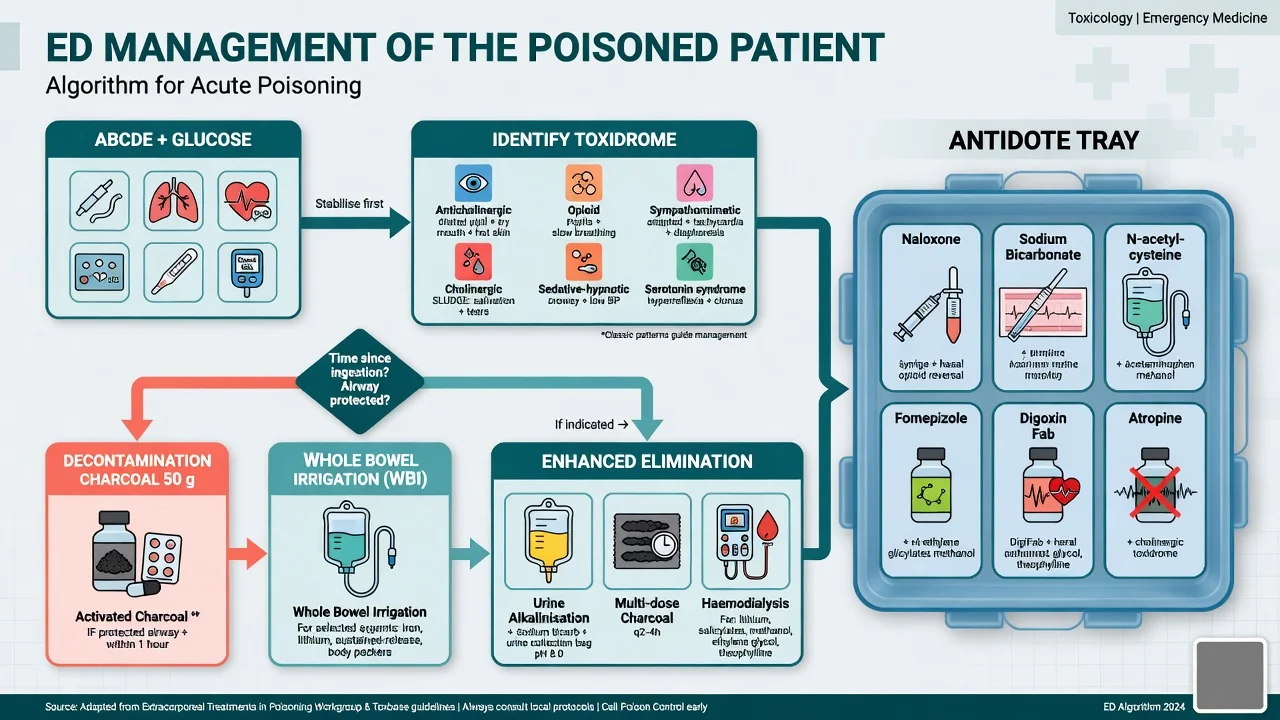
Antidotes reverse or bypass a defined toxic mechanism, and their early administration is the definitive therapy for the agent identified. The Fellowship candidate commits the following to memory. [1]
The emergency antidotes with doses
Why flumazenil is a trap, and the one situation it is safe
Special populations
Children ingest small, unpredictable quantities (the handful at grandmother's), and weight-based dosing of charcoal (1 gram per kilogram), naloxone (100 micrograms per kilogram), and the antidotes is essential; the threshold for intubation before charcoal is lower. Pregnant patients are managed with the mother as the primary patient — NAC and charcoal are safe in pregnancy, the paracetamol nomogram applies unchanged, and flumazenil is avoided; intentional overdose is a leading cause of maternal death and demands a psychosocial as well as a toxicological response. The body packer (the professional who swallows manufactured drug packets for smuggling) and the body stuffer (who swallows loose drug to avoid arrest) face a surgical emergency if a packet ruptures or obstructs: the asymptomatic packer receives whole bowel irrigation and observation, the symptomatic packer goes to theatre. The elderly and the polypharmacy patient present with mixed or attenuated toxidromes, an anticholinergic burden that blurs every sign, and a reduced physiological reserve that lowers the threshold for intensive care. The chronic overdose — methadone accumulation, lithium toxicity in dehydration — develops over days and demands an awareness of the long-acting and the narrow-therapeutic agents. [1]
Common errors and pitfalls
The recurring errors are relying on the qualitative urine toxicology screen to make the acute decision; giving flumazenil to the unknown or co-ingested patient and precipitating seizures; administering charcoal after the one-hour window or to the unprotected airway; forgetting the paracetamol and salicylate levels on every deliberate self-poisoning; failing to recognise the evolving toxidrome — the sympathomimetic patient who develops clonus has serotonin syndrome; treating hyperthermia with antipyretics alone rather than active cooling, benzodiazepines, and (for serotonin syndrome) cyproheptadine; under-dosing atropine in organophosphate poisoning (the dose is measured in milligrammes and repeated until the chest dries); and delaying haemodialysis in the severe salicylate, lithium, or metformin overdose until irreversible harm has occurred. A normal early paracetamol level, drawn before four hours, is uninterpretable and must be repeated. [1]
Evidence and regional guidelines
The decontamination recommendations follow the consensus position papers of the American Academy of Clinical Toxicology and the European Association of Poisons Centres and Clinical Toxicologists: single-dose charcoal is recommended within one hour of a potentially toxic ingestion,[3] whole bowel irrigation is recommended for iron, lithium, sustained-release formulations, and the body packer,[4] and gastric lavage, syrup of ipecac, and cathartics are not recommended for routine use. The general approach to the critically poisoned patient — resuscitation, recognition of the toxidrome, decontamination, enhanced elimination, and antidote — is consistent across the contemporary critical-care and emergency-medicine reviews.[1][5]
ANZ practice note. The framework and the drug doses follow the ANZ approach to the poisoned patient and the local toxicology service. Every deliberate self-poisoning has a paracetamol and salicylate level and a four-hour paracetamol nomogram read against the 100-mg-per-litre treatment line. N-acetylcysteine is the 21-hour regimen (150 then 50 then 100 mg per kilogram) or the two-bag regimen (200 then 100 mg per kilogram) per local protocol. The Poisons Information Centre on 13 11 26 (24 hours) is called for any unfamiliar agent, any sustained-release formulation, any paediatric ingestion, and any body packer; TOXBASE and the local toxicologist are the supplementary sources. Activated charcoal 50 grams within one hour and whole bowel irrigation for iron, lithium, and packets are the decontamination defaults. [1]
Short answer questions
SAQ — Toxidrome identification at a rave
10 minutes · 10 marks
A 22-year-old man is brought to the emergency department by friends after a rave. He is agitated, diaphoretic, hyperthermic at 39.2 degrees Celsius, tachycardic at 140 per minute, hypertensive at 180 over 110, with mydriasis, inducible sustained lower-limb clonus, ocular clonus and hyperreflexia. His friends report he took several unknown tablets through the evening.
SAQ — Decontamination after a polypharmacy overdose
10 minutes · 10 marks
A 28-year-old woman presents 40 minutes after a deliberate overdose of sustained-release lithium and iron tablets belonging to her grandmother. She is alert and oriented with GCS 15 and stable vital signs. The ingestion was 40 minutes ago.
Exam pearls
- Clonus is the finding that makes serotonin syndrome — inducible, sustained, lower-limb clonus with hyperreflexia distinguishes it from the anticholinergic and sympathomimetic toxidromes, where reflexes are normal or depressed.
- The dry skin separates anticholinergic from sympathomimetic — both are hot, tachycardic, mydriatic and agitated, but the anticholinergic patient is dry (anhidrotic, urinary retention, ileus) and the sympathomimetic patient is sweaty.
- Flumazenil is reserved for isolated iatrogenic benzodiazepine oversedation — never the unknown, the co-ingested, or the chronic user; the seizure it provokes is refractory.
- A wide QRS in the tricyclic overdose is sodium bicarbonate, 1 to 2 mmol per kilogram, not an antiarrhythmic — the problem is sodium-channel blockade.
- Dialyse lithium, salicylate, metformin, and the toxic alcohols — the four pharmacological criteria are water solubility, small size, low protein binding, and a small volume of distribution.
- Every deliberate self-poisoning has paracetamol and salicylate levels — the treatable, the dose-dependent, and the initially asymptomatic.
- The long-acting opioid re-narcotises — naloxone is titrated to ventilation, and an infusion is started for methadone, sustained-release oxycodone, and fentanyl patches.
- Hyperthermia with rigidity is an emergency — cool, sedate with a benzodiazepine, give cyproheptadine for serotonin syndrome and bromocriptine or dantrolene for neuroleptic malignant syndrome; antipyretics do nothing. [1]
Red flags
[1] [1] [1] [1] [1] [1]References
- [1]Hüser C, Persaud P, Jain N, et al. Critical care management of the patient with pharmaceutical poisoning Intensive Care Med, 2025.PMID 41222651
- [2]Parris MA, Ragan PF, Lin A. Found Down: Approach to the Patient with an Unknown Poisoning Emerg Med Clin North Am, 2022.PMID 35461619
- [3]Chyka PA, Seger D, Krenzelok EP, Vale JA. Position paper: Single-dose activated charcoal Clin Toxicol (Phila), 2005.PMID 15822758
- [4]Thanacoody R, Caravati EM, Downs J, et al. Position paper update: whole bowel irrigation for gastrointestinal decontamination of overdose patients Clin Toxicol (Phila), 2015.PMID 25511637
- [5]Levine M, Brooks DE, Franken A, Graham R. Toxicology in the ICU: Part 1: general overview and approach to treatment Chest, 2011.PMID 21896525