EM · Environmental emergencies
Altitude illness
Also known as Acute mountain sickness · High altitude cerebral oedema · High altitude pulmonary oedema · AMS HACE HAPE
Altitude illness is the spectrum that develops after rapid ascent above 2500 m, divided into acute mountain sickness (AMS — headache plus one of nausea, fatigue, dizziness or insomnia), high altitude cerebral oedema (HACE — ataxia and altered consciousness, the lethal brain swelling) and high altitude pulmonary oedema (HAPE — dyspnoea at rest, cough and crackles, the non-cardiogenic pulmonary oedema). The three pillars of management are descent (the definitive cure), oxygen to a saturation above 90 per cent, and drugs — dexamethasone 8 mg then 4 mg every 6 hours for HACE, nifedipine slow-release 30 mg daily for HAPE, sildenafil 50 mg as an adjunct, and acetazolamide 125 mg twice daily for prophylaxis. Prevention is gradual ascent (above 3000 m sleep no more than 500 m higher per night with a rest day every 1000 m) and acetazolamide. The differential is pneumonia, migraine, dehydration, hypothermia and intracerebral events. ACEM-primary, globally tagged.
On this page & tools
Your progress
Saved locally on this device.
Target exams
Red flags
Altitude illness is the textbook example of a condition prevented by behaviour and cured by descent, where the candidate who reaches for a ventilator or a complex workup instead of the mountain itself fails the station. Above 2500 m the falling barometric pressure lowers the inspired partial pressure of oxygen, and a rapid ascent overwhelms the ventilatory and vascular adaptation that takes days to develop. The syndrome divides into three overlapping entities: acute mountain sickness (AMS), a common and self-limiting headache syndrome; high altitude cerebral oedema (HACE), the lethal brain swelling marked by ataxia; and high altitude pulmonary oedema (HAPE), the non-cardiogenic pulmonary oedema marked by dyspnoea at rest. The examiner expects the candidate to name each entity by its diagnostic criterion, to execute the three pillars — descent, oxygen, drugs — with the correct doses, and to counsel the trekker on the gradual ascent and acetazolamide that prevent the illness. The two references that anchor the topic are the Hackett and Roach review in the New England Journal of Medicine (2001) and the Wilderness Medical Society 2024 update by Luks and colleagues.[1][2]

Definition and classification
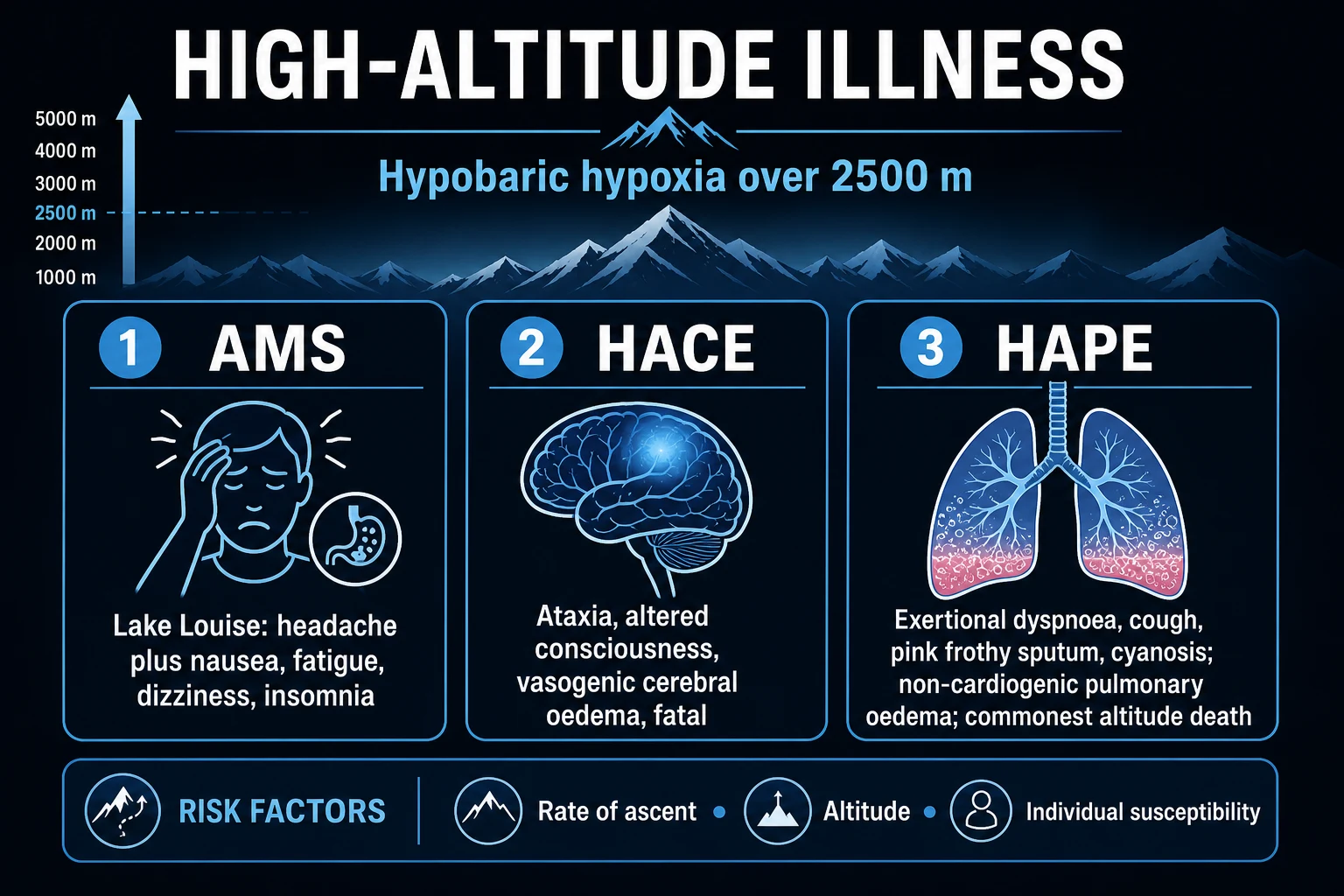
Altitude illness is the clinical spectrum that follows rapid ascent above 2500 m, and it is divided by organ and severity into three entities that share hypobaric hypoxia as their cause and descent as their cure.[1][2]
The altitude illness triad
The three overlap and often coexist: a trekker with worsening AMS may develop HACE and HAPE in the same hours, and HAPE may appear without preceding AMS. HACE is best understood as the severe end of the AMS to HACE continuum, while HAPE is a parallel pulmonary process that can occur in isolation. The candidate who treats the triad as one illness prevented and cured by the same single intervention — descent — has grasped the topic.[2][3]
Epidemiology and risk
AMS affects about a quarter of tourists who ascend directly from sea level to 2500 to 3000 m, and the incidence rises with altitude and speed, reaching above 50 per cent above 4500 m. HACE is uncommon (below 1 per cent of ascending travellers) but lethal if untreated. HAPE is the commonest cause of altitude death, with an incidence of about 1 to 2 per cent above 4000 m. The dominant risk factor is the rate of ascent — flying or driving to altitude abolishes the days of gradual acclimatisation that protect the trekker, and explains why the pilgrim flown to high-altitude destinations (Lhasa, Cusco, La Paz) is the classic victim. Other risks are the absolute altitude reached, a prior history of altitude illness (the strongest predictor of recurrence), heavy exertion on arrival, age under 50 (paradoxically higher AMS risk than in the elderly), obesity, and a constitutionally low hypoxic ventilatory response.[2][3]
[1]Pathophysiology — the mechanism
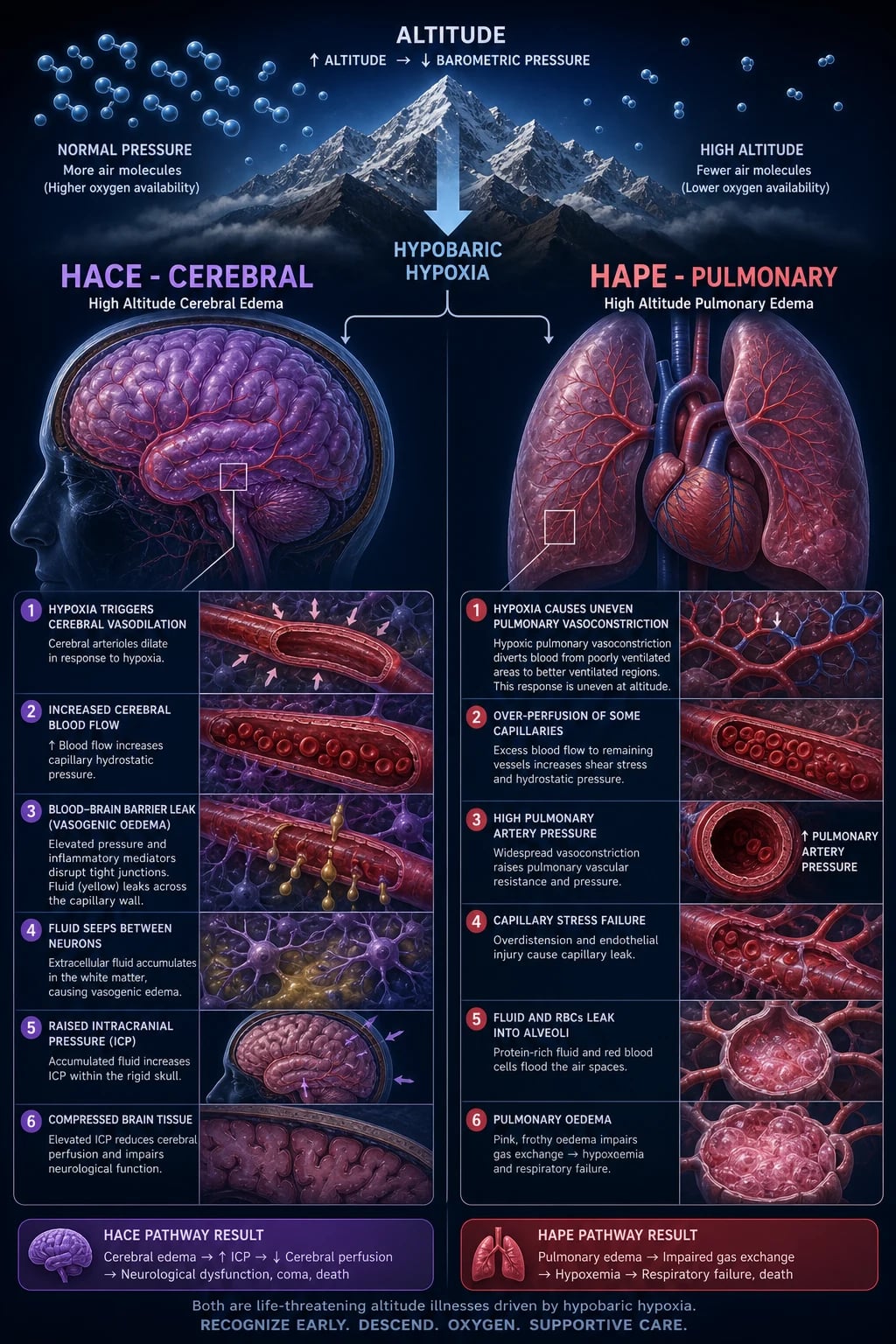
The governing variable is the fall in barometric pressure with altitude: it halves at 5500 m, and with it falls the inspired partial pressure of oxygen and the alveolar and arterial oxygen tension. The body's first defence is hyperventilation, driven by the carotid body chemoreceptors, which raises alveolar oxygen but blows off carbon dioxide, producing a respiratory alkalosis that limits further increases in ventilation until the kidney excretes bicarbonate over the following days — the process called acclimatisation. A trekker who ascends faster than acclimatisation can keep up becomes hypoxaemic, and the hypoxaemia drives all three syndromes.[2][3]
AMS and HACE are cerebral. Hypoxia causes cerebral vasodilation (increasing cerebral blood flow) and a mild rise in intracranial pressure; in the susceptible trekker the autoregulation fails, vasogenic oedema develops, and the brain swells within the rigid skull. Mild swelling is AMS; swelling that overwhelms the cranial vault produces the HACE picture of ataxia and coma, often with cerebral microhaemorrhages on imaging. HAPE is pulmonary and non-cardiogenic. Hypoxia constricts the pulmonary arterioles unevenly, so the cardiac output is forced through the patent vessels at high pressure, over-perfusing and rupturing their capillary beds and producing a protein-rich oedema with a normal cardiac output and a normal pulmonary capillary wedge pressure. This is why HAPE has a normal heart size and why nifedipine — which lowers the pulmonary artery pressure — works.[1][2]
Clinical presentation
The presentation tracks the organ. AMS declares itself 6 to 12 hours after arrival at altitude as a headache (typically bifrontal, worse on exertion and at night) plus one or more of anorexia and nausea, fatigue and weakness, dizziness, and insomnia (the insomnia is often driven by periodic breathing — cycles of apnoea and hyperventilation that fragment sleep). The patient looks well, has no objective signs, and is cardiovascularly stable.[2][4]
HACE is AMS that has crossed into neurological failure. The cardinal sign is ataxia — a tandem gait test (heel to toe, five steps in a straight line) is the single most useful bedside examination at altitude, and an ataxic trekker has HACE until proven otherwise. Altered consciousness ranges from lethargy and confusion to coma; severe headache, vomiting and focal deficits may accompany it. HAPE presents as dyspnoea at rest (the defining feature — dyspnoea on exertion alone is normal at altitude), a dry cough that may become pink and frothy, marked exercise intolerance, cyanosis, bilateral crackles on auscultation, and tachycardia with tachypnoea. A low-grade fever may mimic infection, and oxygen saturation falls well below the altitude-adjusted normal.[2][3]
[1]Differential diagnosis
The differential of altitude illness is the differential of headache, ataxia and dyspnoea in a trekker, and several mimics share its profile. The distinction rests on the ascent history, the symptom pattern, and the response to descent and oxygen. Every trekker who fails to improve with descent and oxygen is searched for an alternative diagnosis.[1][2]
AMS / HACE / HAPE
- Rapid ascent above 2500 m; headache plus nausea, fatigue, dizziness or insomnia (AMS); add ataxia for HACE; add dyspnoea at rest and crackles for HAPE
- Onset 6 to 12 hours after arrival at a new altitude; responds to descent, oxygen and the altitude drugs
- Descend, give oxygen to a saturation above 90 per cent, dexamethasone 8 mg then 4 mg q6h for HACE, nifedipine SR 30 mg for HAPE
Pneumonia
- A productive cough, a high fever, a focal consolidation on the chest radiograph, and a leukocytosis; dyspnoea and crackles mimic HAPE
- A purulent sputum, a lobar infiltrate rather than the patchy peripheral infiltrates of HAPE, and failure to improve with oxygen alone
- Antibiotics, oxygen and fluid; descent remains wise because hypoxaemia of any cause is worse at altitude
Migraine
- A unilateral throbbing headache with aura, photophobia and phonophobia; a prior migraine history; mimics the AMS headache
- The absence of nausea-as-the-dominant symptom, the visual aura, the unilateral site, and no worsening with altitude gain
- Analgesia, an antiemetic, rest and hydration; descend if any ataxia or AMS features are present
Dehydration and exhaustion
- Headache, fatigue, dizziness and oliguria from inadequate fluid intake on the trek; a common mimic of AMS
- Resolution with oral rehydration and rest without descent, a high urine specific gravity, and no insomnia or ataxia
- Oral or intravenous rehydration, rest; if doubt remains, treat as AMS and do not ascend
Hypothermia
- A cold, exposed trekker with apathy, ataxia and a core temperature below 35 degrees; mimics HACE ataxia
- A low core temperature, the environmental history, and shivering (early) or its absence (moderate)
- Gentle handling, removal from the cold, the staged rewarming ladder alongside descent
Intracerebral event
- A stroke, subarachnoid haemorrhage or intracerebral haemorrhage producing focal deficit, coma or seizure at altitude
- A true focal deficit (rather than ataxia), a sudden maximal onset, meningism, and failure to respond to descent and dexamethasone
- Urgent imaging, neuroprotection, blood pressure control and transfer to definitive care
Bedside assessment
Assessment runs in parallel with the first interventions, and in the field the diagnosis is made on history and examination alone. Apply ABCDE, then establish the altitude profile (how high, how fast, flown or walked), the onset and progression of symptoms, and any prior altitude illness. Record the oxygen saturation on room air and interpret it in context — the expected saturation falls with altitude (about 88 to 92 per cent at 4000 m is normal), so an absolute threshold is less useful than the trend and the clinical picture. Perform a focused neurological examination with the tandem gait test front and centre — ataxia is HACE. Auscultate the chest for crackles (HAPE), check the capillary glucose (hypoglycaemia mimics AMS and HACE), the temperature, and the core temperature if cold exposure is in the history. Palpate the abdomen and complete a brief secondary survey.[1][2]
[1]Investigations
In the field, altitude illness is a clinical diagnosis and treatment must not wait for tests. Where imaging and bloods are available (an alpine town clinic, the retrieval base), the panel confirms rather than establishes the diagnosis. The Lake Louise Score (2018 version) quantifies AMS severity for the record and the research setting: headache (0 to 3), gastrointestinal symptoms (0 to 3), fatigue and weakness (0 to 3), and dizziness and lightheadedness (0 to 3); AMS in a trekker with headache is defined by a total of 3 or more on these four components.[4]
The key investigations and their role
Immediate management and resuscitation
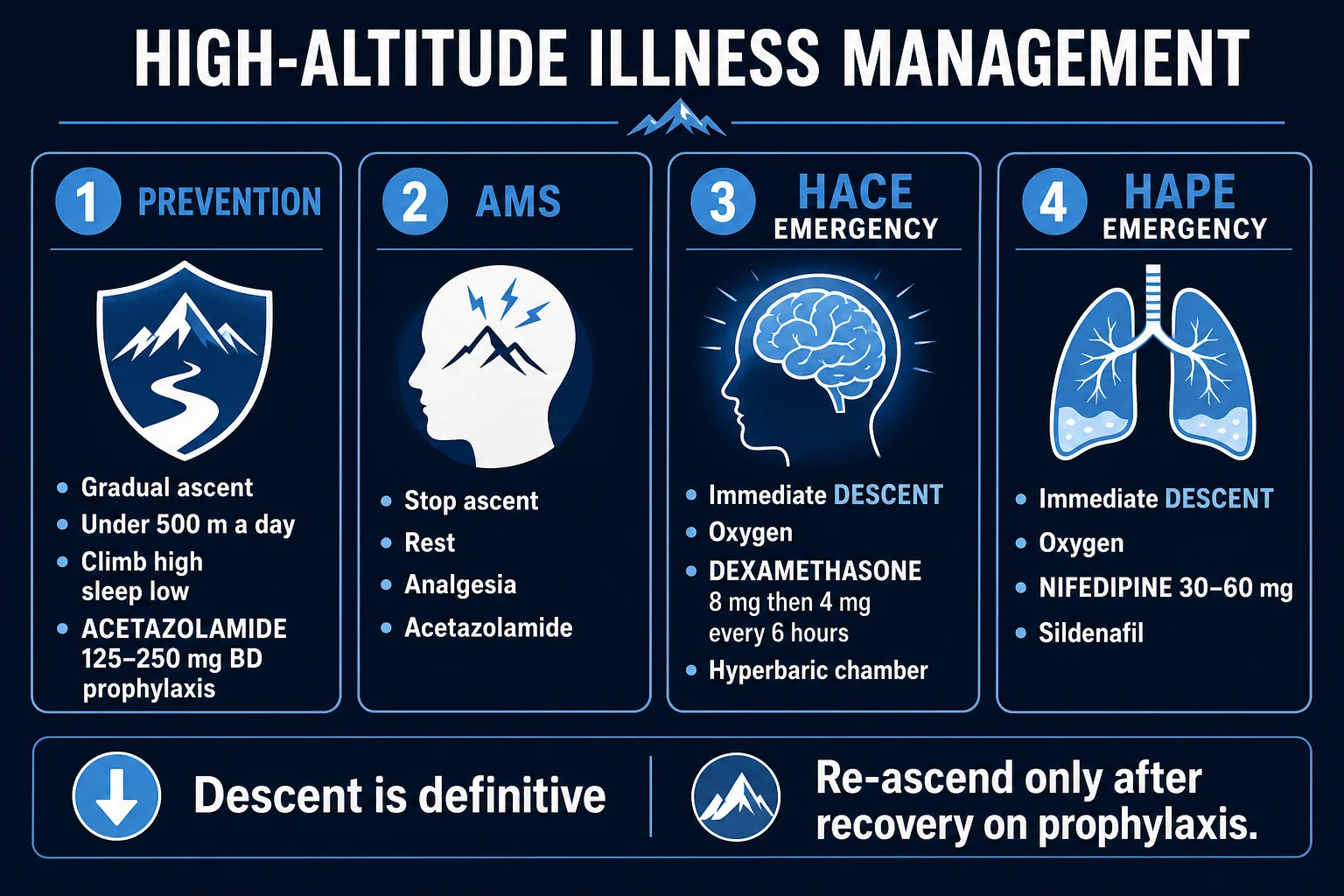
The management of altitude illness rests on three pillars stated aloud in any station: descend, give oxygen, give the right drug. The order matches the severity. Mild AMS is managed by stopping ascent, resting, hydrating, and giving simple analgesia and an antiemetic; the patient descends if symptoms do not resolve within 24 hours and does not ascend again until symptom-free. Any HACE or HAPE triggers immediate descent.[1][2]
Apply ABCDE, give high-flow oxygen by mask to a saturation above 90 per cent, sit the patient upright (HAPE) and reassure. Check the bedside glucose. Establish the route of descent — on foot if the patient can walk (a yak, a horse, a porter, a companion supporting a trekker who can still mobilise), by vehicle, or by stretcher and helicopter for the unconscious or the HAPE patient who cannot be moved otherwise. A portable hyperbaric chamber (the Gamow bag) is a field bridge that simulates descent by raising the ambient pressure around the patient, used when descent is genuinely impossible — it treats but it does not cure, and descent is still required as soon as feasible.[2][3]
Definitive management — descent, oxygen, drugs
Descent is the definitive cure for every form of altitude illness. A drop of 500 to 1000 m is usually sufficient; the patient descends until symptoms resolve, and further if they do not. Descent reverses the hypoxic drive of all three syndromes, and it works when drugs and oxygen are unavailable or have failed.[1][2]
The altitude drugs — doses, route, timing, rationale
HACE is treated with dexamethasone 8 mg as a loading dose by mouth, intramuscularly or intravenously, followed by 4 mg every 6 hours, plus oxygen and descent; the steroid reduces the cerebral oedema and is the drug that buys time while the trekker is carried down. Acetazolamide 250 mg every 12 hours is added as an acclimatisation aid. HAPE is treated with oxygen to a saturation above 90 per cent (the single most effective HAPE measure), nifedipine slow-release 30 mg once daily, and descent; sildenafil 50 mg every 8 hours (or tadalafil) is added as an adjunct that lowers the pulmonary vascular resistance, and a bronchodilator is given if there is wheeze. Continuous positive airway pressure, where available, recruits oedematous alveoli and is a useful bridge. AMS is treated with rest, fluids, analgesia (paracetamol or ibuprofen), an antiemetic (ondansetron 4 mg), and acetazolamide 250 mg every 12 hours; it resolves within a day or two, and the trekker ascends again only when symptom-free after a descent of at least 500 m.[1][2][3]
The altitude illness station in one breath
Recognise the triad: AMS is headache plus one of nausea, fatigue, dizziness or insomnia; HACE adds ataxia or altered consciousness; HAPE adds dyspnoea at rest and crackles. Apply ABCDE, give oxygen to a saturation above 90 per cent, sit the patient upright, check glucose. For HACE give dexamethasone 8 mg then 4 mg every 6 hours; for HAPE give nifedipine slow-release 30 mg daily and consider sildenafil 50 mg every 8 hours; for AMS give rest, fluids, analgesia, an antiemetic and acetazolamide 250 mg every 12 hours. Descend 500 to 1000 m for any HACE or HAPE — descent is the definitive cure. Use a Gamow bag only as a bridge. Do not give opioids or benzodiazepines — they depress ventilation and worsen the hypoxaemia. [1]
Prevention
Prevention is behaviour first, drug second. Gradual ascent is the single most effective measure: above 3000 m, sleep no more than 500 m higher than the previous night and take a rest day every 1000 m of altitude gained; the slogan "climb high, sleep low" lets the body acclimatise by day excursions to greater heights while sleeping at a lower altitude. Avoid heavy exertion on the first days, maintain hydration, avoid alcohol and sedatives, and eat a high-carbohydrate diet. Acetazolamide 125 mg twice daily, started the day before ascent above 3000 m and continued for two to four days at the target altitude, prevents AMS in the trekker with a prior history or a forced rapid ascent; it works by inducing a renal metabolic acidosis that drives ventilation and abolishes the periodic breathing of sleep. Dexametholone 4 mg every 12 hours is an alternative prophylactic for those who cannot take acetazolamide, used on the way up and stopped once altitude is reached. Nifedipine slow-release 30 mg daily is used as HAPE prophylaxis in the trekker with a prior HAPE history.[1][2][3]
Subtypes and scenarios
The trekker is the common AMS case — gradual ascent, mild symptoms, resolves with rest and does not recur if ascent is resumed slowly. The climber at extreme altitude (above 5500 m) is the high-risk case where HACE and HAPE are common and descent may be a logistical challenge. The pilgrim flown to a high-altitude destination (the Hajj to Mecca at altitude, the Mount Kailash pilgrimage) is the mass-casualty scenario where many unacclimatised people arrive together and a cluster of HAPE overwhelms local services. The resident at altitude may develop chronic mountain sickness (Monge disease) — polycythaemia, headache, fatigue and pulmonary hypertension from long-standing hypoxia, managed by descent, phlebotomy and oxygen. The paediatric case is a poor historian (a child who simply becomes irritable, refuses food and sleeps poorly) and is kept at low altitude. The trekker with pre-existing cardiopulmonary disease — coronary disease, pulmonary hypertension, sickle cell trait — is at higher risk of altitude decompensation and is counselled before the trip.[2][3]
Complications and pitfalls
Untreated HACE progresses to coma and death within 24 hours; untreated HAPE to respiratory failure and death over hours to a day. Survivors of severe HACE may be left with residual neurological deficit and cerebral microhaemorrhages on imaging. The pitfalls are the inverse of the protocol. The first is delaying descent for drugs, oxygen or imaging — descent is the cure and must not wait. The second is ascending with a headache — any symptom of AMS is a signal to stop ascent or to descend, never to push on. The third is ignoring ataxia — a tandem gait test takes ten seconds and is the HACE divider. The fourth is giving a benzodiazepine or an opioid for insomnia or cough, which depresses ventilation and worsens hypoxaemia. The fifth is treating HAPE as cardiogenic pulmonary oedema with diuretics and nitrates — HAPE has a normal wedge pressure, and the treatment is oxygen and pulmonary vasodilators. The sixth is missing the alternative diagnosis (pneumonia, subarachnoid haemorrhage) in the patient who fails to respond to descent and oxygen. The seventh is relying on acetazolamide instead of gradual ascent for prevention.[1][2]
Prognosis and disposition
AMS resolves within 24 to 48 hours of stopping ascent or descending, and the trekker resumes only when symptom-free. HACE and HAPE resolve over 24 to 72 hours after descent and oxygen, and the trekker is observed until the oxygen saturation is stable on room air and the neurological examination has normalised. Untreated HACE and HAPE carry a high mortality and HACE may leave permanent deficit. Every HACE and HAPE patient is transferred to a lower altitude for definitive recovery; mild AMS managed at altitude is observed and discharged with ascent advice. The patient is counselled that a prior altitude illness predicts recurrence, and is prescribed acetazolamide and a slower ascent for the next trip.[2][3]
Special populations
Children are at risk and a poor historian — observe behaviour (irritability, poor feeding, sleep disturbance) and keep them at lower altitudes. Pregnant travellers are advised caution above 2500 m, as the data are limited and the fetal consequence of maternal hypoxia is uncertain; short, gradual exposure without symptoms is generally tolerated. The patient with pre-existing cardiopulmonary disease — coronary artery disease (altitude raises cardiac demand), pulmonary hypertension (HAPE risk is markedly higher), severe COPD, sickle cell trait (splenic infarction at altitude) — is counselled and may be advised against high altitude. Older adults have a lower AMS incidence than the young (a blunted ventilatory response paradoxically protective) but a higher consequence of any decompensation.[1][2]
Evidence and regional guidelines
The contemporary framework rests on the Hackett and Roach review in the New England Journal of Medicine (2001), the classic mechanistic and clinical reference that codified the triad, and the Wilderness Medical Society Clinical Practice Guidelines — the 2024 update by Luks and colleagues, the current authoritative consensus for the prevention, diagnosis and treatment, which superseded the 2019 and 2014 versions. The Imray and colleagues review in the BMJ (2011) is the accessible clinical summary. The 2018 Lake Louise Acute Mountain Sickness Score by Roach and colleagues defines the standard symptom score for the diagnosis and severity of AMS.[1][2][3][4] The American, European and ANZ alpine and emergency pathways converge on the same principles: gradual ascent and acetazolamide for prevention; descent, oxygen, dexamethasone for HACE and oxygen with nifedipine for HAPE; and the absolute rule that descent is the definitive cure.
ANZ practice note. The Australian and New Zealand alpine ranges (the New Zealand Southern Alps, the Australian Snowy Mountains) and the growing trekking market to the Himalaya, the Andes and Mount Kilimanjaro make altitude illness a presenting diagnosis in the alpine clinics and the metropolitan emergency departments that receive the returned trekker. The retrieval services (RFDS, air ambulance, alpine rescue) are experienced in the low-altitude transfer of the HAPE and HACE patient with continuous oxygen, and in the helicopter evacuation of the stranded climber. The public-health message — gradual ascent, acetazolamide for the high-risk trekker, and the early recognition of ataxia and dyspnoea at rest — is delivered through travel-medicine consultations, the alpine clubs, and the pre-trek briefings run by the commercial operators. [1]
SAQ — HAPE at 4300 m with the descent decision
10 minutes · 10 marks
A 38-year-old fit male trekker at 4300 m on the Annapurna circuit in Nepal presents to the alpine clinic with dyspnoea at rest, a dry cough that has become pink-tinged, and a marked fall in exercise tolerance over the past twelve hours. He flew into 2800 m four days ago and ascended rapidly. On assessment he is centrally cyanosed, RR 32 and laboured, SpO2 72 per cent on room air, bilateral inspiratory crackles to the mid-zones, HR 124, BP 138/86, JVP not visible, no peripheral oedema. A portable chest film shows patchy peripheral infiltrates with a normal cardiac silhouette. The clinic holds a single oxygen cylinder, nifedipine, sildenafil, acetazolamide, dexamethasone and a Gamow bag; descent on foot requires two porters and six hours to reach the nearest road.
SAQ — HACE at 5000 m with weather-bound evacuation and dexamethasone
10 minutes · 10 marks
A 45-year-old woman at 5000 m on the Everest base camp trek is brought to the alpine clinic by her companions after she became confused and unsteady that morning. She had a bifrontal headache and nausea the previous day but continued to ascend. On examination she is drowsy (GCS 13, E3V4M6), disoriented to place and time, and unable to complete a tandem gait — she staggers and falls to the right after two steps. RR 28, SpO2 78 per cent on room air, no chest crackles, HR 108, BP 142/88, capillary glucose 6.2 mmol/L, core temperature 36.5 degrees Celsius. The clinic holds oxygen, dexamethasone, acetazolamide, nifedipine and a Gamow bag. A helicopter has been requested but the weather forecast prevents flying for at least eight hours.
Exam pearls
- AMS is headache plus one of nausea, fatigue, dizziness or insomnia, 6 to 12 hours after ascent above 2500 m.
- HACE is AMS plus ataxia or altered consciousness — the tandem gait is the bedside test.
- HAPE is dyspnoea at rest, a dry cough and bilateral crackles with a normal heart size.
- The three pillars: descend, give oxygen, give the right drug.
- HACE: dexamethasone 8 mg loading then 4 mg every 6 hours, oxygen, descent.
- HAPE: oxygen to a saturation above 90 per cent, nifedipine slow-release 30 mg daily, sildenafil 50 mg as an adjunct, sit upright, descend.
- Prevention: gradual ascent (above 3000 m sleep no more than 500 m higher per night, rest day every 1000 m) and acetazolamide 125 mg twice daily.
- Never give an opioid or a benzodiazepine for insomnia or cough at altitude — they depress ventilation and worsen hypoxaemia.
- Descent is the definitive cure — do not delay it for drugs, oxygen or imaging. [1]
Red flags
[1]References
- [1]Luks AM, Maloney JA, Hubbard NW, et al. Wilderness Medical Society Clinical Practice Guidelines for the Prevention, Diagnosis, and Treatment of Acute Altitude Illness: 2024 Update Wilderness Environ Med, 2024.PMID 37833187
- [2]Hackett PH, Roach RC. High-altitude illness N Engl J Med, 2001.PMID 11450659
- [3]Imray C, Wright A, Subudhi A, Roach R. Acute altitude illnesses BMJ, 2011.PMID 21844157
- [4]Roach RC, Hackett PH, Oelz O, et al. The 2018 Lake Louise Acute Mountain Sickness Score High Alt Med Biol, 2018.PMID 29583031