EM · ED flow and access block
ED flow and access block — the input-throughput-output model, queuing theory, and the operational intervention ladder
Also known as Input-throughput-output model · ITO model · Asplin conceptual model of crowding · Queuing theory and Little's Law · Access block · ED flow · Patient flow · Bottleneck analysis · Emergency department boarding · Ambulance ramping · Full capacity protocol · Short-stay unit · Discharge lounge · Bed management team · Rapid assessment team
ED flow as an operations-engineering problem — the input-throughput-output model of Asplin (input = demand arriving at the emergency department; throughput = assessment and treatment inside; output = discharge or admission to an inpatient bed), with the output box as the binding constraint whose failure propagates upstream as access block and crowding. Queuing theory and Little's Law (L equals lambda times W; the number in the system equals the arrival rate multiplied by the mean time in system), which predicts that a department running at 100 per cent occupancy is mathematically unstable because waiting time rises non-linearly as utilisation approaches one. Bottleneck analysis — the rate-limiting resource defines system capacity — and Khanna's patient-journey mapping of the ED bottlenecks at triage, the doctor assessment, diagnostic turnaround and the disposition decision. Access block in the ACEM operational sense (total ED length of stay greater than 8 hours for an admitted patient) as the central operational pathology, and its burden of harm: mortality 10–30 per cent higher among boarded patients (Sprivulis, Richardson, Guttmann), excess mortality in critically ill patients boarded awaiting ICU (Chalfin), the dose-response of boarding length and mortality (Singer), and the full-capacity-protocol evidence that boarding in an inpatient hallway is not demonstrably worse than continued ED corridor boarding (Viccellio). The pre-hospital face — ambulance ramping (Yoon, Cook) — and left-without-being-seen as a safety signal. The differential of good versus poor flow. The operational intervention ladder: ED-internal throughput work (team triage, senior at the front door, streaming, parallel processing, fast-track), rapid assessment, short-stay units, inpatient bed-flow management (discharge lounges, early senior-led discharge before midday, predicted discharge dates, bed-management teams, whole-of-hospital bed meetings), the full-capacity protocol, ambulance-ramping mitigation, and structural capacity. The cardinal teaching is that access block is a hospital-system problem whose consequence is felt in the emergency department, and that no amount of ED-internal throughput work alone will solve chronic access block.
On this page & tools
Your progress
Saved locally on this device.
8 MCQs with explanations
Target exams
Red flags
Related topics
- Quality and ED metrics — performance measurement, the four-hour target and quality improvement
- The Australasian Triage Scale — categories, validity, reliability and the under-triaged patient
- Patient disposition and safety-netting in the emergency department
- Team-based care and crisis resource management in the emergency department
- Medical error and patient safety in the emergency department
- Retrieval and inter-hospital transfer
Emergency department flow is the single largest determinant of the safety of the care a department delivers, and it is best understood not as a clinical problem but as an operations-engineering problem — a system of queues, bottlenecks and capacity whose mathematics the candidate must master. The organising framework is Asplin's input-throughput-output model, the governing mathematics is queuing theory and Little's Law, the dominant pathology is access block, and the cardinal teaching is that access block is a hospital-system problem whose consequence is felt in the emergency department. This topic is the operational and engineering twin of the companion topic on quality and ED metrics (Donabedian, NEAT-as-metric, Plan-Do-Study-Act and statistical process control); the two are complementary, and the Fellowship candidate is expected to move fluently between the measurement lens and the flow lens.[1]
The input-throughput-output model
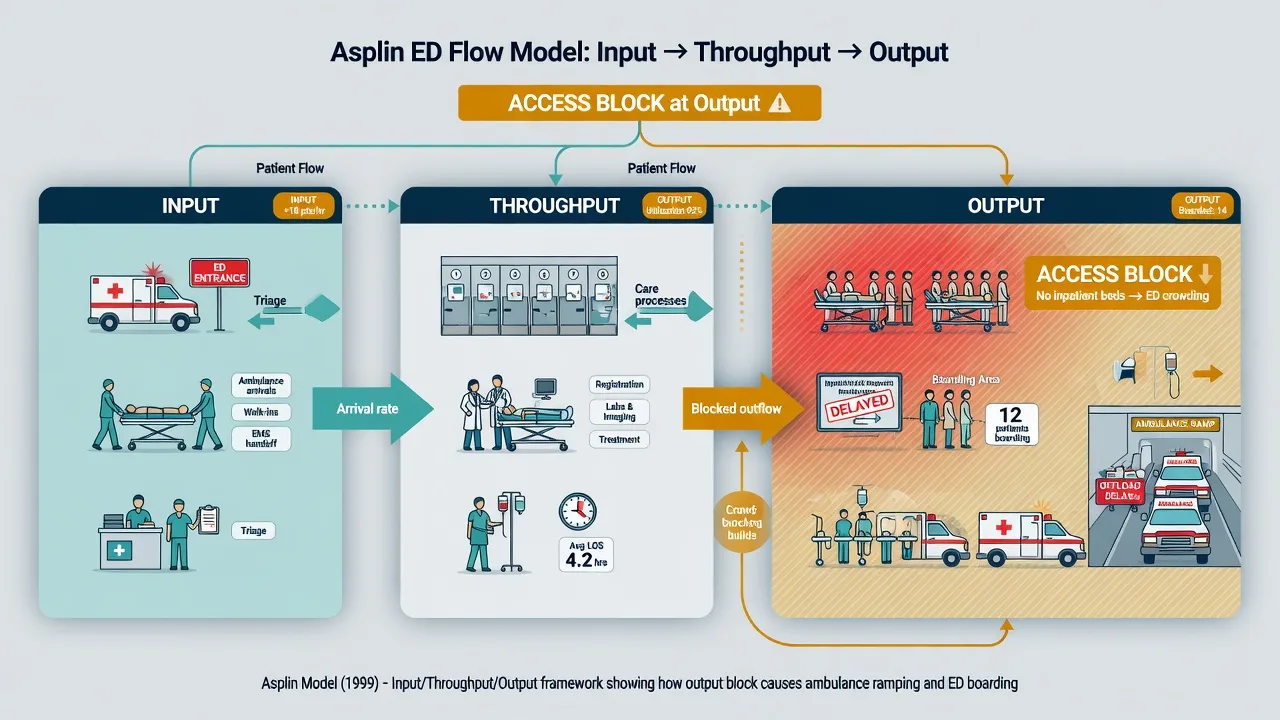
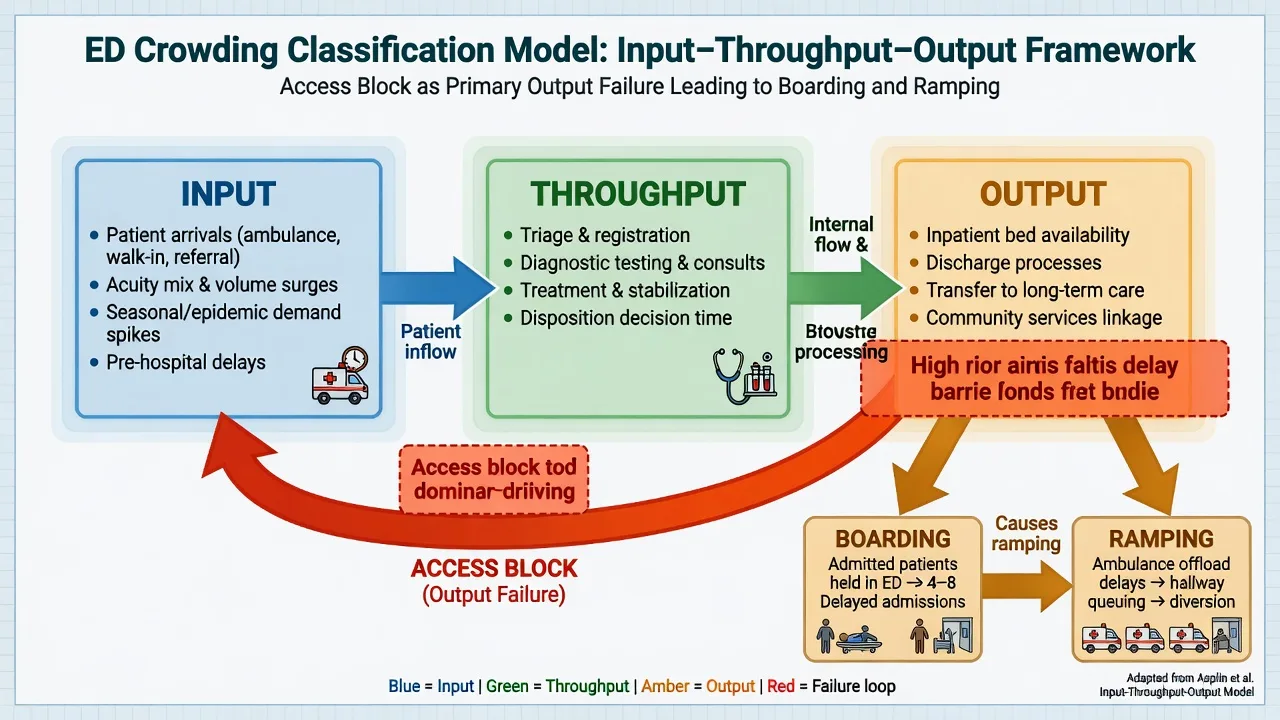
Asplin's input-throughput-output (ITO) model is the conceptual framework that converts the intuitive idea of "the department is busy" into a structured diagnosis of where the flow failure sits, and it is the framework every Fellowship answer on access block must be built on.[1] The model has three boxes. Input is the demand arriving at the emergency department — the number, acuity and case mix of patients presenting, the seasonality and epidemic surges, the after-hours concentration, and the low-acuity attendances that might belong in primary care. Throughput is the work done inside the department — triage, the initial nursing and medical assessment, investigations, treatment, and the senior decision that fixes disposition. Output is the departure of patients from the department — discharge home, admission to an inpatient bed, transfer to another facility, or death in the department.
The teaching that the ITO model delivers — and that the examiner is testing — is that the three boxes are not equal. The output box is the binding constraint: when inpatient beds are unavailable downstream, the admitted patient cannot leave the emergency department, occupies an assessment trolley, blocks the next patient from being seen, and the failure propagates upstream through throughput to input. Most administrative attention is drawn to the input box (rising demand) and the throughput box (a slow doctor, a slow laboratory), but the evidence is unequivocal that the dominant driver of access block and overcrowding is the output box — the hospital's inability to move admitted patients to inpatient beds. Riahi and colleagues' 25-hospital cohort quantified this directly: as hospital bed occupancy rises, emergency department access block rises independently of any emergency department factor.[17][2][9][10][16]
[1]Queuing theory and Little's Law
The emergency department is, mathematically, a queue: patients arrive at some average rate, wait for a server (a doctor, a bay, a bed), receive a service, and depart. Queuing theory describes such systems, and its central results are the ones the candidate must cite because they explain why an overcrowded department does not recover by itself. [1]
The first result is utilisation — the ratio of the arrival rate to the service rate, written ρ = λ/μ. When utilisation is low (the department can serve patients faster than they arrive), queues do not form. As utilisation rises toward 1, the queue length and the waiting time rise non-linearly: at 70 per cent utilisation a department absorbs a surge, but at 95 per cent utilisation a small surge produces a long queue, and at 100 per cent utilisation the system is mathematically unstable — waiting time tends to infinity and the department cannot recover without offloading demand or adding capacity. [1]
The second result is Little's Law, the deceptively simple identity that holds for any stable queue: L = λW, where L is the average number of patients in the system, λ is the average arrival rate, and W is the average time a patient spends in the system. Little's Law is powerful because it is invariant — it holds for any arrival pattern and any service distribution — and because it lets the candidate reason about interventions. If the arrival rate λ is fixed, then reducing the number of patients boarding in the department (L) is possible only by reducing the time each spends (W), and reducing W means moving admitted patients to inpatient beds faster. Conversely, if W is held by access block, then a rising arrival rate λ forces L upward, and the department physically fills. [1]
[1]Bottlenecks — the rate-limiting step
A bottleneck is the resource whose capacity limits the throughput of the whole system: the slowest station defines the rate of the entire queue, exactly as the narrowest section of a pipe defines the flow of water. The cardinal implication — and a frequent SAQ trap — is that expanding any resource other than the bottleneck improves nothing. Adding a second triage nurse when the binding constraint is inpatient beds moves patients from the waiting room to a corridor trolley faster, and the department's measured output (patients discharged or admitted) does not change. [1]
Khanna and colleagues mapped the emergency department patient journey using process-mining of more than 230,000 presentations and identified where patients actually waited.[9] The bottlenecks clustered at four points: triage (the door-to-doctor interval), the doctor assessment and decision, diagnostic turnaround (pathology and imaging), and the disposition decision and bed wait. The first three sit inside the department and are amendable to local quality-improvement work; the fourth — the disposition and bed wait — is the output-side bottleneck that the department cannot fix alone, and it is the one that dominates total length of stay when access block is present.
Access block — the central operational pathology
Access block is the operational disease that the ITO model predicts and that the output-side bottleneck produces. The ACEM policy position defines it operationally: a total emergency department length of stay greater than 8 hours for a patient who is admitted to hospital (or transferred to another facility).[1] Access block is not, in this definition, an emergency department problem — it is a hospital-system problem whose consequence is felt in the emergency department, because the patient who should be on a ward occupies an emergency department trolley, blocks an assessment space, and queues the patient behind them.
The companion state is overcrowding — the condition in which emergency department demand exceeds the department's physical and staffing capacity, every bay full, patients on trolleys in corridors, ambulances queuing to offload. Access block is the cause; overcrowding is the visible consequence inside the department. The two are constantly conflated in casual speech, and the Fellowship candidate must keep them distinct, because conflating them locates the solution inside the emergency department where it does not belong. [1]
[1]The burden of harm — mortality, boarding, ramping and left-without-being-seen
The reason access block is treated as a clinical emergency rather than an administrative inconvenience is the mortality signal, which is now established beyond reasonable doubt. Sprivulis and colleagues' Western Australian cohort found that hospital overcrowding was independently associated with excess mortality among patients admitted via emergency departments.[2] Richardson's companion analysis linked overcrowding to a measurable increase in patient mortality at 10 days.[3] Guttmann and colleagues' Ontario population study found that longer emergency department waiting times and departure before treatment completion were both associated with higher short-term mortality and admission rates.[4] The aggregate mortality signal attributed to access block and overcrowding is in the order of a 10 to 30 per cent relative increase in mortality among affected patients, and it is this figure the candidate must be able to quote.[2][3][10]
The harm is concentrated in the boarded patient. Chalfin and colleagues' cohort of critically ill patients found that delayed transfer from the emergency department to the intensive care unit was independently associated with increased in-hospital mortality — the boarded ICU patient does worse than the promptly transferred one.[7] Singer and colleagues demonstrated a dose-response between the length of emergency department boarding and mortality: every additional hour of boarding adds measurable risk.[6] The modern rapid reviews confirm that medical patient boarding remains a direct source of crowding and delay-related harm.[10][11]
[1]The full-capacity protocol is the operational response that the boarding literature most directly supports, and its evidence base is Viccellio and colleagues' multicenter cohort: the mortality of patients transferred to inpatient hallways when the emergency department was saturated was not demonstrably worse than the mortality of patients who continued to board in the emergency department corridor.[5] The teaching is uncomfortable but important — boarding an admitted patient under the care of the definitive inpatient team in an inpatient hallway is safer than prolonged boarding in an emergency department corridor, because the corridor patient receives delayed antibiotics, delayed analgesia and delayed definitive treatment. The full-capacity protocol formalises this trade-off as a threshold rule: once emergency department saturation exceeds a defined level, boarders are moved to inpatient hallways regardless of bed availability.
The pre-hospital face of access block is ambulance ramping — ambulances queued outside the emergency department, unable to offload their patient because the department is saturated. Yoon and colleagues' 25-hospital Queensland cohort quantified the tight association between access block and ramping and the additional effect of the COVID-19 surge.[12] Cook and colleagues traced the history of ramping as a phenomenon that emerged as access block worsened across Australasian systems.[13] Fouche and colleagues' systematic review confirmed the association between ambulance offload delay and degraded patient outcomes.[18] Ramping harms in two ways: the patient held in the ambulance bay is denied time-critical care inside the department, and the ramped ambulance is removed from the community response, lengthening time to care for the next patient who calls an ambulance.
The third harm marker is left-without-being-seen (LWBS). The LWBS rate rises with access block and overcrowding, and although many who leave are genuinely low-acuity, a meaningful fraction harbour time-critical diagnoses. A climbing LWBS rate is a safety signal that demands investigation, not consolation that those who left were probably not sick. [1]
Differential — good flow versus poor flow
The Fellowship candidate must be able to read a department at the door — to recognise the operational signs that distinguish a department that is flowing from one that is failing — because the diagnosis determines the intervention. [1]
A department that is flowing well
- Input is matched to capacity — arrivals are streamed by acuity, low-acuity patients are fast-tracked or redirected to co-located primary care, and surges are absorbed
- Throughput is parallel, not serial — the senior decision-maker is at the front door, investigations are requested in parallel, and a disposition decision is made early
- Output is unblocked — admitted patients move to inpatient beds within hours, discharge before midday frees downstream capacity, and the boarding count is near zero
- The waiting room empties through the shift, the LWBS rate is below 2 per cent, and ambulance offload is prompt — the visible signs that L is being held down because W is short
- Re-triage is active, the team has situational awareness of every long-stay patient, and the bed-management huddle has happened
A department in flow failure
- Input exceeds capacity — the waiting room fills and climbs, ambulances ramp, and low-acuity patients who would be fast-tracked are instead competing for the same bays
- Throughput is serial and delayed — the doctor is pulled to resus, investigations are requested one at a time, and the disposition decision is deferred because there is nowhere for the patient to go
- Output is blocked — admitted patients board in corridors for many hours, the inpatient bed meeting produced no discharges, and the boarding count climbs through the shift
- The mortality risk rises with every boarding hour (Singer), LWBS climbs as a safety signal, and the ramp grows — the visible signs that L is rising because W is lengthening under access block
- The team is reactive, long-stay patients are invisible until they deteriorate, and the rate-limiting resource (inpatient beds) has not been expanded
The intervention ladder — operational solutions
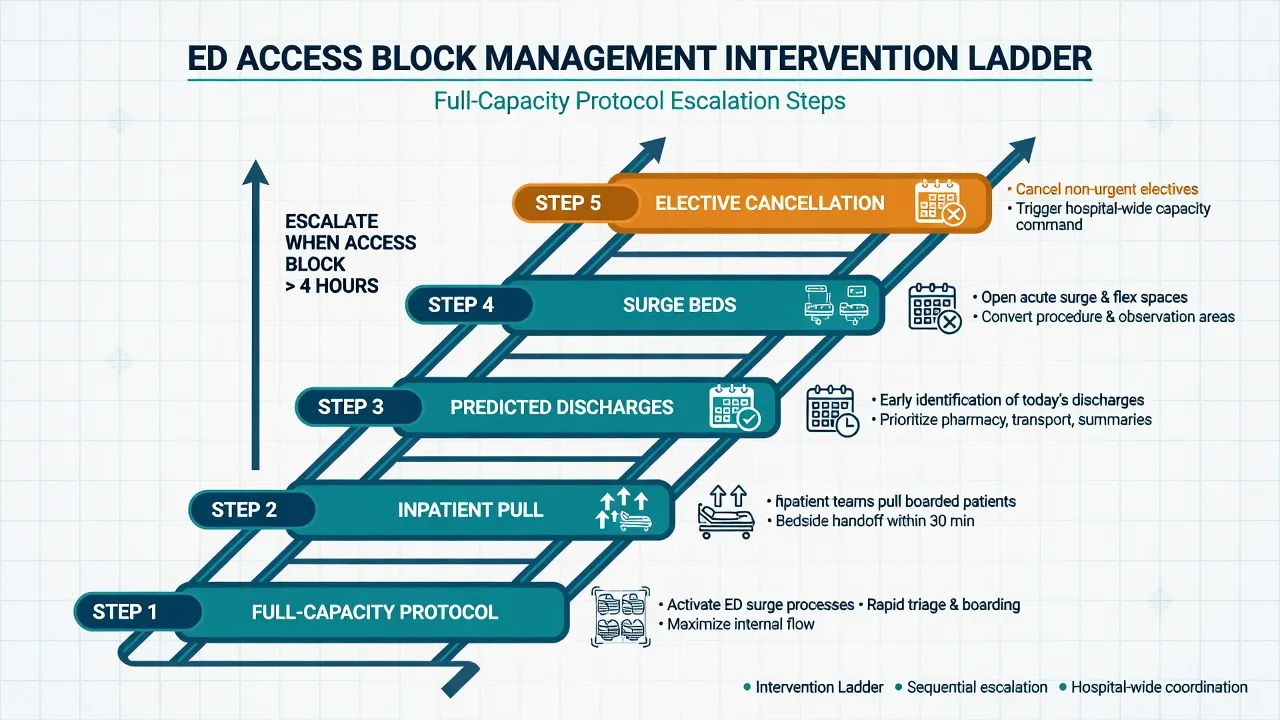
The interventions that move flow fall in a ladder, ordered by where in the ITO model they act and by the strength of the evidence behind them. The candidate is expected to name them in order and to know that the lowest rungs are ED-internal and impotent against chronic output-side access block, while the highest rungs act on the binding constraint.[14][16][10][1]
The four families of flow intervention
FLOW
Team triage, the senior doctor at the front door, streaming by complaint, fast-track for low acuity, parallel processing of investigations, and a rapid assessment team that fixes disposition early — these act on the throughput box and are the rung the ED controls itself
A short-stay or observation unit that admits patients for under 24 hours and frees acute assessment bays — beware the gaming temptation of inflating short-stay admissions to meet a four-hour target
Early senior-led discharge before midday, a discharge lounge, predicted discharge dates, a dedicated bed-management team, and the whole-of-hospital bed meeting that creates inpatient capacity — this is the rung that acts on the binding constraint
The full-capacity protocol that moves boarders to inpatient hallways when the ED is saturated, ambulance-ramping mitigation, hospital-in-the-home and community alternatives, and ultimately additional inpatient bed capacity — the only definitive fix for chronic access block
The rapid assessment team (RAT) and the senior decision-maker at the front door act on the throughput box: a senior clinician sees the patient within minutes of triage, requests investigations in parallel, and fixes disposition early, shortening W for the patients who can go home. Team triage adds a doctor to the triage desk and reduces the door-to-doctor interval, though it does not by itself solve access block. The short-stay unit (emergency medicine unit, observation unit) admits patients expected to stay under 24 hours — conditions such as mild asthma, renal colic, or observation after a procedure — and frees acute assessment bays; Neijzen and colleagues' systematic review confirmed that well-governed short-stay units shorten length of stay and reduce avoidable admissions.[15]
The discharge lounge and early senior-led discharge before midday act on the output box and are among the most effective operational levers, because an inpatient bed emptied by 10 a.m. is available for the emergency department admission at noon. Woods described the discharge lounge as a patient-flow process solution, and Franklin and colleagues' evaluation confirmed measurable flow benefit — the bed is freed earlier in the day, and the boarded emergency department patient can be moved up sooner.[19][20] A dedicated bed-management team and a whole-of-hospital bed meeting convert this into a system: the team tracks every bed, every predicted discharge, and every boarding patient, and the meeting forces the inpatient teams to commit to discharges. The full-capacity protocol is the emergency lever — when emergency department saturation exceeds a defined threshold, boarders are moved to inpatient hallways under their definitive team, on the Viccellio evidence that this is safer than continued corridor boarding.[5]
Model answer — the intervention ladder presented to a hospital executive
Common errors and pitfalls
The recurring failures are themselves examinable. Locating the problem inside the emergency department — blaming the triage nurse, the junior doctor or the laboratory for a problem whose root cause is downstream inpatient bed capacity — is the cardinal error, because it locates the solution where it cannot work. Expanding the resource next to the bottleneck — a second triage nurse, a fast-track doctor, a fourth CT scanner — improves nothing when the binding constraint is inpatient beds; flow improves only by expanding the rate-limiting resource. Running the department at 100 per cent occupancy — by queuing theory a saturated system is mathematically unstable, and a department that is "full" cannot absorb the next arrival without offloading. Confusing throughput with output interventions — presenting a team-triage PDSA cycle as the answer to chronic access block — is a frequent SAQ trap and marks a candidate who has not understood the ITO model. Gaming the four-hour target — premature discharge, deferring the decision to admit until after the four-hour mark, inflating short-stay-unit admissions — meets the metric and harms the patient (Forero, "cuts both ways").[8] And neglecting re-triage and LWBS follow-up — leaving the waiting room unmonitored while the team fights the corridors — is the proximate cause of the waiting-room collapse.
Evidence and regional guidelines
The evidence base for the input-throughput-output model is Asplin's 2003 conceptual paper, which remains the organising framework for emergency department crowding research.[1] Morley and colleagues' systematic review synthesised the causes, consequences and solutions of emergency department crowding and confirmed the dominance of the output side.[16] The mortality consequence of access block is established by Sprivulis and Richardson in Western Australia and by Guttmann in Ontario, and the boarding literature — Chalfin on the ICU-bound patient, Singer on the boarding dose-response, Viccellio on the full-capacity protocol — defines the operational response.[2][3][4][5][6][7] Howlett's rapid review and Nicolaidis' multicenter cohort confirm that boarding and occupancy remain the dominant modern sources of delay-related harm.[10][11] The bottleneck analysis comes from Khanna's patient-journey mining, the ambulance offload evidence from Fouche's systematic review, and the intervention evidence from Chan's review of strategies to alleviate access block and Neijzen's systematic review of short-stay units.[9][18][14][15]
ANZ practice note. The National Emergency Access Target (NEAT) — 90 per cent of emergency department presentations discharged or admitted within four hours — is the policy lever that forces whole-of-hospital flow, and access block (length of stay greater than 8 hours for an admitted patient) is the operational disease it targets.[1] ACEM publishes the Policy on Access Block and Emergency Department Overcrowding (P02), which frames access block as a hospital-system responsibility and endorses the full-capacity protocol and whole-of-hospital bed-flow management. Ambulance ramping is measured and reported in most Australian states; Yoon's 25-hospital Queensland cohort quantified the tight link between ramping and access block.[12] ACEM's National Emergency Medicine Audit provides the peer-comparison dataset for flow metrics.
Exam practice
SAQ — Access block and ICU flow: the Monday-evening failure cascade
10 minutes · 10 marks
You are the emergency department consultant at a tertiary teaching hospital at 18:00 on a Monday. There are 14 admitted patients boarding in the department, six ambulances are ramped outside unable to offload, and the waiting room holds 38 patients including seven triage category 2 patients now beyond their threshold. Four patients in the resuscitation bays require intensive-care admission within the hour: a 68-year-old with uroseptic shock on noradrenaline 0.3 microgram per kg per minute, a 58-year-old with severe community-acquired pneumonia on high-flow nasal cannulae at 60 L and FiO2 0.9, a 72-year-old post-return-of-spontaneous-circulation candidate for targeted-temperature management, and a 24-year-old with diabetic ketoacidosis and a pH of 7.10. The 12-bed intensive-care unit is full; three of those patients have been deemed ready for step-down since the morning but the wards have not accepted them. The hospital executive on call asks you to fix the emergency department.
SAQ — Boarding the admitted septic patient in the emergency department corridor
10 minutes · 10 marks
A 72-year-old woman was admitted from the emergency department 14 hours ago with community-acquired pneumonia and sepsis. She has been accepted for intensive-care admission for six hours but no bed is available, and she remains in an emergency-department cubicle monitored by an emergency-department nurse managing three other patients. She is on noradrenaline 0.25 microgram per kg per minute (was 0.12 six hours ago), high-flow nasal cannulae at 50 L and FiO2 0.6, and her lactate has risen from 2.4 to 3.8 mmol per litre. Two further admitted patients board in adjacent cubicles. The intensive-care consultant states the unit is full and will remain so overnight.
Exam pearls
- The three ITO boxes: input (demand), throughput (the work inside the ED), output (departure). The output box is the binding constraint in chronic access block (Asplin).
- Little's Law: L = λW — the number of patients in the system equals the arrival rate multiplied by the mean time in system; waiting time rises non-linearly as utilisation ρ = λ/μ approaches 1, so a department at 100 per cent occupancy is mathematically unstable.
- Access block = total ED length of stay greater than 8 hours for an admitted patient (ACEM P02); the dominant driver is the output side — the inability to move admitted patients to inpatient beds.
- Mortality signal of access block and overcrowding is a 10 to 30 per cent relative increase (Sprivulis, Richardson, Guttmann); the boarded ICU patient does worse (Chalfin); every additional boarding hour adds risk (Singer).
- The full-capacity protocol moves ED boarders to inpatient hallways when the department is saturated — Viccellio found mortality was not demonstrably worse than continued ED corridor boarding; it is safer than prolonged corridor boarding.
- The bottleneck defines system capacity — expanding any resource other than the bottleneck improves nothing (Khanna mapped the ED bottlenecks at triage, assessment, diagnostics and disposition).
- The intervention ladder: front-door throughput → short-stay unit → output-side bed-flow management (discharge lounge, early discharge before midday, bed-management team) → full-capacity protocol → ambulance-ramping mitigation → structural capacity. The only definitive fix is downstream inpatient beds.
- Ambulance ramping is the pre-hospital face of access block — the ramped ambulance denies time-critical care and removes a community resource (Yoon, Cook).
- LWBS is a safety signal, not a complaint — a climbing rate tracks with access block and harbours time-critical diagnoses.
- Gaming the four-hour target harms patients — premature discharge, decision-to-admit delay, short-stay-unit inflation (Forero, "cuts both ways"). [1]
Red flags
[1]References
- [1]Asplin BR, Magid DJ, Rhodes KV, Solberg LI, Lurie N, Camargo CA Jr. A conceptual model of emergency department crowding Ann Emerg Med, 2003.PMID 12883504
- [2]Sprivulis PC, Da Silva JA, Jacobs IG, Frazer AR, Jelinek GA. The association between hospital overcrowding and mortality among patients admitted via Western Australian emergency departments Med J Aust, 2006.PMID 16515429
- [3]Richardson DB. Increase in patient mortality at 10 days associated with emergency department overcrowding Med J Aust, 2006.PMID 16515430
- [4]Guttmann A, Schull MJ, Vermeulen MJ, Stukel TA. Association between waiting times and short term mortality and hospital admission after departure from emergency department: population based cohort study from Ontario, Canada BMJ, 2011.PMID 21632665
- [5]Viccellio A, Santora C, Singer AJ, Thode HC Jr, Henry MC. The association between transfer of emergency department boarders to inpatient hallways and mortality: a 4-year experience Ann Emerg Med, 2009.PMID 19345442
- [6]Singer AJ, Thode HC Jr, Viccellio P, Pines JM. The association between length of emergency department boarding and mortality Acad Emerg Med, 2011.PMID 22168198
- [7]Chalfin DB, Trzeciak S, Likourezos A, Baumann BM, Dellinger RP, DELAY-ED study group. Impact of delayed transfer of critically ill patients from the emergency department to the intensive care unit Crit Care Med, 2007.PMID 17440421
- [8]Forero R, McCarthy S, Hillman K. Impact of the four-hour National Emergency Access Target on 30 day mortality, access block and chronic emergency department overcrowding in Australian emergency departments Emerg Med Australas, 2019.PMID 30062847
- [9]Khanna S, Boyle J, Good N, Lind J. Analysing the emergency department patient journey: Discovery of bottlenecks to emergency department patient flow Emerg Med Australas, 2017.PMID 27862986
- [10]Howlett N, Cameron J, Wood R. Medical patient boarding in the emergency department as a source of crowding and delay-related harm, impacting patient outcomes and the efficiency of urgent and emergency care Emerg Med J, 2026.PMID 41672875
- [11]Nicolaidis R, Bordini Ferro E, Martinho MAD, et al. Emergency department boarding and occupancy differ in their association with early in-hospital mortality: A multicenter cohort Am J Emerg Med, 2026.PMID 42167132
- [12]Yoon HJ, Boyle J, Diouf I, Bosley E, Staib A, Riahi V. The Association Between Access Block And Ambulance Ramping, And The Impact of COVID-19: A Retrospective Observational Cohort Study of 25 Queensland Hospitals Med J Aust, 2026.PMID 41665071
- [13]Cook B, Evenden J, Genborg R, Stretton B, Kovoor J, Gibson K. A brief history of ramping Intern Med J, 2024.PMID 39086192
- [14]Chan SS, Cheung NK, Graham CA, Rainer TH. Strategies and solutions to alleviate access block and overcrowding in emergency departments Hong Kong Med J, 2015.PMID 26087756
- [15]Neijzen TR, Haaksma ME, Raaijmakers N, Schol-Gelok S, Wesselius HM, Goeijenbier M, et al. Optimizing efficiency in the acute care chain: a systematic review on the implementation and impact of interdisciplinary short-term monitoring in acute care units Intern Emerg Med, 2026.PMID 41264222
- [16]Morley C, Unwin M, Peterson GM, Stankovich J, Kinsman L. Emergency department crowding: A systematic review of causes, consequences and solutions PLoS One, 2018.PMID 30161242
- [17]Riahi V, Boyle J, Yoon HJ, Hassanzadeh H. The Impact of Hospital Bed Occupancy on Patient Flow and Emergency Department Access: A 25-Hospital Cohort Study Med J Aust, 2026.PMID 41755541
- [18]Fouche PF, Stein C, Nehme Z, Strum RP. Ambulance offload delays and patient outcomes: a systematic review Emerg Med J, 2026.PMID 42242732
- [19]Woods R, Sandoval R, Vermillion G, Bates-Jackson B. The Discharge Lounge: A Patient Flow Process Solution J Nurs Care Qual, 2020.PMID 32433147
- [20]Franklin BJ, Vakili S, Huckman RS, Hosein S, Salama A, Hwrsky A, Samra H, Bush A, Frohna W, Lipnick D, Schuur JD, Alter H, Raja AS, Traub SJ. The Inpatient Discharge Lounge as a Potential Mechanism to Mitigate Emergency Department Boarding and Crowding Ann Emerg Med, 2020.PMID 31983501