EM · Foreign body ingestion and aspiration
Foreign body ingestion and aspiration — coins, button batteries, magnets and the choking child
Also known as Button battery ingestion · Coin ingestion · Magnet ingestion · Foreign body aspiration · Inhaled foreign body · Choking child · Ingested foreign body
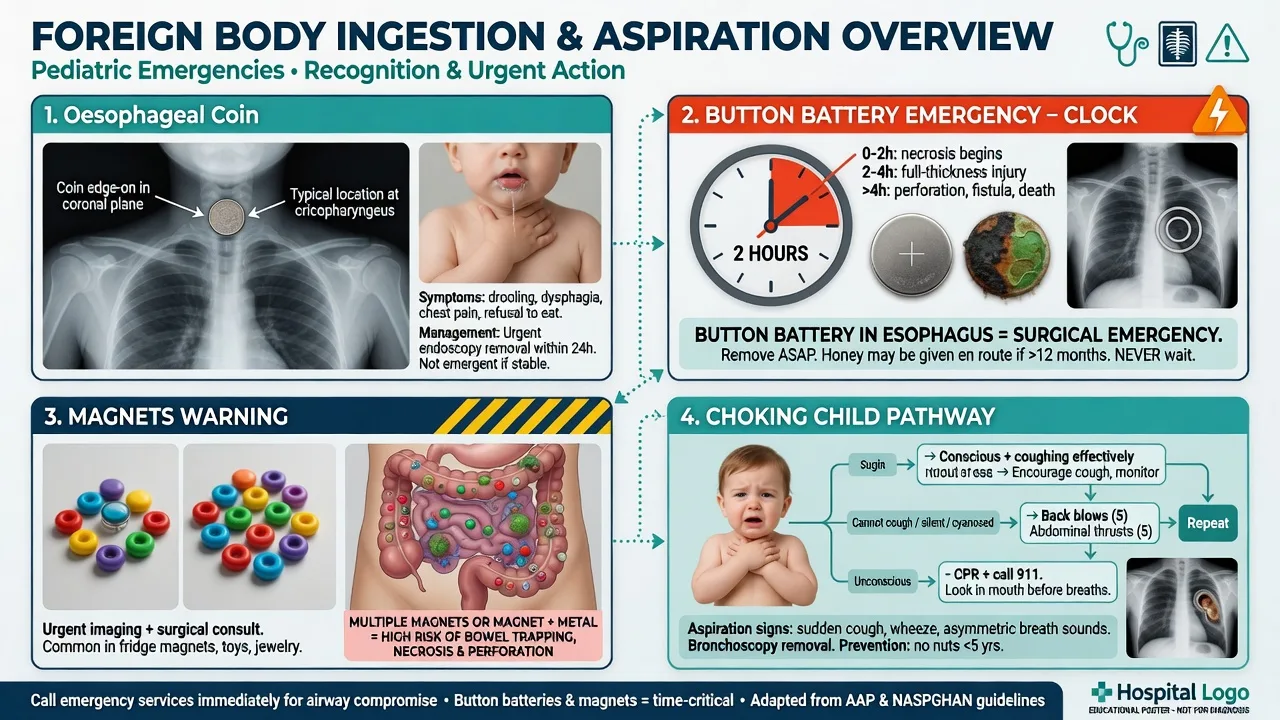
Foreign body ingestion and aspiration — the two anatomic compartments and the time-critical objects. Ingestion: coins (oesophageal impaction at the three physiological narrowings, urgent oesophagogastroduodenoscopy), button battery (an EMERGENCY — electrolysis and liquefaction necrosis of the oesophageal wall within hours, oesophagogastroduodenoscopy within 2 hours, the double-ring and halo sign on X-ray, honey and sucralfate as a bridge, aortoesophageal fistula as the lethal complication), and magnets (attraction across bowel walls with pressure necrosis, perforation and fistula — emergency removal when two or more are present). Aspiration: sudden choking, stridor, monophonic or fixed wheeze, and asymmetric air entry, distinguished from croup, epiglottitis and asthma, with back blows and chest thrusts for the choking infant (abdominal thrusts for the child over one year) and rigid bronchoscopy as the gold standard. ACEM-primary, globally tagged.
On this page & tools
Your progress
Saved locally on this device.
5 MCQs with explanations
Target exams
Red flags
Foreign body ingestion and aspiration are presentations in which a single correct early decision — recognise the object, recognise the compartment, recognise the clock — determines whether the patient is discharged the same day or dies of an aortoesophageal fistula. The framework rests on two anatomic compartments: objects that are swallowed into the gastrointestinal tract (coins, button batteries, magnets, food bolus, sharp and long objects) and objects that are inhaled into the airway (larynx, trachea, bronchi). The Fellowship candidate must separate the two, then within ingestion identify the three time-critical objects — the button battery (a liquefaction emergency measured in hours), the magnet (a perforation emergency when two or more are present), and the coin (a far more benign object whose danger is oesophageal impaction alone).[1][2]
Definition and classification — the compartment decides the pathway
A foreign body is any object not meant to be in the body. Ingestion is the passage of an object through the mouth into the oesophagus and beyond; aspiration is the passage of an object through the larynx into the tracheobronchial tree. The classification that matters clinically sorts ingested objects by risk: the coin (radiopaque, low intrinsic toxicity, dangerous only if impacted in the oesophagus), the button or disc battery (radiopaque, actively tissue-destructive, dangerous wherever it lodges), the magnet (radiopaque, dangerous when two or more attract across bowel walls), and the sharp, long or food bolus objects (radiolucent or radiopaque, dangerous by mechanical trauma or by revealing underlying oesophageal pathology). The high-risk object that an examiner will test most is the button battery.[1]
Epidemiology and risk
Foreign body ingestion is overwhelmingly a disease of young children — the peak incidence is between six months and three years, the age of oral exploration — but it spans every age. Button battery ingestion clusters between one and six years, the ages at which the 20 mm lithium coin cell (the size of the older child's oesophagus) is most likely to lodge and cause the worst injury. Aspiration is the classic toddler event, classically during eating or play, but occurs at any age.[2][6] In adults the risk groups are the edentulous elderly, the alcohol-intoxicated, those with intellectual or developmental disability, psychiatric patients, and the deliberate body-packer who swallows drug-filled packets for concealment. Coins remain the commonest ingested object in children; the prospective Insert-Coin cohort confirmed that most pass spontaneously and that complications are dominated by oesophageal impaction.[7]
Pathophysiology — why the button battery is an emergency, and why two magnets perforate
The button battery is uniquely destructive because it does not simply obstruct — it dissolves the tissue. Once a lithium coin cell lodges against the oesophageal mucosa, its negative pole contacts the tissue and an electrolytic current generates local hydroxide at the negative pole, producing a liquefaction necrosis that begins within hours and progresses to full-thickness injury. The injury is compounded by pressure necrosis from the disc itself and by leakage of the alkaline electrolyte. The lethal consequence is the aortoesophageal fistula, in which the necrosis erodes into the descending aorta and produces a massive, fatal haemorrhage — often heralded days after removal by a small "sentinel" haematemesis. This time-dependence is the entire reason an oesophageal battery mandates oesophagogastroduodenoscopy within 2 hours, not the next available endoscopy list.[2][3]
Magnets injure by a different mechanism. Two or more magnets — or a magnet and a ferrometallic object — ingested separately can attract each other across the walls of adjacent bowel loops, trapping the intervening mucosa and producing pressure necrosis, perforation, fistula, volvulus and obstruction. A single magnet in the stomach of an asymptomatic child is watched; two magnets anywhere in the gastrointestinal tract are removed urgently before they have time to approximate and pinch.[5]
[1]An aspirated foreign body injures by ball-valve obstruction: the object permits inspiratory air entry past it but blocks expiratory exit, producing localised air-trapping and hyperinflation (a partial obstruction), or complete collapse and atelectasis (a complete obstruction). A laryngeal or tracheal object obstructs the whole airway and presents as choking and stridor. The delayed presentation is the trap: a child who inhaled a peanut days ago now has lobar collapse, recurrent pneumonia or a lung abscess on one side.[6]
Clinical presentation — and the silent trap
Most ingested foreign bodies are asymptomatic and the history is the diagnosis — a parent who saw the child swallow the object. Symptoms of oesophageal impaction are drooling, dysphagia, refusal of feeds, retrosternal or neck pain, vomiting and choking with feeds; a child who cannot swallow secretions has a complete oesophageal obstruction. Stomach and distal objects are usually asymptomatic. Abdominal pain, distension, fever or peritonism are red flags for magnet-related perforation or, rarely, oesophageal perforation from a battery. [1]
The aspirated foreign body presents along a spectrum. The classic is the sudden choking, coughing or gagging episode in a toddler, followed by one of three patterns: persistent cough, stridor (a laryngeal or tracheal object), or a monophonic, fixed wheeze with asymmetrically reduced air entry (a bronchial object). The dangerous variant is the silent aspiration: the choking episode was unwitnessed or forgotten, and the child presents days later with persistent unilateral findings. A high index of suspicion — for any new monophonic wheeze, any unexplained lobar collapse or recurrent unilateral pneumonia, and any child with a sudden cough while eating — is the single most important diagnostic tool.[6]
Differential diagnosis — the mimics, distinguished
The differential is built around the presenting symptom and the compartment. [1]
Foreign body aspiration
- Toddler, SUDDEN choking while eating or playing
- Asymmetric air entry, monophonic/fixed wheeze, or stridor
- Inspiratory–expiratory CXR: lobar air-trapping or atelectasis
- Rigid bronchoscopy is diagnostic AND therapeutic — do not delay
Croup
- 6 mo to 6 yr, viral, barking cough, inspiratory stridor
- Low fever, NON-toxic, gradual onset over days
- Bilateral and symmetrical signs; responds to dexamethasone
- Dexamethasone 0.15 mg/kg orally; nebulised adrenaline if moderate
Epiglottitis
- Toxic, rapid, drooling, tripod posture, high fever
- Soft stridor, NO cough; post-Hib vaccine, now rare
- DO NOT agitate — call anaesthetist + ENT for theatre airway
- Ceftriaxone 50 to 75 mg/kg IV after airway secured
Acute asthma
- Over 1 yr, recurrent, atopy, viral trigger
- Bilateral polyphonic expiratory wheeze, prolonged expiration
- Responds to bronchodilator; symmetric
- Salbutamol 2.5 to 5 mg neb + ipratropium + steroid
GORD / eosinophilic oesophagitis
- Recurrent food impaction in older child or adult
- No acute choking; chronic dysphagia, atopy
- Distinguished by recurrent pattern and endoscopy
- Food bolus in an adult = suspect underlying oesophageal pathology
Perforated viscus (magnet)
- Abdo pain, peritonism, fever after magnet ingestion
- Free gas under diaphragm on erect CXR
- Surgical emergency — laparotomy
- Two magnets attracting across bowel loops
A monophonic wheeze is foreign body until proven otherwise; a polyphonic expiratory wheeze that is bilateral and responds to bronchodilator is asthma. Stridor in a toxic child with no cough and high fever is epiglottitis. Recurrent food bolus impaction in an older child or adult raises eosinophilic oesophagitis or a peptic stricture.[6]
Bedside assessment
Begin with the airway and the work of breathing, and for the suspected aspirated foreign body keep the child calm and on the carer's lap — agitation worsens obstruction and can convert a partial into a complete blockage. Assess for drooling, stridor, wheeze, and asymmetric air entry, and estimate the weight before any drug. For the ingested foreign body, examine the oropharynx for a visible object (but never perform a blind sweep), assess for oesophageal obstruction (drooling, inability to swallow secretions), and examine the abdomen for peritonism. The single most important bedside question is what was swallowed, how many, and when — and, for any disc on a radiograph, to interrogate it as a possible battery rather than a coin.[1]
Investigations — radiographs, and the signs that distinguish a battery from a coin
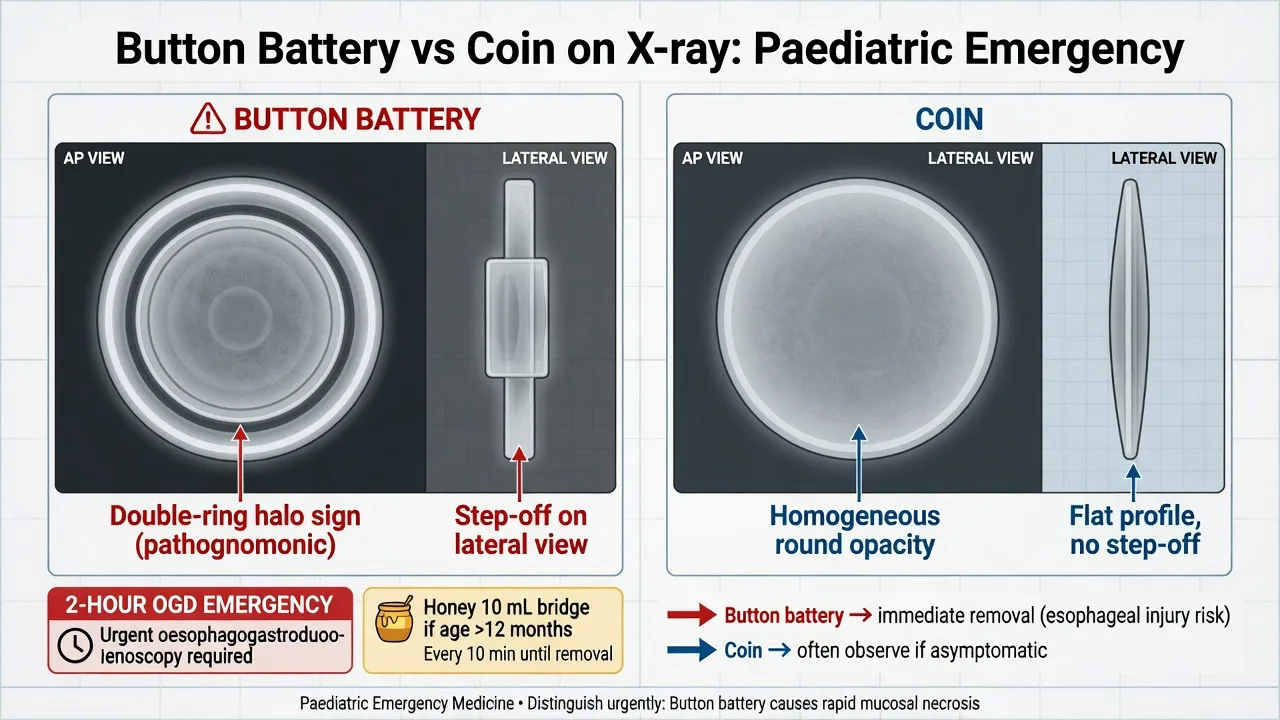
Plain radiographs are the workhorse. For a suspected ingested foreign body obtain anteroposterior and lateral views of the neck, chest and abdomen to locate a radiopaque object along the gastrointestinal tract. Coins lie in the coronal plane and show a circular disc on the anteroposterior view; a button battery in the oesophagus shows the double-ring or halo sign on the anteroposterior view (the two poles of the battery) and a step-off or narrowing on the lateral view — the discriminating signs that prevent the dangerous error of treating a battery as a coin. The three physiological narrowings of the oesophagus — the cricopharyngeus (upper oesophageal sphincter), the aortic crossover, and the diaphragmatic hiatus — are the sites where coins and batteries lodge.[2][4]
For suspected aspiration obtain inspiratory and expiratory chest radiographs: a ball-valve bronchial object produces asymmetric hyperinflation (air-trapping) on the expiratory film, the obstructed lung failing to deflate. In a young child who cannot cooperate with an expiratory film, use right and left lateral decubitus films or fluorosscopy to demonstrate differential deflation. Radiographs are normal in a substantial minority of aspirated foreign bodies, because many organic objects (peanuts, other nuts, plastic) are radiolucent — a convincing history mandates bronchoscopy regardless of a normal film. A handheld metal detector localises coins in children with reasonable accuracy and reduces radiation, but cannot substitute for a film when a battery is possible. Computed tomography is reserved for suspected perforation, fistula (battery), or an unlocated object, and contrast swallow for a suspected radiolucent oesophageal object. Investigations must not delay definitive airway intervention in the obstructed child.[1][6]
[1]Immediate management — the choking algorithm
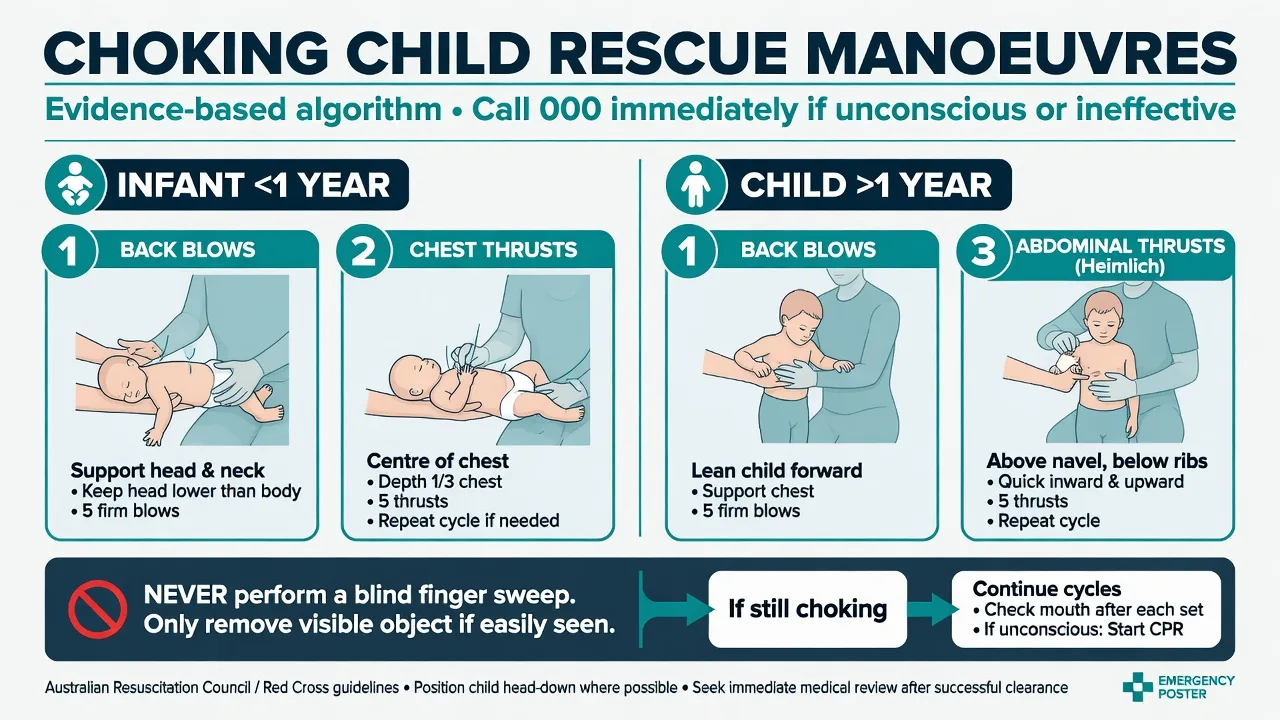
For the patient who is choking and conscious, the manoeuvre depends on age. Give an infant under one year up to five back blows between the scapulae with the infant held head-down along the forearm, alternating with up to five chest thrusts using two fingers on the lower sternum — never abdominal thrusts in an infant, whose abdominal organs are unprotected. Give a child over one year or an adult up to five back blows, alternating with up to five abdominal thrusts (the Heimlich manoeuvre) using a fist above the umbilicus. Reassess between each set; if the object is not dislodged and the patient becomes unconscious, begin cardiopulmonary resuscitation and look in the mouth before each breath, removing an object only if it is directly visible.[8]
[1]For the patient with an aspirated foreign body who is stable, give humidified oxygen, keep the child calm, keep the child nil by mouth, summon the paediatric anaesthetist and the ear-nose-throat surgeon, and arrange rigid bronchoscopy. If the child with an aspirated foreign body is in severe distress with an obstructed airway, nebulised adrenaline 1:1000 in 5 mL may reduce mucosal oedema enough to temporise, but the definitive step is the airway. Do not send an unstable child to the radiology department. [1]
Definitive management of the ingested foreign body — by object
The management is decided by the object, its location, and the time since ingestion.[1][4]
Coins. A coin in the oesophagus, whether symptomatic or not, is removed by oesophagogastroduodenoscopy — urgent if the child is symptomatic with drooling or inability to swallow secretions, otherwise within 24 hours. A coin in the stomach of an asymptomatic child is managed expectantly: most pass spontaneously, and the NASPGHAN guideline permits observation at home with a repeat radiograph and a safety-net in 1 to 2 weeks, retrieving it endoscopically only if it fails to progress over two to four weeks or if symptoms develop.[1]
Button battery — the 2-hour emergency. An oesophageal button battery is one of the few true endoscopic emergencies. It is removed by oesophagogastroduodenoscopy within 2 hours of presentation, because liquefaction necrosis is already underway. While the endoscopy team is assembled, give a tissue-protective bridge where appropriate: honey 10 mL by mouth every 10 minutes, up to six doses, in a child over 12 months and within 12 hours of ingestion, and sucralfate 10 mL of the 1 g per 10 mL suspension, can neutralise the local pH and limit necrosis — they are a bridge, not a substitute for emergent removal. A battery in the stomach of an asymptomatic child can be observed if the ingestion was recent (within 6 hours); if it remains in the stomach beyond 24 hours, or if the child is symptomatic or younger than five years, retrieve it endoscopically. After any oesophageal battery removal, admit for observation because aortoesophageal and tracheoesophageal fistulae can declare themselves days after removal, and treat or refer for the long-term sequelae of stricture.[2][3][9]
[1]Magnets. A single magnet in the stomach of an asymptomatic child can be observed with serial radiographs and a safety-net. Two or more magnets, or a magnet with a metal object, anywhere in the gastrointestinal tract is an emergency even when the child is asymptomatic — remove them urgently by endoscopy if within endoscopic reach or by surgery if they have passed the duodenum, before they attract across bowel walls and perforate. The systematic review evidence confirms that delay is the modifiable risk factor for the worst outcomes.[5]
Sharp, long and food-bolus objects. Sharp objects (pins, toothpicks, fish bones) in the oesophagus are removed urgently; in the stomach they are retrieved endoscopically because of the perforation risk. Objects longer than 6 cm, and batteries 20 mm or larger, are less likely to pass and are retrieved if within reach. A food bolus in an adult that does not pass is removed endoscopically, and its presence mandates a search for underlying oesophageal pathology — a peptic or eosinophilic stricture — because a food bolus in a normal-calibre oesophagus is rare. [1]
Definitive management of the aspirated foreign body — rigid bronchoscopy
Rigid bronchoscopy under general anaesthetic is the gold standard for the diagnosis and removal of an inhaled foreign body in a child, performed jointly by the anaesthetist and the ear-nose-throat surgeon. The rigid scope secures the airway, permits ventilation through the scope, and allows the use of rigid grasping forceps on a solid object in a small airway — none of which the flexible bronchoscope reliably offers in a toddler. A flexible bronchoscopy may be diagnostic in the older, cooperative adult, but a suspected paediatric aspiration is referred directly for rigid bronchoscopy even when the child looks well and the radiograph is normal. Do not delay the procedure for imaging in the obstructed child.[6]
Complications and pitfalls
The complications follow the object. The button battery causes oesophageal perforation, mediastinitis, stricture, vocal-cord paralysis from recurrent-laryngeal-nerve injury, tracheoesophageal fistula and aortoesophageal fistula — the last often fatal and sometimes presenting as a sentinel haematemesis days after an apparently successful removal. Two magnets cause bowel perforation, peritonitis, short-bowel syndrome after resection, fistula and volvulus. An aspirated foreign body causes atelectasis, post-obstructive pneumonia, lung abscess, bronchiectasis and pneumothorax. The pitfalls are the inverse of the framework: mistaking a button battery for a coin on the radiograph; sending an oesophageal battery for the next available list instead of within 2 hours; missing the presence of a second magnet; treating a delayed aspiration as community-acquired pneumonia; performing a blind finger sweep; and sending an obstructed child to radiology. The examinee who recognises the double-ring sign, who times the battery in hours, and who refers the asymptomatic two-magnet child for removal will answer every question the examiner sets.[2][5][6]
Prognosis and disposition
Most coins in the stomach pass spontaneously and the child is discharged with a repeat-film and safety-net plan. An oesophageal battery is admitted after removal to a monitored bed and watched — often for several days and with interval imaging — for a delayed fistula, because the necrosis can continue to progress after the battery is gone. A two-magnet ingestion that has been removed is observed for signs of perforation. A child after rigid bronchoscopy for an aspirated foreign body is observed for laryngeal oedema and post-obstructive infection and discharged once feeding is tolerated. A deliberate body-packer is admitted for observation and surgical or endoscopic retrieval, never discharged with packets retained. [1]
Special populations
The toddler is the index patient for both ingestion and aspiration. The child with developmental or intellectual disability may swallow or inhale objects repeatedly and may not give a clear history. The edentulous or intoxicated adult aspirates more readily. The psychiatric patient may ingest objects deliberately and repeatedly. The body-packer who swallows drug packets risks acute, lethal packet rupture and is managed jointly with toxicology and surgery. Pregnancy does not change the indications for endoscopic or bronchoscopic removal — the time-critical object is still time-critical — but involves the obstetric team and a modified technique. [1]
Evidence and regional guidelines
The contemporary evidence base is convergent and guideline-driven. The NASPGHAN Endoscopy Committee clinical report (Kramer 2015) sets the standard for the management of ingested foreign bodies in children.[1] The Litovitz analysis established the severity and the time-course of button battery injury, and the button battery task force update (Jatana 2013) and the ESPGHAN position paper (Mubarak 2021) consolidated the emergency-timing and the tissue-protective bridge therapy.[2][3][4] The systematic review of paediatric magnet ingestion (Nezhentsev 2026) quantifies the risk of multiple magnets and the cost of delay.[5] The rigid-bronchoscopy standard for aspirated foreign bodies is reaffirmed by the contemporary Breathe review (Cole 2026),[6] and the choking-rescue evidence is appraised in the Bieliński review.[8] Regional practice follows NASPGHAN and ESPGHAN in the Americas and Europe, the National Capital Poison Center battery algorithm and its emergency-timing hotline, and the local paediatric retrieval pathways in Australia and New Zealand for the rural or remote child who has swallowed a battery or a magnet.
ANZ practice note. Australasian emergency practice follows the NASPGHAN and ESPGHAN ingest guidance for object-specific and time-specific management, with the early involvement of paediatric gastroenterology, anaesthetics and ear-nose-throat for the oesophageal battery (within 2 hours), the two-magnet ingestion, and the suspected aspirated foreign body. Rural and remote presentations are escalated early to paediatric retrieval, because the time to definitive endoscopy or rigid bronchoscopy governs outcome; a child who has swallowed a button battery in a remote centre is retrieved as an emergency, not deferred. Weight-based dosing with a Broselow tape or the age formula defends against the dosing error in any resuscitation. [1]
Exam practice
SAQ — Oesophageal button battery in a three-year-old
10 minutes · 10 marks
A three-year-old boy is brought to your emergency department two hours after his parents found him playing with a remote control whose battery compartment was open. He is drooling, refuses to drink, points to his lower neck and has had one small episode of coffee-ground vomitus. He is alert, HR 124, RR 28, SpO2 97 per cent on room air, with no stridor or wheeze. A plain anteroposterior and lateral radiograph of the chest shows a 20 mm disc lodged at the aortic crossover with a circumferential rim and central area on the AP view and a clear step-off on the lateral view.
SAQ — Suspected airway foreign body in a toddler
10 minutes · 10 marks
A two-year-old girl is brought to your emergency department thirty minutes after a sudden choking and coughing episode while eating peanuts at a family barbecue. She coughed vigorously, then settled, and is now alert and playing on her mother\'s lap with an SaO2 of 96 per cent on room air. On examination she has reduced air entry and a fixed monophonic wheeze over the right lower zone, with the rest of the examination unremarkable. She is haemodynamically stable.
Exam pearls
- A button battery in the oesophagus is a 2-hour emergency — oesophagogastroduodenoscopy now, honey 10 mL ×6 (over 12 months, within 12 h) and sucralfate as a bridge, then admit and watch for a delayed aortoesophageal fistula.
- Battery or coin? Look for the double-ring or halo sign on the anteroposterior view and the step-off on the lateral view — treat any disc as a battery until proven otherwise.
- Two magnets, or a magnet plus metal, anywhere = emergency removal, even in the asymptomatic child, before they attract across bowel walls and perforate.
- Ingested coins: oesophageal → oesophagogastroduodenoscopy; stomach, asymptomatic → observe and most pass spontaneously.
- Aspirated foreign body = rigid bronchoscopy under general anaesthetic by anaesthetics and ear-nose-throat — refer even when the child looks well and the radiograph is normal.
- Choking: infant under 1 yr → 5 back blows + 5 chest thrusts (never abdominal thrusts); child over 1 yr or adult → 5 back blows + 5 abdominal thrusts; unconscious → CPR, look before each breath. Never a blind finger sweep.
- Monophonic or fixed wheeze = foreign body until proven otherwise; polyphonic bilateral wheeze that responds to bronchodilator is asthma. [1]
Red flags
[1]References
- [1]Kramer RE, Lerner DG, Lin T, et al. Management of ingested foreign bodies in children: a clinical report of the NASPGHAN Endoscopy Committee J Pediatr Gastroenterol Nutr, 2015.PMID 25611037
- [2]Litovitz T, Whitaker N, Clark L, White NC, Marsolek M. Emerging battery-ingestion hazard: clinical implications Pediatrics, 2010.PMID 20498173
- [3]Jatana KR, Litovitz T, Reilly JS, Koltai PJ, Rider G, Jacobs IN. Pediatric button battery injuries: 2013 task force update Int J Pediatr Otorhinolaryngol, 2013.PMID 23896385
- [4]Mubarak A, Benninga MA, Broekaert I, et al. Diagnosis, Management, and Prevention of Button Battery Ingestion in Childhood: A European Society for Paediatric Gastroenterology Hepatology and Nutrition Position Paper J Pediatr Gastroenterol Nutr, 2021.PMID 33555169
- [5]Nezhentsev A, Rautiainen M, Lähdesmäki A, et al. Diagnosis and management of paediatric magnet ingestion: a systematic review of clinical practice guidelines Emerg Med J, 2026.PMID 41381185
- [6]Cole S, Prowse S, Speggiorin S, et al. Rigid bronchoscopy is the gold standard management of inhaled foreign bodies in children: myth or maxim? Breathe (Sheff), 2026.PMID 42344147
- [7]Quitadamo P, Zenzeri L, Giannetti E, et al. Insert-Coin: A Prospective Study of Coin Ingestion in Children of Southern Italy Am J Gastroenterol, 2024.PMID 39787368
- [8]Bieliński JR, Braszak-Cymerman A, Lewandowicz A, Timler D. Do We Actually Help Choking Children? The Quality of Evidence on the Effectiveness and Safety of First Aid Rescue Manoeuvres: A Narrative Review Medicina (Kaunas), 2024.PMID 39597012
- [9]Hoagland MA, Hauswald M, Braun JE, Janz TG, Farnon SS. Anesthetic Implications of the New Guidelines for Button Battery Ingestion in Children Anesth Analg, 2020.PMID 30829672