EM · Toxicology and environmental emergencies
Opioid poisoning and the opioid toxidrome (emergency department diagnosis and management)
Also known as Opioid overdose · Opiate toxicity · Heroin overdose · Naloxone-reversible coma · Fentanyl overdose
Opioid poisoning — the classic toxidrome of central nervous system depression, pin-point pupils (miosis) and respiratory depression (a reduced respiratory rate AND depth), caused by heroin, morphine, oxycodone, fentanyl, methadone and tramadol through mu-receptor agonism at the medullary respiratory centre. The management is airway, oxygen and titrated naloxone 400 micrograms intravenously every two to three minutes to adequate ventilation (NOT to full consciousness), naloxone 800 micrograms intramuscularly when intravenous access is absent, and a naloxone infusion at two-thirds of the effective bolus per hour for the long-acting opioids such as methadone. The differential is the pontine haemorrhage and the clonidine (alpha-2 agonist) overdose; tramadol adds seizures and serotonin syndrome. ACEM-primary, globally tagged.
On this page & tools
Your progress
Saved locally on this device.
8 MCQs with explanations
Target exams
Red flags
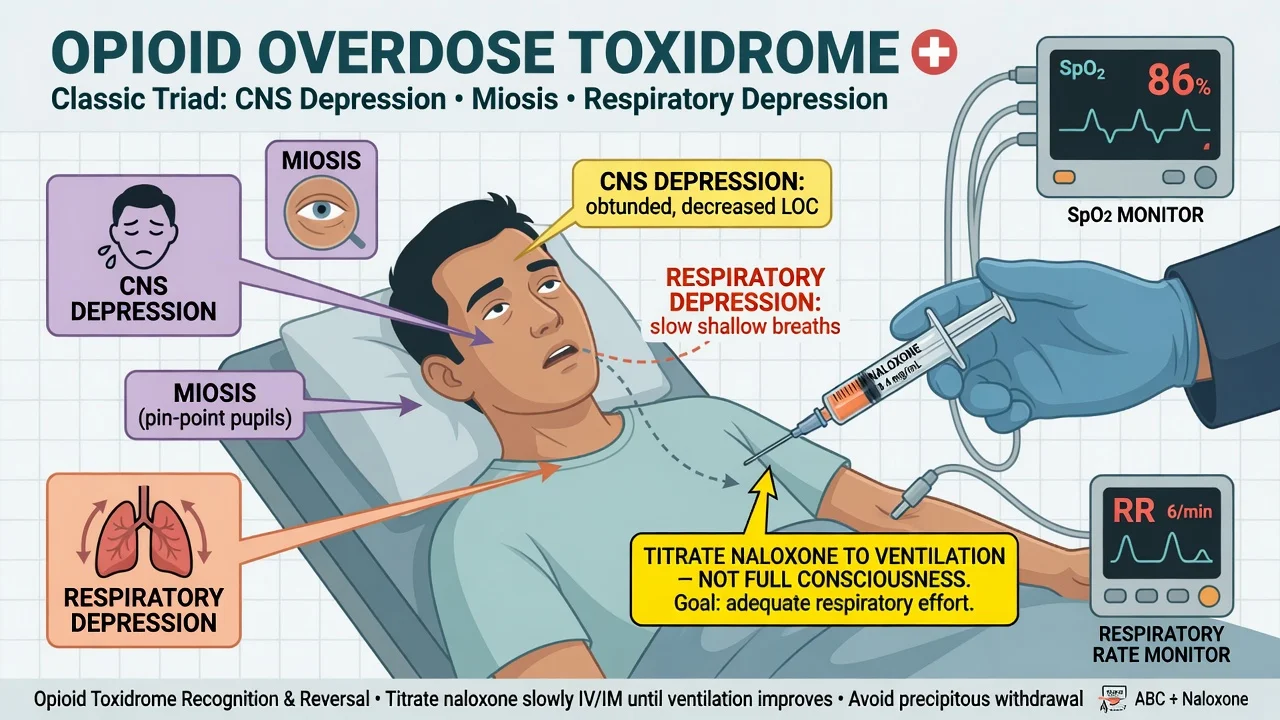
Opioid poisoning is the archetype of the receptor-mediated toxidrome: a patient who is obtunded, with pin-point pupils and a slow, shallow breathing pattern, is opioid-toxic until proven otherwise, and the reversible cause is naloxone. The Fellowship candidate must recognise the triad, titrate naloxone to adequate ventilation rather than to full consciousness, and never be caught by the long half-life of methadone or the serotonergic and pro-convulsant profile of tramadol. The danger is hypoxia from respiratory depression, and the danger of the antidote is precipitating acute withdrawal or a catecholamine surge. The candidate who empties a large naloxone bolus and walks away has failed both the patient and the topic.[1][2]
Definition and classification
An opioid is any compound, natural or synthetic, that produces its characteristic effects by agonism at the mu-opioid receptor. The opioid toxidrome is the predictable clinical syndrome of that agonism: central nervous system depression, miosis (pin-point pupils) and respiratory depression, with hypotension, hypothermia and reduced gastrointestinal motility as supporting features. The class spans the natural opium alkaloids (morphine, codeine), the semisynthetics derived from them (heroin or diamorphine, oxycodone, hydrocodone, buprenorphine), and the fully synthetic agents (fentanyl, pethidine or meperidine, methadone, tramadol, propoxyphene). The distinction that matters at the bedside is duration of action: the short-acting agents (heroin, morphine, fentanyl, most immediate-release oxycodone) re-narcotise only briefly after a naloxone bolus, whereas the long-acting agents (methadone, sustained-release oxycodone, the fentanyl patch) store drug in a deep compartment and re-sedate the patient hours later. Tramadol and pethidine stand apart because they are serotonergic and pro-convulsant as well as opioid, and buprenorphine is a partial agonist that complicates naloxone reversal. [1]
Epidemiology and risk factors
Opioid overdose is a leading cause of accidental and drug-related death globally, driven by prescription opioid exposure and, increasingly, by illicit fentanyl and its analogues. The risk of fatal poisoning is concentrated in three groups: the opioid-naive patient given a therapeutic dose (the postoperative patient, the elderly patient started on oxycodone, the child who finds a tablet), the opioid-tolerant patient whose supply changes (loss of tolerance after a period of abstinence — prison release, supervised detoxification, hospital discharge), and the long-acting or sustained-release user (methadone maintenance, the fentanyl patch, sustained-release morphine) in whom accumulation and delayed peak produce toxicity many hours after ingestion. Fentanyl has transformed the epidemiology because it is cheap, potent (approximately 100 times morphine by weight) and rapidly fatal: respiratory arrest can occur within minutes of exposure, and a proportion of overdose deaths now involve a fentanyl analogue the user never knew they had taken. Co-ingestion of alcohol, benzodiazepines or gabapentinoids multiplies the respiratory depressant effect and is present in a large fraction of fatal cases. Reduced tolerance and polysubstance use, not dose escalation alone, are the recurrent themes.[1]
Pathophysiology
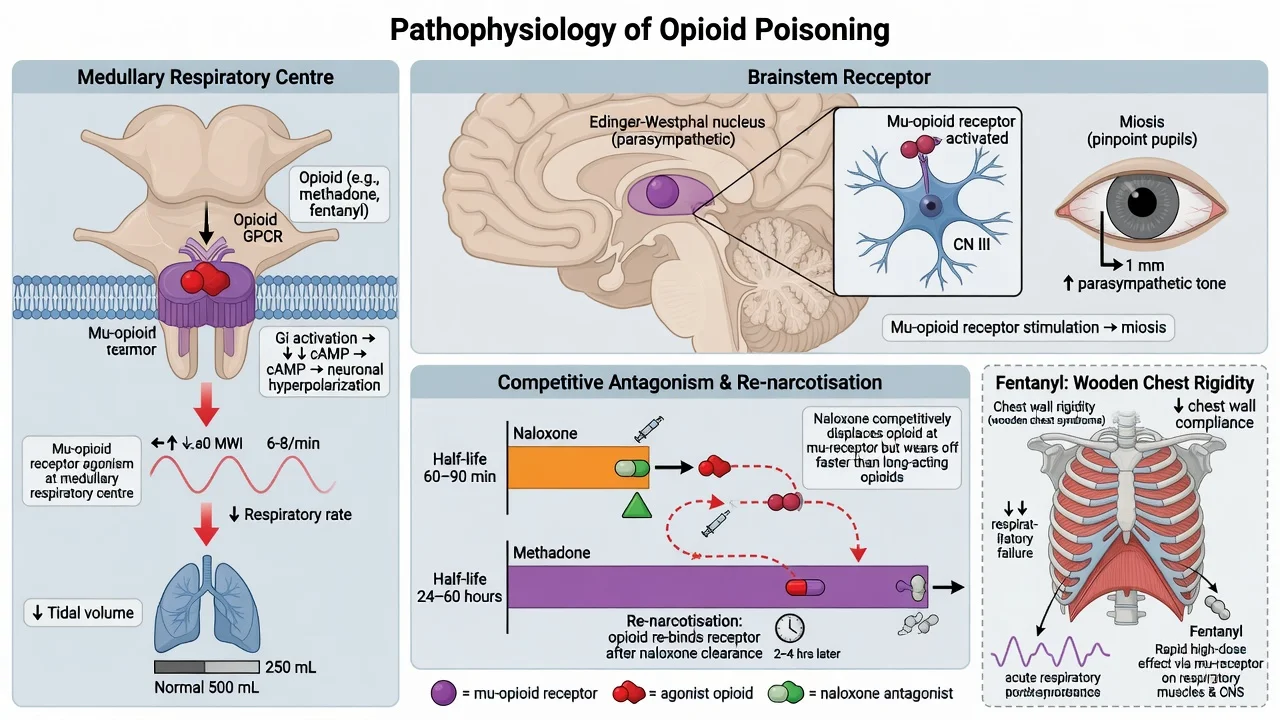
Opioid toxicity is generated by agonism at the mu-opioid receptor, and the candidate must trace each clinical feature to the receptor and the site. Mu-receptor agonism in the ventrolateral medulla and the pre-Bötzinger complex — the brainstem respiratory pattern generator — abolishes the central chemoreceptor response to hypercapnia and blunts the peripheral response to hypoxia. The result is the lethal feature of the toxidrome: respiratory depression that falls on both the rate and the depth of breathing, so tidal volume and minute ventilation collapse together and the patient becomes hypoxaemic and hypercapnic. Mu-receptor activity in the Edinger-Westphal nucleus of the midbrain produces miosis by parasympathetic stimulation of the sphincter pupillae, giving the pin-point pupil (one to two millimetres) that is the signature of the syndrome; miosis is bilateral and reactive in pure opioid toxicity. Agonism at the locus coeruleus and the thalamus produces sedation and analgesia that deepen to coma, and at the nucleus tractus solitarius it produces bradycardia and hypotension through vagal tone. Histamine release from mast cells, particularly with morphine and meperidine, adds urticaria, bronchospasm and hypotension that are pharmacological rather than IgE-mediated, which is why true anaphylaxis to an opioid is rare but opioid-related flushing and wheeze are common.[2]
[1]Clinical presentation
The opioid toxidrome is a triad, and the candidate must name all three components and their physiology. Central nervous system depression ranges from mild drowsiness and slurred speech through to deep coma; the Glasgow Coma Scale may be as low as 3 in the apnoeic patient. Miosis is the pin-point pupil of one to two millimetres, bilateral and reactive, and is present in the overwhelming majority of pure opioid overdoses — its absence should prompt a search for a co-ingestant, a mixed toxidrome or a structural lesion, though severe hypoxia or a fentanyl analogue may occasionally spare the pupils. Respiratory depression is the killing feature: both the rate (commonly four to eight per minute) and the depth (small tidal volumes) fall, the oxygen saturation drops, and the capnography shows a rising end-tidal carbon dioxide. The breathing pattern is slow and shallow, and the patient may be cyanosed and hypothermic. Supporting features are hypotension from vasodilatation and bradycardia, hypothermia, hyporeflexia, reduced bowel sounds and a palpably soft abdomen from reduced gut motility. Needle tracks, a fentanyl patch on the skin or tablet bottles in the belongings are circumstantial but decisive. [1]
The opioid toxidrome at the bedside
OPIOID
Sedation and coma from locus coeruleus and thalamic mu-receptor agonism; GCS may be 3 in the apnoeic patient
Miosis of one to two millimetres from Edinger-Westphal parasympathetic outflow; bilateral and reactive
Reduced respiratory rate AND depth from brainstem respiratory-centre depression; the lethal feature
Hypoxaemia with a rising carbon dioxide; cyanosis in the late presentation
Reduced bowel sounds and a soft abdomen from gut mu-receptor agonism
Hyporeflexia, hypothermia and hypotension complete the picture; bradycardia from vagal tone
The syndrome is modified by the agent. Fentanyl may produce chest-wall rigidity (wooden chest syndrome) that makes ventilation difficult even before naloxone is given, and its onset is within minutes. Methadone produces a prolonged coma with QT prolongation and torsades risk on the ECG. Tramadol and pethidine add a tremulous, agitated, clonus-positive serotonergic picture and a seizure risk that naloxone does not abolish. Buprenorphine, a partial agonist with high receptor affinity, may require higher cumulative naloxone doses to reverse.[2]
Differential diagnosis
The differential of the opioid toxidrome splits into two questions: what else causes a coma with miosis, and what else causes respiratory depression with a reduced conscious level. The pin-point pupil narrows the field dramatically — only a handful of conditions reproduce it. [1]
Opioid overdose
- Coma + pin-point pupils + reduced rate and depth of breathing
- Needle tracks, fentanyl patch, opioid tablets; history from paramedics
- Rapid and complete response to titrated naloxone
- Heroin, morphine, oxycodone, fentanyl, methadone, tramadol, codeine
Clonidine / alpha-2 agonist
- Miosis, coma, bradycardia, hypotension and respiratory depression — mimics opioid toxicity closely
- Partial or transient response to naloxone; children on clonidine, guanfacine, brimonidine eye drops
- Symmetrical and bradycardic; may need supportive care and an infusion
- Consider in the child or the hypertensive on clonidine therapy
Pontine haemorrhage
- Pin-point pupils, coma and abnormal respiratory pattern from a structural brainstem lesion
- No response to naloxone; often a sudden headache, hypertension or a Cushing response
- CT head shows the haemorrhage; check glucose and image if atypical or unresponsive
- A "fixed pupil" lesion — the naloxone non-responder with miosis
Organophosphate / cholinergic
- Miosis with the SLUDGE picture: salivation, lacrimation, urination, defecation, sweating and bradycardia
- Fasciculations, bronchorrhoea and a wet lung — opposite of the dry opioid picture
- Atropine and pralidoxime; history of pesticide or agricultural exposure
- Pupils small but the patient is wet and fasciculating
Mixed sedative / hypnotic
- Coma and respiratory depression without miosis — benzodiazepine, alcohol, barbiturate, gabapentinoid
- Pupils normal or mid-position; co-ingestion with the opioid is the rule
- Flumazenil avoided in the mixed or unknown overdose; supportive airway care
- Send paracetamol, salicylate and ethanol levels on every overdose
A practical rule: the patient who fails to respond to an adequate dose of naloxone (1.2 to 2 milligrams intravenously) either does not have a pure opioid overdose, has a co-ingestant or a structural lesion, or has taken a long-acting agent that has not yet fully reversed. Check a glucose, re-examine the pupils for asymmetry, and image if the picture is atypical. [1]
The toxidrome approach to the unknown overdose
When the agent is unknown, the Fellowship candidate abandons the agent-led search and works from the toxidrome — the cluster of vital signs, pupil size, secretions, bowel sounds and skin that fingerprints a receptor class. The unknown-overdose patient who is comatose with a reduced respiratory rate is managed by the same ABCDE pathway as the opioid overdose, but the diagnostic engine is the toxidrome, and the pupil is the single most discriminating sign. Miosis narrows the field to the opioid, the alpha-2 agonist (clonidine), the pontine lesion and the cholinergic syndrome; mydriasis points to the sympathomimetic (amphetamines, cocaine) or the anticholinergic (antihistamines, tricyclics, atropine); a mid-position or normal pupil points to the sedative-hypnotic group (benzodiazepine, alcohol, barbiturate, gabapentinoid). The candidate runs the four classical toxidromes in parallel and treats the one the bedside matches, never waiting for a drug level.[5]
The unknown-coma overdose — a toxidrome-led algorithm
Resuscitate first — the airway is the priority
Suction, left lateral position, high-flow oxygen; protect the airway before any antidote. Obtain IV access; attach pulse oximetry, continuous capnography and cardiac monitoring.
Bedside glucose on every comatose patient
Hypoglycaemia is the great mimic and is rapidly reversible — give 50 mL of 50% dextrose (or 5 mL/kg of 10% in a child) if low. Thiamine 100 to 250 mg IV is given to the alcoholic or malnourished patient before or with glucose.
Read the pupils
Miosis (1 to 2 mm) = opioid, clonidine, pontine lesion, cholinergic. Mydriasis (dilated, 6 to 8 mm) = sympathomimetic or anticholinergic. Mid-position / normal = sedative-hypnotic. An asymmetric or unreactive pupil is a structural lesion until proven otherwise — image it.
Read the vital signs and the bedside cluster
Vital signs, secretions, bowel sounds and skin complete the toxidrome: dry and tachycardic = anticholinergic; wet and bradycardic = cholinergic; hyperthermic and hypertensive = sympathomimetic; bradypnoeic and hypotensive with miosis = opioid.
Administer the empirical diagnostic antidote — titrated naloxone
If miosis and respiratory depression are present, give naloxone 400 mcg IV (40 to 100 mcg if opioid-tolerant), repeated every 2 to 3 minutes. A rapid, complete response confirms the opioid toxidrome; a partial response suggests clonidine; no response excludes a pure opioid overdose.
Send the universal panel
Paracetamol and salicylate levels, ethanol concentration, ECG (QRS width, QT), VBG and a creatine kinase on every deliberate overdose. These pick up the silent co-ingestant that changes management — above all the paracetamol level that opens the acetylcysteine window.
Image the non-responder
A patient with miosis who does not respond to an adequate naloxone dose (1.2 to 2 mg IV) has a co-ingestant, a structural brainstem lesion or a long-acting agent. Check glucose, re-examine for asymmetry, and obtain a CT head if any atypical feature is present.
The four classical toxidromes are the scaffold for the unknown overdose, and the candidate must be able to recite the vital-sign, pupil, secretion and gut pattern of each in under thirty seconds. [1]
Opioid (sedative)
- CNS depression, miosis (1 to 2 mm), reduced rate AND depth of breathing
- Bradycardia, hypotension, hypothermia, hyporeflexia, reduced bowel sounds, dry skin
- Antidote: naloxone — titrate 0.04 to 0.4 mg IV q2 to 3 min to RR > 12
- Methadone and sustained-release agents re-narcotise — start an infusion
Sympathomimetic
- Agitation, mydriasis, tachycardia, hypertension, hyperthermia, diaphoresis
- Tachypnoea but with a good tidal volume; seizures and rhabdomyolysis in severe cases
- No antidote — benzodiazepines are first-line (cooling, sedation, control of agitation)
- Agents: cocaine, amphetamines, MDMA, ephedrine, caffeine; ketoacidosis with MDMA
Anticholinergic
- Agitated delirium, mydriasis, tachycardia, hyperthermia, urinary retention, dry skin
- Memory aid: "blind as a bat, mad as a hatter, red as a beet, hot as a hare, dry as a bone"
- Antidote: physostigmine in selected pure anticholinergic toxicity (avoid in tricyclic QRS widening)
- Agents: antihistamines, atropine, tricyclics, jimsonweed; bowel sounds absent
Cholinergic
- Miosis, salivation, lacrimation, urination, defecation, sweating, bradycardia, bronchorrhoea
- SLUDGE / DUMBELS — the wet toxidrome; fasciculations and a wheeze from bronchospasm
- Antidotes: atropine (for muscarinic effects) and pralidoxime (to reactivate cholinesterase)
- Agents: organophosphates, carbamates, nerve agents; agricultural or pesticide exposure
Sedative-hypnotic
- CNS depression with normal or mid-position pupils, normal vital signs early, reduced bowel sounds
- Respiratory depression with a normal pupil pattern; co-ingestion with the opioid is the rule
- Flumazenil is AVOIDED in the mixed or unknown overdose (seizure risk in TCA-dependent users)
- Agents: benzodiazepine, alcohol, barbiturate, gabapentinoid; supportive airway care
Bedside assessment
The first assessment is resuscitative and is read in parallel with the airway. Establish airway patency — the obtunded opioid patient is at high risk of aspiration, and the left lateral position with suction protects the airway until naloxone works. Give high-flow oxygen to the cyanosed or desaturating patient, but recognise that the target is ventilation, not oxygenation alone: a patient saturated on a non-rebreather mask who is still hypercapnic and bradypnoeic needs naloxone, not more oxygen. Secure intravenous access and attach pulse oximetry, continuous capnography (the rising end-tidal carbon dioxide is the earliest objective sign of respiratory depression) and cardiac monitoring. Take the history from paramedics, family and the patient's own belongings: the agent, the route (intravenous, inhaled, transdermal, oral), the time of exposure, and any co-ingestants, with particular attention to benzodiazepines, alcohol, gabapentinoids and serotonergic drugs. The focused examination confirms miosis, the slow shallow breathing pattern, the soft silent abdomen, the needle tracks or transdermal patch, and excludes the mimic — check for asymmetry of the pupils, a focal neurological deficit or a Cushing response that points to a pontine lesion. A bedside glucose is checked immediately on every comatose patient. [1]
Investigations
Opioid poisoning is a clinical and naloxone-responsive diagnosis, and treatment is never delayed for investigation. The bedside glucose is the single mandatory point-of-care test, because hypoglycaemia is the great mimic of any coma and is rapidly reversible. A venous or arterial blood gas quantifies the hypoxaemia, the hypercapnia and the acidosis, and tracks the response to naloxone. The 12-lead ECG screens for methadone-driven QT prolongation and torsades risk, for the QRS widening of a co-ingested sodium-channel blocker (tricyclic, lamotrigine), and for the bradycardia of clonidine. A paracetamol level, a salicylate level and an ethanol concentration are sent on every deliberate self-harm overdose, because the opioid is frequently one component of a mixed ingestion. A creatine kinase screens for rhabdomyolysis in the prolonged-coma patient, and a chest radiograph identifies aspiration and the non-cardiogenic pulmonary oedema that complicates opioid and especially heroin overdose. A urine drug screen is confirmatory but rarely changes acute management; quantitative opioid levels are not useful in real time.[3][4]
The opioid toxidrome — recognition and co-ingestion panel
Immediate management and resuscitation
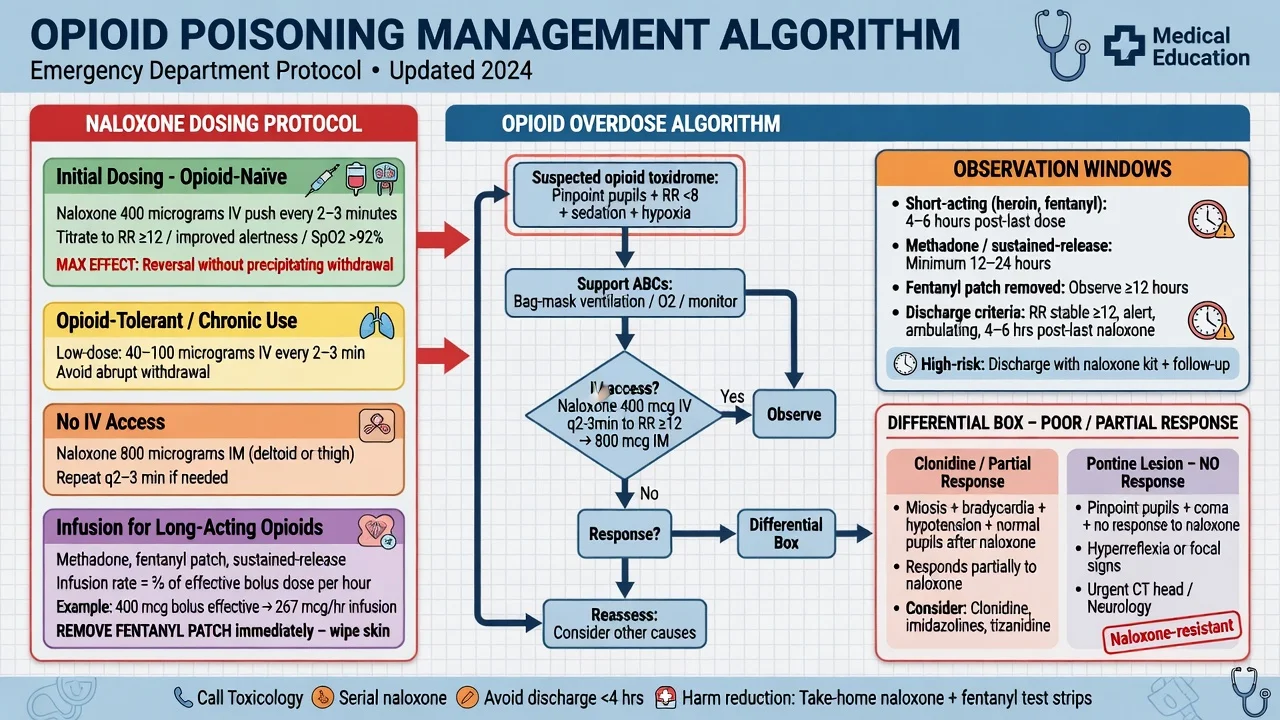
The management is airway, oxygen and titrated naloxone, and the dose philosophy is the core of the topic. Run the ABCDE: open and protect the airway (suction, head tilt, left lateral position; intubate only if ventilation cannot be maintained or naloxone fails), give high-flow oxygen to the hypoxaemic patient, and establish intravenous access. The definitive reversal is naloxone 400 micrograms intravenously, repeated every two to three minutes and titrated to an adequate respiratory rate and oxygen saturation rather than to full wakefulness. The opioid-tolerant patient who is fully reversed will be pitched into acute withdrawal, with vomiting, agitation, tachycardia and pain, and may develop non-cardiogenic pulmonary oedema from the catecholamine surge, so the endpoint is a patient who breathes at 12 to 14 per minute and oxygenates well, even if they remain drowsy.[1]
When intravenous access cannot be obtained, naloxone 800 micrograms intramuscularly (or the intranasal preparation) is the alternative, with onset in five to ten minutes and a longer duration. For the patient who re-narcotises — typically the methadone, sustained-release oxycodone or fentanyl-patch overdose — a naloxone infusion is started at two-thirds of the effective bolus dose per hour (for example, if 1.2 milligrams intravenously restored ventilation, infuse 0.8 milligrams per hour), titrated to maintain an adequate respiratory rate for at least 12 hours after the last opioid dose because methadone has a half-life of 24 to 60 hours.[3]
[1]Activated charcoal 50 grams (one gram per kilogram) is given only to the patient who is awake, protecting their airway and within one to two hours of an oral opioid — it is never prioritised over naloxone and never given to the obtunded patient without a protected airway. Whole-bowel irrigation is reserved for the body-packer or the sustained-release formulation. Hypotension responds to intravenous crystalloid and to naloxone reversal; an inotrope is rarely needed. Intubation is reserved for the patient who cannot be ventilated, who has failed an adequate naloxone trial, or who has a co-ingestant or a structural lesion requiring airway control. [1]
Model answer — first 10 minutes of a suspected heroin overdose
Airway, suction, left lateral position, high-flow oxygen; call for senior and toxicology. Continuous pulse oximetry, capnography and cardiac monitoring; two large-bore cannulae. Bedside glucose immediately; VBG for hypoxia, hypercapnia and acidosis; paracetamol, salicylate and ethanol levels; 12-lead ECG (methadone QT, co-ingestant QRS). Confirm miosis and the slow shallow breathing pattern. Naloxone 400 micrograms intravenously, repeated every 2 to 3 minutes until the respiratory rate is 12 to 14 and the saturation is adequate — do NOT push to full consciousness. If intravenous access fails, naloxone 800 micrograms intramuscularly. Reassess: if re-narcotisation occurs or methadone is the agent, start a naloxone infusion at two-thirds of the effective bolus per hour. Admit to a monitored bed; observe for at least 2 hours after short-acting agents and 12 hours or more after methadone. [1]
Naloxone pharmacology and the dosing strategy
Naloxone is a competitive mu-opioid-receptor antagonist with a rapid onset (one to two minutes intravenously), a short half-life of 60 to 90 minutes, and a duration of action of 20 to 90 minutes — shorter than every long-acting opioid and most sustained-release formulations, which is why re-narcotisation is the rule rather than the exception for methadone and the fentanyl patch. The drug has no agonist activity and is essentially inert in the opioid-naive patient, which makes it safe to give as a diagnostic challenge — but in the opioid-tolerant patient it displaces the opioid from the receptor and precipitates acute withdrawal, with vomiting, agitation, piloerection, tachycardia, pain and a catecholamine surge that may generate non-cardiogenic pulmonary oedema. The dosing strategy therefore splits into two philosophies that the candidate must hold simultaneously: the higher-dose empirical reversal (0.4 mg IV, repeated) for the opioid-naive or the respiratory-arrest patient, and the low-dose titrated reversal (0.04 to 0.1 mg IV, repeated) for the opioid-tolerant chronic user in whom the goal is ventilation, not wakefulness.[1]
Naloxone titration — the two-dose philosophy
Airway and ventilation first
The airway is the priority. Suction, left lateral position, high-flow oxygen and bag-valve-mask support while IV access is obtained. If the patient is in respiratory arrest or is opioid-naive, move straight to standard dosing.
Standard-dose naloxone — opioid-naive or apnoeic
Naloxone 0.4 mg (400 micrograms) IV every 2 to 3 minutes, titrated to a respiratory rate above 12 and adequate oxygenation. Up to 10 mg may be given if the response is incomplete (synthetic opioids). The endpoint is ventilation, NOT full consciousness.
Low-dose naloxone — opioid-tolerant chronic user
Dilute and give naloxone 0.04 mg (40 micrograms) IV, or 0.1 mg (100 micrograms), every 2 to 3 minutes, titrated to ventilation. This avoids precipitating acute withdrawal and the catecholamine-driven pulmonary oedema. Double the dose every few minutes if there is no response.
Intramuscular or intranasal when IV access fails
Naloxone 0.8 mg (800 micrograms) IM, or the intranasal formulation (4 mg / 8 mg), onset 5 to 10 minutes. Repeat if there is no response within 3 to 5 minutes while airway support continues.
Start a naloxone infusion for long-acting opioids
For methadone, sustained-release oxycodone, the fentanyl patch, or any re-narcotising patient: calculate two-thirds of the effective bolus dose and deliver it per hour by infusion. Titrate to a respiratory rate above 12 for at least 12 hours after the last opioid dose.
Avoid the two errors — over-reversal and under-observation
Do NOT push naloxone to full consciousness (precipitates withdrawal and pulmonary oedema). Do NOT discharge the long-acting patient early (re-narcotisation at home). The endpoint and the observation window are both dictated by the agent.
Short-acting opioids
- Heroin (diamorphine), morphine, immediate-release oxycodone, fentanyl (IV)
- Onset of toxicity within minutes; peak within 1 to 2 hours
- Naloxone half-life (60 to 90 min) outlasts the opioid — observe 2 hours after last naloxone dose
- Single or repeat bolus usually sufficient; infusion rarely needed unless re-narcotising
Long-acting opioids
- Methadone (half-life 24 to 60 h), sustained-release oxycodone, fentanyl patch, sustained-release morphine
- Re-narcotisation is the rule — opioid outlasts naloxone by many hours
- Naloxone infusion at two-thirds of effective bolus per hour for 12 hours or more
- Methadone adds QT prolongation and torsades risk — check the ECG
Partial agonist
- Buprenorphine — high mu-receptor affinity, partial agonism
- Reversal may require higher cumulative naloxone doses; onset of toxicity can be delayed
- If no response to 2 mg naloxone, switch to airway support rather than escalating boluses
- Withdrawal precipitated by naloxone can be severe — titrate carefully
Atypical opioids
- Tramadol and pethidine (meperidine) — serotonergic and pro-convulsant
- Add seizures, tremor, agitation and (with tramadol) possible serotonin syndrome
- Naloxone does not abolish the seizure risk — treat seizures with a benzodiazepine
- Ryan and Isbister: serotonin toxicity from tramadol alone is uncommon — seizures are the dominant risk
Evidence-Based Guidelines for EMS Administration of Naloxone
Prehospital Emergency Care
PMID 30924736
Evidence-based guideline (GRADE)
Population: Prehospital opioid-overdose patients
Comparator: Standard supportive care
Key finding
Recommends titrated naloxone as first-line, with intramuscular or intranasal administration when intravenous access is delayed, and a low initial dose titrated to ventilation.
Practice change
The modern standard of naloxone care — titrate to adequate ventilation, use the IM/IN route when IV access fails, and avoid a single large bolus.
Behavioural Effects and Naloxone Effectiveness With New Synthetic Opioids
Drug and Alcohol Review
PMID 41093771
Review of nitazenes and fentanyl analogues
Population: Users exposed to novel synthetic opioids (nitazenes, carfentanil)
Comparator: Naloxone reversal of pharmaceutical-opioid toxicity
Key finding
Nitazenes and the high-potency fentanyl analogues may require higher cumulative naloxone doses and repeated dosing; standard single-dose naloxone may be insufficient.
Practice change
In the synthetic-opioid era, expect higher naloxone requirements, rapid re-narcotisation, and the frequent need for an infusion — do not be reassured by a single reversal.
Opioid Overdose Rates and Overdose Education / Nasal Naloxone Distribution (Massachusetts)
BMJ
PMID 23372174
Interrupted time-series analysis, 19 communities
Population: Opioid users at risk of overdose
Comparator: Communities without the programme
Key finding
Implementation was associated with a reduction in opioid-overdose death rates, with a dose-response relationship to programme penetration.
Practice change
Take-home naloxone and overdose education reduce overdose mortality — offer them to every at-risk patient at discharge.
CDC Clinical Practice Guideline for Prescribing Opioids for Pain — United States, 2022
MMWR Recommendations and Reports
PMID 36327391
National clinical practice guideline
Population: Patients prescribed opioids for pain
Comparator: Usual opioid-prescribing practice
Key finding
Recommends prescribing the lowest effective opioid dose, avoiding concurrent opioid-benzodiazepine prescribing, and co-prescribing naloxone to patients at elevated overdose risk.
Practice change
The prescribing side of the overdose epidemic — concurrent benzodiazepines and high-dose opioids drive fatal toxicity, and co-prescribed naloxone is now a standard of care.
Definitive management and escalation
Definitive care is the maintenance of adequate ventilation for the full duration of the opioid's action, and the escalation ladder is built around the duration of the agent. For a short-acting heroin or fentanyl overdose, the patient who responds to one or two naloxone boluses and remains well is observed for at least two hours after the last naloxone dose, because naloxone's half-life (60 to 90 minutes) outlasts the opioid and re-narcotisation is the risk. For methadone, sustained-release oxycodone and the fentanyl patch, a single bolus is never sufficient: the opioid re-enters the circulation from a deep compartment as naloxone is cleared, and a naloxone infusion at two-thirds of the effective bolus per hour (titrated to the respiratory rate) is continued for at least 12 hours, often longer for methadone.[3] For buprenorphine, which binds the mu receptor tightly, higher cumulative naloxone doses may be required and the patient who does not respond to 2 milligrams of naloxone needs airway support rather than escalating boluses.
The two errors to refuse are an over-large naloxone bolus and a too-short observation. Over-reversal precipitates acute withdrawal, agitation, vomiting and aspiration, and a sympathetic surge that generates non-cardiogenic pulmonary oedema; naloxone is titrated, not dumped. Under-observation discharges a methadone or sustained-release patient who re-narcotises at home; the observation period is dictated by the agent, not by how well the patient looks after the first bolus. [1]
Subtypes and specific scenarios
The exam-favoured distinctions are five. Fentanyl and the synthetic opioids (sufentanil, carfentanil) are extraordinarily potent and may cause chest-wall rigidity that makes bag-mask ventilation difficult, rapid apnoea, and a requirement for higher cumulative naloxone doses; transdermal fentanyl continues to deliver drug and the patch must be removed and the skin washed. Methadone is the long-acting trap: a half-life of 24 to 60 hours, QT prolongation with torsades risk, and re-narcotisation hours after a bolus — the naloxone infusion is mandatory and the observation is prolonged. Tramadol is serotonergic and lowers the seizure threshold: the opioid-overdose patient who is tremulous, agitated, hyperreflexic and clonus-positive has serotonin syndrome and needs benzodiazepines, cooling and (for moderate-to-severe cases) cyproheptadine, not escalating naloxone; seizures are treated with a benzodiazepine.[2] Heroin (diamorphine), usually injected or inhaled ('chasing the dragon'), is the classic short-acting overdose and the archetype of the naloxone-responsive toxidrome, with non-cardiogenic pulmonary oedema as its signature complication. The body-packer (swallowing packets for transport) presents with intestinal obstruction or packet rupture and massive toxicity; whole-bowel irrigation, imaging and surgical consultation are added to naloxone. The patient found down for a prolonged period develops the secondary complications of immobility — rhabdomyolysis, compartment syndrome and pressure injury — that dominate the later course.
Complications and pitfalls
The complications are the consequences of respiratory depression and immobility, and the candidate must link each to its mechanism. Aspiration of gastric contents follows the loss of airway reflexes in the obtunded patient and may proceed to aspiration pneumonitis and pneumonia; airway protection and the left lateral position are preventive. Non-cardiogenic pulmonary oedema develops in a fraction of heroin and other opioid overdoses, both before and after naloxone — the mechanism is a capillary-leak and catecholamine surge, and it is treated with oxygen and positive-pressure ventilation (non-invasive or invasive), not with diuresis.[4] Rhabdomyolysis follows prolonged immobility and muscle compression, with a rising creatine kinase and a risk of acute kidney injury; intravenous fluids and monitoring of the creatine kinase and renal function are the management. Compartment syndrome is the limb-threatening end of the same prolonged-immobility picture and demands a high index of suspicion and surgical decompression. Acute withdrawal is precipitated by over-reversal with naloxone and is the most common iatrogenic complication. The pitfalls are the inverse of the management: pushing naloxone to full consciousness; failing to start an infusion for methadone; discharging the long-acting patient too early; missing a co-ingestant or a pontine lesion in the naloxone non-responder; and forgetting the secondary complications of the prolonged-down patient.[3][4]
[1]Naloxone pharmacology at a glance
Precipitated opioid withdrawal — recognise and do not cause it
WITHDRAW
Mydriasis from sympathetic over-activity after naloxone displaces the opioid from the receptor
'Gooseflesh' — a hallmark of acute withdrawal alongside yawning and lacrimation
Catecholamine surge that can drive non-cardiogenic pulmonary oedema and dysrhythmia
From sympathetic overdrive and agitation; the patient is diaphoretic and restless
Gut hypermotility and emesis — an aspiration risk in the newly-reversed patient
The patient appears to fight the ventilator or the staff — sedation is supportive, not the answer
Subjective misery; craving; the patient may leave against advice
Diffuse myalgia and muscle spasm; bone and joint pain are characteristic
Prognosis and disposition
The prognosis is excellent for the patient who is reversed before a cardiac arrest: survival with full neurological recovery is expected, because the mechanism is reversible receptor blockade rather than structural injury. Death, when it occurs, is from hypoxic cardiac arrest in the patient who presented late or was found down, or from aspiration and pulmonary oedema. The disposition turns on the agent. The short-acting overdose (heroin, immediate-release oxycodone, fentanyl by injection) that responds to one or two naloxone boluses is observed for a minimum of two hours after the last naloxone dose; if ventilation and consciousness are stable, the patient is discharged to psychiatric or addiction care. The long-acting overdose (methadone, sustained-release oxycoxone, the fentanyl patch) is admitted to a monitored bed for a minimum of 12 hours on a naloxone infusion, because re-narcotisation is the rule. Any patient requiring intubation, an infusion or more than two boluses goes to a high-dependency or intensive care bed. Take-home naloxone and overdose-prevention education are offered at discharge. [1]
Special populations
The opioid-tolerant patient (chronic opioid therapy, methadone or buprenorphine maintenance) is the patient most at risk of over-reversal: naloxone is titrated with particular care to ventilation, and full reversal is avoided because it precipitates a severe withdrawal that the patient will not forgive. The opioid-naive elderly patient, started on a therapeutic opioid for pain, is exquisitely sensitive and may present with toxicity from a single prescribed dose; the dose is reduced, the agent is reviewed, and naloxone is titrated gently. The paediatric ingestion — a child who finds a grandparent's oxycodone or a methadone tablet — is a medical emergency, because opioid-naive children develop toxicity at adult doses and methadone is frequently fatal; naloxone is weight-based (10 to 20 micrograms per kilogram) and the observation is prolonged. The pregnant patient is managed identically — naloxone is not teratogenic and the maternal circulation is resuscitated first, because the foetus dies if the mother is hypoxic. The body-packer is admitted for the whole duration of the packet transit with imaging surveillance. [1]
Evidence and regional guidelines
The contemporary framework is built on titrated naloxone as the universal reversal agent, with route and infusion strategy dictated by the agent and the clinical setting. The evidence-based guidelines for naloxone administration consolidate the titrated-dose philosophy and the intramuscular alternative when intravenous access is delayed.[1] Tramadol's serotonergic and pro-convulsant profile, and its capacity to generate serotonin syndrome in overdose, is documented in the case literature and is the basis for treating the agitated opioid patient with benzodiazepines rather than escalating naloxone.[2] The prolonged toxicity of methadone, and its requirement for a naloxone infusion and non-invasive ventilation for the pulmonary complication, is illustrated in the methadone-induced acute respiratory distress syndrome reports.[3] The non-cardiogenic pulmonary oedema, rhabdomyolysis and myocardial injury that complicate heroin overdose are documented together in the heroin-inhalation case literature and frame the secondary-complication management.[4]
Exam practice
SAQ — Methadone overdose with prolonged opioid toxicity
12 minutes · 10 marks
A 34-year-old man on a 60 mg daily methadone maintenance programme is found unconscious at home by his family, estimated down time two to three hours. In the emergency department he is deeply comatose with pin-point pupils, RR 6, SpO2 88 per cent on room air, GCS 6. He responds to two boluses of naloxone 400 micrograms IV with return of adequate ventilation (RR 14) and GCS 14, but 45 minutes later he is again drowsy with RR 8.
SAQ — Tramadol overdose with serotonergic toxicity
10 minutes · 10 marks
A 41-year-old woman on sertraline 200 mg daily for depression presents after taking 20 tablets of tramadol 50 mg (1 g) two hours ago. She is agitated, tremulous, diaphoretic and confused, with a temperature of 38.4, HR 124, BP 156/94, dilated pupils, inducible clonus at the ankles and hyperreflexia. RR 22, SpO2 97 per cent, GCS 14.
Exam pearls
- The triad is coma, pin-point pupils (miosis) and reduced rate AND depth of breathing — and it is opioid toxicity until proven otherwise.
- Naloxone 400 micrograms intravenously, repeated every 2 to 3 minutes, titrated to a respiratory rate of 12 to 14 and a good saturation — NOT to full consciousness. A breathing but drowsy patient is correctly managed.
- No intravenous access: naloxone 800 micrograms intramuscularly (or intranasal), onset 5 to 10 minutes.
- Long-acting opioids (methadone, sustained-release oxycodone, fentanyl patch): naloxone infusion at two-thirds of the effective bolus per hour, for 12 hours or more — methadone has a 24 to 60 hour half-life and a single bolus will wear off.
- The naloxone non-responder does not have a pure opioid overdose — check glucose, look for a co-ingestant (tricyclic QRS, benzodiazepine) or a structural lesion (pontine haemorrhage), and consider clonidine.
- Tramadol is serotonergic and pro-convulsant: the agitated, tremulous, clonus-positive opioid patient has serotonin syndrome — treat with benzodiazepines and cooling, not more naloxone.
- Complications: aspiration, non-cardiogenic pulmonary oedema (oxygen and positive-pressure ventilation, not diuretic), rhabdomyolysis, and compartment syndrome from prolonged immobility.
- Over-reversal precipitates acute withdrawal, vomiting and a catecholamine-driven pulmonary oedema — titrate, do not dump.
- For the opioid-tolerant patient, start low — naloxone 0.04 mg (40 micrograms) IV titrated every 2 to 3 minutes to a respiratory rate above 12, to avoid precipitating acute withdrawal and catecholamine-driven pulmonary oedema.
- Remove the fentanyl patch immediately and wash the skin — the drug depot in the skin keeps releasing for up to 17 hours; start a naloxone infusion.
- Wooden chest syndrome (fentanyl rigidity) can defeat bag-valve-mask ventilation — be ready to paralyse and intubate; the rigidity is partially naloxone-responsive.
- Activated charcoal ONLY if the airway is protected and ingestion was within 1 hour — never prioritise it over naloxone, never in the obtunded unprotected patient.
- Check a bedside glucose on every comatose patient — hypoglycaemia is the great mimic and is rapidly reversible.
- Capnography is the earliest objective sign — the rising end-tidal carbon dioxide precedes the falling saturation in the pre-oxygenated patient.
- Buprenorphine, a high-affinity partial agonist, may need higher cumulative naloxone doses; if no response to 2 mg, switch to airway support rather than escalating boluses.
- Methadone prolongs the QT — check the ECG and the potassium and magnesium; torsades risk rises at higher doses and with co-ingested QT-prolonging drugs.
- Nitazenes and the high-potency fentanyl analogues may require higher cumulative naloxone and repeated dosing — do not be reassured by a single reversal.
- The body-packer presents with packet rupture and massive toxicity or intestinal obstruction — whole-bowel irrigation, imaging and surgical consultation, alongside naloxone.
- Offer take-home naloxone and overdose-prevention education at discharge — community naloxone distribution reduces opioid-overdose mortality.
- In the unknown overdose, the pupil is the single most discriminating sign — miosis narrows the field to opioid, clonidine, the pontine lesion and the cholinergic syndrome. [1]
Red flags
[1]References
- [1]Williams K, Lang ES, Panchal AR. Evidence-Based Guidelines for EMS Administration of Naloxone Prehosp Emerg Care, 2019.PMID 30924736
- [2]van Gemert RLA, Wansink L, Gresnigt FMJ. Chronic tramadol abuse as a cause of serotonin syndrome Toxicol Rep, 2026.PMID 41853658
- [3]Ridgway ZA, Pountney AJ. Acute respiratory distress syndrome induced by oral methadone managed with non-invasive ventilation Emerg Med J, 2007.PMID 17711964
- [4]Bazoukis G, Spiliopoulou A, Mourouzis K. Non-cardiogenic pulmonary edema, rhabdomyolysis and myocardial injury following heroin inhalation: a case report Hippokratia, 2016.PMID 27895451
- [5]Seger DL, Loden JK. Naloxone reversal of clonidine toxicity: dose, dose, dose Clin Toxicol (Phila), 2018.PMID 29544366
- [6]Ryan NM, Isbister GK. Tramadol overdose causes seizures and respiratory depression but serotonin toxicity appears unlikely Clin Toxicol (Phila), 2015.PMID 25901965
- [7]Walley AY, Xuan Z, Hackman HH, Quinn E, Doe-Simkins M, Sorensen-Alawad A, Ruiz S, Ozonoff A. Opioid overdose rates and implementation of overdose education and nasal naloxone distribution in Massachusetts: interrupted time series analysis BMJ, 2013.PMID 23372174
- [8]Dowell D, Ragan KR, Jones CM, Baldwin GT. CDC Clinical Practice Guideline for Prescribing Opioids for Pain - United States, 2022 MMWR Recomm Rep, 2022.PMID 36327391
- [9]Nielsen S, Silva JP, Jones JD, Krotulski A. Behavioural Effects and Naloxone Effectiveness With New Synthetic Opioids Drug Alcohol Rev, 2026.PMID 41093771
- [10]Megarbane B, Chevillard L. The large spectrum of pulmonary complications following illicit drug use: features and mechanisms Chem Biol Interact, 2013.PMID 24144776
- [11]Sporer KA. Strategies for preventing heroin overdose BMJ, 2003.PMID 12595388