EM · Toxicology and environmental emergencies
Salicylate poisoning
Also known as Aspirin overdose · Salicylism · Chronic salicylate intoxication · Oil of wintergreen poisoning · Methyl salicylate toxicity
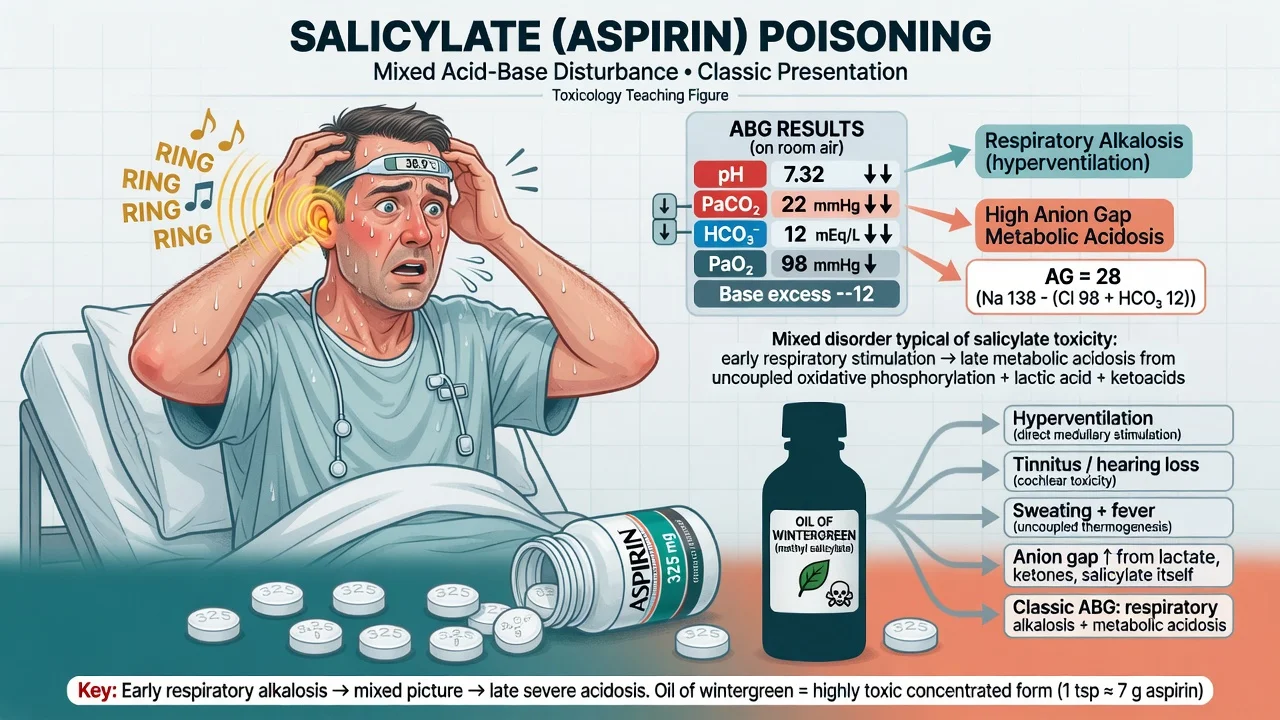
Salicylate (aspirin) poisoning — the uncoupling of oxidative phosphorylation (fever, hypermetabolism), the direct stimulation of the respiratory centre (respiratory alkalosis), and the Krebs-cycle interference (high anion gap metabolic acidosis), producing the classic mixed respiratory alkalosis and high anion gap metabolic acidosis on the blood gas. The clinical picture is tinnitus, hyperventilation, sweating, vomiting, agitation, dehydration and hyperthermia. Management is activated charcoal 50 g, sodium bicarbonate 1 to 2 mmol/kg IV for alkaline diuresis (urine pH above 7.5 enhances salicylate excretion), IV fluid, potassium replacement, and haemodialysis for the severe case (level over 700 mg/L, severe acidosis, renal failure, pulmonary oedema). Intubation is avoided where possible because loss of the respiratory compensation worsens the acidosis. ACEM-primary, globally tagged.
On this page & tools
Your progress
Saved locally on this device.
8 MCQs with explanations
Target exams
Red flags
Related topics
- Paracetamol poisoning
- Tricyclic antidepressant poisoning (emergency department diagnosis and management)
- Toxic alcohol poisoning (methanol and ethylene glycol)
- The toxidrome approach and the general management of the poisoned patient
- Coma and GCS assessment
- Acute decompensated heart failure and cardiogenic pulmonary oedema
- Electrolyte emergencies — potassium and sodium
- Lithium poisoning
Salicylate poisoning is the prototype of the mixed acid-base disturbance and one of the few overdoses in which the bedside blood gas alone points to the diagnosis. The Fellowship candidate must read it on the gas before the level returns: a respiratory alkalosis paired with a high anion gap metabolic acidosis in a sweaty, agitated, hyperventilating patient with tinnitus is salicylate toxicity until proven otherwise. The mechanism is taught as three actions on three targets — uncoupling of oxidative phosphorylation, direct stimulation of the respiratory centre, and disruption of the Krebs cycle — and the candidate who can name each, link it to its clinical sign, and explain why intubation is the most dangerous intervention in the disease will answer any question the examiner can set. The danger is not the salicylate level alone; it is the loss of respiratory compensation, the hypokalaemia that defeats alkalinisation, and the chronic salicylism that hides in the elderly arthritic.[1][2]
Definition and classification
A salicylate is any ester or salt of salicylic acid. Acetylsalicylic acid (aspirin) is the prototype and the commonest culprit; other sources include methyl salicylate (oil of wintergreen, a topical counter-irritant), salicylic acid (keratolytic preparations and wart paints), bismuth subsalicylate (Pepto-Bismol), and salsalate or choline magnesium trisalicylate (non-acetylated NSAIDs). The candidate must think in salicylate-equivalents: 5 mL of oil of wintergreen (98 per cent methyl salicylate) delivers the salicylate load of approximately 20 adult aspirin tablets and is a frequent cause of fatal paediatric exposure.[1]
Acute intoxication is the single large ingestion taken over an hour or less, typically a deliberate self-harm dose of 10 to 30 g. Chronic salicylism (repeated supratherapeutic ingestion) is the more dangerous pattern in clinical practice: it occurs in the elderly arthritic, the chronic pain patient, and the febrile child dosed with combination cold remedies over several days. Chronic toxicity carries a higher mortality than acute at any given serum level because the patient presents late, with established tissue loading, dehydration, and acidosis that drives salicylate into the brain. The threshold to treat and to dialyse is therefore lower in the chronic pattern.[1][2]
Pathophysiology — the three mechanisms and the three acid-base changes
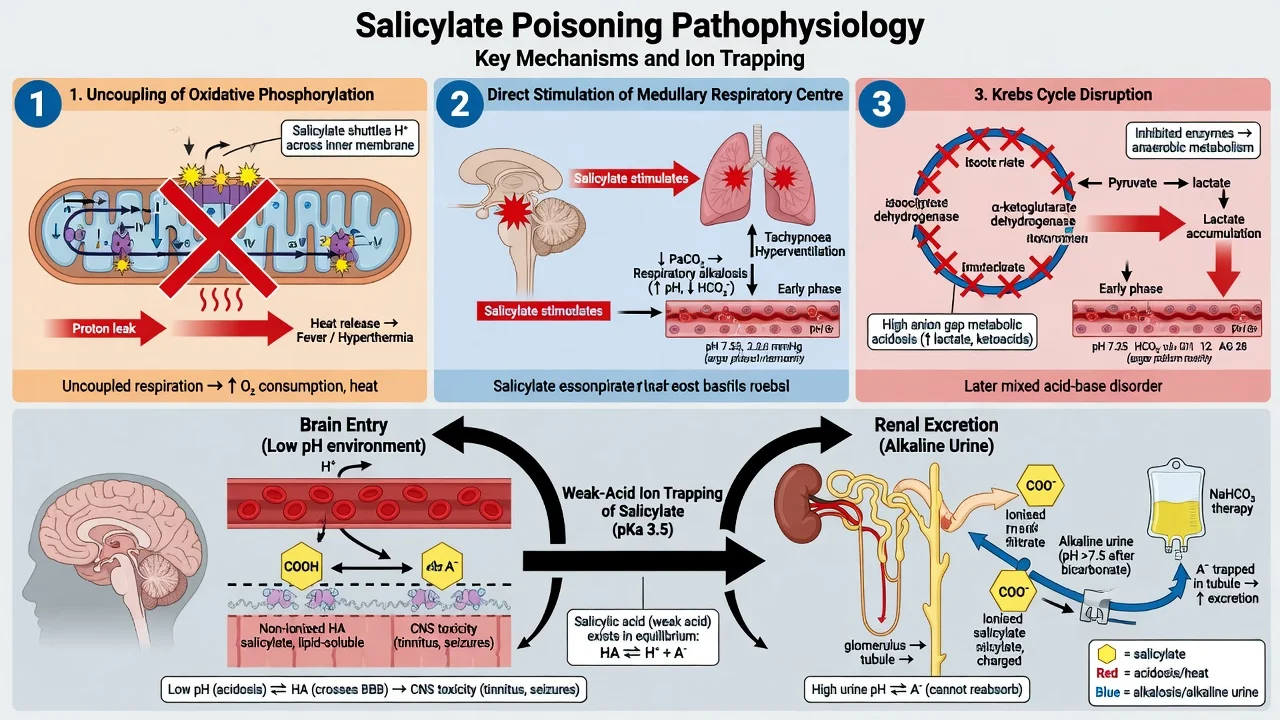
Salicylate is a weak acid (pKa 3.0). At physiological pH it is almost entirely ionised, but a small fraction remains non-ionised and lipid-soluble, and this non-ionised fraction crosses the blood-brain barrier freely. This is the central fact of salicylate toxicology: anything that lowers the pH shifts the equilibrium toward the non-ionised, lipophilic form and drives salicylate into the brain, and anything that raises the pH traps it in the blood and urine as the ionised, excretable form. Acidosis is therefore the enemy — it deepens CNS toxicity and it is the proximate cause of death.[1][3]
The three mechanisms and their clinical consequences
The first action is uncoupling of oxidative phosphorylation. Salicylate carries protons across the inner mitochondrial membrane, dissipating the electrochemical gradient that drives ATP synthase. Electron transport accelerates, oxygen consumption rises, and the energy of substrate oxidation is released as heat rather than captured as ATP. The clinical correlates are hyperthermia, sweating, and a hypermetabolic state with tachycardia and tachypnoea; biochemically there is increased CO2 production. This is the same mechanism as dinitrophenol and shares features with malignant hyperthermia and the syndromes of uncoupling, though salicylate hyperthermia is usually modest (38 to 39 °C).[1][4]
The second action is direct stimulation of the medullary respiratory centre. Salicylate increases the sensitivity of the central chemoreceptors to CO2 and directly excites the respiratory neurons, producing a tachypnoea out of all proportion to the metabolic demand. The PaCO2 falls, the pH rises, and the earliest blood-gas change in salicylate poisoning is a primary respiratory alkalosis. This compensation is critical and is what the patient will lose if intubated without permissive hyperventilation.[1]
The third action is disruption of intermediary metabolism. Salicylate inhibits several Krebs-cycle dehydrogenases (notably isocitrate and alpha-ketoglutarate dehydrogenase) and the oxidative phosphorylation pathway itself, so pyruvate is shunted to lactate and fatty-acid oxidation is impaired, generating ketoacids. The result is a high anion gap metabolic acidosis driven by lactate, ketoacids, and salicylate itself (salicylate is an unmeasured anion). The acidosis may also be intensified by renal failure and dehydration. As the metabolic acidosis deepens it overwhelms the respiratory alkalosis, the pH falls, salicylate shifts into the CNS, and the patient crosses from agitation to coma and seizures.[1][4]
[1]The three mechanisms mapped to signs — the examiner's table
The Fellowship examiner wants the candidate to map each of the three mechanisms to a bedside sign and a blood-gas finding. The three act simultaneously but on different time-courses: respiratory-centre stimulation is the earliest (often the only change in the first hour), uncoupling and Krebs-cycle disruption develop over hours, and the metabolic acidosis deepens as renal failure, dehydration, and ongoing absorption compound it. The candidate who can name the mechanism, the molecular target, the clinical sign, and the gas change in one sentence answers any viva question.[1][4]
Uncoupling of oxidative phosphorylation
- Target: inner mitochondrial membrane. Salicylate carries H+ across the membrane, dissipating the proton gradient that drives ATP synthase
- Substrate oxidation is released as heat; electron transport accelerates; O2 consumption and CO2 production rise
- Clinical signs: hyperthermia (usually 38–39 °C), profuse diaphoresis, warm flushed skin, tachycardia, dehydration from insensible loss
- Shared mechanism with dinitrophenol; a mild version of the malignant-hyperthermia uncoupling phenotype
- Gas/lab clue: rising lactate, raised oxygen consumption, contraction alkalosis from dehydration
Direct respiratory-centre stimulation
- Target: medullary respiratory centre. Salicylate increases central chemoreceptor sensitivity to CO2 and directly excites respiratory neurons
- Produces tachypnoea out of all proportion to metabolic demand; PaCO2 falls below the metabolic compensation line
- Gas change: a PRIMARY respiratory alkalosis — the earliest blood-gas change, often present before the metabolic acidosis
- This is the compensation that MUST be preserved: loss of it (intubation, sedation, exhaustion) is the commonest proximate cause of death
- Clinical sign: a deep, sighing, sometimes painful tachypnoea (NOT Kussmaul — the drive is respiratory, not metabolic)
Krebs-cycle disruption
- Target: mitochondrial dehydrogenases (isocitrate, alpha-ketoglutarate) and fatty-acid oxidation
- Pyruvate is shunted to lactate; ketoacids accumulate; salicylate itself is an unmeasured anion that raises the gap
- Gas change: a PRIMARY high anion gap metabolic acidosis — lactate, ketoacids, and salicylate all contribute
- Coexists with (does NOT compensate for) the respiratory alkalosis → the classic mixed disorder
- As acidosis deepens, the non-ionised salicylate fraction rises and drug shifts into the CNS → agitation → seizures → coma
Severity grading and salicylate levels — the milligram-per-decilitre table
Levels are reported in two units and the candidate must move fluently between them. ANZ and UK laboratories report mg/L; North American and many older texts report mg/dL (1 mg/dL = 10 mg/L). The classic Done nomogram (Done 1960) related a single post-ingestion serum level, plotted against time since ingestion, to severity — but the nomogram is reliable only for a single acute ingestion of immediate-release aspirin with a known time, and has been largely retired in favour of serial levels interpreted with the blood gas and the clinical picture.[5]
Therapeutic 15–30 mg/dL (150–300 mg/L)
- Analgesic / anti-inflammatory range; no toxicity in the naive patient
- The chronic low-dose cardiovascular-aspirin user sits here and is asymptomatic
- Tinnitus may appear at the upper end of this range in sensitive individuals
- No intervention beyond confirming adherence and indication
Mild 30–50 mg/dL (300–500 mg/L)
- Tinnitus, mild hyperventilation, nausea, diaphoresis, flushed appearance
- Earliest mixed acid-base change: respiratory alkalosis ± early anion-gap rise
- Activated charcoal if within 1–2 h; IV fluid; observe with serial levels
- Start urinary alkalinisation if the level is rising or the patient is symptomatic
Moderate 50–100 mg/dL (500–1000 mg/L)
- Marked hyperventilation, fever, dehydration, agitation, hypokalaemia, a clear mixed acid-base disorder
- Non-cardiogenic pulmonary oedema may appear at the upper end of this band
- Urinary alkalinisation is mandatory; admit to a monitored bed
- Lower threshold for haemodialysis in chronic toxicity, the elderly, or any end-organ sign
Severe >100 mg/dL (>1000 mg/L)
- Confusion, seizures, coma, hyperthermia, pulmonary and/or cerebral oedema, cardiovascular instability
- Refractory metabolic acidosis; high risk of arrest, especially if intubated without precautions
- Haemodialysis is indicated (the EXTRIP acute threshold of 700 mg/L is already crossed)
- ICU admission; nephrology and toxicology involved; arrange dialysis BEFORE the patient deteriorates
Clinical features by phase of acute intoxication
Sources and epidemiology
Salicylate exposure remains among the ten commonest substances in poison-centre calls and a leading cause of pharmaceutical poisoning death. Aspirin is widely available over the counter, and oil of wintergreen and combination cough-and-cold preparations add to the exposure burden. Two epidemiological patterns dominate: the young adult deliberate self-harm ingestion (acute, large dose, classic course) and the elderly chronic user (low-dose over days, atypical presentation, high mortality). Paediatric exposure is most often exploratory ingestion of flavoured aspirin or oil of wintergreen. Mortality is concentrated in the chronic and the oil-of-wintergreen patterns and in any patient who is intubated without the precautions that protect respiratory compensation.[1][2]
Clinical presentation
The acute and chronic patterns present differently, and the candidate must hold both in mind. [1]
Acute intoxication evolves over hours. Early (2 to 4 hours) the patient is symptomatic with tinnitus, decreased hearing, nausea and vomiting, diaphoresis, and hyperventilation — a deep, sighing, sometimes painful tachypnoea. The mental state is agitated, restless, or anxious. By 6 to 12 hours moderate toxicity produces fever, dehydration, hypokalaemia, and the mixed acid-base disorder; the patient remains alert and hyperventilating. Severe toxicity (over 12 hours, or a massive acute dose) progresses to confusion, delirium, hallucinations, seizures, coma, hyperthermia, pulmonary oedema, and cardiovascular collapse. The pulmonary oedema of salicylate toxicity is non-cardiogenic — a direct capillary-leak effect — and is itself an indication for haemodialysis. Tinnitus and deafness are dose-dependent and reversible; they reflect both a direct cochlear effect and CNS salicylate levels.[1][4]
Chronic salicylism is the trap. The elderly patient on long-term aspirin or multiple salicylate-containing preparations presents over days with confusion, slurred speech, hallucinations, deafness, and a fluctuating encephalopathy, often misdiagnosed as sepsis, delirium, stroke, or heart failure. The vital signs show tachypnoea and a low-grade fever; the blood gas shows the mixed disorder. Because the history of salicylate intake is not volunteered (and the patient cannot give it), the salicylate level is the diagnostic test — sent as part of the "confusion work-up" in any older patient with an unexplained high anion gap metabolic acidosis. Mortality in chronic salicylism is several-fold higher than in acute at comparable serum levels.[1][2]
[1]Differential diagnosis
The differential of salicylate poisoning splits into two: the cause of the high anion gap metabolic acidosis (the MUDPILES family) and the cause of the agitation-and-hyperventilation picture (the toxidromes). The history, the blood gas, and the salicylate level resolve most, but the others must be considered because the management diverges and several are missed by a narrow tox-focused history. [1]
Salicylate
- Mixed respiratory alkalosis + high AG metabolic acidosis
- Tinnitus, hyperventilation, sweating, fever, agitation
- Salicylate level raised; tachypnoea out of proportion
- Alkaline diuresis with sodium bicarbonate; haemodialysis for severe
Toxic alcohols (methanol/ethylene glycol)
- High AG metabolic acidosis with a concurrent osmolar gap
- Visual disturbance (methanol); calcium oxalate crystals/renal failure (ethylene glycol)
- No respiratory alkalosis; no tinnitus
- Fomepizole or ethanol; haemodialysis; thiamine and pyridoxine
Diabetic ketoacidosis
- High AG metabolic acidosis with ketosis and hyperglycaemia
- Kussmaul breathing (compensatory), dehydration, polyuria
- No respiratory alkalosis; no tinnitus; glucose markedly raised
- IV insulin, fluid, potassium; treat the cause
Lactic acidosis (sepsis/shock)
- High AG metabolic acidosis with a raised lactate
- Hypotension, septic or cardiogenic source; cold peripheries
- No respiratory alkalosis; no tinnitus; no fever pattern of salicylate
- Treat the underlying shock; fluids, antibiotics, source control
Sepsis / pneumonia with respiratory alkalosis
- Septic patient may have both a respiratory alkalosis and a metabolic (lactic) acidosis
- Fever, focal chest signs, raised lactate, normal salicylate level
- Salicylate level normal — the decisive test
- Antibiotics, oxygen, fluids, source control
Uraemia / renal failure
- High AG metabolic acidosis from retained organic acids
- Chronic kidney history; uraemic features; creatinine raised
- No respiratory alkalosis, no tinnitus
- Renal replacement therapy; bicarbonate if acidotic
The candidate should note that the mixed respiratory alkalosis and high anion gap metabolic acidosis is shared only with sepsis and with the late stages of some hepatorenal syndromes — a salicylate level is sent in any patient with this gas pattern, especially the elderly, the confused, and the hyperventilating. [1]
Bedside assessment
The history establishes the agent, the dose, the time, the formulation (immediate or enteric-coated), and any co-ingestants. Enteric-coated aspirin delays and prolongs absorption and may form a pharmacobezoar; serial levels are mandatory in these ingestions. The examination documents the conscious level, the temperature, the respiratory rate and depth, the hydration, the oxygen saturation, the blood pressure, and a careful chest and neurological examination. Tinnitus, deafness, sweating, tremor, agitation, and a flushed appearance are the bedside clues; a reduced conscious level, hyperthermia, hypoxia from pulmonary oedema, and hypotension mark severe toxicity. A psychiatric and self-harm risk assessment is begun once the patient is stable.[1]
Investigations
The cornerstone is the serum salicylate level, drawn at 2 to 4 hours after an acute ingestion and repeated every 2 to 4 hours until it is clearly falling and the patient is clinically well. A single early level (under 2 hours) underestimates the load because absorption is incomplete; enteric-coated and bezoar-forming preparations produce delayed and erratic absorption, so serial levels are essential and a single "normal" level in such a patient is not reassurance. In the chronic or unknown-time patient the level is drawn on arrival and interpreted with the clinical picture and the blood gas.[1][2]
[1]The accompanying panel is the venous (or arterial) blood gas with pH, PaCO2, bicarbonate, base excess, and anion gap; the electrolytes including potassium, glucose, calcium, renal function, and lactate; the co-ingestant screen (paracetamol level always, ethanol, and a urine drug screen); and an ECG to exclude a co-ingested cardiotoxic agent. The anion gap is calculated as sodium minus chloride minus bicarbonate (normal 8 to 12), and is raised by salicylate, lactate, and ketoacids. A normal anion gap with a low bicarbonate suggests a non-anion-gap acidosis (renal tubular, GI bicarbonate loss), which is not the salicylate pattern. A chest radiograph detects pulmonary oedema; a CT brain is reserved for the patient whose encephalopathy is disproportionate to the level, to exclude a structural cause.[1]
Immediate management and resuscitation
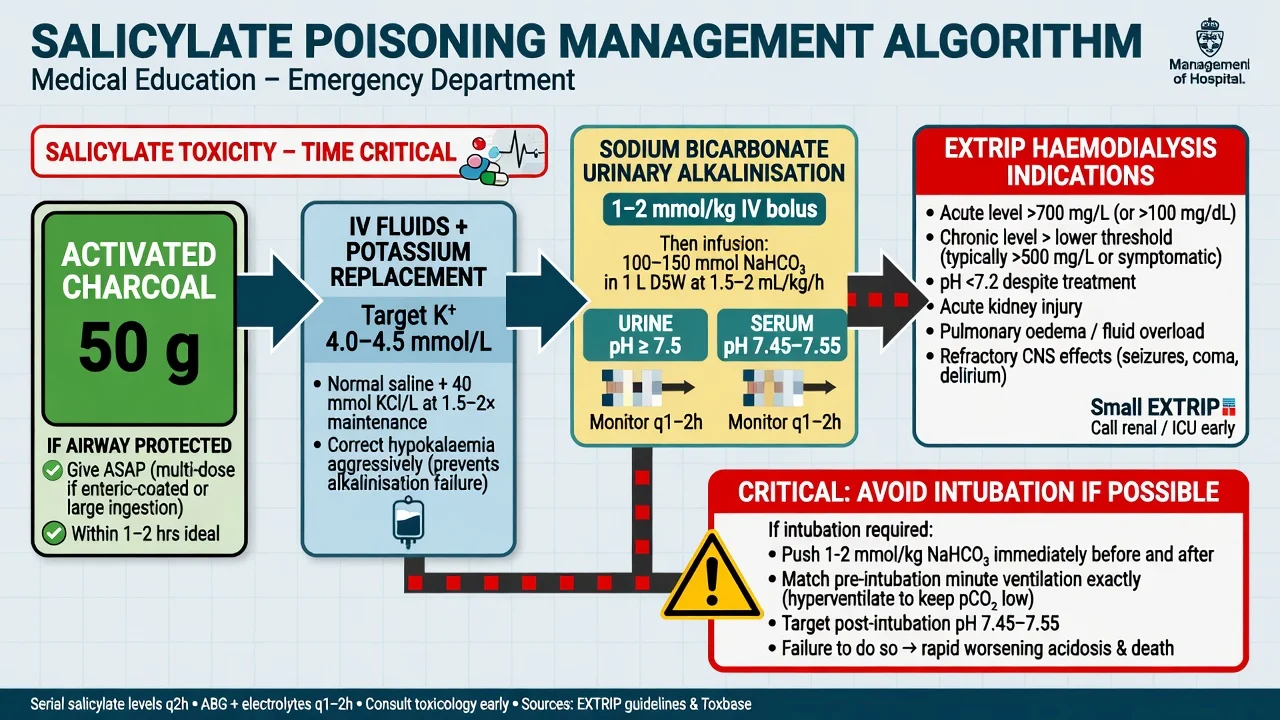
Resuscitation follows ABCDE with one overriding principle that distinguishes salicylate from every other overdose. [1]
[1]Most salicylate patients are cardiovascularly stable; the late-presenting or chronic patient may be hypotensive from dehydration and vasodilatation. IV fluid (a balanced crystalloid, 1 to 2 L in the adult, titrated to hydration and perfusion) restores intravascular volume, supports renal salicylate clearance, and counters the dehydration from vomiting, sweating, and the hypermetabolic insensible loss. Activated charcoal 50 g (1 g/kg in the child) given within 1 to 2 hours of an acute ingestion reduces absorption; multi-dose charcoal (50 g every 4 hours) may further enhance elimination by gut dialysis in moderate-to-severe toxicity, though vomiting limits its use and an antiemetic (ondansetron 4 mg IV) is often required. For enteric-coated or bezoar-forming preparations, whole-bowel irrigation with polyethylene glycol 1 to 2 L per hour via nasogastric tube until the effluent clears is considered when a large ingestion is confirmed on imaging or when levels continue to rise.[1][4]
Definitive management — alkaline diuresis, potassium, and haemodialysis
The definitive treatment is urinary alkalinisation with sodium bicarbonate, which is the antidote-like intervention for salicylate poisoning. The mechanism is ion-trapping: raising the urine pH above 7.5 shifts salicylate (a weak acid) into its ionised form in the tubular lumen, which cannot be reabsorbed and is excreted. Each 0.1 unit rise in urine pH roughly triples the renal salicylate clearance; an alkaline urine can increase elimination five-to ten-fold over the acidic baseline. Proudfoot and colleagues established the physiological basis and the clinical practice of urine alkalinisation, which remains the cornerstone of moderate salicylate toxicity.[3]
The sodium bicarbonate regimen for alkaline diuresis
Potassium replacement is not an adjunct — it is a precondition. The distal tubule exchanges H+ for K+; in the hypokalaemic state it reabsorbs K+ by secreting H+, which acidifies the urine and defeats the bicarbonate. If the urine will not alkalinise despite escalating bicarbonate, the potassium is low and must be replaced first, to a target of 4 to 4.5 mmol/L. Potassium chloride 20 to 40 mmol is added to each bicarbonate bag, and the serum potassium is checked every 2 to 4 hours. Hypokalaemia is the commonest reason that alkaline diuresis fails.[3][1]
The candidate must monitor the serum pH carefully: the goal is mild alkalaemia (7.45 to 7.55), not over-alkalinisation, which causes symptomatic hypocalcaemia, tetany, and a left-shifted oxyhaemoglobin curve. The urine pH is checked every 1 to 2 hours (a urinary catheter is often required). The salicylate level is repeated every 2 to 4 hours; a falling level with a clinically improving patient and a normalising blood gas signals that alkaline diuresis can be weaned. [1]
Haemodialysis is reserved for severe toxicity and is the most effective elimination method, clearing salicylate three to five times faster than alkaline diuresis. The EXTRIP Workgroup (Juurlink 2015) reviewed the evidence and produced the consensus indications.[2]
EXTRIP indications for haemodialysis in salicylate poisoning
The clinical indications — renal failure, pulmonary oedema, refractory CNS toxicity, and deterioration despite maximal therapy — override the level in the decision to dialyse. The EXTRIP recommendations are GRADE 1D for the level thresholds and reflect the consensus of nephrology, toxicology, and emergency-medicine experts; they are followed across ANZ, the UK, North America, and Europe.[2]
The ED management pathway — flow by minute
The candidate must walk the examiner through the first hour of an acute salicylate ingestion without hesitation. The decisive forks are (i) whether to intubate (almost never, and only with safeguards), (ii) whether the potassium is adequate to permit alkalinisation, and (iii) whether the patient meets dialysis criteria now or is trending toward them. The pathway below is the one to recite.[1][2]
Acute salicylate poisoning — the first-hour ED pathway
Assess ABCDE. Confirm hyperventilation is intact and the patient is protecting the airway. Do NOT sedate or intubate unless respiratory failure is overt.
Two large-bore cannulae; bloods — VBG/ABG (pH, PaCO2, HCO3, anion gap, lactate), U&E (especially K+), glucose, salicylate level, paracetamol level, renal function; 12-lead ECG; urine drug screen.
If within 1–2 h of ingestion (or later for enteric-coated / sustained-release): activated charcoal 50 g (1 g/kg in the child) via NG after an antiemetic (ondansetron 4 mg IV).
Start IV fluid: balanced crystalloid 1–2 L titrated to hydration. Use 5% dextrose as the bicarbonate vehicle — the brain may be functionally hypoglycaemic despite a normal blood glucose.
Check the potassium — if below 4.0 mmol/L, plan to correct it in parallel; hypokalaemia will defeat alkalinisation. Add KCl 20–40 mmol to each bicarbonate bag.
Begin urinary alkalinisation: sodium bicarbonate 1–2 mmol/kg IV bolus (8.4%), then 1.5 mmol/kg/h infusion in 5% dextrose. Targets: serum pH 7.45–7.55, urine pH 7.5–8.0, K+ 4–4.5 mmol/L.
Insert a urinary catheter; check urine pH hourly, serum pH and K+ every 2–4 h, and the salicylate level every 2–4 h until two consecutive falling levels.
Assess dialysis criteria (EXTRIP): level over 700 mg/L acute / over 500 mg/L chronic, pH below 7.2, AKI, pulmonary or cerebral oedema, refractory CNS toxicity, or deterioration despite maximal therapy. Involve ICU and nephrology EARLY.
Reassess continuously for pulmonary oedema, a falling pH, a falling GCS, or a rising PaCO2 (loss of compensation) — each is an immediate escalation trigger.
Urinary alkalinisation — setup and titration
Confirm K+ at least 4.0 mmol/L first (or replace in parallel). Hypokalaemia is the commonest reason alkalinisation fails.
Bolus: sodium bicarbonate 8.4%, 1–2 mmol/kg IV over 1–2 h. Goal: serum pH 7.45–7.55.
Infusion: sodium bicarbonate 1.5 mmol/kg/h added to 5% dextrose (1 L) with KCl 20–40 mmol.
Catheterise; check urine pH every hour. Target urine pH 7.5–8.0. Each 0.1 unit rise triples renal salicylate clearance.
If urine pH stays below 7.5 despite the serum pH target being met, the potassium is the culprit — replace K+ to 4–4.5 mmol/L before escalating the bicarbonate.
Check serum pH and K+ every 2–4 h. Avoid over-alkalinisation (serum pH above 7.55): risk of hypocalcaemic tetany and a left-shifted oxyhaemoglobin curve.
Continue until two consecutive falling salicylate levels, a normalising blood gas, and clear clinical improvement. Then wean the infusion and observe for rebound (especially after enteric-coated ingestion).
Safe intubation in salicylate toxicity — when it cannot be avoided
Recognise the ONLY acceptable trigger: refractory respiratory failure (exhaustion, a PaCO2 rising toward normal, a rising lactate with a falling pH) or loss of the airway. NEVER intubate for agitation or to control the patient.
Pre-oxygenase fully; aim for an end-tidal and PaCO2 that MATCH the pre-intubation compensatory level, not a normal one.
Give sodium bicarbonate 1–2 mmol/kg IV bolus immediately before induction to pre-empt the acidification from lost ventilation.
Use a rapid-sequence technique with the least cardiodepressant agents; avoid prolonged apnoea.
Set the ventilator to PERMISSIVE HYPERVENTILATION: a high respiratory rate to drive PaCO2 down to the pre-intubation level (e.g. 25–35 mmHg) and hold the pH at 7.45–7.50. NEVER ventilate to a normal PaCO2.
Start haemodialysis as soon as access is obtained — the intubated salicylate patient cannot be weaned from the ventilator until the salicylate burden is cleared.
Run a sodium bicarbonate infusion continuously; check a blood gas within 10 min of intubation and every 30 min thereafter.
Elimination methods compared
The three elimination strategies have different kinetics, indications, and failure modes. The candidate must know which to use when, and why multi-dose charcoal enhances elimination by gut dialysis in moderate toxicity but cannot substitute for alkalinisation or dialysis in the severely toxic patient.[1][3]
Activated charcoal (single + multi-dose)
- Single 50 g within 1–2 h reduces absorption; multi-dose 50 g every 4 h enhances elimination by interrupting enterohepatic recycling ("gut dialysis")
- Best for early acute ingestion; essential adjunct for enteric-coated and bezoar-forming preparations
- Limited by vomiting (give ondansetron first); ineffective once absorption is complete
- Does NOT alkalinise serum or urine; not a treatment for the acidosis or the CNS toxicity
Urinary alkalinisation (sodium bicarbonate)
- Ion-trapping: a urine pH above 7.5 shifts salicylate to its ionised, non-reabsorbable form; each 0.1 pH-unit rise triples clearance
- First-line elimination enhancement for moderate toxicity; can increase elimination 5–10-fold
- Requires adequate K+ (target 4–4.5 mmol/L); fails if the patient is hypokalaemic, dehydrated, or in renal failure
- Slower than dialysis; insufficient for very high levels or severe end-organ toxicity
Haemodialysis
- Clears salicylate 3–5 times faster than alkalinisation (roughly 80–120 mL/min vs 5–10 mL/min); corrects acidosis and fluid overload simultaneously
- Indicated (EXTRIP): level over 700 mg/L acute / over 500 mg/L chronic, pH below 7.2, AKI, pulmonary or cerebral oedema, refractory CNS toxicity, deterioration despite maximal therapy
- The default in the intubated patient; the most reliable way to remove a large or tissue-bound burden
- Requires vascular access, anticoagulation, and ICU; arrange EARLY — do not wait for the patient to crash
Acute versus chronic salicylism — the comparison that explains mortality
The same serum level kills in chronic toxicity and is survivable in acute. The reason is tissue distribution and the duration of acidosis, and the candidate must explain this when asked why the dialysis threshold is lower in chronic salicylism.[2][6]
Acute intoxication
- Single large dose (typically 10–30 g deliberate self-harm); classic evolution over hours
- Level correlates reasonably with severity; the Done nomogram is sometimes applicable (single immediate-release ingestion, known time)
- Mortality low with prompt treatment; patient usually young and physiologically robust
- Higher dialysis threshold (over 700 mg/L) because the tissue burden tracks the serum more closely
Chronic salicylism
- Repeated supratherapeutic dosing over days; the elderly arthritic, the chronic-pain patient, the febrile child on combination remedies
- Level is DISPROPORTIONATE to severity — tissue and CNS levels exceed the serum; encephalopathy at "moderate" levels
- Mortality several-fold higher than acute at comparable levels; presents late, dehydrated, and acidotic
- Lower dialysis threshold (over 500 mg/L); treat the patient and the gas, never the number alone
The landmark evidence — trial cards
EXTRIP — extracorporeal treatment for salicylate poisoning (Ann Emerg Med 2015)
Annals of Emergency Medicine
PMID 25986310
Key finding
A systematic review and GRADE-based consensus from nephrology, toxicology, critical care, and emergency medicine across international societies. Haemodialysis recommended (GRADE 1D) for acute salicylate over 700 mg/L (7.7 mmol/L) or chronic over 500 mg/L (5.5 mmol/L) with end-organ toxicity, and also for refractory acidosis (pH below 7.2), AKI, pulmonary or cerebral oedema, refractory CNS toxicity, or clinical deterioration despite maximal therapy.
Practice change
The international consensus reference for the dialysis decision in salicylate poisoning; adopted across ANZ, the UK, North America, and Europe. Replaced the older practice of dialysing only at very high levels and pushed the threshold lower for chronic toxicity.
Done nomogram — the original level-time severity correlation (Pediatrics 1960)
Pediatrics
PMID 13723722
Key finding
An observational cohort of children and adults after a single acute aspirin ingestion. Established that a single post-ingestion serum level, interpreted against the time since ingestion, predicts severity — introducing the concept of dose-dependent severity grading that still underlies modern thresholds.
Practice change
The original level-severity correlation. Now largely retired for enteric-coated, sustained-release, chronic, and mixed ingestions (it underestimates these), but the conceptual framework — serial levels interpreted with the clinical picture — remains the standard.
Proudfoot position paper — urine alkalinisation (J Toxicol Clin Toxicol 2004)
Journal of Toxicology: Clinical Toxicology
PMID 15083932
Key finding
An international consensus position on the role and technique of urinary alkalinisation in poisoned patients. Established the ion-trapping rationale and the clinical practice of urine alkalinisation (urine pH above 7.5) as the first-line elimination-enhancement method for salicylate and other weak-acid poisons, and clarified that hypokalaemia must be corrected for alkalinisation to succeed.
Practice change
The reference for the bicarbonate regimen still taught and used; the physiological basis for the urine-pH target of 7.5–8.0 and the mandatory potassium replacement.
Chapman and Proudfoot — outcome of high plasma salicylate (Q J Med 1989)
Quarterly Journal of Medicine
PMID 2602553
Key finding
A case series / outcome analysis of adults presenting with very high plasma salicylate concentrations. Documented that death correlates with CNS toxicity, acidosis, and delayed treatment, and that the chronic and elderly patterns carry disproportionate risk at any given serum level.
Practice change
Defined the high-mortality end of the spectrum and reinforced the need for early, aggressive elimination — the clinical justification for the lower dialysis threshold in severe and chronic toxicity.
Subtypes and scenarios
Chronic salicylism is the highest-mortality pattern and the one most often missed. The elderly arthritic on multiple salicylate-containing preparations, or the febrile child dosed with combination remedies over days, presents with an encephalopathy disproportionate to a serum level that the acute-toxicity table calls moderate. The threshold to dialyse is lower (over 500 mg/L), the alkaline diuresis is started early, and the dehydration and acid-base disturbance are corrected aggressively. The candidate must not be reassured by a level that looks "acceptable" in the acute context.[1][2]
Oil of wintergreen (methyl salicylate) is the concentrated topical preparation that causes rapid, severe toxicity. One teaspoon (5 mL) carries the salicylate load of approximately 20 adult aspirin tablets; fatalities in toddlers follow exploratory ingestion of a single bottle. Methyl salicylate is absorbed rapidly across skin and mucosa, so dermal exposure of a large body-surface area is also toxic. Management is the same as for aspirin, with an early and aggressive approach to alkaline diuresis and a low threshold for dialysis.[1]
Enteric-coated and bezoar-forming aspirin delays absorption, so the serum level may be low or normal at 4 hours and then climb for many hours. Serial levels (every 2 to 4 hours for 12 to 24 hours) are mandatory, and whole-bowel irrigation is considered if levels continue to rise or imaging confirms a bezoar. The patient with enteric-coated ingestion is observed until two consecutive falling levels confirm that absorption is complete.[1]
Pregnancy deserves special note. Salicylate crosses the placenta and is more toxic to the fetus (whose blood-brain barrier is immature and whose acid-base buffering favours the non-ionised form); the maternal salicylate level understates the fetal level. Alkaline diuresis and haemodialysis are both used in pregnancy, with obstetric and toxicology input; the threshold to treat is lower and delivery may be considered at term.[1]
Complications and pitfalls
The complications of salicylate poisoning are the consequences of the three mechanisms and of the treatment itself. Pulmonary oedema is non-cardiogenic, from a direct capillary-leak effect on the pulmonary vasculature; it is an indication for haemodialysis, and fluid resuscitation must be titrated carefully to avoid worsening it. Cerebral oedema accompanies severe CNS toxicity and may be a consequence of acidosis-driven salicylate shift into the brain. Hypoglycaemia is common in children and reflects impaired gluconeogenesis; in adults the CNS may be functionally hypoglycaemic (low CSF glucose) despite a normal blood glucose, and a dextrose-containing fluid is preferred for the alkaline diuresis infusion. Acute kidney injury occurs from dehydration, rhabdomyolysis in the agitated or seizing patient, and direct salicylate effect on the proximal tubule. Hypokalaemia is near-universal and is the rate-limiting factor for alkaline diuresis. Hyperthermia, arrhythmia, and coagulopathy (salicylate lowers prothrombin by interfering with vitamin K–dependent factors) round out the picture.[1][4]
The pitfalls are well described. The first and most dangerous is intubation without permissive hyperventilation — the loss of respiratory compensation causes a precipitous rise in PaCO2, a fall in pH, and arrest. If intubation is unavoidable, the candidate must pre-oxygenate, give a bicarbonate bolus, and ventilate to a respiratory alkalosis matching the pre-intubation minute volume. The second is missing chronic salicylism in the elderly confused patient — the salicylate level must be part of the unexplained-encephalopathy work-up. The third is failing to replace potassium, so the urine never alkalinises and the salicylate is not trapped. The fourth is false reassurance from a falling level in chronic toxicity — the tissue level remains high and the patient can deteriorate as drug redistributes from a deep compartment. The fifth is stopping alkaline diuresis too early in the enteric-coated or bezoar ingestion — absorption is prolonged and the level rebounds. The sixth is over-resuscitation with crystalloid, worsening the non-cardiogenic pulmonary oedema.[1][2]
Prognosis and disposition
The prognosis depends on the pattern and the timing of treatment. Acute intoxication treated early and correctly has a low mortality; chronic salicylism and oil-of-wintergreen ingestion carry several-fold higher mortality at comparable serum levels. The patient is observed until clinically well with a normal blood gas and two consecutive falling salicylate levels, and (for enteric-coated ingestion) until absorption is confirmed complete. The patient with mild toxicity managed with activated charcoal and fluids alone is discharged after psychiatric assessment if the overdose was deliberate. The patient receiving alkaline diuresis is admitted to a monitored bed with serial levels and gases; the patient meeting dialysis criteria is admitted to intensive care. A falling level, a normalising blood gas, an improving mental state, and resolution of tinnitus and fever signal recovery.[1][2]
Special populations
The elderly are the highest-risk group: chronic salicylism presents atypically, the level understates toxicity, and the threshold to dialyse is lower. Pregnancy lowers the threshold to treat because fetal salicylate levels exceed maternal. Children develop hypoglycaemia readily and are dosed by weight; oil-of-wintergreen ingestion in a toddler is a medical emergency with early dialysis consideration. The patient with pre-existing renal or cardiac failure tolerates the alkaline diuresis poorly and meets dialysis criteria earlier. The agitated or seizing patient needs early benzodiazepine (lorazepam 4 mg IV, or midazolam 5 mg IV) both for seizure control and to reduce the hypermetabolic demand — but with the airway caveat that any sedation risks loss of respiratory compensation.[1]
Evidence and regional guidelines
The evidence base and the regional practice are well aligned across the Anglosphere. The EXTRIP Workgroup systematic review (Juurlink, Annals of Emergency Medicine 2015) is the consensus reference for haemodialysis, with the level and clinical indications cited above and adopted across ANZ, the UK, North America, and Europe.[2] The Proudfoot position paper on urine alkalinisation (2003) established the ion-trapping rationale and the clinical practice of urinary alkalinisation, which remains the first-line elimination enhancement for moderate toxicity.[3] The Sidlak narrative review (Cureus 2025) is the current emergency-medicine overview covering mechanism, presentation, and the integrated management pathway.[1] ANZ practice follows the EXTRIP dialysis criteria and the Proudfoot alkalinisation regimen, with activated charcoal 50 g within 1 to 2 hours of acute ingestion, sodium bicarbonate 1 to 2 mmol/kg then infusion to urine pH 7.5 and serum pH 7.45 to 7.55, mandatory potassium replacement, and a low threshold for dialysis in the chronic and the elderly.[1][2]
ANZ practice note. The Australasian approach follows the integrated pathway: a 2- to 4-hour salicylate level with serial levels for enteric-coated ingestion; activated charcoal 50 g within 1 to 2 hours of an acute ingestion; sodium bicarbonate 1 to 2 mmol/kg IV bolus followed by a 1.5 mmol/kg per hour infusion in 5 per cent dextrose, titrated to a urine pH above 7.5 and a serum pH of 7.45 to 7.55; potassium chloride 20 to 40 mmol per bag to a serum potassium target of 4 to 4.5 mmol/L; and haemodialysis per the EXTRIP criteria (level over 700 mg/L in acute, over 500 mg/L in chronic, severe acidosis, renal failure, pulmonary or cerebral oedema, or deterioration despite maximal therapy). Intubation is avoided where possible; if unavoidable, a bicarbonate bolus is given pre-intubation and the ventilator is set to a respiratory alkalosis matching the pre-intubation minute volume. [1]
Exam practice
SAQ — Chronic salicylism in the elderly patient
12 minutes · 10 marks
A 78-year-old woman is brought from a nursing home with three days of progressive confusion, agitation, fever, tachypnoea and two episodes of vomiting. She takes aspirin 150 mg daily for atrial fibrillation and has used topical methylsalicylate cream freely for arthritis. T 38.6, HR 118, RR 32, BP 104/68, SpO2 95 per cent on room air, GCS 13. ABG: pH 7.32, PaCO2 22 mmHg, HCO3 14 mmol/L, AG 24, lactate 2.1. Salicylate level 620 mg/L. Creatinine 168 micromol/L, K 3.2 mmol/L.
SAQ — Acute massive salicylate ingestion and the intubation dilemma
10 minutes · 10 marks
A 24-year-old man presents four hours after ingesting 60 g of aspirin. He is agitated, diaphoretic, tachypnoeic with RR 38, T 38.8, and complaining of tinnitus and deafness. ABG: pH 7.47, PaCO2 24 mmHg, HCO3 17 mmol/L, AG 25. Salicylate 780 mg/L. K 3.0 mmol/L.
Exam pearls
- The mechanism in one breath: salicylate uncouples oxidative phosphorylation (fever, hypermetabolism), directly stimulates the respiratory centre (respiratory alkalosis), and disrupts the Krebs cycle (high anion gap metabolic acidosis). The classic blood gas is the mixed respiratory alkalosis AND high anion gap metabolic acidosis — both primary, neither compensatory.
- A pure metabolic acidosis in a salicylate patient means respiratory exhaustion and impending arrest — intubate only with a pre-induction bicarbonate bolus and a ventilator set to permissive hyperventilation.
- Urine pH above 7.5 is the endpoint of alkaline diuresis; each 0.1 unit rise triples renal salicylate clearance. If the urine will not alkalinise, the potassium is low — replace it first.
- Sodium bicarbonate 1 to 2 mmol/kg IV bolus, then 1.5 mmol/kg per hour infusion, with potassium chloride 20 to 40 mmol per bag. Serum pH target 7.45 to 7.55, urine pH 7.5 to 8.0.
- Haemodialysis (EXTRIP): salicylate over 700 mg/L in acute, over 500 mg/L in chronic, severe acidosis (pH below 7.2), renal failure, pulmonary or cerebral oedema, or clinical deterioration despite maximal therapy.
- Activated charcoal 50 g (1 g/kg in children) within 1 to 2 hours; multi-dose charcoal or whole-bowel irrigation for enteric-coated and bezoar-forming ingestion.
- Chronic salicylism is the trap: the elderly confused patient with an unexplained high anion gap metabolic acidosis gets a salicylate level. The level understates the tissue burden, and the dialysis threshold is lower.
- Oil of wintergreen: 5 mL carries the salicylate load of 20 adult aspirin tablets. Paediatric ingestion is a medical emergency. [1]
Model answer — A 22-year-old woman, 60 g of aspirin 4 hours ago. RR 36, tinnitus, diaphoresis, temp 38.4. ABG: pH 7.48, PaCO2 24 mmHg, HCO3 18 mmol/L, AG 24. Salicylate 750 mg/L. K 3.1 mmol/L. Outline the immediate management.
Immediate management. The diagnosis is acute salicylate poisoning with the classic mixed respiratory alkalosis (pH 7.48, PaCO2 24) and high anion gap metabolic acidosis (HCO3 18, AG 24). The patient is compensating well — her hyperventilation holds the pH alkalaemic and keeps salicylate out of her brain. Do not intubate. The airway is protected by her own respiratory drive; sedation or paralysis would raise her PaCO2, drop her pH, shift salicylate into her CNS, and risk arrest. Resuscitation is IV access, IV fluid (balanced crystalloid 1 L over the first hour), and an antiemetic (ondansetron 4 mg IV) because she will vomit on charcoal and bicarbonate. Activated charcoal 50 g via nasogastric tube is given now (within the 1- to 2-hour window it is past, but multi-dose charcoal enhances elimination and is offered if she can tolerate it). [1]
The definitive treatment is urinary alkalinisation. The potassium is 3.1 mmol/L — this is the rate-limiting problem and must be corrected first or the urine will not alkalinise. Sodium bicarbonate 1 to 2 mmol/kg IV (8.4 per cent, approximately 100 mmol over 1 to 2 hours) is given to raise the serum pH toward 7.45 to 7.55 and the urine pH above 7.5, followed by a 1.5 mmol/kg per hour infusion in 5 per cent dextrose with potassium chloride 20 to 40 mmol per bag, titrated to a serum potassium of 4 to 4.5 mmol/L and a urine pH of 7.5 to 8.0. A urinary catheter is placed and the urine pH checked hourly. [1]
Does she qualify for haemodialysis? Her salicylate level is 750 mg/L, which exceeds the EXTRIP acute threshold of 700 mg/L; she also has end-organ toxicity (hyperthermia, hyperventilation). She meets dialysis criteria. While alkaline diuresis is started, the intensive-care and nephrology teams are contacted for haemodialysis, which clears salicylate three to five times faster than alkalinisation. Serial salicylate levels (every 2 to 4 hours) and blood gases guide the response; the level is expected to fall and the gas to normalise. A psychiatric and self-harm risk assessment is performed once she is medically stable. [1]
Red flags
[1] [1] [1]References
- [1]Sidlak AM, Bhattarai B, Ganti L. Acute Salicylate Toxicity: A Narrative Review for Emergency Clinicians Cureus, 2025.PMID 41049912
- [2]Juurlink DN, Gosselin S, Kielstein JT, Ghannoum M, Lavergne V, Nolin TD, Hoffman RS; EXTRIP Workgroup. Extracorporeal Treatment for Salicylate Poisoning: Systematic Review and Recommendations From the EXTRIP Workgroup Ann Emerg Med, 2015.PMID 25986310
- [3]Proudfoot AT, Krenzelok EP, Brent J, Vale JA. Position Paper on urine alkalinization J Toxicol Clin Toxicol, 2004.PMID 15083932
- [4]Sallis RE. Management of salicylate toxicity Am Fam Physician, 1989.PMID 2646886
- [5]Done AK. Salicylate intoxication. Significance of measurements of salicylate in blood in cases of acute ingestion Pediatrics, 1960.PMID 13723722
- [6]Chapman BJ, Proudfoot AT. Adult salicylate poisoning: deaths and outcome in patients with high plasma salicylate concentrations Q J Med, 1989.PMID 2602553