EM · Toxicology and environmental emergencies
Tricyclic antidepressant poisoning (emergency department diagnosis and management)
Also known as TCA overdose · Tricyclic overdose · Amitriptyline poisoning · Cyclic antidepressant toxicity · Sodium-channel-blocker cardiotoxicity
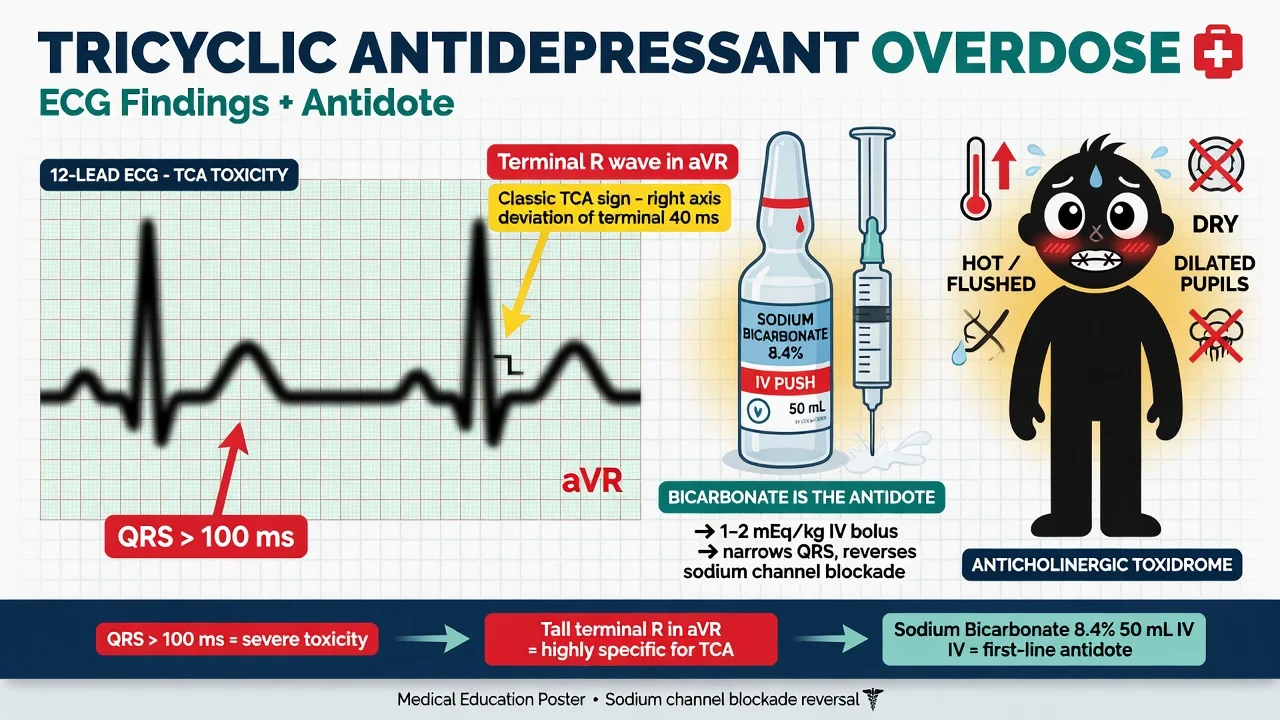
Tricyclic antidepressant poisoning — the fast sodium-channel blockade of the myocardium (the QRS over 100 ms, the right-axis deviation of the terminal R wave in aVR, the tachycardia), the anticholinergic toxidrome (the dry, the hot, the red, the dilated pupils, the urinary retention), the cardiovascular toxicity (the VT, the VF, the hypotension) and the CNS toxicity (the seizures, the coma). The management is sodium bicarbonate 8.4 per cent, 50 mL IV (1 to 2 mmol/kg), repeated to QRS narrowing and pH 7.45 to 7.55, with hyperventilation, IV fluid and a vasopressor; lipid emulsion 1.5 mL/kg of 20 per cent for refractory cardiovascular toxicity; and never flumazenil or a class Ia antiarrhythmic. ACEM-primary, globally tagged.
On this page & tools
Your progress
Saved locally on this device.
8 MCQs with explanations
Target exams
Red flags
Tricyclic antidepressant poisoning is the prototype of the membrane-stabilising, sodium-channel-blocking overdose. The Fellowship candidate must read it on the ECG before reading it on the patient: a widening QRS, a terminal R wave in aVR, and a tachycardia in a patient who is dry, hot, flushed and confused is tricyclic toxicity until proven otherwise, and the antidote is sodium bicarbonate. The danger is cardiovascular — ventricular tachycardia, ventricular fibrillation and refractory hypotension — and it is generated by blockade of the fast sodium channel in the myocardium, the same channel that the class Ia antiarrhythmics block. The candidate who reaches for procainamide or flumazenil has failed the topic.[1][3]
Definition and classification
A tricyclic antidepressant (TCA) is a drug whose three-ring central structure carries a side chain that confers reuptake inhibition of serotonin and noradrenaline at therapeutic dose. In overdose the structure matters far more than the indication: the drugs that kill do so through off-target pharmacology that is shared across the class. Amitriptyline, nortriptyline, imipramine, desipramine, clomipramine, dosulepin (dothiepin), doxepin and trimipramine are the classic agents; cyclobenzaprine (a muscle relaxant with a TCA skeleton), carbamazepine and the antimalarial quinine share the same fast-sodium-channel blockade and produce an identical cardiotoxic profile. The term cyclic antidepressant is sometimes preferred to acknowledge this structural family. Severity is graded by the ECG, not by the ingested dose, because absorption is unpredictable and the quoted milligram amount is usually wrong: a QRS over 100 ms, a terminal R wave in aVR, hypotension, arrhythmia, seizure or coma each mark a patient who needs bicarbonate now.[1][3]
Epidemiology and risk factors
Tricyclics remain a leading cause of fatal pharmaceutical overdose wherever they are still prescribed in volume. Amitriptyline carries the highest case-fatality among common antidepressants in ANZ and UK toxicosurveillance data, and dosulepin is comparably lethal per exposure. Risk factors for severe toxicity are a large ingested dose (over 10 to 20 mg/kg of amitriptyline is the traditional threshold for major toxicity), sustained-release or co-ingested membrane-stabilising drugs, pre-existing cardiac disease, the extremes of age, and co-ingestion of alcohol or other sedatives that deepen coma and obscure the examination. Children are exquisitely sensitive: a single adult tablet can produce a wide-QRS cardiotoxicity in a toddler. The deliberate self-harm context dominates — the typical patient is young, takes a handful of their own or a relative's tablets, and presents within one to four hours drowsy, tachycardic and dry.[1]
Pathophysiology
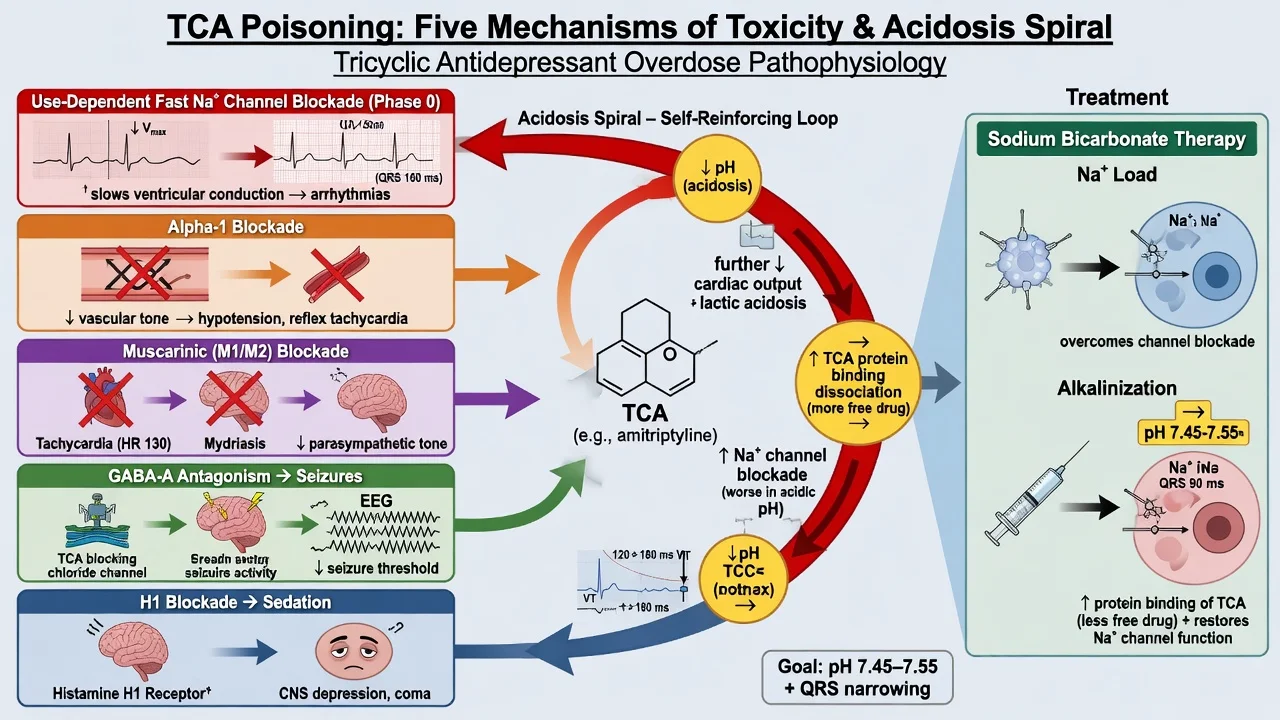
TCA toxicity is generated by five pharmacological actions, and the candidate must name the receptor, the tissue and the clinical consequence for each. The first and lethal action is use-dependent blockade of the fast voltage-gated sodium channel on the myocardial cell membrane — the channel that carries phase 0 depolarisation. The tricyclic binds preferentially when the channel is open and inactivated, so it accumulates in rapidly firing tissue; it slows the upstroke of the action potential, slows conduction through the His-Purkinje system and ventricle, and so produces QRS widening, re-entrant ventricular arrhythmia, and negative inotropy with hypotension. The second is alpha-1 adrenergic receptor blockade, causing vasodilatation and an orthostatic or absolute hypotension that often precedes the arrhythmia. The third is muscarinic acetylcholine receptor blockade, the source of the anticholinergic toxidrome — the dry, hot, flushed, dilated, tachycardic patient with an atonic bowel and bladder. The fourth is histamine H1 and GABA-A receptor antagonism: the H1 blockade contributes to sedation and coma, while GABA-A receptor antagonism in the central nervous system is the principal driver of the tricyclic-induced seizure, lowering the convulsive threshold independently of the sodium-channel effect. The fifth is serotonin and noradrenaline reuptake inhibition, which at therapeutic dose treats depression but in overdose contributes to the sinus tachycardia and, in the rare co-ingestion with a serotonergic agent, can tip the patient into serotonin toxicity. [1]
[1]Na+ channel (phase 0)
- Use-dependent blockade of fast voltage-gated sodium channel
- Slows phase-0 depolarisation and His-Purkinje conduction
- QRS >100 ms, terminal R in aVR, VT/VF, negative inotropy
- Lethal mechanism — bicarbonate is the antidote
Alpha-1 blockade
- Peripheral vasodilatation
- Orthostatic and absolute hypotension, often first sign
- Precedes arrhythmia in many patients
- IV crystalloid and norepinephrine
Muscarinic blockade
- Anticholinergic toxidrome
- Sinus tachycardia, dry/hot/flushed skin, mydriasis, ileus, retention
- Blind as a bat, mad as a hatter, red as a beet, hot as a hare, dry as a bone
- Discriminates from sympathomimetic (wet) and cholinergic (wet + bradycardic)
GABA-A antagonism
- CNS inhibition of inhibitory pathway
- Generalised tonic-clonic seizures
- Independent of Na-channel blockade; amoxapine/maprotiline most pro-convulsant
- Benzodiazepine first-line; seizures worsen acidosis → deeper channel blockade
H1 / SERT blockade
- H1: sedation, somnolence, coma; SERT/NET: serotonin and noradrenaline reuptake inhibition
- Sinus tachycardia, mild pressor effect, sedation
- Rare serotonin toxicity if co-ingested serotonergic agent
- Supportive; benzodiazepine and cyproheptadine if serotonergic
Clinical presentation
The presentation is the anticholinergic toxidrome laid over a poisoned myocardium. The candidate should expect a reduced conscious level ranging from mild drowsiness to deep coma, a sinus tachycardia that is partly anticholinergic and partly reflex, and dry, flushed, warm skin with dilated pupils and an empty bladder on catheterisation. The classic anticholinergic mnemonic captures it: blind as a bat, mad as a hatter, red as a beet, hot as a hare, dry as a bone, the bowel and the heart run wild, and the full bladder fails to drain. [1]
Anticholinergic toxidrome of TCA poisoning
DRY-AS-A-BONE
Dry mucousae, anhidrosis, absent axillary sweat
Reflex vasodilatation gives a flushed, red skin
Anhidrotic fever from impaired sweating, severe cases only
Agitation, picking, mumbling — the mumbling, picking patient
Vagolysis plus reflex drive
Pupils large and poorly reactive
Hypoactive bowel sounds, urinary retention
Sedation from H1 blockade, declining to coma
Dry axillae are the bedside discriminator from cholinergic/sympathomimetic states
Catheter returns little — retention not oliguria
The cardiovascular findings are the dangerous ones: an initial sinus tachycardia gives way to a wide-complex tachycardia, then monomorphic ventricular tachycardia, torsades de pointes, ventricular fibrillation, or a pre-terminal bradycardia and asystole as conduction collapses. Hypotension from combined alpha-1 blockade and negative inotropy may be the first abnormal sign. Central nervous system toxicity ranges from delirium through generalised tonic-clonic seizures to coma; seizures are most frequent with amoxapine and maprotiline and they themselves worsen acidosis, deepening the sodium-channel blockade into a self-perpetuating spiral.[3]
Differential diagnosis
The differential is the wide-sodium-channel-blocker overdose, the anticholinergic toxidrome, and the toxic-metabolic cause of a reduced conscious level with a tachycardia. The QRS widening and the aVR sign are the decisive discriminators: only other sodium-channel blockers reproduce them. [1]
TCA poisoning
- Wide QRS over 100 ms with terminal R in aVR, sinus tachycardia
- Dry, hot, flushed, dilated pupils, urinary retention (anticholinergic)
- Sodium bicarbonate is the antidote
- Amitriptyline, nortriptyline, dosulepin, imipramine, clomipramine
Other sodium-channel blockers
- Same wide-QRS cardiotoxicity and aVR sign
- Anticholinergic features absent (carbamazepine may cause ataxia/nystagmus)
- Class Ia/Ic antiarrhythmics, cocaine, carbamazepine, lamotrigine, quinine, diphenhydramine, venlafaxine
- Bicarbonate still first-line; identify the agent on history
Sympathomimetic / cocaine toxicity
- Tachycardia, hypertension, mydriasis, agitation, hyperthermia
- Wet (diaphoretic) skin, bowel sounds present — opposite of anticholinergic
- QRS can widen with high-dose cocaine (Na-channel), but predominantly a pressor picture
- Benzodiazepine first-line; avoid beta-blocker (unopposed alpha)
Anticholinergic plants / antihistamines
- Same dry-hot-red-blind toxidrome
- QRS usually narrow unless a membrane stabiliser co-ingested
- Atropine, hyoscine, jimsonweed (Datura), oxybutynin, first-generation antihistamines
- Supportive; physostigmine rarely, sedation and cooling mainstays
Serotonin toxicity
- Clonus (inducible or spontaneous), hyperreflexia, myocriasis, hyperthermia
- Wet, tremulous, rigid lower limbs; not dry-anticholinergic
- On a serotonergic agent within hours
- Benzodiazepine, cooling, cyproheptadine for moderate-to-severe
A reduced conscious level with a tachycardia should also prompt paracetamol, salicylate and ethanol levels and a glucose, because the patient who took a tricyclic often took more than one agent, and the mixed overdose is the rule rather than the exception. [1]
Bedside assessment
The first assessment is resuscitative and reads the ECG in parallel with the airway. Establish airway patency and give high-flow oxygen to the obtunded patient; secure two large-bore cannulae and attach continuous cardiac monitoring and a waveform capnography line before any sedation. Take the history from paramedics, family and the patient's own tablet bottles: the agent, the estimated dose, the time of ingestion and any co-ingestants, especially a benzodiazepine, an opioid, alcohol, a serotonergic drug or another sodium-channel blocker. The focused examination looks for the anticholinergic stigmata (dry axillae and mucousae, flushed skin, mydriasis, hypoactive bowel sounds, a palpably full bladder), the haemodynamic profile (the hypotensive, wide-complex patient is pre-arrest), and the neurological state — the conscious level is serially tracked by the eye, verbal and motor responses of the Glasgow Coma Scale (GCS), the pupil size and reactivity, the reflexes, and clonus to exclude co-existing serotonin toxicity. A bedside glucose is mandatory in any reduced-conscious-level overdose, and a temperature is taken early because severe hyperthermia changes management toward aggressive cooling.[3]
Investigations
A 12-lead ECG is the single most important investigation and must be obtained and interpreted within minutes of arrival, then repeated every 30 to 60 minutes until the QRS has returned to under 100 ms. The four findings to name are sinus tachycardia, QRS duration over 100 ms, right-axis deviation of the terminal 40 milliseconds manifested as a terminal R wave in aVR of 3 mm or more or an R/S ratio in aVR over 0.7, and QT prolongation; with severe toxicity the tracing deteriorates to a broad bizarre wide-complex tachycardia that can masquerade as ventricular tachycardia. A venous or arterial blood gas is taken at the same time for the pH (the target for therapy is 7.45 to 7.55), the potassium and the lactate, and to follow the acidosis that seizures and shock generate. Paracetamol and salicylate levels are sent on every overdose, a beta-hCG in any female of reproductive age, and a TCA level is essentially never useful acutely because toxicity correlates with the ECG, not the concentration; the drug has a large volume of distribution and is highly protein-bound. A chest film looks for aspiration, and a CT brain is reserved for the patient whose coma or focal signs are disproportionate to the toxidrome or who fails to wake as expected.[1][2]
ECG thresholds that demand sodium bicarbonate
ECG interpretation in depth
The 12-lead ECG is both the diagnostic instrument and the risk-stratification tool in TCA poisoning, and every Fellowship candidate must be able to read it from memory. Severity is graded by the QRS duration: under 100 ms is low risk, 100 to 160 ms is moderate risk with a rising probability of arrhythmia, and over 160 ms is high risk of seizures and ventricular arrhythmia. The QRS narrows or widens in near-real-time with the serum sodium concentration and pH, so it is the most sensitive bedside marker of response to bicarbonate — re-measure it after every bolus. The terminal R wave in aVR (3 mm or more, or an R/S ratio over 0.7) reflects right-axis deviation of the terminal 40 ms of the QRS and is the most specific single predictor of sodium-channel blockade; its presence after tricyclic ingestion predicts seizure and arrhythmia with a sensitivity that exceeds any blood-level measurement.[7]
Reading the ECG in suspected TCA poisoning
Rate and rhythm
QRS duration
Terminal R wave in aVR
QT and PR intervals
Pattern evolution
Pre-terminal patterns
Immediate management and resuscitation
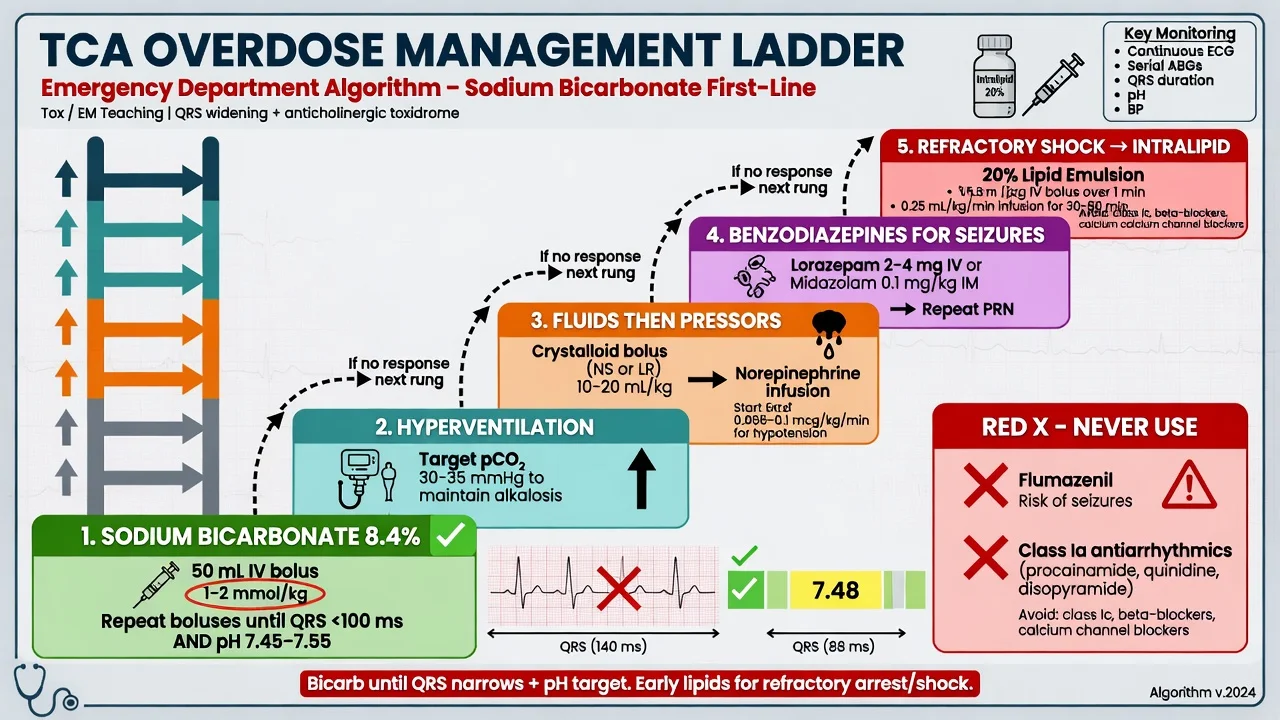
Resuscitation is the sodium-channel blockade treated at the source. The airway is secured and ventilation established; in the wide-complex patient this is the moment to hyperventilate to a pH of 7.45 to 7.55 because respiratory alkalosis adds to serum alkalinisation. Two large-bore cannulae are placed and cardiac monitoring is continuous. The decisive drug is sodium bicarbonate 8.4 per cent, 50 mL intravenously (1 to 2 mmol/kg), given as a rapid bolus for any QRS over 100 ms, any ventricular arrhythmia, or hypotension not corrected by fluid; the bolus is repeated every few minutes until the QRS narrows to under 100 ms and the pH reaches 7.45 to 7.55.[2][3] A maintenance infusion of 100 mmol sodium bicarbonate in 1 litre of 5 per cent dextrose, run at 1 to 2 mL/kg per hour, holds the alkalinisation. Intravenous fluid — a 10 mL/kg bolus of crystalloid repeated to effect — treats the vasodilatory component of the hypotension, and a vasopressor is added early: norepinephrine 0.05 to 0.5 micrograms/kg per minute is preferred over dopamine or dobutamine because the tricyclic already blocks noradrenaline reuptake and pure beta-agonists worsen the tachycardia and the vasodilatation. Magnesium sulphate 2 g IV over 10 minutes is the agent for torsades de pointes.[1]
[1]Seizures are treated with a benzodiazepine — lorazepam 4 mg IV, diazepam 10 mg IV, or midazolam 5 to 10 mg IV — repeated to control. Phenytoin and fosphenytoin are avoided because they are themselves sodium-channel blockers with an uncertain effect on the tricyclic myocardium, and high-dose propofol is used with caution because its negative inotropy can deepen the shock. Activated charcoal 50 g (1 g/kg) is given only if the patient is awake and protecting their airway and presents within one to two hours of ingestion, or after a definitive airway is in place in the intubated patient; it is never prioritised over bicarbonate in the wide-complex patient. Whole-bowel irrigation is reserved for massive ingestion of a sustained-release preparation, which is rare for the tricyclic class. Haemodialysis is ineffective: the tricyclic is highly tissue-bound with a volume of distribution of 10 to 20 L/kg, so extracorporeal removal does not change the course.[1]
Model answer — first 10 minutes of a wide-QRS amitriptyline overdose
Airway, high-flow oxygen, left lateral position if obtunded; call for senior and toxicology. Continuous cardiac monitoring, 12-lead ECG now and every 30 minutes, waveform capnography, two large-bore cannulae. Bedside glucose, VBG for pH/potassium/lactate, paracetamol and salicylate levels, beta-hCG. Sodium bicarbonate 8.4 per cent 50 mL IV bolus (1 to 2 mmol/kg), repeated to QRS under 100 ms and pH 7.45 to 7.55; hyperventilate intubated patient to the same target. IV crystalloid 10 mL/kg, then norepinephrine infusion 0.05 to 0.5 micrograms/kg per minute for refractory hypotension. Lorazepam 4 mg IV for seizures. Do NOT give flumazenil, procainamide, amiodarone as class-Ia substitute, or phenytoin. Prepare lipid emulsion if bicarbonate, fluid and vasopressor fail.
Escalation ladder for refractory TCA cardiotoxicity
Sodium bicarbonate bolus
Hyperventilation
IV crystalloid and vasopressor
Sodium bicarbonate infusion
Hypertonic saline
IV lipid emulsion 20 per cent
ECMO / cardiopulmonary bypass
Sodium bicarbonate
- First-line antidote — raises Na+ and alkalinises
- 1 to 2 mmol/kg bolus, repeat to QRS <100 ms and pH 7.45 to 7.55
- Proven by decades of observational and mechanistic evidence
- Give for any QRS >100 ms, arrhythmia, or hypotension
Hypertonic saline 3%
- Adjunct — supplies sodium without further alkali load
- For refractory QRS widening despite bicarbonate
- Supported by Paksu et al. animal and human data
- Caution: hypernatraemia, volume overload
IV lipid emulsion 20%
- Rescue therapy — lipid sink sequesters lipophilic TCA
- 1.5 mL/kg bolus then 0.25 mL/kg/min infusion
- After bicarbonate + fluid + vasopressor fail
- Risk: pancreatitis, ARDS, fat embolism (rare)
ECMO / bypass
- Last-resort bridge in refractory shock or arrest
- Buys time for drug redistribution
- Requires tertiary centre and cannulation team
- Survival reported even after prolonged arrest
Flumazenil / class Ia / phenytoin
- CONTRAINDICATED — formally harmful
- Flumazenil precipitates seizures; Ia/Ic and phenytoin worsen Na+ blockade
- These are the wrong answers on the exam
- Never give in TCA overdose
Definitive management and escalation
Definitive care is the maintenance of serum alkalinisation and the escalation ladder for refractory cardiotoxicity. Once the QRS has narrowed on boluses, a sodium bicarbonate infusion — 100 mmol of 8.4 per cent in 1 litre of 5 per cent dextrose at 1 to 2 mL/kg per hour, or 0.5 to 1 mmol/kg per hour — holds the pH between 7.45 and 7.55, with the rate titrated to serial QRS measurements and blood gases for at least 12 to 24 hours after the last arrhythmia, because tricyclics redistribute back out of tissue and re-widening is well described.[2] Hypertonic saline 3 per cent is a reasonable adjunct when bicarbonate alone fails to narrow the QRS, supplying additional sodium load. If the patient progresses to refractory ventricular arrhythmia or shock despite bicarbonate, fluid and a vasopressor, the next step is intravenous lipid emulsion 20 per cent, 1.5 mL/kg as a bolus over one minute, followed by an infusion of 0.25 mL/kg per minute for 30 to 60 minutes (a second bolus of 1.5 mL/kg can be given for persistent instability, to a maximum of about 12 mL/kg). Lipid creates a plasma lipid sink that sequesters the lipophilic tricyclic and reduces its free concentration at the channel; the 2026 Clinical Toxicology Recommendations Collaborative places lipid as the rescue therapy after standard measures.[1] Cardiopulmonary bypass, extracorporeal membrane oxygenation and intra-aortic balloon pumping are the final bridge for the patient in refractory shock or arrest, buying time for the drug to redistribute; transvenous pacing is generally ineffective because the problem is channel blockade at the myocyte, not failure of impulse generation.
The two drugs the candidate must refuse to give are flumazenil and a class Ia antiarrhythmic. Flumazenil lowers the seizure threshold and, in the mixed tricyclic-benzodiazepine overdose, precipitates refractory convulsions and wide-complex arrhythmia; the benzodiazepine the patient has co-ingested is partially protecting them and must not be reversed. Procainamide, quinidine and disopyramide (class Ia), and flecainide (class Ic) worsen the very sodium-channel blockade that is killing the myocardium and are formally contraindicated; amiodarone is not a clean substitute either. Lidocaine (class Ib) is the only antiarrhythmic occasionally considered for refractory VT, but it is controversial and second-line to bicarbonate and magnesium. Phenytoin is avoided for the same reason as the class Ia drugs. [1]
Subtypes and specific scenarios
Individual tricyclics vary in their toxicity profile and the candidate should know the three exam-favoured distinctions. Amoxapine is the most pro-convulsant of the class and produces seizures with relatively little cardiotoxicity, yet the seizures themselves generate acidosis that then deepens the sodium-channel blockade. Maprotiline is a tetracyclic with a similar pro-seizure, pro-arrhythmia profile and a long half-life that prolongs monitoring. Dosulepin (dothiepin) is disproportionately lethal per exposure in UK and ANZ data and carries a high rate of wide-complex arrhythmia at modest doses. Doxepin is potent at histamine blockade and produces profound sedation. The structurally-related non-antidepressants must be recognised as TCA-equivalent in overdose: cyclobenzaprine (a muscle relaxant), carbamazepine and quinine all block the fast sodium channel and present with the same wide-QRS, aVR-positive cardiotoxicity, managed identically with sodium bicarbonate.[3] The mixed overdose dominates practice: a tricyclic with ethanol deepens the coma, with a benzodiazepine raises the flumazenil trap, with a serotonergic agent adds clonus and rigidity, and with an opioid adds a respiratory acidosis that must be corrected to protect the alkalinisation strategy.
Complications and pitfalls
The preventable deaths in TCA poisoning come from three errors. The first is reaching for an antiarrhythmic or for flumazenil instead of bicarbonate — both are formally harmful and both are listed as wrong answers on the exam. The second is under-resuscitating the hypotension: the wide-complex hypotensive patient needs an early, adequate bicarbonate load, fluid and a vasopressor, not a watch-and-wait approach; a single sub-therapeutic bicarbonate bolus followed by observation is a common failure mode. The third is failing to control seizures, which generate a lactic acidosis that deepens channel blockade into a spiral toward cardiac arrest — benzodiazepines are given promptly and to effect. Other pitfalls include intubating without hyperventilating to the alkalaemic target (losing the alkalinisation benefit), giving activated charcoal to a drowsy unprotected airway with subsequent aspiration, mistaking a wide-complex TCA tachycardia for straightforward VT and shocking repeatedly when the antidote is bicarbonate, and discharging the patient before a stable six-hour observation window with a normal ECG. Hyperthermia from severe anticholinergic toxicity or from sustained seizure is treated with benzodiazepines and evaporative cooling; antipyretics are useless because the mechanism is muscular and central, not prostaglandin-driven. [1]
Prognosis and disposition
The prognosis is excellent for the patient who receives bicarbonate before cardiac arrest: survival with full neurological recovery is expected even after ventricular tachycardia or a brief cardiac arrest, provided the myocardium is unblocked promptly. Death, when it occurs, is from refractory shock or arrhythmia in the first 12 hours, almost always in the patient who presented late or in whom the antidote was delayed. The disposition rule is straightforward: any patient with a QRS over 100 ms, an arrhythmia, hypotension, a seizure or a reduced conscious level is admitted to a monitored bed, usually intensive care, for at least 12 to 24 hours after the last bicarbonate bolus. The patient who is asymptomatic with a normal ECG at six hours after ingestion may be cleared medically and referred for psychiatric assessment — late decompensation beyond the six-hour window is rare and should prompt a search for a co-ingestant or a sustained-release preparation.[1] Every deliberate self-harm ingestion receives a mental-health and risk assessment before discharge.
Special populations
Children are exquisitely sensitive to the tricyclic myocardium: a single adult tablet of amitriptyline (25 to 75 mg) can produce life-threatening cardiotoxicity in a toddler, and any paediatric ingestion warrants a minimum of six hours of cardiac monitoring and an ECG, with bicarbonate at the first sign of QRS widening. The elderly patient with ischaemic heart disease, conduction disease or pre-existing bundle branch block tolerates the additional sodium-channel blockade poorly and decompensates at lower doses; the ECG baseline must be read against their normal. The pregnant patient is managed identically — sodium bicarbonate and lipid are not contraindicated in pregnancy, and the maternal circulation is resuscitated first because the foetus dies if the mother arrests. The patient on long-term tricyclic therapy for chronic pain or depression has tolerance to the sedative and anticholinergic effects but no tolerance to the cardiotoxicity, so a similar overdose produces a deceptively alert patient with a wide QRS. The renal or hepatic impairment does not meaningfully change acute management because the drug is largely tissue-redistributed rather than acutely eliminated.[3]
Evidence and regional guidelines
The evidence base has matured from mechanistic and observational studies to a formal recommendations document. The 2026 Clinical Toxicology Recommendations Collaborative guidance on tricyclic antidepressant poisoning consolidates the international position: sodium bicarbonate as first-line for cardiotoxicity, hypertonic saline as adjunct, lipid emulsion as rescue therapy, and explicit avoidance of class Ia antiarrhythmics, phenytoin and flumazenil.[1] Pai and colleagues demonstrated the dose-response of serum alkalinisation on QRS narrowing, providing the quantitative basis for the pH target of 7.45 to 7.55.[2] The mechanistic and clinical framework, including the aVR sign and the use-dependent sodium-channel model, traces to the targeted-management reviews of the late 1990s that remain the clearest statement of the receptor-channel-clinical triad.[3] There are no randomised trials of bicarbonate versus placebo in human overdose and there will not be, because the observational and mechanistic evidence is overwhelming and equipoise is absent; the regional guidelines (ANZ Toxicology Recommendations Collaborative, UK NPIS/Toxbase, US AACTE position statements, European EAPCCT) are concordant on every point that appears on the Fellowship exam.
Clinical Toxicology Recommendations Collaborative — TCA poisoning (2026)
PMID 41906697
International expert consensus recommendations
Key finding
Sodium bicarbonate remains first-line for cardiotoxicity; lipid emulsion is the rescue therapy after standard measures; flumazenil and class Ia antiarrhythmics are formally contraindicated.
Practice change
The definitive international position statement — the backbone of exam answers on TCA management.
Optimising alkalinisation and QRS narrowing (Pai et al., 2022)
PMID 34312917
Prospective observational cohort
Key finding
Demonstrated a quantifiable dose-response between serum alkalinisation and QRS narrowing, establishing the pH 7.45 to 7.55 target on empirical data.
Practice change
Provides the quantitative basis for the pH endpoint used worldwide — the exam figure of 7.45 to 7.55 traces to this work.
Relative lethal toxicity of substances (Brett, Isbister et al., 2019)
PMID 31173392
16-year population-based toxicosurveillance study
Key finding
Tricyclic antidepressants, especially amitriptyline and dosulepin, carry among the highest case-fatality rates of any pharmaceutical overdose, confirming their disproportionate lethality per exposure.
Practice change
Why TCA poisoning is a high-stakes topic: per-exposure lethality exceeds most other pharmaceuticals and justifies aggressive early antidotal therapy.
SAQ — Tricyclic antidepressant overdose with cardiotoxicity
10 minutes · 10 marks
A 32-year-old woman is brought to the ED 90 minutes after ingesting 5 g of amitriptyline in a deliberate overdose. She is drowsy but rousable (GCS 12). HR 128, BP 84/52, RR 14, SpO2 96 per cent on room air. ECG shows a sinus tachycardia with a QRS duration of 140 ms and a dominant R wave in lead aVR.
SAQ — The mixed overdose with the anticholinergic toxidrome
10 minutes · 10 marks
A 45-year-old man presents after an unknown overdose 2 hours ago. He is agitated, confused and hallucinating. Examination: T 38.6, HR 140, BP 150/90, dry mucousae, flushed skin, dilated pupils, a full bladder on examination and reduced bowel sounds. ECG: QRS 120 ms, QT 480 ms.
Exam pearls
- The ECG is the diagnosis and the monitor: a QRS over 100 ms with a terminal R wave in aVR after tricyclic ingestion is cardiotoxicity — treat with sodium bicarbonate, do not wait for the patient to deteriorate.
- Sodium bicarbonate 8.4 per cent 50 mL IV (1 to 2 mmol/kg), repeated to QRS under 100 ms and pH 7.45 to 7.55; then an infusion of 100 mmol in 1 litre of 5 per cent dextrose at 1 to 2 mL/kg per hour.
- Lipid emulsion 20 per cent 1.5 mL/kg bolus then 0.25 mL/kg per minute is the rescue therapy for refractory shock or arrhythmia after bicarbonate, fluid and norepinephrine.
- Never give flumazenil (precipitates seizures in mixed overdose) or a class Ia antiarrhythmic (procainamide, quinidine, disopyramide) — they worsen the sodium-channel blockade that is killing the patient.
- Hypotension: IV crystalloid 10 mL/kg, then norepinephrine 0.05 to 0.5 micrograms/kg per minute — avoid dopamine and dobutamine.
- Seizures: lorazepam 4 mg IV or diazepam 10 mg IV; avoid phenytoin. Correct any acidosis and hypoxia because they deepen channel blockade.
- The dry, hot, flushed, dilated, mumbling patient with a tachycardia is anticholinergic — and if the QRS is wide, the diagnosis is tricyclic until proven otherwise.
- Six hours symptom-free with a normal ECG clears the patient medically; late decompensation means look for a co-ingestant. [1]
Red flags
[1]References
- [1]Hoegberg LCG, Yates C, Bedina-Rać Z, et al. Recommendations from the Clinical Toxicology Recommendations Collaborative on the administration of activated charcoal in acute oral overdose Clin Toxicol (Phila), 2026.PMID 41906697
- [2]Pai K, Roberts DM, Tofhgari A, et al. Optimising alkalinisation and its effect on QRS narrowing in tricyclic antidepressant poisoning Br J Clin Pharmacol, 2022.PMID 34312917
- [3]Liebelt EL, Francis PD, Woolf AD. Targeted management strategies for cardiovascular toxicity from tricyclic antidepressant overdose: the pivotal role for alkalinization and sodium loading Pediatr Emerg Care, 1998.PMID 9733258
- [4]Brett J, Wylie CE, Raubenheimer J, Isbister GK, et al. The relative lethal toxicity of pharmaceutical and illicit substances: A 16-year study of the Greater Newcastle Hunter Area, Australia Br J Clin Pharmacol, 2019.PMID 31173392
- [5]Hwang Y, Sohn JT. Effect of lipid emulsion on neuropsychiatric drug-induced toxicity: A narrative review Medicine (Baltimore), 2024.PMID 38489675
- [6]Paksu MS, Zengin H, Ilkaya F, Paksu S, et al. Can empirical hypertonic saline or sodium bicarbonate treatment prevent the development of cardiotoxicity during serious amitriptyline poisoning? Experimental research Cardiovasc J Afr, 2015.PMID 25939777
- [7]Paksu S, Duran L, Altuntas M, Zengin H, et al. Amitriptyline overdose in emergency department of university hospital: evaluation of 250 patients Hum Exp Toxicol, 2014.PMID 24505046