EM · Paediatric sepsis and septic shock
Paediatric sepsis and septic shock (the septic child in the emergency department)
Also known as Paediatric sepsis · Septic shock in children · Paediatric septic shock · Phoenix sepsis criteria · Sepsis six in children
Paediatric sepsis is the dysregulated host response to infection producing life-threatening organ dysfunction, now defined (2024 Phoenix criteria) as suspected infection plus a Phoenix Sepsis Score of 2 or more, with septic shock adding cardiovascular dysfunction. The Fellowship-critical recognition rests on age-specific physiological thresholds — the tachycardia, the tachypnoea, and the hypotension that is systolic below 70 plus 2 times the age in years for a child under 10 and below 90 for a child over 10 — and on the perfusion signs of mottled skin, a capillary refill over 3 seconds and an altered mental state. The management is the first-hour bundle: fluid boluses of 10 to 20 mL per kilogram of balanced crystalloid (titrated, up to 40 to 60 mL per kilogram), early intravenous antibiotics within the hour (ceftriaxone 50 to 75 mg per kilogram; cefotaxime plus ampicillin in the neonate), vasopressors (adrenaline 0.05 to 0.5 mcg per kilogram per minute for cold shock), and intubation for refractory shock. Children differ from adults in the weight-based dosing, the higher heart-rate thresholds and the earlier need for intubation. The differential is meningococcaemia, Kawasaki disease and the serious bacterial illnesses. ACEM-primary, globally tagged.
On this page & tools
Your progress
Saved locally on this device.
5 MCQs with explanations
Target exams
Red flags
Related topics
- Paediatric fever and serious bacterial illness (the febrile child in the emergency department)
- Sepsis and septic shock — the emergency department approach
- Fluid resuscitation in the emergency department
- Vasoactive drugs in resuscitation
- Meningitis and encephalitis (emergency department diagnosis and management)
- Community-acquired pneumonia
- DKA, HHS and hypoglycaemia
Paediatric sepsis is the dysregulated, life-threatening host response to infection that produces organ dysfunction, and septic shock is its haemodynamic endpoint. The child who dies of sepsis usually dies of unrecognised, untreated or under-resuscitated shock, and the Fellowship candidate's job at the bedside is three things at once: recognise the age-specific physiological decompensation that a child conceals until late, deliver the first-hour bundle (fluid, antibiotics, vasoactive support) without delay, and titrate every intervention against the reassessment. The margins are narrow — a child can lose a quarter of their circulating volume with an unchanged blood pressure, then crash in minutes — and the dosing is weight-based throughout. The 2020 Surviving Sepsis Campaign paediatric guideline and the 2024 Phoenix sepsis definition are the two contemporary frameworks that govern recognition and management.[1][2][3]
Definition and classification
Sepsis in children was historically defined (the 2005 Goldstein consensus) as the systemic inflammatory response syndrome (SIRS) plus suspected or proven infection, with septic shock adding cardiovascular dysfunction unresponsive to a fluid bolus. That definition depended on SIRS — the tachycardia, the temperature abnormality, the white-cell shift — and was found to be neither sensitive nor specific for the sick child. The 2024 international consensus replaced it with the Phoenix criteria, which drop SIRS and define paediatric sepsis as suspected infection plus a Phoenix Sepsis Score of 2 or more, and septic shock as sepsis plus at least one point of cardiovascular dysfunction. The Phoenix score grades dysfunction across four organ domains — respiratory, cardiovascular, coagulation and neurological — and was validated to predict mortality more accurately than the old SIRS definition in over three million paediatric encounters.[2][3]
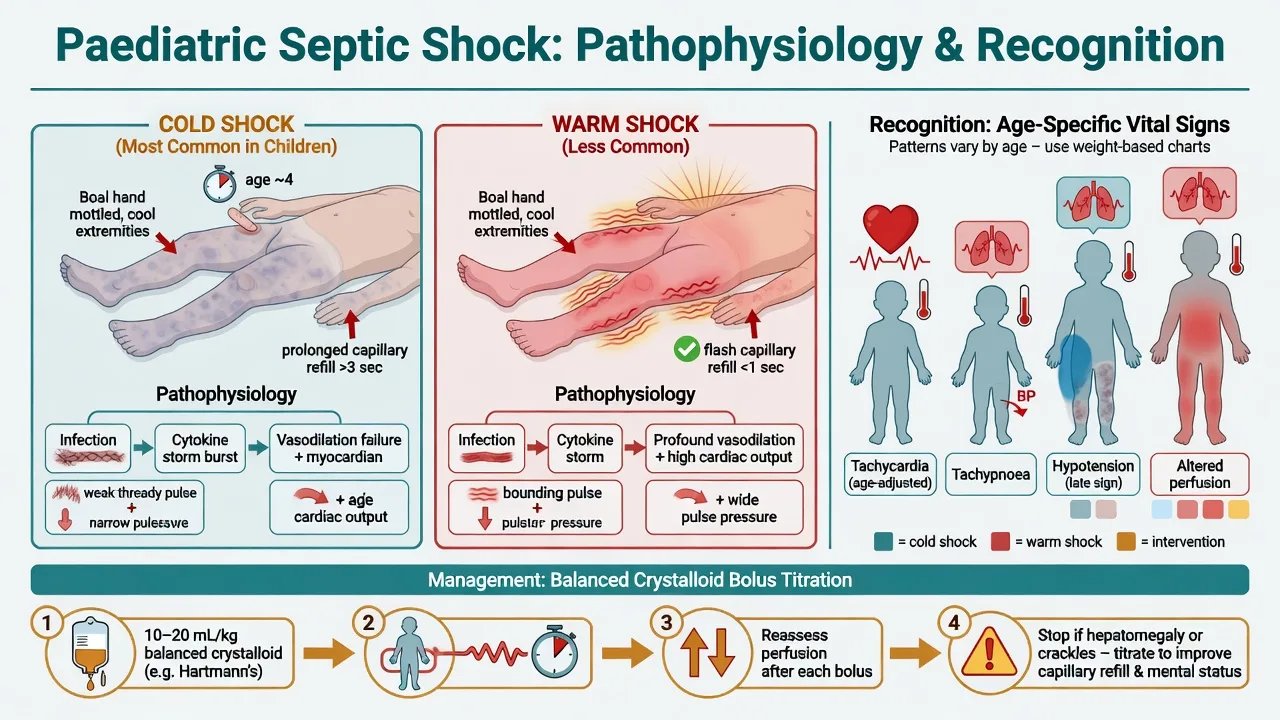
The clinical classification that matters in the resuscitation bay is the haemodynamic one. Compensated shock describes a child with a normal blood pressure but with perfusion failure — tachycardia, prolonged capillary refill, mottled skin, altered mentation — and is far more common than the lay reader would guess. Decompensated shock is the state in which the blood pressure has finally fallen, and it is a late, pre-arrest sign in children. The further distinction is between cold shock (low cardiac output, high systemic vascular resistance — the cold, mottled, thready-pulse child, the commonest pattern in paediatric sepsis) and warm shock (high output, low resistance — the warm, vasodilated, flash-capillary-refill child, seen in older children and in late, vasoplegic disease). The pattern determines the first vasoactive agent.[1]
Pathophysiology
The septic cascade begins when a pathogen-associated molecular pattern (endotoxin, teichoic acid) binds the innate immune receptor, releasing tumour necrosis factor, interleukin-1 and interleukin-6 within hours. The cytokine surge drives endothelial activation, glycocalyx shedding, capillary leak and nitric-oxide-mediated vasodilation; the consequent distributive shock is compounded by myocardial depression (a circulating myocardial depressant substance reduces contractility), hypovolaemia from third-space losses, and disordered microvascular flow with mitochondrial dysfunction. The end-organ injury — acute kidney injury, acute respiratory distress syndrome, disseminated intravascular coagulation, encephalopathy — is the product of hypoperfusion, inflammation and disordered cellular oxygen use. [1]
The paediatric cardiovascular system explains why shock is so often missed early. Cardiac output is the product of heart rate and stroke volume; the infant's stroke volume is fixed by a poorly compliant, less contractile ventricle, so the only lever available to maintain output is heart rate. A child therefore compensates for hypovolaemia and vasodilation with tachycardia and intense peripheral vasoconstriction, holding the blood pressure normal until 25 to 30 per cent of circulating volume is lost. The blood pressure falls last, and the first sign of decompensation is more often a rising heart rate, a prolonged capillary refill, a cool periphery and an altered mental state than a falling blood pressure. This is why the vital-sign thresholds and the perfusion examination — not the blood pressure — drive recognition.[1]
Epidemiology and risk factors
Sepsis remains among the leading causes of childhood death worldwide, with the burden heaviest in the first year of life and in the immunocompromised. The causative organisms track with age. The neonate under 28 days is prey to group B streptococcus, Escherichia coli and Listeria monocytogenes — the maternal-genital-tract flora that mandate cefotaxime plus ampicillin. The infant and older child acquire pneumococcus, meningococcus, Staphylococcus aureus, group A streptococcus and the enteric gram-negatives; Haemophilus influenzae type b re-enters the differential in the under-vaccinated. The common foci are pneumonia, urinary tract infection, meningitis, the abdominal sepsis (appendicitis, intussusception), skin and soft-tissue infection, and device-related infection in the child with a central line. Risk factors that raise the pre-test probability and lower the threshold to treat are an indwelling central venous catheter, neutropenia or immunosuppression, asplenia or sickle-cell disease, a congenital urinary tract anomaly, a neuromuscular disability impairing secretion clearance, and any chronic complex condition. The mortality of paediatric septic shock reaches 5 to 10 per cent in the intensive-care setting and concentrates in the neonate, the immunocompromised, and the child who presents late.[1][3]
Clinical presentation
The history and examination are designed to find the infected, decompensating child within the first minutes. The paediatric assessment triangle — appearance, work of breathing, and circulation to the skin — is observed before the child is touched and tells the experienced clinician instantly whether the child is sick. The sick septic child looks abnormal: listless or irritable, with a reduced interaction, a cool mottled skin, and a rapid grunting respiration. The vital signs are interpreted against the age-specific thresholds, because a heart rate of 130 is normal in a neonate and a marker of shock in a ten-year-old. [1]
Age-specific vital sign thresholds for paediatric sepsis
The classic shock signs are a prolonged capillary refill above three seconds, mottled or cold skin, weak or thready peripheral pulses with a widened pulse pressure in warm shock or a narrowed one in cold shock, an altered mental state (irritability, lethargy, confusion), oliguria, and — in meningococcaemia — the non-blanching petechial or purpurial rash. Hypotension is the late sign and signals decompensated, pre-arrest shock. A febrile child who is tachycardic for age, cool peripherally, and not interacting is in compensated septic shock until proven otherwise; the threshold to act is the perfusion deficit, not the blood pressure.[1][2]
Differential diagnosis
Paediatric sepsis is the leading diagnosis in any unwell febrile or shocked child, but several mimics share its presentation and several conditions coexist with or precipitate it. The Fellowship candidate must distinguish the infected-shocked child from the cardiogenic, hypovolaemic and obstructed child at the bedside, because the empiric therapy diverges. [1]
Meningococcaemia
- Rapidly progressive febrile illness with a non-blanching petechial or purpuric rash, classically Neisseria meningitidis
- Meningitis features (photophobia, neck stiffness, altered mental state) may or may not coexist; bacteraemia alone produces purpura fulminans and DIC
- Ceftriaxone 50 to 75 mg per kilogram IV immediately, fluid resuscitation, intubation for shock, notify public health, chemoprophylaxis of close contacts
- The examinational archetype of paediatric septic shock — purpura, shock, and rapid deterioration within hours
Kawasaki disease
- Fever for 5 days or more plus 4 of 5: bilateral non-purulent conjunctivitis, polymorphous rash, oral changes, extremity changes, cervical lymphadenopathy
- Can present in shock (Kawasaki shock syndrome) mimicking sepsis; raised inflammatory markers and CRP
- Intravenous immunoglobulin 2 g per kilogram and aspirin within 10 days to prevent coronary aneurysm; not an antibiotic problem once cultures are drawn
- Hold both diagnoses simultaneously — a febrile child over 5 days gets the septic screen and is assessed for Kawasaki
Serious bacterial illness (SBI)
- The occult urinary tract infection, lobar pneumonia, occult bacteraemia, osteomyelitis and septic arthritis that seed the septic response
- Distinguished by the focused source on history and examination — the urine, the chest, the irritable limb
- Source-targeted antibiotics plus the sepsis bundle when the child is shocked
- Sepsis is the endpoint of an untreated SBI; the search for the source runs in parallel with resuscitation
Cardiogenic shock (myocarditis)
- A recent viral illness, tachycardia disproportionate to fever, a gallop rhythm, hepatomegaly, cool peripheries; the chest X-ray shows cardiomegaly and pulmonary oedema
- No fever or a low-grade fever; raised troponin; echo shows poor function
- Cautious fluids (5 mL per kilogram aliquots), inotropes early, avoid fluid overload, cardiology referral
- A bolus in cardiogenic shock can precipitate pulmonary oedema — always examine for the gallop and the hepatomegaly before fluids
Hypovolaemic shock / DKA
- A history of vomiting, diarrhoea, haemorrhage, or polyuria and polydipsia with ketoacidosis; dry mucous membranes, no fever
- DKA produces abdominal pain, Kussmaul breathing and a metabolic acidosis with ketones and a high glucose
- DKA pathway with careful fluid and insulin; haemorrhagic shock with blood; gastroenteritis with isotonic saline
- A shocked child with a high glucose is DKA until proven otherwise — but sepsis can precipitate DKA, so draw cultures
Anaphylaxis
- Sudden onset after an allergen exposure, urticarial rash, angioedema, stridor, wheeze and hypotension; no fever
- Biphasic response; a history of allergy or a recent food, drug or sting
- Intramuscular adrenaline 10 mcg per kilogram (0.01 mL per kilogram of 1 in 1000), fluid, repeat adrenaline
- A shocked child with a rash is not always sepsis — the timing and the urticaria distinguish anaphylaxis
Bedside assessment
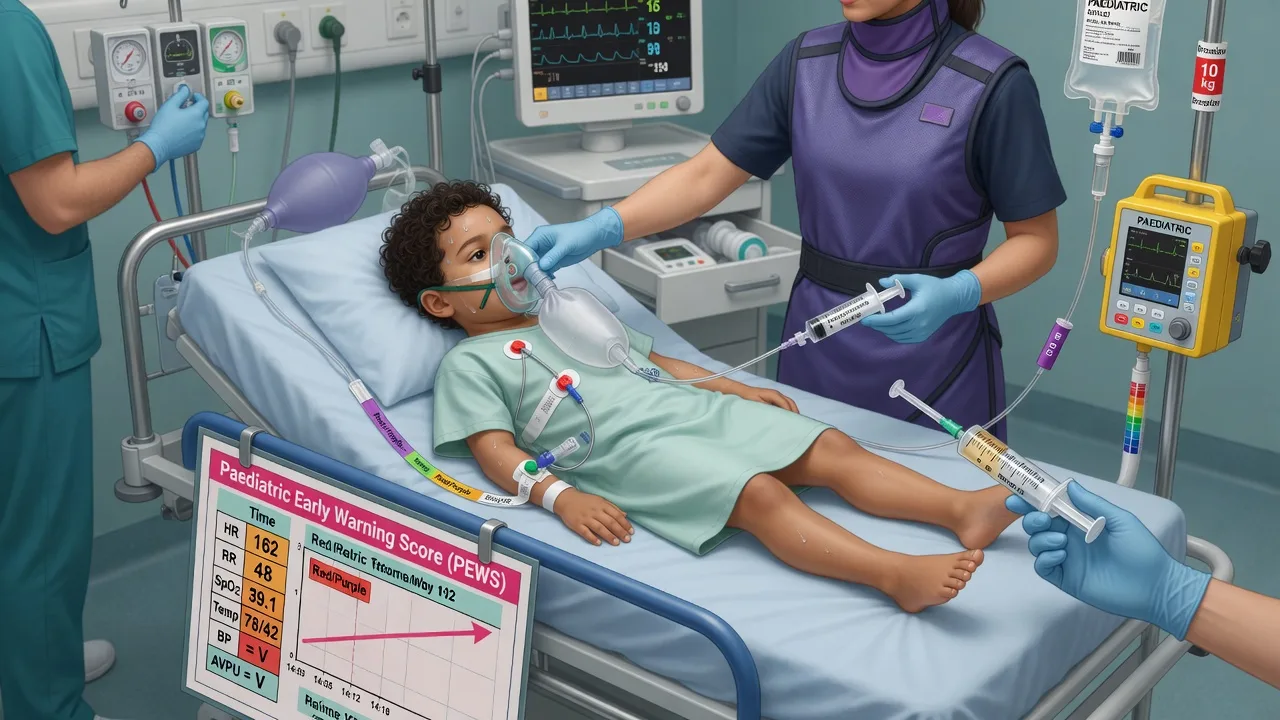
The bedside assessment combines the paediatric assessment triangle with the age-corrected vital signs and a perfusion-focused examination. Observe the appearance (alert and interactive, or irritable, listless and unresponsive), the work of breathing (the rate, the recession, the grunting, the nasal flaring), and the circulation to the skin (the colour, the warmth, the capillary refill). Then measure the temperature, the heart rate and the respiratory rate against the age-specific thresholds, the oxygen saturation, and the blood pressure — remembering that a normal blood pressure in a tachycardic, mottled child does not exclude shock. Examine for the source: the ears and throat, the chest, the abdomen, the urine, every joint, the skin for a rash, and the central nervous system. Grade the consciousness with AVPU — Alert, responds to Voice, responds to Pain, Unresponsive — and track it serially. The paediatric early warning score operationalises the vital-sign deviation into a track-and-trigger escalation, and a child who triggers on two or more age-corrected vital signs is presumed septic until the workup says otherwise.[2][3]
Investigations and the Phoenix score
The investigations run in parallel with — never before — the first fluid bolus and the antibiotic. A venous or capillary gas gives the immediate lactate, the pH, and the base deficit; a lactate above 2 mmol per litre signals tissue hypoperfusion and a rising lactate after fluids predicts mortality. A full blood count and CRP, coagulation and fibrinogen (for disseminated intravascular coagulation), urea, electrolytes, creatinine, glucose (hypoglycaemia is common and dangerous), liver function, and blood cultures are drawn before the antibiotic whenever practical but never delay it. A urinalysis and urine culture are obtained by catheter or suprapubic aspirate, never by bag, in the unwell child, and a chest radiograph is taken for respiratory signs or an occult source. A lumbar puncture is performed when meningitis is suspected and the child is stable; it is deferred, never the antibiotic, in the shocked or comatose child, and performed later once the child is resuscitated. Procalcitonin is more sensitive than CRP for an invasive bacterial infection and supports the decision to continue antibiotics.[1]
The Phoenix Sepsis Score grades four organ domains and defines the diagnosis. The respiratory domain scores the PaO2 to FiO2 ratio (or the oxygen saturation to FiO2 ratio) and the need for ventilatory support. The cardiovascular domain scores the lactate, the vasoactive medication requirement and the mean arterial pressure. The coagulation domain scores the platelet count and the international normalised ratio, D-dimer or fibrinogen. The neurological domain scores the level of consciousness using an age-appropriate coma scale. A score of 2 or more (out of a maximum of 9) on the Phoenix criteria, in a child with suspected infection, defines sepsis; the addition of cardiovascular dysfunction (at least one cardiovascular point) defines septic shock. The Phoenix score predicts in-hospital mortality better than the old SIRS criteria and is the contemporary benchmark for paediatric sepsis research and audit.[2][3]
Immediate management and resuscitation
The first hour is the hour that decides outcome. The bundle — recognise, resuscitate, antibiotics, source control, escalate — is delivered in parallel, with the reassessment after every intervention. Secure the airway and give high-flow oxygen to any child in shock or respiratory distress. Establish intravenous access within 90 seconds, or an intra-osseous line after two failed attempts or 90 seconds — the intra-osseous route delivers drugs, fluid and blood as effectively as a central line. Send the cultures if they can be drawn without delaying the antibiotic, then give the first dose of antibiotics within the first hour.[1][4]
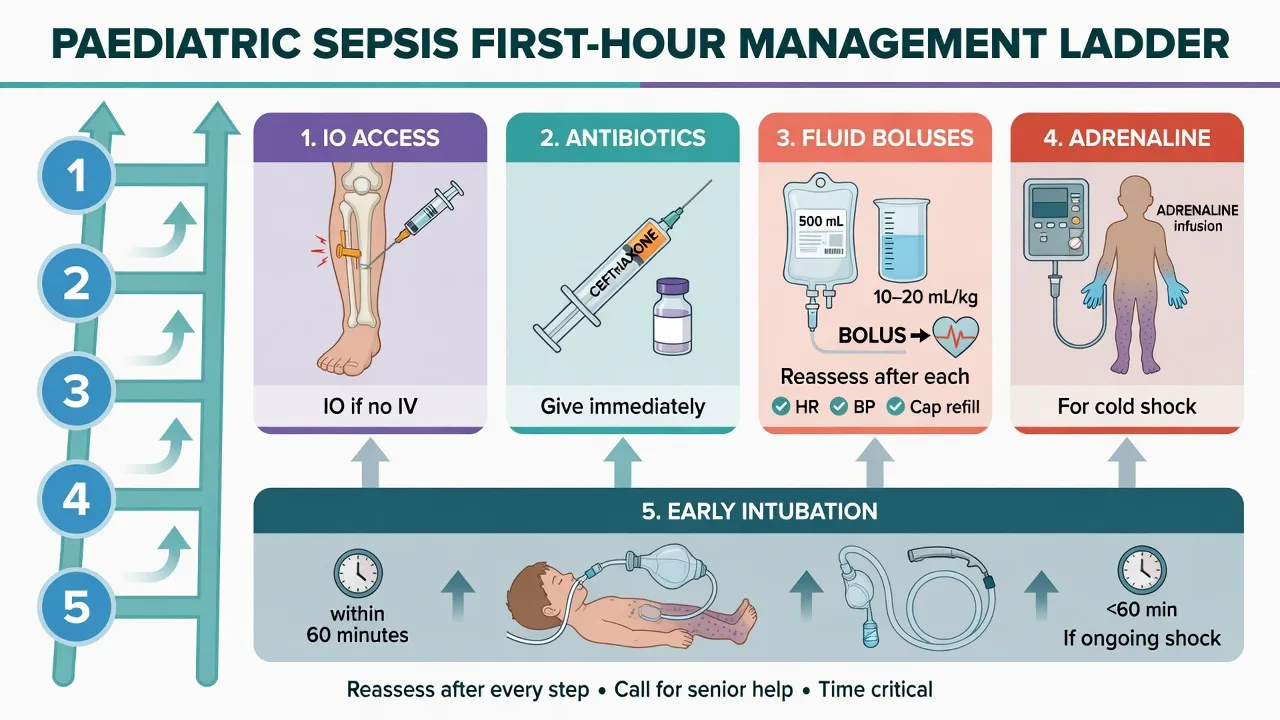
Fluid resuscitation uses a balanced crystalloid (Hartmann's solution or Plasma-Lyte, preferred over 0.9 per cent saline for the lower chloride and the lower risk of hyperchloraemic acidosis), given as 10 to 20 mL per kilogram boluses over 5 to 10 minutes, reassessed after each bolus against the perfusion, the heart rate, the capillary refill, the mental state, the liver size and the work of breathing. Up to 40 to 60 mL per kilogram may be given in the first hour in the shocked child, but the boluses are titrated and stopped at the first sign of fluid overload — hepatomegaly, a gallop rhythm, a rising work of breathing, or pulmonary crackles. The FEAST trial, conducted in resource-limited African children without access to intensive care, showed that unmonitored aggressive fluid boluses increased mortality compared with conservative fluid, and the lesson carried into the Surviving Sepsis Campaign: boluses are reassessed, not given as a blind large-volume push, and a child who is not clearing lactate or is developing hepatomegaly is escalated to vasoactive support rather than given more fluid.[1][4]
[1]Definitive management and drug doses
Once the first hour is delivered, the management escalates along the ladder of vasoactive support, intubation, hydrocortisone and source control. Antibiotics are the definitive infection therapy and are given within the first hour. The empiric regimen is ceftriaxone 50 to 75 mg per kilogram intravenously (maximum 2 g per day, up to 4 g per day in meningitis), which covers pneumococcus, meningococcus and the enteric gram-negatives. The neonate under 28 days receives cefotaxime 50 mg per kilogram intravenously plus ampicillin 50 mg per kilogram intravenously — ceftriaxone is avoided in the neonate for bilirubin displacement and biliary sludging, and the ampicillin covers Listeria. Vancomycin 15 mg per kilogram intravenously every 6 to 8 hours is added when a resistant organism, a central line infection or methicillin-resistant Staphylococcus aureus is suspected, and aciclovir 20 mg per kilogram every 8 hours is added when herpes simplex encephalitis is plausible. Vasoactive support is started early once the fluid limit is reached or the child is in refractory shock. Adrenaline 0.05 to 0.5 micrograms per kilogram per minute is the first-line agent for cold shock (the commonest pattern in children), improving contractility and systemic vascular resistance; noradrenaline 0.05 to 0.5 micrograms per kilogram per minute is first-line for warm shock (the vasodilated, flash-refill child). A central line is ideal but the agent can be run peripherally while central access is secured. Hydrocortisone 2 mg per kilogram intravenously (maximum 100 mg, then 50 to 100 mg per square metre per day) is considered for catecholamine-resistant shock or suspected adrenal insufficiency — the child on chronic steroids, the child with a known adrenal disorder, or the child with purpura fulminans. Intubation and mechanical ventilation is indicated for refractory shock, a falling conscious level, respiratory failure, or the child who is tiring from the work of breathing; the induction is dangerous in the shocked child, and ketamine 1 to 2 mg per kilogram intravenously (or etomidate) with rocuronium 1 mg per kilogram is a cardiovascular-stable regimen, with a fluid bolus or vasopressor running in case the induction drops the pressure. Source control — draining an abscess, removing an infected central line, relieving an obstruction — runs in parallel with the resuscitation.[1][4]
[1]Model answer — the first 60 minutes of paediatric septic shock
A 3-year-old with fever, mottled skin, capillary refill 5 seconds, heart rate 170, and a systolic blood pressure of 64 is in decompensated septic shock (the systolic is below 70 plus 2 times 3, which is 76). Apply oxygen, establish intravenous or intra-osseous access within 90 seconds, and draw blood cultures, a gas with lactate, full blood count, CRP, coagulation, glucose, electrolytes and a urine. Give ceftriaxone 75 mg per kilogram intravenously within the hour. Run in 20 mL per kilogram of Hartmann's solution over 10 minutes and reassess the perfusion, the capillary refill, the heart rate, the blood pressure, the mental state and the liver size; repeat up to 40 to 60 mL per kilogram in the first hour, stopping at hepatomegaly or a gallop. If shock persists, start adrenaline 0.05 to 0.5 micrograms per kilogram per minute peripherally while central access is secured. Intubate early with ketamine 1 to 2 mg per kilogram and rocuronium 1 mg per kilogram if the child tires, the conscious level falls, or the shock is refractory. Add hydrocortisone 2 mg per kilogram for catecholamine-resistant shock. Treat hypoglycaemia with 5 mL per kilogram of 10 per cent dextrose. Call the retrieval team and transfer to paediatric intensive care. [1]
Differences from adult sepsis
The Fellowship candidate is regularly asked to articulate the differences between paediatric and adult sepsis, and they fall into four groups. Weight-based dosing governs every drug, every fluid and every vasoactive infusion — the ceftriaxone is 50 to 75 mg per kilogram, the fluid is 10 to 20 mL per kilogram, and the adrenaline is dosed per kilogram per minute; the adult "1 g ceftriaxone and 1 litre of saline" does not apply, and the Broselow tape or the age-formula weight is used when the actual weight is unknown. The vital-sign thresholds differ: the heart-rate ceiling is far higher in the young child (above 160 in the neonate, above 100 in the adult), and the systolic-blood-pressure threshold is age-derived (below 70 plus 2 times age for under 10, below 90 for over 10) rather than the fixed adult 90. The blood pressure falls late: children compensate with tachycardia and vasoconstriction and maintain a normal blood pressure until a quarter of the volume is lost, so recognition rests on the perfusion signs rather than the blood pressure, and a normal blood pressure is not reassuring. Intubation is earlier: the child tires faster, the myocardium is less compliant, and the shock physiology deteriorates more rapidly, so the threshold to intubate and ventilate a septic child is lower than in the adult — both to reduce the work of breathing and to support the shocked circulation during vasoactive escalation.[1][4]
Subtypes and scenarios
Cold shock is the commonest haemodynamic pattern in paediatric sepsis and presents with a low cardiac output and a high systemic vascular resistance — the cool mottled skin, the weak thready pulses, a narrow pulse pressure, a prolonged capillary refill, and a low central venous oxygen saturation. Adrenaline is the first-line vasoactive. Warm shock is the vasoplegic pattern seen in older children and in late disease — the warm dry skin, the bounding pulses, a wide pulse pressure, and a flash capillary refill — and noradrenaline is first-line to restore vascular tone. Meningococcal septic shock is the archetype: a rapidly progressive febrile illness with a petechial or purpuric rash, purpura fulminans and disseminated intravascular coagulation, adrenal haemorrhage (the Waterhouse-Friderichsen syndrome, which underpins the role of hydrocortisone), and the need for ceftriaxone, fluid, vasoactive support and intubation within the first hours. Neonatal sepsis is governed by its own organism list (group B streptococcus, E. coli, Listeria) and its own antibiotic regimen (cefotaxime plus ampicillin), with ceftriaxone avoided. The neutropenic or immunocompromised child is treated as septic on arrival, with broadened empiric cover to include piperacillin-tazobactam or meropenem and an early decision on antifungal therapy. [1]
Complications and pitfalls
The complications are the organ failures the resuscitation is designed to prevent: acute respiratory distress syndrome from capillary leak and inflammatory injury, disseminated intravascular coagulation with purpura fulminans and digital ischaemia, acute kidney injury from hypoperfusion, hepatic dysfunction, and the septic encephalopathy that drives long-term cognitive morbidity. Fluid overload — pulmonary oedema and a worsened gas exchange from an overzealous fluid push — is the principal iatrogenic complication and is the lesson of the FEAST trial. The recurring pitfalls mirror the protocol's inversions. The first is waiting for hypotension before recognising shock — the blood pressure falls last in children, and the compensated phase is the window for intervention. The second is giving unmonitored fluid boluses without reassessing the liver and the work of breathing — a child can be drowned by the seventh bolus that the protocol never intended as a push. The third is delaying the antibiotic for the lumbar puncture or the imaging — the first dose is due within the hour, and the lumbar puncture is deferred, never the antibiotic. The fourth is the age-based dosing error — the adult dose given to a child, or the neonatal ceftriaxone given in error; the Broselow tape, the age-formula weight, and the drug card exist to prevent it. The fifth is failing to intubate early in the tiring child, mistaking the rising respiratory rate for compensation when it is exhaustion.[1][4]
Prognosis and disposition
Treated promptly, paediatric septic shock reverses over the first 24 to 48 hours, with the mortality sitting around 5 to 10 per cent in the intensive-care setting and rising sharply in the neonate, the immunocompromised and the child who presents late. Every child receiving fluid boluses, vasoactive support or intubation for septic shock is admitted to paediatric intensive care, with the retrieval service engaged early — the deteriorating septic child is retrieved to a centre that can deliver intensive care, not managed in a peripheral emergency department beyond the first hour. The disposition from the emergency department is therefore a decision about timing and transport: stabilise the first-hour bundle, secure the airway and the access, start the vasoactive agent, and hand over to the retrieval and intensive-care teams with the documented timeline of the resuscitation.[1]
Special populations
The neonate under 28 days is managed at the highest level of caution: any sepsis presentation receives cefotaxime plus ampicillin (never ceftriaxone), a full septic workup including the lumbar puncture when stable, and admission to a neonatal or paediatric intensive-care bed. The infant 1 to 3 months is amber by age and is managed with ceftriaxone 50 to 75 mg per kilogram if sepsis is suspected, with a low threshold for the septic screen. The immunocompromised, neutropenic or asplenic child is treated as septic on arrival at any age and any appearance — broadened empiric cover, early vasoactive support, and an aggressive search for the source. The child with a central line raises device-related infection to the top of the differential, and source control includes the removal of the line once access is secure. The under-vaccinated child brings Haemophilus influenzae type b back into the organism list and is a public-health notification when meningococcal or Hib disease is confirmed. [1]
Evidence and regional guidelines
The contemporary framework is the Surviving Sepsis Campaign International Guidelines for the Management of Septic Shock and Sepsis-Associated Organ Dysfunction in Children (Weiss and colleagues, 2020), which sets the first-hour bundle, the titrated 10 to 20 mL per kilogram fluid boluses, the early antibiotics, the early vasoactive support, the role of hydrocortisone and the threshold for intubation used throughout this topic.[1] The Phoenix criteria (Sanchez-Pinto and colleagues, 2024, and the Schlapbach international consensus) redefine paediatric sepsis as a Phoenix score of 2 or more and septic shock as sepsis with cardiovascular dysfunction, replacing the old SIRS definition with an organ-dysfunction construct that better predicts mortality.[2][3] The FEAST trial (Maitland and colleagues, 2011) is the landmark evidence on fluid resuscitation, demonstrating that aggressive unmonitored boluses increased mortality in resource-limited African children, and it reshaped the global approach toward titrated, reassessed fluid boluses and an early move to vasoactive support.[4]
ANZ practice note. The Australian and New Zealand paediatric and intensive-care pathways follow the Surviving Sepsis Campaign bundle and adopt the Phoenix definition for audit and research. The Royal Australasian College of Physicians and the state paediatric guidelines (the Queensland, New South Wales and Starship Child Health pathways) operationalise the first-hour bundle into a recogniser-to-retrieval flow, with weight-based dosing from the Broselow tape or the formula (age in years plus 4) times 2 in kilograms. Meningococcal disease is notifiable in all Australian states and New Zealand, and chemoprophylaxis of close contacts uses rifampicin or a single dose of ciprofloxacin. Retrieval is engaged early through the state retrieval services for any child receiving vasoactive support or intubation for sepsis. [1]
SAQ — fluid-refractory cold septic shock in a 3-year-old after 60 mL/kg
10 minutes · 10 marks
A 3-year-old, 14 kg girl is brought to the paediatric resuscitation bay febrile, mottled and unresponsive. Heart rate 178, respiratory rate 42, capillary refill 6 seconds, blood pressure 62/40 mmHg (age threshold 76), SpO2 90 per cent on room air, AVPU responds to pain. Capillary lactate is 5.6 mmol per litre. She has received three 20 mL per kilogram boluses of Hartmann's solution over the last 35 minutes; the last reassessment shows cool peripheries, a palpable liver edge 3 cm below the costal margin, and a respiratory rate that has risen from 32 to 46. Blood cultures are drawn, ceftriaxone 75 mg per kilogram has been given, and two peripheral cannulae are in place. The retrieval team is 90 minutes away.
SAQ — meningococcal septicaemia with purpura fulminans and DIC in a 6-year-old
10 minutes · 10 marks
A 6-year-old boy is brought to the emergency department with a 10-hour history of fever, vomiting and an evolving rash. He is drowsy and floppy, cool peripherally with mottled skin, heart rate 188, blood pressure unrecordable, capillary refill 8 seconds, AVPU responds to pain. A rapidly progressive non-blanching petechial and purpuric rash covers his trunk and limbs, with two large necrotic purpuric patches on the right thigh. Capillary glucose 3.8 mmol per litre, venous lactate 8.2 mmol per litre, INR 2.8, fibrinogen 1.1 g per litre, platelets 38 times 10 to the 9 per litre. Two peripheral cannulae are placed and high-flow oxygen applied.
Exam pearls
- A normal blood pressure does not exclude shock in a child — recognise the tachycardia, the mottled skin, the prolonged capillary refill and the altered mental state first; hypotension is a late, pre-arrest sign.
- The systolic blood-pressure threshold is below 70 plus 2 times the age in years for under 10, and below 90 for 10 and over.
- Heart-rate thresholds fall with age: above 160 under 1 year, above 150 in 1 to 2 years, above 140 in 2 to 5 years, above 120 in 5 to 12 years, above 100 over 12 years.
- Fluids are 10 to 20 mL per kilogram of balanced crystalloid, reassessed, up to 40 to 60 mL per kilogram in the first hour — stop at hepatomegaly, a gallop or a rising work of breathing.
- Antibiotics within the hour: ceftriaxone 50 to 75 mg per kilogram IV; cefotaxime plus ampicillin in the neonate; add vancomycin for line infection or MRSA.
- Adrenaline 0.05 to 0.5 mcg per kilogram per minute for cold shock (the commonest pattern); noradrenaline for warm shock; hydrocortisone 2 mg per kilogram for catecholamine-resistant shock.
- Intubate early with ketamine 1 to 2 mg per kilogram and rocuronium 1 mg per kilogram — the shocked child tires fast and the induction drops the pressure, so run a fluid bolus or vasopressor in.
- The Phoenix criteria (2024) define sepsis as suspected infection plus a Phoenix score of 2 or more, and septic shock as sepsis plus cardiovascular dysfunction. [1]
Red flags
[1]References
- [1]Weiss SL, Peters MJ, Alhazzani W, et al. Surviving sepsis campaign international guidelines for the management of septic shock and sepsis-associated organ dysfunction in children Intensive Care Med, 2020.PMID 32030529
- [2]Sanchez-Pinto LN, Bennett TD, DeWitt PE, et al. Development and Validation of the Phoenix Criteria for Pediatric Sepsis and Septic Shock JAMA, 2024.PMID 38245897
- [3]Schlapbach LJ, Weiss SL, Wolfier A, et al. International Consensus Criteria for Pediatric Sepsis and Septic Shock JAMA, 2024.PMID 38245889
- [4]Maitland K, Kiguli S, Opoka RO, et al. Mortality after fluid bolus in African children with severe infection N Engl J Med, 2011.PMID 21615299