EM · Radiation and chemical exposure
Radiation and chemical exposure
Also known as CBRN exposure · Acute radiation syndrome · Nerve agent poisoning · Sulfur mustard exposure · Chemical casualty management
Radiation and chemical exposure — the receiving-hospital side of a CBRN incident. The topic pairs two threats the Fellowship candidate must hold together: ionizing radiation, whose whole-body dose produces the acute radiation syndrome (prodromal nausea and vomiting within hours, marrow suppression and pancytopenia over days to weeks, cutaneous burns), and the chemical warfare and industrial agents — nerve agents that inhibit acetylcholinesterase, the vesicant sulfur mustard, and cyanide. The single most tested decision is decontamination before any casualty crosses the emergency-department threshold: remove the clothing to clear the majority of the contaminant, shower with water and soap, contain the runoff, and protect the staff in personal protective equipment. The antidotes are narrow and must be named with dose and route — atropine 2 mg and pralidoxime 30 mg per kilogram for the nerve agent, hydroxocobalamin 5 g for cyanide, and no antidote at all for mustard, where decontamination and supportive burns care are everything. ACEM-primary, globally tagged.
On this page & tools
Your progress
Saved locally on this device.
Target exams
Red flags
Radiation and chemical exposure is the receiving-hospital face of a CBRN (chemical, biological, radiological, nuclear) incident. The Fellowship candidate is tested as the team leader who holds three things at once: scene safety and staff protection, decontamination before the casualty crosses the department threshold, and recognition of the specific toxidrome that dictates the named antidote. The two halves of the topic divide cleanly — ionizing radiation, whose whole-body dose produces the acute radiation syndrome (ARS), and the chemical agents, which fall into the nerve agents (organophosphates), the blistering agent sulfur mustard, and cyanide. The decisions the examiner probes are narrow and dose-specific: atropine 2 mg and pralidoxime 30 mg per kilogram for the nerve agent, hydroxocobalamin 5 g for cyanide, decontamination alone for mustard, and supportive care with marrow-supporting cytokines and decorporation for the radiation casualty.[1][4]
Classification — radiation and the chemical agents
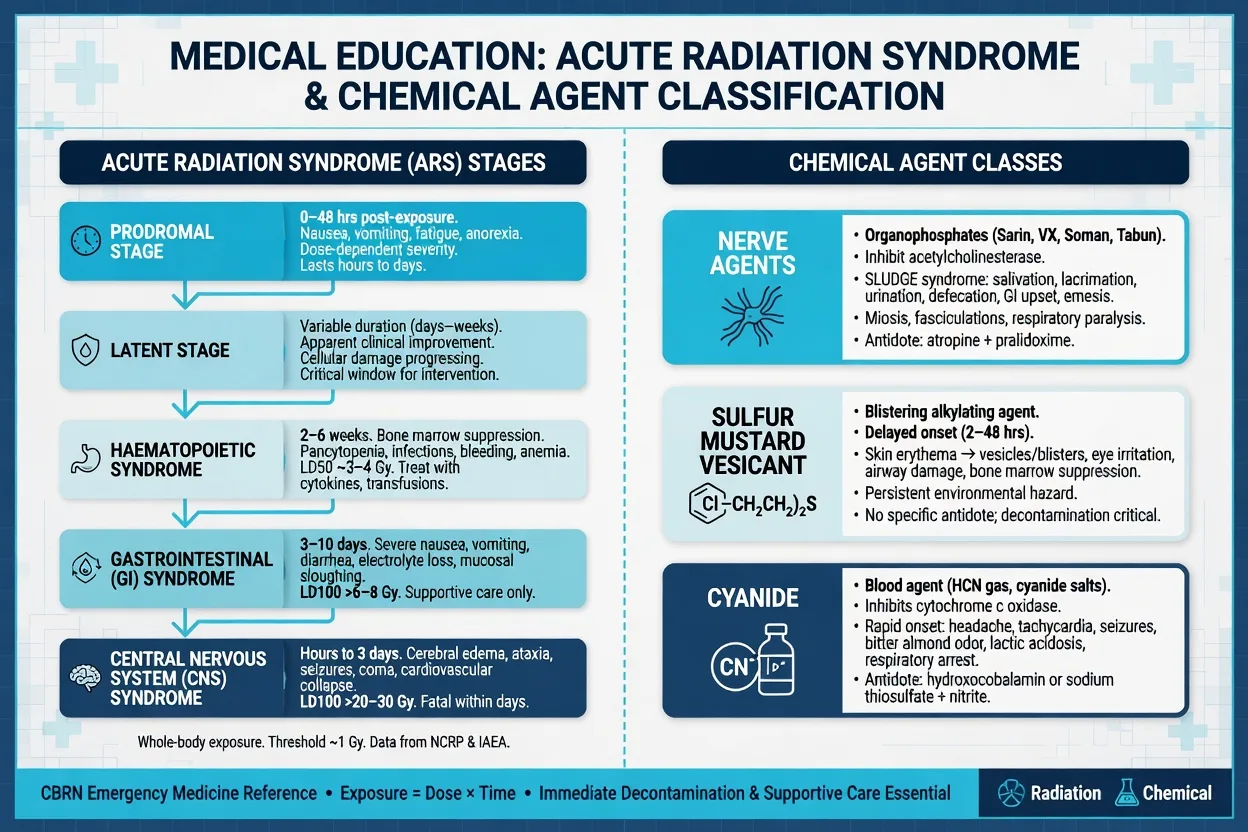
Ionizing radiation exposure is classified by the route and the target. Whole-body exposure produces the acute radiation syndrome; localised exposure (a source held against the skin, a fluoroscopy over-run) produces the cutaneous radiation injury; and internal contamination (ingestion, inhalation, wound contamination with a radioisotope) demands decorporation. The dose is measured in gray (Gy) — an absorbed dose — and is distinct from the sievert (Sv), the dose-equivalent that weights the biological effect of the radiation type.[1][3]
The chemical agents are grouped by their effect. The nerve agents — sarin, soman, tabun, cyclosarin and VX — are organophosphates that inhibit acetylcholinesterase and are far more potent and more rapidly aging than the agricultural insecticides. The blister agents (vesicants) — chiefly sulfur mustard (mustard gas, HD), and the Lewisites — alkylate tissue and produce delayed blistering of skin, eye and airway. The blood agents / asphyxiants — cyanide and the choking agents (chlorine, phosgene) — disable cellular respiration or the alveolar-capillary membrane.[4][6]
Pathophysiology — the three mechanisms
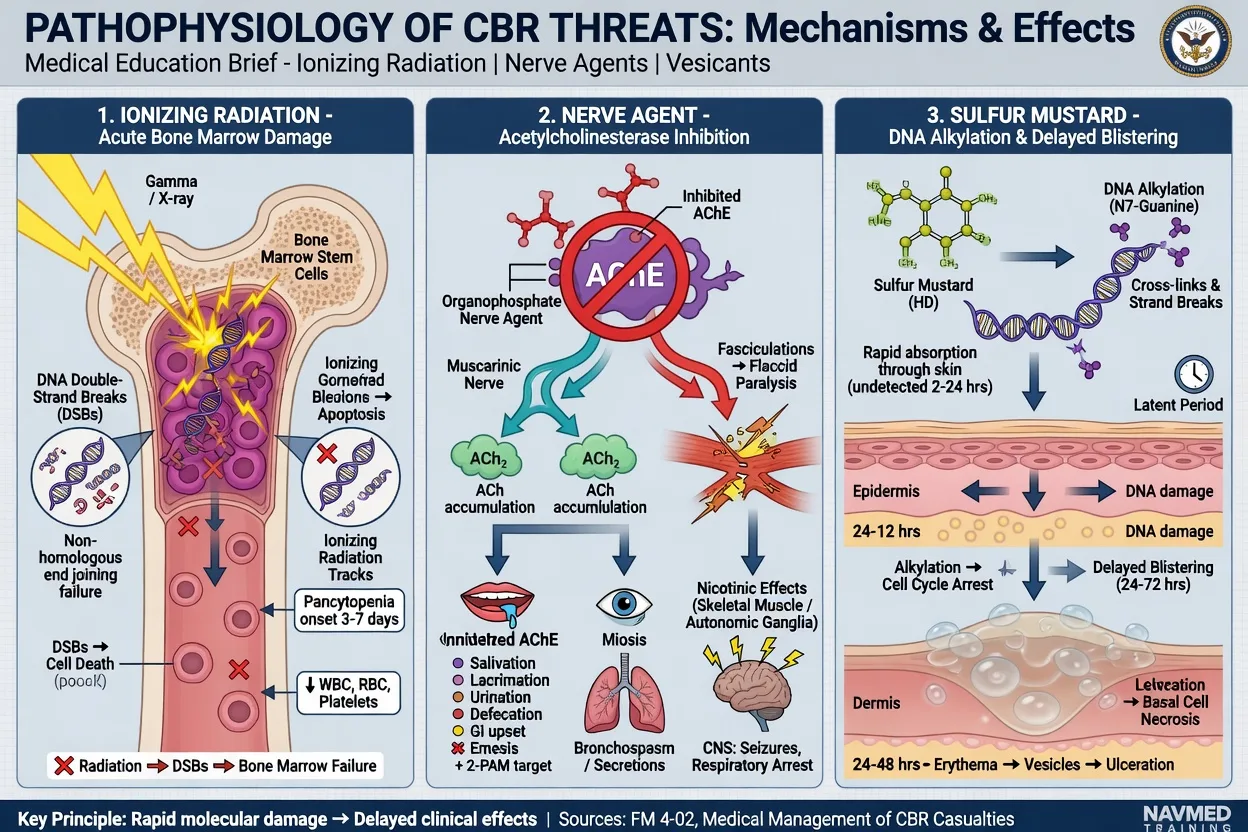
Radiation damages tissue by ionization, depositing energy that breaks DNA — most lethally the double-strand break. The cell-cycle kinetics govern the sensitivity: rapidly dividing tissues (marrow, gut mucosa, skin, gonads) fail first. Radiation injury is deterministic above a threshold dose (severity rises with dose, as in ARS and the cutaneous burn) and stochastic without a threshold (the probability of late cancer rises with dose).[1][3]
The three mechanisms in one chain
The nerve agent binds a serine hydroxyl on acetylcholinesterase, leaving acetylcholine to accumulate at every synapse — muscarinic (the SLUDGE secretions and miosis), nicotinic (the fasciculations, weakness and paralysis) and central (seizure and coma). The inhibited enzyme undergoes "aging" — irreversible loss of the binding site — at a rate that is agent-specific: soman ages within minutes, sarin within hours, VX over days. Pralidoxime reactivates the enzyme only before aging is complete, which is why it is time-critical for soman.[4][5] Sulfur mustard alkylates DNA and crosslinks strands, triggering inflammation and delayed vesication; its latent period of several hours means the casualties often arrive before the blisters appear.[6]
Acute radiation syndrome — prodrome, marrow and cutaneous injury
The acute radiation syndrome unfolds in phases over days to weeks and the severity tracks the dose. The prodromal phase (hours) is nausea, vomiting, diarrhoea and fatigue; the earlier and more severe the vomiting, the higher the dose. A latent phase of apparent wellbeing follows, then the manifest-illness phase, in which the dose determines which of three overlapping syndromes dominates.[1][2]
Hematopoietic (2 to 6 Gy)
- Marrow suppression — pancytopenia over 1 to 4 weeks
- Infection (neutropenia) and bleeding (thrombocytopenia) are the threats
- Cytokine support (G-CSF/pegfilgrastim), transfusion, antimicrobials; transplant in selected
- Survivable with intensive support
Gastrointestinal (6 to 10 Gy)
- Mucosal sloughing — bloody diarrhoea, fluid loss, sepsis
- Severe nausea, vomiting and electrolyte disturbance
- GI decontamination, fluid, antimicrobials; high mortality
- Overlaps with marrow suppression
Neurovascular (greater than 10 Gy)
- Hypotension, convulsions, ataxia, cardiovascular collapse
- Onset within hours; death in days
- The prodromal vomiting is immediate and profound
- Uniformly fatal — supportive and palliative
Cutaneous (local exposure)
- A source held against the skin — erythema, blistering, necrosis
- Distinguished from a thermal burn by the latent onset and the radiation history
- Surgical debridement, wound care, sometimes amputation
- May coexist with a lower whole-body dose
Chemical agent toxidromes
The nerve agent produces the cholinergic toxidrome in full. The muscarinic effects are summarised by DUMBELS — diarrhoea, urination, miosis, bronchospasm and bronchorrhoea, emesis, lacrimation, salivation. The nicotinic effects are the "days of the week" — muscle twitching, fasciculation, then flaccid paralysis, with cramping and weakness; the respiratory muscles are paralysed. The central effects are anxiety, confusion, seizure and coma. Miosis and bronchorrhoea are the bedside hallmarks that distinguish the nerve agent from other causes of collapse.[4][5]
DUMBELS
Sulfur mustard produces a latent, dose-dependent injury. After an asymptomatic interval of several hours the casualty develops skin erythema, then blistering (the bullae are filled with yellow fluid), eye inflammation (conjunctivitis to corneal ulceration) and an airway injury ranging from hoarseness to sloughing of the bronchial mucosa. There is no specific antidote, and the blistering continues to evolve after decontamination — management is supportive burns, airway and eye care.[6] Cyanide — whether released in a fire or as a deliberate agent — produces rapid collapse with a high lactate and is managed as in the cyanide topic, with empirical hydroxocobalamin.[7][8]
Differential diagnosis
The differential turns on the toxidrome and the source history, and the Fellowship candidate must distinguish the mimics because the management diverges sharply. [1]
Sepsis / septic shock
- Fever, source, inflammatory response; hypotension
- Lactate raised but usually lower; lymphocytes normal or reactive
- No cluster, no contamination, normal cholinesterase
- Antibiotics, fluids, source control, vasopressors
Organophosphate insecticide
- Identical cholinergic toxidrome; agricultural exposure
- Slower aging — pralidoxime has a longer window
- Single casualty, occupational or ingestion history
- Same atropine + pralidoxime regimen
Opioid / sedative overdose
- Coma with small pupils but no secretions or fasciculations
- No bronchorrhoea, no miosis response pattern; respiratory depression
- Responds to naloxone; no cluster
- Naloxone titrated to respiratory rate
Heat illness / heat stroke
- Hot environment, hyperthermia, confusion, anhidrosis or sweating
- No miosis or bronchorrhoea; normal cholinesterase
- Elevated creatine kinase and transaminases
- Rapid cooling, fluids, supportive
Carbon monoxide (smoke)
- Enclosed-space fire; coexists with cyanide
- Headache, confusion; COHb elevated on co-oximetry
- No cholinergic features; no radiation history
- 100% oxygen, treat coexistent cyanide empirically
The decisive discriminator in the chemical casualty is the pattern: a cluster of casualties with shared symptoms (miosis, bronchorrhoea, blistering, collapse) and a common exposure points to a released agent, and the specific toxidrome — cholinergic for the nerve agent, delayed vesicant for mustard, rapid histotoxic collapse for cyanide — selects the antidote. [1]
Bedside assessment and decontamination
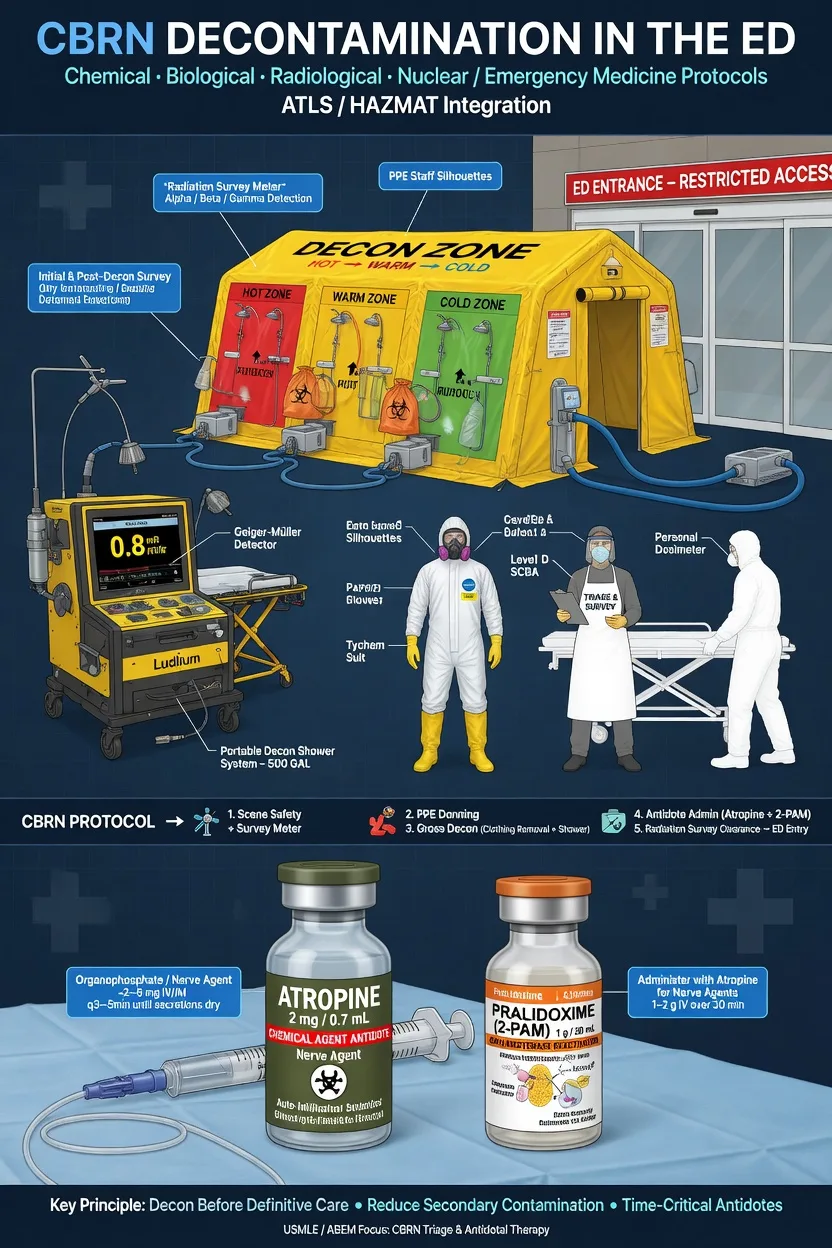
Decontamination precedes the formal ABCDE survey. The candidate must verbalise the sequence before any casualty crosses the department threshold: establish a controlled warm decontamination zone outside, brief the team into personal protective equipment (Level A for an unknown high-hazard vapour with a self-contained breathing apparatus; Level B with SCBA for a known liquid splash; Level C with an air-purifying respirator when the agent and concentration are known), and accept the casualty into the zone. Remove the clothing — this alone clears the majority of the external contamination. Then shower the casualty with warm water and soap, working head-down so contaminated water does not run across the face, and contain the runoff for safe disposal.[3][6]
[1]Only once decontaminated does the casualty enter the resuscitation bay for the ABCDE survey. Airway — secure early for the mustard airway injury or the cyanotic collapse. Breathing — 100 per cent oxygen for the cyanide and the nerve-agent casualty (the bronchorrhoea is treated by atropine). Circulation — IV access, fluids for the hypotension of the neurovascular radiation syndrome or the mustard fluid loss. Disability — document the Glasgow Coma Scale, reproduced because the depth of coma determines the urgency of the airway and the antidote: eye opening (4 spontaneous, 3 to speech, 2 to pain, 1 none), verbal response (5 oriented, 4 confused, 3 words, 2 sounds, 1 none) and motor response (6 obeys, 5 localises, 4 withdraws, 3 flexion, 2 extension, 1 none) for a maximum of 15; record the pupils (miosis for the nerve agent), the blood glucose, and terminate any seizure with a benzodiazepine. [1]
[1]Investigations and radiation biodosimetry
In the radiation casualty the absolute lymphocyte count is the bedside biodosimeter. Lymphocytes circulate and are radiosensitive, so their rate of fall over the first 24 to 48 hours reflects the marrow dose via the Andrews lymphocyte-depletion curve. A lymphocyte count that halves or falls below 0.5 times 10⁹ per litre within 24 hours implies a supralethal dose and a poor prognosis; a count that remains near normal over 48 hours implies a sublethal exposure.[1][3]
The key investigations
A full panel is sent in parallel: a complete blood count and film for the baseline marrow and the lymphocyte trend, electrolytes and renal function, a blood gas for the acid-base status and the lactate, a 12-lead ECG, a beta-hCG in any woman of childbearing age, and — in the suspected chemical release — a red-cell cholinesterase for the nerve agent (it recovers slowly and confirms the diagnosis retrospectively). In the radiation casualty, dosimetry is refined later by cytogenetic chromosomal analysis (dicentric assay), the radiation dose estimate at the scene, and any personal dosimeter reading. [1]
Immediate management — resuscitation and the antidotes
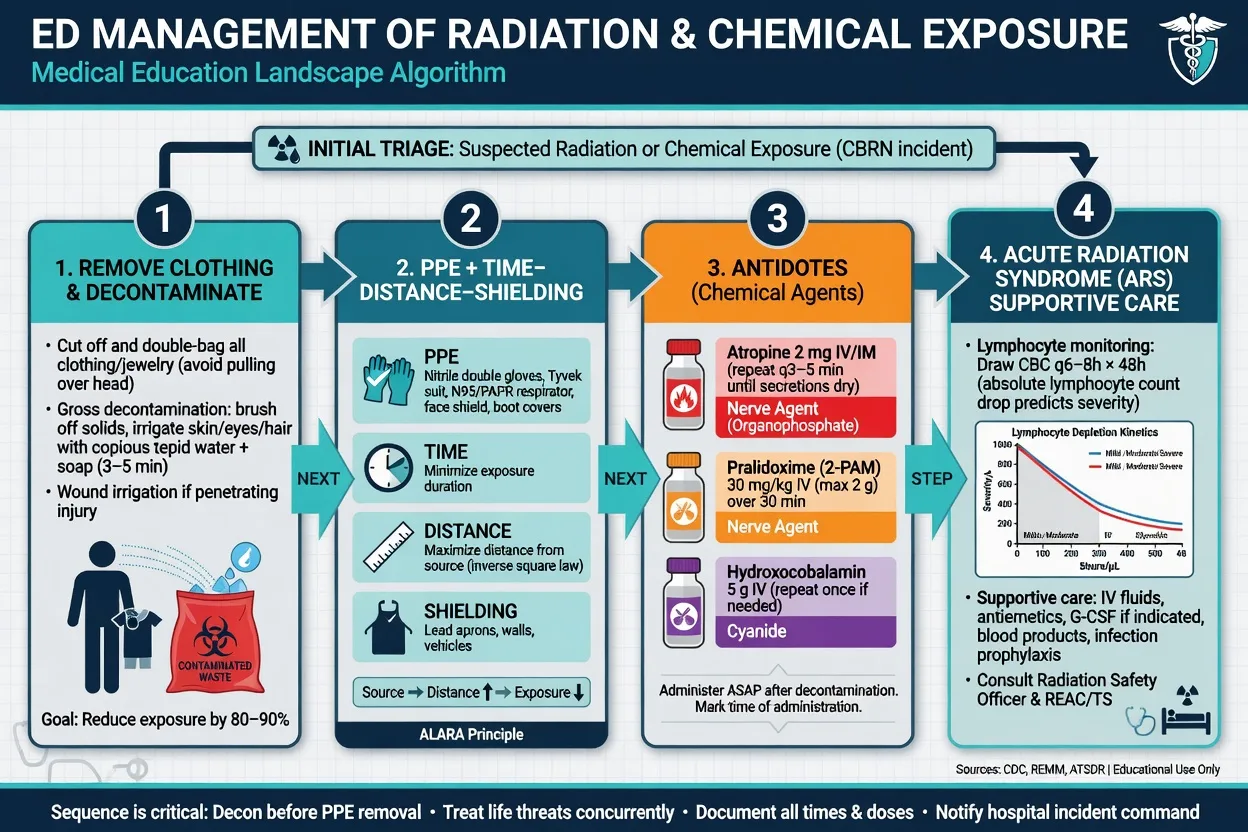
Resuscitation follows ABCDE after decontamination, with 100 per cent oxygen as the universal first treatment for the chemical casualty. The named antidotes are narrow and must be given by dose and route. [1]
The named antidotes
For the nerve-agent casualty the regimen is atropine 2 mg intravenously or intramuscularly, repeated every three to five minutes until the secretions dry and the bronchospasm resolves (atropinisation — titrate to the chest, not to the pupil, which may remain constricted), combined with pralidoxime 30 mg per kilogram intravenously (adult 1 to 2 g, maximum 50 mg per kilogram) given early before the enzyme ages, and a benzodiazepine for any seizure.[4][5] For the cyanide casualty the antidote is hydroxocobalamin 5 g intravenously over 15 minutes (child 70 mg per kilogram) — preferred because it causes neither hypotension nor methaemoglobinaemia — with sodium thiosulfate for the severe case.[7][8]
Radiation — supportive care, GI decontamination and decorporation
The acute radiation syndrome has no antidote; management is supportive, and the candidate must name the marrow-supporting and the decorporation measures. Supportive care is fluids, antiemetics, analgesia, and meticulous attention to the neutropenic precautions (a single fever in the irradiated neutropenic patient is treated as febrile neutropenia). Cytokine support with a granulocyte colony-stimulating factor — filgrastim or the long-acting pegfilgrastim — shortens the neutropenic nadir and is recommended for a significant whole-body dose; a haemopoietic stem-cell transplant is considered for the casualty whose marrow is expected not to recover.[1][2]
Prussian blue
- Decorporation for caesium-137 and thallium
- Insoluble; given orally 1 g three times daily; binds the isotope in the gut lumen
- The Goiânia accident is the named example
- Reduces the biological half-life of caesium
DTPA
- Diethylenetriaminepentaacetic acid — for the transuranics (plutonium, americium, curium)
- Calcium-DTPA first, then zinc-DTPA; given IV or by nebuliser
- Chelates the actinide for renal excretion
- Most effective if given within hours of internal contamination
Potassium iodide (KI)
- For radioiodine (iodine-131) — thyroid blockade
- Saturates the thyroid with stable iodine; given within hours of release
- Dose: adult 130 mg; repeat daily while exposure continues
- Useless for non-iodine isotopes
GI decontamination
- For a swallowed radioisotope — lavage, charcoal only if the isotope is adsorbed, purgatives
- Reduce absorption and accelerate transit
- Agent-specific — coordinated with the radiation-safety / nuclear-medicine service
- Blood and stool samples for bioassay
GI decontamination for a swallowed radioisotope — gastric lavage if early, and purgatives to accelerate transit — is combined with the isotope-specific decorporation agent: Prussian blue for caesium-137 and thallium (it binds the isotope in the gut lumen, the named example being the Goiânia accident), calcium or zinc DTPA for the transuranics (plutonium, americium, curium), and potassium iodide for radioiodine, which must be given within hours to block the thyroid.[2][3] For sulfur mustard there is no antidote at all — the entire management is immediate decontamination followed by supportive burns care, airway protection and ophthalmology review, exactly as for a thermal or chemical burn.[6]
Complications and pitfalls
The complications are the consequences of the toxin and of the secondary contamination. The dominant pitfall is taking a contaminated casualty into the clinical area and contaminating the department and the staff — the cardinal error the candidate must avoid. The radiation casualty develops marrow aplasia (infection and bleeding), GI mucosal loss (fluid and sepsis) and delayed multi-organ failure. The nerve-agent casualty suffers anoxic brain injury from the prolonged seizure and apnoea, and a recurring weakness if the pralidoxime is given too late or in too small a dose. The mustard casualty develops airway obstruction from mucosal sloughing and corneal ulceration.[1][4][6]
[1]The other pitfalls are the inverse of the management. Forgetting the run-off contaminates the drains and the environment. Treating cyanide with the wrong antidote — a nitrite kit in a fire casualty with co-existent carbon monoxide — worsens the hypoxia; hydroxocobalamin is preferred. Delaying the lymphocyte trend forfeits the only bedside biodosimeter in the first 48 hours. Underestimating the mustard latent period — the casualty who looks well on arrival may blister hours later. Failing to protect the pregnant casualty — the fetus is highly radiosensitive, and the dose estimate must be refined urgently. [1]
Prognosis and disposition
The prognosis in the radiation casualty is governed by the dose, estimated from the prodrome, the lymphocyte trend and the cytogenetic analysis. The hematopoietic syndrome is survivable with intensive marrow support and antimicrobial cover; the gastrointestinal syndrome carries a high mortality; and the neurovascular syndrome is uniformly fatal within days, and care shifts to palliation. Every significant radiation casualty is admitted to a specialist service and discussed with a radiation-safety expert, a radiation oncologist, and — where available — a national response centre (REAC/TS in the United States; the Australian Radiation Protection and Nuclear Safety Agency, ARPANSA, in ANZ), which holds the decorporation agents and the cytogenetic service.[1][2][3]
The nerve-agent casualty who has been resuscitated and atropinised is admitted to intensive care for ongoing atropine (the half-life is short and the enzyme inhibition long), ventilation for the nicotinic paralysis, and seizure control. The mustard casualty is managed in a burns or intensive-care setting for the airway, the fluid balance and the eyes. The cyanide casualty who survives is admitted for the delayed neurological follow-up described in the cyanide topic. [1]
Special populations
The pregnant casualty is managed for the mother first, recognising that the fetus is highly radiosensitive and that the dose estimate must be refined and the obstetric team involved early; decorporation agents in pregnancy are coordinated with the radiation-safety service. The child is dosed by weight for every antidote — atropine 0.05 mg per kilogram, pralidoxime 25 to 50 mg per kilogram, hydroxocobalamin 70 mg per kilogram — and is more vulnerable to the fluid loss of the GI radiation syndrome and the mustard burn. The mass-casualty setting reframes the whole topic: the candidate applies a triage tool (the ESTE, ASYRELA, or a local CBRN triage sieve), decontaminates in the warm zone, and reserves the antidotes for those who will survive — a nerve-agent casualty who is apnoeic and flaccid with miosis is a candidate for immediate atropine before any detailed assessment.[4][6]
Evidence and regional guidelines
The evidence base is built on the references the Fellowship candidate must know. Waselenko and the Strategic National Stockpile Radiation Working Group (Annals of Internal Medicine 2004) is the seminal consensus on the medical management of the acute radiation syndrome, codifying the cytokine support, the antimicrobials and the transplant criteria.[1] Dainiak (Journal of Radiological Protection 2022) is the contemporary review of the medical management of the acute radiation syndrome.[2] Kearns and colleagues (Surgical Clinics of North America 2023) is the recent surgical and cutaneous perspective on radiation injury.[3] Hulse and colleagues (British Journal of Anaesthesia 2019) is the practical review of the organophosphorus nerve-agent casualty, covering atropine titration, the pralidoxime dose and the airway.[4] Worek and colleagues (Archives of Toxicology 2020) is the critical review of organophosphorus compounds and oximes, including the aging kinetics.[5] Kehe and Szinicz (Toxicology 2005) is the medical-aspects reference for sulfur-mustard poisoning.[6] Borron and colleagues (American Journal of Emergency Medicine 2007) and Reade and the Australian Resuscitation Council (Emergency Medicine Australasia 2012) are the hydroxocobalamin and the ANZ cyanide-management references.[7][8]
ANZ practice note. The Australasian response to a CBRN incident is structured by the state Hazmat and counter-terrorism arrangements, with the hospital decontamination team activated for any confirmed release. The candidate verbalises the warm-zone decontamination, the Level C personal protective equipment for a known agent, and the contained run-off. Atropine and pralidoxime are held as the Combopen or the regional autoinjector stock; hydroxocobalamin 5 g is held by urban emergency departments for the fire casualty. Radiation casualties are referred to the state radiation-safety service and, for decorporation, to ARPANSA; radioiodine blockade with potassium iodide is coordinated by the public-health response. The Reade review (EMA 2012) is the ANZ consensus on cyanide, and the principles of decontamination before departmental entry are common to every Australian and New Zealand CBRN protocol. [1]
Exam pearls
- Decontamination first — remove the clothing (clears the majority), shower with warm water and soap, contain the run-off, protect the staff in PPE. Never accept a contaminated casualty into the clinical area.
- Nerve agent — atropine 2 mg IV/IM (child 0.05 mg/kg), repeat until secretions dry (atropinisation, titrate to the chest); pralidoxime 30 mg/kg IV early before the enzyme ages; benzodiazepine for seizure. Atropine does not reverse the nicotinic paralysis — that is what kills.
- Cyanide — hydroxocobalamin 5 g IV over 15 minutes (child 70 mg/kg); no hypotension, no methaemoglobinaemia, preferred in the fire casualty.
- Sulfur mustard — no antidote; decontaminate immediately, then supportive burns, airway and eye care. The latent period means the casualty may look well on arrival.
- Radiation — the lymphocyte count is the bedside biodosimeter; the rate of fall over 24 to 48 hours reflects the marrow dose. Cytokine support (G-CSF/pegfilgrastim), GI decontamination and decorporation (Prussian blue for caesium, DTPA for the transuranics, potassium iodide for radioiodine).
- Externally decontaminated casualty is safe — the staff hazard is the contaminant, not irradiation; never delay resuscitation for fear of irradiation. [1]
Model answer — A chemical-release mass-casualty incident: three ambulatory casualties arrive salivating, with pinpoint pupils and bronchorrhoea, and one is apnoeic and fasciculating. Outline the immediate hospital response and the antidote regimen with doses.
This is a nerve-agent release. The immediate response is to stop the casualties at the warm decontamination zone before they cross the department threshold: activate the hospital decontamination team, brief the staff into personal protective equipment (Level C with an air-purifying respirator for a known organophosphate agent), remove the clothing, shower with warm water and soap working head-down, and contain the run-off. Only the decontaminated casualty enters the resuscitation bay. [1]
Resuscitate in parallel with ABCDE and 100 per cent oxygen. The antidote regimen is atropine 2 mg intravenously or intramuscularly, repeated every three to five minutes until the secretions dry and the bronchospasm resolves (atropinisation — titrate to the chest, not to the pupil, which may remain constricted), combined with pralidoxime 30 mg per kilogram intravenously (adult 1 to 2 g) given early before the enzyme ages — pralidoxime is the only agent that reverses the nicotinic respiratory-muscle paralysis that atropine cannot touch. Give a benzodiazepine (diazepam 10 mg IV or midazolam 5 to 10 mg) for any seizure. The apnoeic, fasciculating casualty is intubated and ventilated and receives atropine and pralidoxime immediately. [1]
After decontamination and stabilisation, admit to intensive care for ongoing atropine (the enzyme inhibition outlasts the atropine half-life), ventilation for the nicotinic paralysis, and seizure control. Notify the public-health and the police counter-terrorism services, and prepare for further casualties. [1]
Exam practice
SAQ — Nerve-agent release with multiple cholinergic casualties
10 minutes · 10 marks
Three ambulatory casualties arrive at the ED after a suspected release at a railway station. They are salivating, with pinpoint pupils and profuse bronchorrhoea; one is apnoeic and fasciculating. They are still in their contaminated clothing.
SAQ — Acute radiation syndrome after a whole-body exposure
10 minutes · 10 marks
An industrial worker is exposed to a whole-body radiation dose from a misplaced iridium-192 source. Two hours later he vomits profusely. At the 24-hour bloods, his absolute lymphocyte count is 0.8 times 10 to the ninth per litre (baseline 2.4).
Red flags
[1]References
- [1]Waselenko JK, MacVittie TJ, Blakely WF, et al. Medical management of the acute radiation syndrome: recommendations of the Strategic National Stockpile Radiation Working Group Ann Intern Med, 2004.PMID 15197022
- [2]Dainiak N. Medical management of acute radiation syndrome J Radiol Prot, 2022.PMID 35767939
- [3]Kearns RD, Holmes JH 4th, Cairns BA. Radiation Injuries Surg Clin North Am, 2023.PMID 37149389
- [4]Hulse EJ, Haslam JD, Emmett ER, Woolley T. Organophosphorus nerve agent poisoning: managing the poisoned patient Br J Anaesth, 2019.PMID 31248646
- [5]Worek F, Wille T, Koller M, Thiermann H. Organophosphorus compounds and oximes: a critical review Arch Toxicol, 2020.PMID 32506210
- [6]Kehe K, Balszuweit F, Steinritz D, Thiermann H. Molecular toxicology of sulfur mustard-induced cutaneous inflammation and blistering Toxicology, 2009.PMID 19651324
- [7]Borron SW, Baud FJ, Barriot P, Imbert M, Bismuth C. Hydroxocobalamin for severe acute cyanide poisoning by ingestion or inhalation Am J Emerg Med, 2007.PMID 17543660
- [8]Reade MC, Davies SR, Morley PT, Dennett J, Jacobs IC; Australian Resuscitation Council. Review article: management of cyanide poisoning Emerg Med Australas, 2012.PMID 22672162