EM · Seizures and first fit
Seizures and the first fit
Also known as First seizure · New-onset seizure · First fit · Provoked seizure · Unprovoked seizure
The first seizure in the emergency department — the operational definition (an epileptic seizure, ILAE 2014 definition of epilepsy: two unprovoked seizures over 24 hours apart, or one unprovoked seizure with at least 60 per cent recurrence risk over 10 years), the provoked versus unprovoked distinction that drives every downstream decision, the workup (capillary glucose, sodium, calcium, magnesium, toxicology, ECG, beta-hCG, non-contrast CT, lumbar puncture if fever, EEG within 24 to 72 hours, outpatient MRI), the management (ABCDE, a benzodiazepine only if ongoing or recurrent, admission if first seizure with abnormal neurology or recurrent in the department, antiepileptic drug initiation based on recurrence risk with levetiracetam preferred and valproate avoided in women of childbearing potential), the recurrence prognosis (about a third recur at two years, higher with an abnormal EEG, an imaging lesion, a nocturnal seizure or a prior neurological insult), the differential (syncope, psychogenic non-epileptic seizure, hypoglycaemia, TIA, Todd paresis), and the driving restrictions (Austroads: 6 months off a private licence after a first unprovoked seizure, 12 months for established epilepsy, 5 to 10 years commercial). ACEM-primary, globally tagged.
On this page & tools
Your progress
Saved locally on this device.
Target exams
Red flags
A seizure is a transient occurrence of signs and symptoms produced by abnormal excessive or synchronous neuronal activity in the brain. The patient who has just had one, or who is still having one, is among the commonest neurological presentations to the emergency department, and the Fellowship candidate must do four things in order: stop the seizure if it is ongoing, exclude the rapidly reversible causes (glucose above all), decide whether the event was provoked or unprovoked — because that single distinction governs recurrence risk, antiepileptic drug initiation and driving — and arrange safe disposition with the right imaging, the right referral and the right counselling. A seizure that has not stopped at five minutes has crossed into status epilepticus and is managed up the benzodiazepine ladder (see the status epilepticus topic); the present topic covers everything else — the stopped seizure, the first fit, the workup and the advice.[1][2][3]

Definition and classification
An epileptic seizure is the transient neurological event — the clinical manifestation of the abnormal synchronous neuronal discharge. Epilepsy is the chronic tendency to have recurrent unprovoked seizures, and the International League Against Epilepsy gives a practical clinical definition: epilepsy is present with two or more unprovoked seizures more than 24 hours apart, or with a single unprovoked seizure and a probability of further seizures of at least 60 per cent over the next 10 years (which approximates the recurrence risk after two unprovoked seizures), or with a recognised epilepsy syndrome.[1] This definition matters in the emergency department because a first unprovoked seizure in an adult already carries a recurrence risk high enough to trigger driving restrictions and a workup even before a second event — the candidate must not wait for the "second seizure" to act.
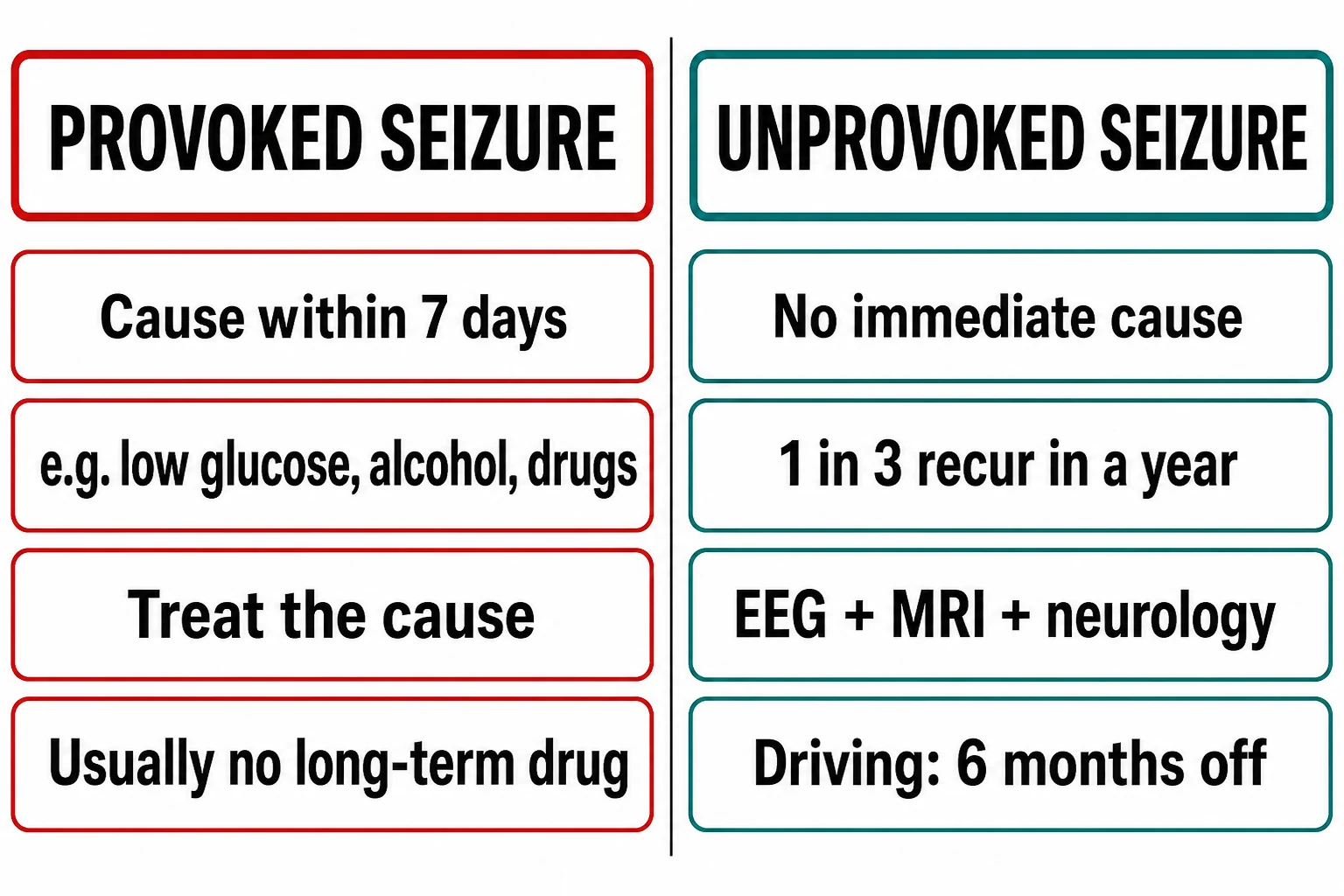
The classification that runs the rest of the topic is provoked versus unprovoked. [1]
Provoked (acute symptomatic)
- A seizure within 7 days of an acute brain insult or a systemic/metabolic/toxic disturbance
- Causes: hypoglycaemia, hyponatraemia, hypocalcaemia, alcohol withdrawal, drugs (TCA, theophylline, INH, cocaine), trauma, stroke, haemorrhage, CNS infection, hypoxia, eclampsia
- Treat the provoking factor — AEDs are usually not needed long term
- Recurrence depends on whether the cause recurs or persists
- Shorter driving restriction once the provoking factor is gone
Unprovoked (remote or unknown)
- No immediate provoking factor, or a remote static insult (prior stroke, trauma, meningitis)
- Higher recurrence risk — about a third at two years, rising with EEG/imaging abnormalities
- Drives the decision to start an AED and the duration of the driving restriction
- Demands an EEG within 24 to 72 hours and an outpatient MRI brain
- The entity the AAN/AES first-seizure guideline is written for
Seizures are also classified by semiology, which guides the EEG and MRI interpretation by the neurologist rather than changing the emergency workup: focal aware (consciousness intact, formerly simple partial), focal impaired-awareness (formerly complex partial), focal-to-bilateral tonic-clonic (formerly secondary generalisation), and the generalised onset types — tonic-clonic, absence, myoclonic, atonic. A first presentation is most often a focal-to-bilateral tonic-clonic seizure because that is the event dramatic enough to bring the patient in. [1]
Epidemiology and recurrence risk
About one in ten people will have a seizure in their lifetime, and the annual incidence of a first unprovoked seizure is roughly 50 to 70 per 100,000. The Fellowship question is rarely "how common is it" and almost always "what is the chance of another one" — and the answer is now well quantified. A Cochrane synthesis of the prognosis after a first unprovoked seizure found a pooled recurrence of about 32 per cent at one year and 39 to 46 per cent at two years, falling to a low rate thereafter for those who remain seizure-free.[5]
The recurrence risk is not uniform, and four factors move it up — the AAN/AES guideline and the prognostic literature converge on them:[2][5]
Recurrence risk after a first unprovoked seizure
A patient with two or three of these factors approaches a 60 per cent recurrence risk over the next two years — which is the threshold the ILAE uses to diagnose epilepsy after a single seizure. This is the arithmetic that justifies starting an antiepileptic drug after one seizure in selected patients, and the arithmetic the OSCE counselling station is built around.[1][2]
Pathophysiology
A seizure is sustained by excessive glutamatergic (excitatory) drive and a failure of GABAergic (inhibitory) control, producing a population of neurones that fire synchronously and recruit neighbouring cortex. The clinical semiology reflects the cortex involved — motor (tonic-clonic), sensory (aura), autonomic, or conscious awareness impaired (temporal). When the seizure terminates (most do so spontaneously within two minutes), a wave of neuronal exhaustion and inhibitory suppression produces the post-ictal state — confusion, amnesia, headache, sleepiness and sometimes a Todd paresis, a transient focal weakness lasting hours to a day or two that is a focal post-ictal inhibition and not a stroke. The pitfall is the reverse — labelling a genuine acute stroke as a Todd paresis — which is why any focal deficit that does not recover promptly is reimaged and treated as a stroke until proven otherwise. [1]
The recurrence risk has a structural correlate: a seizure from a chronic lesion (tumour, scar, malformation) recurs because the lesion persists, whereas a seizure from a transient provoking factor (hypoglycaemia, alcohol) does not recur once the factor is removed. This is the mechanistic basis of the provoked-versus-unprovoked distinction that organises the whole topic. [1]
Clinical presentation
Most first seizures are witnessed, and the history from a bystander is worth more than any scan. The generalised tonic-clonic seizure has an abrupt loss of consciousness, a tonic phase (stiffening, cry, cyanosis, upward eye deviation), a clonic phase (rhythmic limb jerking for one to two minutes), and a post-ictal phase (confusion, amnesia, sleepiness, headache). Lateral tongue-biting, urinary incontinence and post-ictal confusion favour a seizure over its mimics. A preceding aura (epigastric rising, déjà vu, olfactory hallucination, focal sensory disturbance) localises to a focal onset and raises the probability of an epileptogenic focus. The patient who arrives post-ictal is examined for a focal deficit (a Todd paresis or a structural lesion), head trauma, a rash or a needle mark, and the temperature (a febrile first seizure demands a search for infection including meningitis). [1]
Atypical presentations matter. In the elderly, seizures are more often focal, the post-ictal confusion is prolonged and may be misdiagnosed as delirium, and the cause is more often structural (stroke, tumour, subdural) or metabolic. In the known-epilepsy patient, the first question is adherence and the drug level — non-compliance is the commonest reason for a breakthrough. In the alcoholic, a seizure within 6 to 48 hours of cessation is an alcohol-withdrawal seizure, typically a single generalised convulsion that is self-limiting and not epilepsy. [1]
Differential diagnosis
Not everything that shakes is a seizure, and a misdiagnosis is doubly harmful — the patient gets unnecessary antiepileptic drugs and the true cause (cardiac, metabolic, psychogenic) goes untreated. Up to a third of patients referred to epilepsy services with "refractory seizures" have psychogenic non-epileptic seizures; the emergency department is where this mistake begins.[2]
Epileptic seizure
- Stereotyped, 1 to 2 minutes, post-ictal confusion lasting minutes to hours
- Lateral tongue-bite, urinary incontinence, cyanosis, injury
- May have an aura; abrupt onset; gradual recovery
- EEG (later) shows epileptiform activity; reproducible semiology
Syncope (incl. convulsive)
- Brief (under 30 seconds), provoked (standing, pain, fright), rapid full recovery
- A few myoclonic jerks from cerebral hypoperfusion — not a sustained tonic-clonic
- No post-ictal state, no tongue-bite, pallor and sweating
- Cardiac work-up and an ECG, not antiepileptics
Psychogenic non-epileptic seizure (PNES)
- Out-of-phase, asynchronous, side-to-side limb movements; eyes clenched shut
- Consciousness often preserved; resists eye opening; no cyanosis, no post-ictal confusion
- Triggered by psychological stress; may wax and wane for many minutes
- EEG normal during the event; benzodiazepines ineffective and harmful — avoid the refractory ladder
Hypoglycaemia
- Diabetic on insulin or sulphonylurea; pre-event sweating, confusion, hunger
- Can mimic any seizure semiology; may present as coma
- Bedside glucose under 3 mmol/L; correct glucose and the seizure stops
- Treat the cause, not the convulsion; thiamine before glucose if alcoholic
TIA / stroke (and Todd paresis)
- A focal deficit without a seizure is a TIA or stroke; a Todd paresis follows a witnessed convulsion
- Sudden onset; vascular risk factors; a territorial deficit
- A deficit that does not resolve promptly is treated as a stroke until proven otherwise
- Limb-shaking TIA is a carotid-territory haemodynamic phenomenon — different from a seizure
Other mimics
- Rigors (sepsis), breath-holding (a child), paroxysmal dyskinesia, migraine with aura
- Conscious, no post-ictal state, a context that fits
- A careful history separates them
- Treat the underlying condition
The single highest-yield discriminator at the bedside is the post-ictal state: syncope recovers in under a minute, a seizure takes minutes to hours, and PNES has none. The second is the capillary glucose, which excludes hypoglycaemia in seconds. The third is the ECG, which exposes the cardiac cause masquerading as a seizure — a long QT, a Brugada pattern, a conduction block — and which is performed on every patient with a suspected first seizure. [1]
Bedside assessment
Assess in parallel, not in sequence. Airway and breathing — open the airway, position laterally (recovery position) once the cervical spine is cleared, suction secretions, give high-flow oxygen; bag-valve-mask ventilate if apnoeic. Circulation — IV access, blood pressure and heart rate, a fluid bolus if hypotensive. Disability — check the capillary glucose immediately (the single most important bedside test), examine the pupils, and document the Glasgow Coma Scale, reproduced here because it grades the post-ictal depth and is examined. The GCS sums three responses: Eye opening (4 spontaneous, 3 to voice, 2 to pain, 1 none), Verbal response (5 oriented, 4 confused, 3 inappropriate words, 2 incomprehensible sounds, 1 none), and Motor response (6 obeys commands, 5 localises pain, 4 withdraws, 3 abnormal flexion, 2 abnormal extension, 1 none), for a maximum of 15 and a minimum of 3 — record also the temperature and a focused neurological examination for a focal deficit. Exposure — look for head trauma, a MedicAlert bracelet, needle marks, a rash, and the tongue. Take the history from any witness: the onset, the duration, the motor pattern, the recovery, and the provoking context (alcohol, sleep deprivation, drugs, recent illness, head injury). [1]
If the patient is still seizing at five minutes, the assessment pivots to the status epilepticus ladder — give a benzodiazepine and start the clock (see the status epilepticus topic). The post-ictal patient who does not wake up is presumed to be in non-convulsive status until an EEG proves otherwise. [1]
The first-fit ED resuscitation ladder — ABCDE in parallel with the glucose
Protect the patient and the airway
Oxygen, monitoring and IV access
The capillary glucose — the single non-negotiable bedside test
Crossing into status epilepticus — give the first benzodiazepine
Second benzodiazepine dose, then the second-line agent
Refractory — anaesthetic infusion and the airway
Investigations
Investigations run in parallel with resuscitation and never delay the first drug in an ongoing seizure. In the stopped, stable first seizure they answer four questions: is there a reversible metabolic or toxic cause, is there a structural intracranial cause, is there an infective cause, and is there a cardiac cause masquerading as a seizure. [1]
A few specifics the Fellowship examiner tests. Non-contrast CT is the emergency-department structural study of choice because it is fast, available, and detects the haemorrhage, the mass effect and the large lesion; MRI is more sensitive (mesial temporal sclerosis, a small tumour, cortical dysplasia) but is deferred. An EEG performed within 24 to 48 hours of a first seizure is more likely to show an epileptiform abnormality and improves the recurrence-risk estimate; a normal interictal EEG does not exclude epilepsy. A toxicology screen is not routine — it is sent when the history or the examination suggests a toxin or withdrawal. A prolactin level, once popular to distinguish a seizure from a syncope or a PNES, is no longer recommended because it is non-specific. The ECG is the investigation most often omitted and most often diagnostic when a "seizure" is in fact a cardiac arrhythmia with secondary convulsive movements. [1]
Structural
- Brain tumour (primary or metastatic — lung, breast, melanoma), ischaemic or haemorrhagic stroke, subdural or extradural haematoma, traumatic brain injury and gliosis, vascular malformation (AVM, cavernoma), mesial temporal sclerosis
- The persistent lesion drives a high recurrence risk and the indication to start an AED and to image (CT now, MRI as outpatient)
- Look for a focal deficit, a progressive history, a new headache, or a first seizure over 40
- MRI brain is the gold standard — mesial temporal sclerosis, a small tumour and cortical dysplasia are missed on CT
Metabolic
- Hypoglycaemia (the bedside glucose — insulin/sulphonylurea, sepsis, liver failure), hyponatraemia (under 120), hypocalcaemia, hypomagnesaemia, uraemia, hepatic encephalopathy, hypoxia, hypoglycaemia from sepsis
- Provoked seizures — treat the disturbance and the seizure usually does not recur; AEDs are usually not needed long term
- Send sodium, calcium, magnesium, glucose, urea, creatinine, LFTs on every first seizure
- Hypoglycaemia is the one rapidly reversible and lethal cause — never miss it
Infectious
- Bacterial meningitis (Streptococcus pneumoniae, Neisseria), viral encephalitis (HSV — the one not to miss, treat empirically with aciclovir), cerebral abscess, cerebral malaria, neurocysticercosis (endemic regions), tuberculosis
- Fever, neck stiffness, rash, immunocompromise, recent travel — a febrile seizure in an adult is meningitis or encephalitis until proven otherwise
- CT before lumbar puncture; start empirical ceftriaxone and aciclovir early if suspected
- A first seizure with fever needs a CT, an LP, and empirical antimicrobials — not discharge
Toxic and withdrawal
- Alcohol withdrawal (6–48 h after cessation), benzodiazepine withdrawal, cocaine and amphetamines, tricyclic antidepressants (widened QRS), theophylline, isoniazid (responds to pyridoxine), lithium, antipsychotics, tramadol and serotonergic agents
- A toxin or withdrawal provokes the seizure — treat the toxin alongside the ladder (sodium bicarbonate for TCA, pyridoxine for INH)
- Send ethanol and a toxicology screen when the history or examination suggests it — not routinely
- The alcohol-withdrawal seizure is a diagnosis of exclusion — a subdural, a metabolic cause or a co-ingestant is easily missed
Vascular / immune
- Subarachnoid haemorrhage (the sentinel bleed presents as a seizure with a thunderclap headache), posterior reversible encephalopathy syndrome (PRES — hypertensive, immunosuppressed), cerebral venous sinus thrombosis, autoimmune encephalitis (NMDA, LGI1, voltage-gated potassium channel), eclampsia
- Thunderclap headache, hypertension, pregnancy or postpartum, a rapid cognitive decline, faciobrachial dystonic seizures (LGI1)
- CT first (the SAH, the bleed); MRI and CSF for autoimmune; magnesium sulfate first for eclampsia
- A seizure with a thunderclap headache is a subarachnoid haemorrhage until a CT and LP exclude it
Immediate management
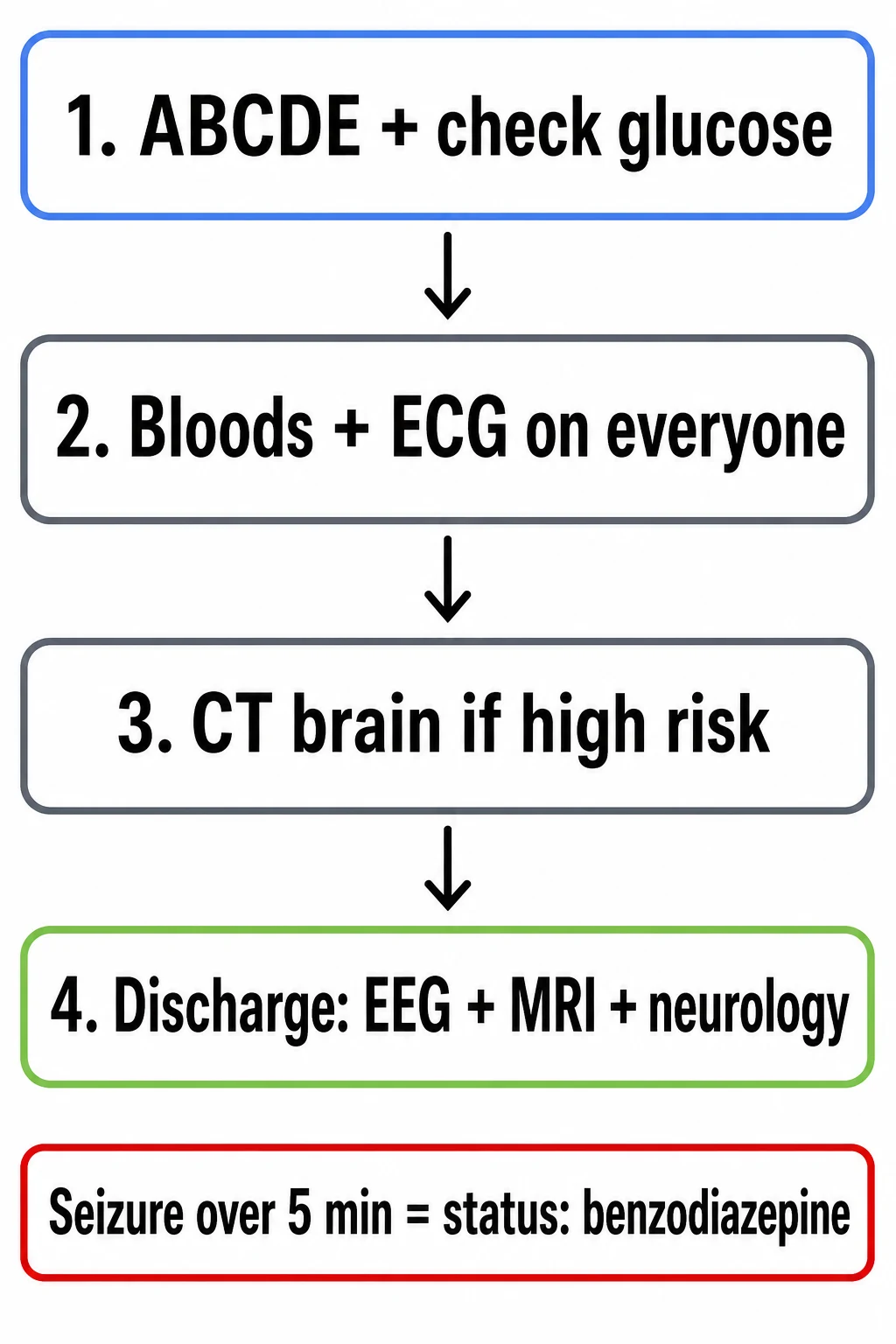
ABCDE is the frame, and the glucose is the key. In the patient who has stopped seizing and is post-ictal, the priority is the airway (recovery position, suction, oxygen), the capillary glucose (treat if low — give 50 mL of 50 per cent dextrose IV in the adult, or 250 mL of 10 per cent dextrose in the child, and thiamine 100 mg IV before or with the glucose in the alcoholic or malnourished patient to prevent Wernicke encephalopathy), and the search for a provoking factor. A benzodiazepine is given only if the seizure is ongoing or recurs in the department — lorazepam 4 mg IV over two minutes (repeat once at 10 minutes), or midazolam 10 mg IM if IV access is impossible. A patient who has clearly stopped seizing and recovered does not need a benzodiazepine, and giving one to a post-ictal patient adds respiratory depression without benefit. If the seizure does not stop at five minutes, escalate to the status epilepticus ladder: a second benzodiazepine dose, then a second-line anti-seizure medication (fosphenytoin 20 mg PE/kg, levetiracetam 60 mg/kg, or valproate 30 mg/kg), then an anaesthetic infusion for refractory disease. [1]
IV lorazepam (first-line if access)
- 0.1 mg/kg — 4 mg in the adult — over 2 minutes; repeat once at 10 minutes if ongoing
- Reliable, rapid onset (1–5 min), and the agent of choice wherever IV access is established
- Most sedation and respiratory depression of the three — oxygen and airway equipment ready
- Poor light stability — keep in the dark; dilute with saline, not water for injection
IM midazolam (no IV access)
- 10 mg IM in the adult (5 mg over 60 kg, 5 mg under 40 kg); onset 3–5 min
- RAMPART showed IM midazolam at least as effective as IV lorazepam in prehospital status — do not delay while fishing for a vein
- No vein needed — use the preferred first agent when IV access will take more than a few minutes
- Short duration; recurrent seizure common — start the second-line drug early
Buccal midazolam (no IV, no IM practical)
- 0.5 mg/kg up to 10 mg — draw up the IV formulation and instill into the buccal fossa
- Used in the community and by carers for known epilepsy; an ED fallback in the difficult child or the agitated adult
- Avoid if there is copious oral secretions, a clenched jaw, or active vomiting — aspiration and unreliable absorption
- Onset 5–10 min; the buccal route has largely replaced rectal diazepam in adults and older children
Rectal diazepam (fallback)
- 0.5 mg/kg (up to 20 mg) per rectum as the ready-made tube; onset 3–5 min
- The historical community and prehospital option — still used in infants, the profoundly agitated, or where no other route is possible
- Undignified, socially awkward in the ED, and absorption is unreliable with faecal loading or diarrhoea
- Largely superseded by buccal midazolam in adults and older children; retains a niche in infants
First-line benzodiazepine dosing for the ongoing seizure
Definitive management — starting the antiepileptic drug
The Fellowship candidate must know that an antiepileptic drug is not automatic after a first seizure. The decision to start lifelong medication balances the reduction in recurrence against the side effects, the teratogenicity, the interactions and the stigma — and the evidence says the trade-off is closer than it appears. The MESS trial randomised over 1400 patients with early epilepsy or a single seizure to immediate versus deferred antiepileptic treatment and found that immediate treatment delayed the time to the next seizure but did not improve long-term seizure remission at three to five years; a Cochrane synthesis confirmed this — immediate treatment reduces the one- to two-year recurrence risk but does not change the longer-term probability of being seizure-free, nor the quality of life.[3][4]
Model answer — when to start an AED after a first seizure
When the decision is to treat, the agent matters. [1]
Antiepileptic drugs after a first unprovoked seizure
Levetiracetam is the preferred first-line agent for a new adult diagnosis: it is broad-spectrum (covers focal and generalised seizures), has minimal drug interactions (renal excretion, no hepatic enzyme induction — important for the contraceptive pill, warfarin and other antiepileptics), is available intravenously, and is well tolerated. The oral dose starts at 500 mg twice daily (titrated to 1000 to 3000 mg/day), and an IV load of 20 to 60 mg/kg is used in status. Valproate is at least as effective but is avoided in women of childbearing potential because it is teratogenic (neural tube defects, facial clefts) and lowers the childhood IQ and raises the risk of autism; it carries prescribing restrictions under the pregnancy prevention programme. In the woman who might become pregnant, levetiracetam or lamotrigine is preferred, with folate supplementation and pre-conception neurology counselling. Phenytoin is largely historical for new-onset treatment (interactions, gingival hypertrophy, narrow therapeutic window) and is now confined to status epilepticus and established regimens. The choice is usually confirmed by the neurologist, but the emergency physician must start correctly when treatment is begun in the department. [1]
[1]Subtypes and scenarios
Alcohol-withdrawal seizure — a generalised convulsion 6 to 48 hours after cessation or reduction, typically single and self-limiting; management is benzodiazepine-based withdrawal treatment (e.g. diazepam 10 mg or lorazepam symptom-triggered), thiamine 100 mg IV before glucose, and investigation only if atypical (focal, prolonged, first, head trauma) — because the alcohol-withdrawal seizure is a diagnosis of exclusion and a subdural haematoma or a seizure from another cause is easily missed in the alcoholic. [1]
Febrile seizure (paeds) — a seizure with fever in a child aged 6 months to 5 years without CNS infection or a prior afebrile seizure; simple (generalised, under 15 minutes, no recurrence in 24 hours) is benign and needs only fever control and parental reassurance, while complex (focal, over 15 minutes, or recurrent in 24 hours) has a higher risk of later epilepsy and warrants investigation and sometimes a benzodiazepine (see the paediatric topics). [1]
Eclampsia — any seizure in a pregnant or postpartum woman is presumed eclamptic until proven otherwise and is treated first with magnesium sulfate (4 g IV over 5 to 15 minutes, then 1 g/hour infusion, or a 10 g IM loading alternative), not with the standard antiepileptic ladder; involve the obstetric team for delivery (see the hypertensive disorder of pregnancy topic). [1]
Provoked toxic seizure — tricyclic antidepressant (sodium bicarbonate 8.4 per cent 1 to 2 mmol/kg), theophylline, isoniazid (pyridoxine / vitamin B6, the antidote for the refractory seizure of INH overdose), cocaine, and withdrawal from benzodiazepines or alcohol; treat the toxin alongside the ladder. [1]
Known epilepsy with a breakthrough — check adherence and the drug level; non-compliance is the commonest cause and the easiest to fix. A first seizure over the age of 40, or in an immunocompromised patient, or with a new focal deficit, carries a high probability of a structural cause and is imaged before discharge. [1]
Complications and pitfalls
The complications of a seizure are direct and delayed. Aspiration of gastric contents (the depressed consciousness and the absent gag reflex) causes a pneumonitis and pneumonia; injury — a fall, a fracture, a shoulder dislocation, a head injury, a drown if in water; sudden unexpected death in epilepsy (SUDEP), a rare but real risk (about 1 per 1000 patient-years, higher in uncontrolled generalised tonic-clonic seizures) that the patient is counselled about — not in the emergency department at the first event, but by the neurologist at the first clinic visit. The pitfalls are the inverse of the management: missing hypoglycaemia by not checking the glucose; sending an unstable or unrecovered patient to the CT scanner; misdiagnosing a PNES or a convulsive syncope as epilepsy and committing the patient to unnecessary drugs and driving restrictions; missing a structural cause by not imaging the high-risk patient; prescribing valproate to a woman of childbearing potential; and forgetting the driving advice and the legal duty to notify the licensing authority. [1]
Prognosis and disposition
Disposition turns on the recovery and the risk. Admit the patient who has a first seizure with any of: an abnormal neurological examination or a persistent deficit, failure to return to baseline in the department, a recurrent seizure in the department, an abnormal CT, a provocative metabolic or toxic cause needing correction or observation (e.g. severe hyponatraemia, alcohol withdrawal needing a benzodiazepine regimen, drug overdose), an infectious cause needing intravenous antibiotics, poor social support or unsafe home circumstances, or a child with a complex febrile seizure or a first afebrile seizure needing workup. Discharge the recovered low-risk adult — normal glucose and electrolytes, a normal ECG, no focal deficit, recovered to baseline — with an outpatient EEG within 24 to 72 hours, an outpatient MRI arranged by the neurologist, a neurology referral, written safety advice, and the driving restriction explained and documented. The recurrence risk and the driving rules are the two pieces of information the patient must leave with. The long-term prognosis is good: most patients with a first unprovoked seizure do not develop refractory epilepsy, and immediate treatment does not change the long-term outcome — which is why counselling and a measured approach matter as much as the drug.[4][5]
Driving restrictions
Driving is the OSCE counselling question, and it is examined. The principle is a balance between the individual's mobility and the public's safety: a seizure at the wheel risks lives, so a defined seizure-free interval is required before driving resumes. The rules are jurisdiction-specific and the candidate must know the local standard. [1]
ANZ — Austroads Assessing Fitness to Drive (2024). The standard is set by Austroads and the National Transport Commission and applied by the state licensing authorities. After a first unprovoked seizure, the driver must not drive a private (car) licence for a minimum of 6 months, with a conditional licence possible on neurologist review; some low-risk cases may be reduced to 3 months on specialist advice. After established epilepsy, the requirement is 12 months seizure-free for a private licence. Commercial licences are far stricter — a minimum of 5 years seizure-free after a first unprovoked seizure, and 10 years for established epilepsy, effectively ending a commercial driving career. A provoked seizure (a single, clearly reversible cause such as alcohol withdrawal, hypoglycaemia, or a drug) carries a shorter restriction — the provoking factor treated, with the period individualised (often a minimum of 3 months once the cause is resolved). The patient has a legal duty to notify the licensing authority of a seizure or a diagnosis of epilepsy; failure to do so invalidates insurance and carries penalties. The treating doctor advises the patient of this duty in writing and documents the advice. [1]
The emergency physician's job is not to grant or revoke a licence — it is to tell the patient not to drive until cleared, to explain the legal duty to notify, and to document the advice in writing in the discharge record. [1]
Special populations
The elderly present more often with a focal or a silent seizure, a prolonged post-ictal confusion (mistaken for delirium), and a structural or metabolic cause (stroke, tumour, subdural, hyponatraemia); they tolerate antiepileptics poorly (sedation, falls, interactions) and levetiracetam is preferred. The woman of childbearing potential is started on levetiracetam or lamotrigine, never valproate, with folate and contraception counselling. The pregnant or postpartum woman with a seizure is presumed to have eclampsia and is treated first with magnesium sulfate. The child with a febrile seizure follows the simple-versus-complex pathway; a first afebrile seizure is worked up and referred. The alcoholic is assessed for a withdrawal seizure (and given thiamine before glucose) but is investigated for other causes if the seizure is atypical. The known-epilepsy patient with a breakthrough is checked for adherence and the drug level before a new cause is assumed. [1]
Evidence and regional guidelines
The contemporary evidence base is the ILAE practical definition of epilepsy (Fisher 2014), which redefined a single unprovoked seizure with a high recurrence risk as epilepsy; the AAN/AES evidence-based guideline on the management of a first unprovoked seizure in adults (Krumholz 2015), which codified the imaging, EEG and counselling recommendations; the MESS trial (Marson 2005) and the Cochrane review of immediate versus deferred treatment (Leone 2021), which together established that immediate treatment delays but does not prevent long-term recurrence; and the Cochrane review of prognosis after a first unprovoked seizure (Neligan 2023), which quantified the recurrence risk and its modifiers.[1][2][3][4][5] Regional guidance is the NICE and SIGN epilepsy guidelines, the Austroads Assessing Fitness to Drive standard in Australia and New Zealand, and the DVLA At-a-Glance guide in the United Kingdom.
Landmark trials and the evidence base
The Fellowship candidate should hold the first-seizure and status-epilepticus evidence base as a small, ordered set of papers — each answers one examination question, and each is named in the OSCE and the viva. The five anchor trials are the prehospital route question (RAMPART), the second-line agent question (ESETT), the new-diagnosis drug-effectiveness question (SANAD), the recurrence-risk quantification after two seizures (Hauser), and the immediate-versus-deferred treatment question after a first seizure (MESS).[3][6][7][8][9]
RAMPART — intramuscular versus intravenous therapy for prehospital status epilepticus
New England Journal of Medicine
PMID 22335736
Key finding
A double-blind randomised non-inferiority trial of 893 patients in status epilepticus, comparing autoinjector intramuscular midazolam 10 mg with intravenous lorazepam 4 mg given by paramedics before hospital arrival. Intramuscular midazolam was at least as effective as, and on several endpoints superior to, intravenous lorazepam — seizure termination without rescue was 73.4% with IM midazolam versus 63.4% with IV lorazepam, and IM was faster because it avoided the delay of establishing IV access.
Practice change
The practice-changing message for the emergency physician: do not delay the first benzodiazepine while fishing for a vein. If IV access will take more than a few minutes, give IM midazolam 10 mg — it is the first-line agent of the no-access situation.
ESETT — three anticonvulsants for established status epilepticus
New England Journal of Medicine
PMID 31774955
Key finding
A double-blind randomised trial of 384 patients with established status epilepticus (ongoing despite an adequate benzodiazepine dose), comparing intravenous levetiracetam 60 mg/kg, fosphenytoin 20 mg PE/kg, and valproate 40 mg/kg. The three agents were equivalent — seizure cessation at 10 minutes occurred in 47%, 45% and 46% respectively, with no significant difference and no difference in adverse events.
Practice change
After two benzodiazepine doses, any of levetiracetam, fosphenytoin or valproate is a valid second-line agent — the choice is driven by the patient (avoid valproate in a woman of childbearing potential; prefer levetiracetam for its simplicity and interaction profile) rather than by superiority of efficacy.
SANAD — effectiveness of standard and new antiepileptic drugs for newly diagnosed epilepsy
Lancet
PMID 17382827
Key finding
A large pragmatic randomised controlled trial (over 1700 patients with newly diagnosed focal epilepsy) comparing carbamazepine, gabapentin, lamotrigine, oxcarbazepine and topiramate. Lamotrigine was superior to carbamazepine on time-to-treatment-failure for focal seizures (better tolerability), while valproate (in the companion arm for generalised epilepsy) remained the most effective for idiopathic generalised epilepsy — but valproate's teratogenicity now limits it in women of childbearing potential.
Practice change
For a new adult diagnosis of focal epilepsy, lamotrigine or levetiracetam is preferred on tolerability and the childbearing-potential constraint; valproate remains effective for generalised epilepsy but is restricted in women who may become pregnant.
Hauser — risk of recurrent seizures after two unprovoked seizures
New England Journal of Medicine
PMID 9459646
Key finding
A population-based cohort from Rochester, Minnesota quantifying the recurrence risk after unprovoked seizures. The cumulative risk of a third seizure after two unprovoked seizures was 57% at one year and 73% at four years — confirming that two unprovoked seizures define epilepsy with a high recurrence probability and justifying treatment after the second seizure.
Practice change
The empirical anchor for the ILAE practical definition: a patient with two unprovoked seizures has epilepsy and is treated. A single unprovoked seizure carries a lower (around a third at one year) but still material risk that drives the workup, the counselling and the driving restriction.
MESS — immediate versus deferred antiepileptic treatment for early epilepsy and single seizures
Lancet
PMID 15950714
Key finding
A randomised controlled trial of 1443 patients with early epilepsy or a single seizure, comparing immediate with deferred antiepileptic drug treatment. Immediate treatment delayed the time to the first and second recurrent seizures and increased the proportion seizure-free at one to two years, but there was no difference in longer-term (three-to-five-year) remission, quality of life, or the proportion with epilepsy at five years.
Practice change
The decision to start an AED after a first seizure is not automatic — immediate treatment buys short-term seizure freedom without changing the long-term prognosis. The decision is driven by the recurrence risk and the informed patient's preference, not by a reflex to treat every first seizure.
The exam numbers to hold for the first-seizure viva
SAQ — The status epilepticus ladder and the no-access route
10 minutes · 10 marks
A 56-year-old man is brought to the emergency department by ambulance after a generalised tonic-clonic seizure that began 8 minutes before arrival and is still ongoing. He has no intravenous access. The capillary glucose is 6.2 mmol per litre. The paramedics have not given any benzodiazepine.
SAQ — The first seizure in a young woman
10 minutes · 10 marks
A 24-year-old woman presents to the emergency department after a single witnessed generalised tonic-clonic seizure at home, lasting 90 seconds and self-terminating. She has recovered fully, the capillary glucose is normal, the neurological examination is normal, and the beta-hCG is negative. This is her first seizure.
Exam pearls
- Provoked versus unprovoked is the master distinction — it governs recurrence risk, antiepileptic initiation and driving. A provoked seizure is treated by removing the cause; an unprovoked seizure carries a recurrence risk of about a third at one year.
- Check the glucose first, the ECG on everyone, and image selectively — hypoglycaemia is rapidly reversible, a cardiac arrhythmia masquerades as a seizure, and a CT is not needed in the fully recovered low-risk young adult.
- A first unprovoked seizure does not automatically need an AED — MESS and Cochrane show immediate treatment delays but does not prevent long-term recurrence; treat when the recurrence risk is high (EEG, imaging, nocturnal, prior insult) or the patient chooses to after counselling.
- Levetiracetam first, valproate avoided in women of childbearing potential — broad spectrum, few interactions, teratogenicity avoided.
- Driving: 6 months off a private licence after a first unprovoked seizure, 12 months for established epilepsy, 5 to 10 years commercial; legal duty to notify.
- Not everything that shakes is a seizure — convulsive syncope recovers in under a minute with no post-ictal state; PNES has out-of-phase movements and preserved consciousness; a Todd paresis follows a witnessed convulsion and resolves.
- The first benzodiazepine is IV lorazepam 0.1 mg/kg (4 mg) or IM midazolam 10 mg if no vein — do not delay for access (RAMPART). Give a second dose at 10 minutes if ongoing, then a second-line agent; a third benzodiazepine dose adds harm without benefit.
- Buccal midazolam 0.5 mg/kg (up to 10 mg) and rectal diazepam 0.5 mg/kg are the no-access, no-IM fallbacks — buccal has largely replaced rectal in adults and older children.
- The five-bucket cause sieve — structural, metabolic, infectious, toxic/withdrawal, vascular/immune — frames every first seizure: a febrile seizure in an adult is meningitis or encephalitis until proven otherwise; a seizure with a thunderclap headache is a subarachnoid haemorrhage; an alcoholic's seizure needs a subdural excluded.
- Thiamine before or with the glucose in the alcoholic or malnourished patient — prevents precipitating Wernicke encephalopathy, but never let the hunt for thiamine delay correction of a dangerous hypoglycaemia.
- Prolactin is obsolete as a seizure marker — distinguish a seizure from its mimics with the post-ictal state, the witnessed history (tongue-bite, incontinence, cyanosis), the capillary glucose and the ECG.
- Eclampsia is treated first with magnesium sulfate, not the antiepileptic ladder (4 g IV then 1 g/h); any seizure in a pregnant or postpartum woman is eclampsia until proven otherwise.
- Document the driving advice in writing and warn the patient of the legal duty to notify — failure to notify the licensing authority invalidates insurance and carries penalties; the ED doctor advises and documents, and does not grant or revoke the licence. [1]
Red flags
[1]References
- [1]Fisher RS, Acevedo C, Arzimanoglou A, et al. ILAE official report: a practical clinical definition of epilepsy Epilepsia, 2014.PMID 24730690
- [2]Krumholz A, Wiebe S, Gronseth GS, et al. Evidence-based guideline: Management of an unprovoked first seizure in adults: Report of the Guideline Development Subcommittee of the American Academy of Neurology and the American Epilepsy Society Neurology, 2015.PMID 26503589
- [3]Marson A, Jacoby A, Johnson A, et al. Immediate versus deferred antiepileptic drug treatment for early epilepsy and single seizures: a randomised controlled trial Lancet, 2005.PMID 15950714
- [4]Leone MA, Giussani G, Nolan SJ, et al. Immediate antiepileptic drug treatment, versus placebo, deferred, or no treatment for first unprovoked seizure Cochrane Database Syst Rev, 2021.PMID 33942281
- [5]Neligan A, Leone MA, Verzotti L, et al. Prognosis of adults and children following a first unprovoked seizure Cochrane Database Syst Rev, 2023.PMID 36688481
- [6]Silbergleit R, Durkalski V, Lowenstein D, et al. Intramuscular versus intravenous therapy for prehospital status epilepticus N Engl J Med, 2012.PMID 22335736
- [7]Marson AG, Al-Kharusi AM, Alwaidh M, et al. The SANAD study of effectiveness of carbamazepine, gabapentin, lamotrigine, oxcarbazepine, or topiramate for treatment of partial epilepsy: an unblinded randomised controlled trial Lancet, 2007.PMID 17382827
- [8]Hauser WA, Rich SS, Lee JR, et al. Risk of recurrent seizures after two unprovoked seizures N Engl J Med, 1998.PMID 9459646
- [9]Kapur J, Elm J, Chamberlain JM, et al. Randomized Trial of Three Anticonvulsant Medications for Status Epilepticus N Engl J Med, 2019.PMID 31774955