EM · Toxicology and environmental emergencies
Spider and marine envenomation
Also known as Latrodectism · Red-back spider bite · Funnel-web spider bite · Box jellyfish sting · Chironex fleckeri envenomation · Irukandji syndrome · Blue-ringed octopus envenomation · Tetrodotoxin poisoning
ANZ spider and marine envenomation — five syndromes the Fellowship candidate must hold as patterns. Latrodectism (red-back) is sustained painful muscle contraction with regional diaphoresis and autonomic surge, driven by alpha-latrotoxin opening presynaptic calcium channels; treatment is analgesia and red-back spider antivenom (efficacy contested). Funnel-web spider envenomation is the only ANZ spider that kills — fasciculations, profuse sweating, hypertension, pulmonary oedema and catecholamine cardiomyopathy from robustoxin blocking neuronal sodium channels; first aid is pressure immobilisation and treatment is funnel-web antivenom two vials intravenously, repeated. Box jellyfish (Chironex fleckeri) sting causes immediate severe pain, ladder-track dermonecrosis and sudden cardiac arrest from pore-forming cardiotoxins; first aid is vinegar then box-jellyfish antivenom. Irukandji syndrome is a delayed catecholamine-surge cardiomyopathy with troponin leak and hypertension. Blue-ringed octopus envenomation is rapid tetrodotoxin flaccid paralysis with an awake patient — supportive ventilation is definitive, there is no antivenom. Differential is snake bite and allergic reaction. ACEM-primary, globally tagged.
On this page & tools
Your progress
Saved locally on this device.
5 MCQs with explanations
Target exams
Red flags
Spider and marine envenomation is a distinct cluster from snakebite because the venom syndromes are smaller, the first aid is creature-specific, and antivenom has a defined but uneven role. The Fellowship candidate must hold five patterns — latrodectism (red-back), funnel-web spider envenomation, box jellyfish (Chironex) sting, Irukandji syndrome and blue-ringed octopus envenomation — and must know which first aid belongs to which creature, which syndrome kills, and where antivenom is definitive versus contested. The danger lies in misapplying first aid (pressure immobilisation on a red-back bite that prolongs the pain, freshwater on a jellyfish sting that triggers further discharge), in under-treating the one spider that kills (funnel-web), and in failing to ventilate the awake but paralysed blue-ringed octopus victim who will recover fully if given an hour or two of mechanical ventilation. The coagulation profile is normal in every one of these syndromes — a preserved INR in the envenomed coastal patient distinguishes them from snakebite at once.[1][3][7]
Definition and classification
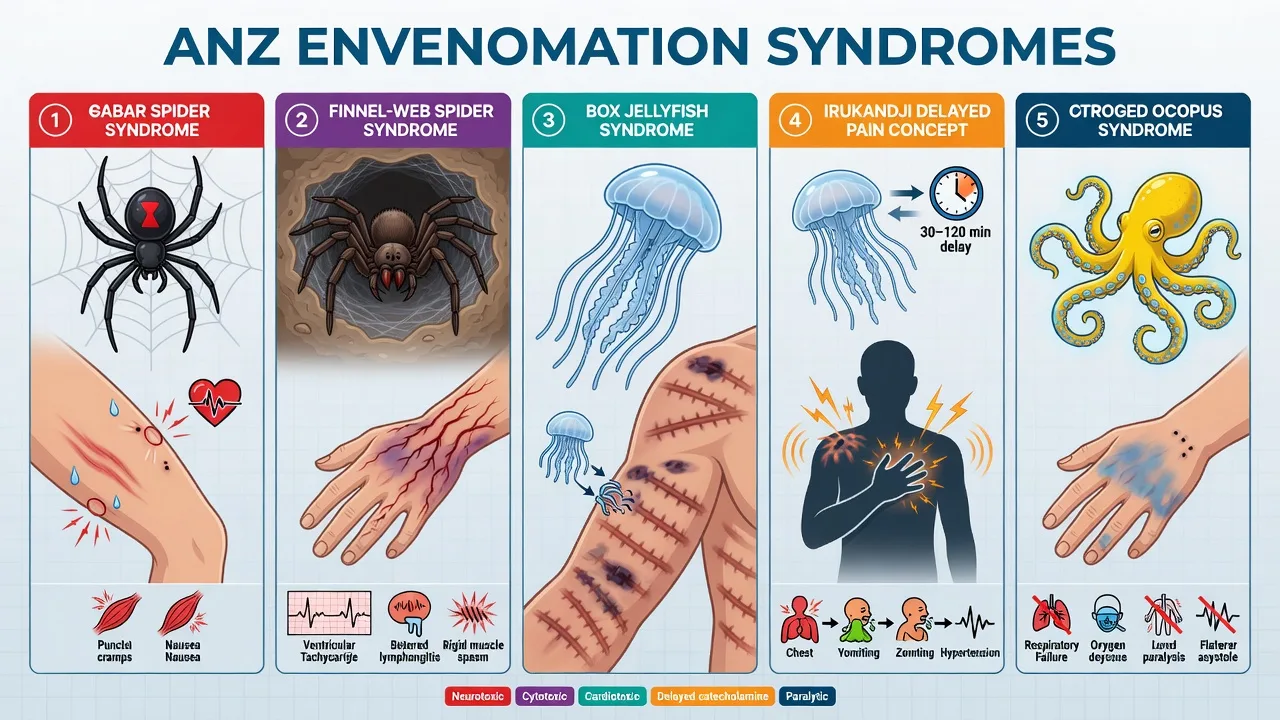
The topic covers two spider syndromes and three marine syndromes, each with a characteristic toxin, a characteristic clinical course and a characteristic first aid. The candidate must not blur them.[7]
Latrodectism is the syndrome caused by widow spiders, of which the red-back spider (Latrodectus hasselti) is the ANZ representative. Its toxin, alpha-latrotoxin, produces sustained painful muscle contraction, regional diaphoresis and an autonomic surge. It is painful and protracted but not lethal. Funnel-web spider envenomation is caused by the Sydney funnel-web (Atrax robustus) and related tree-dwelling Hadronyche species, restricted to New South Wales and southern Queensland; robustoxin and related delta-hexatoxins produce a massive autonomic and catecholamine surge with neuromuscular excitation, pulmonary oedema and catecholamine cardiomyopathy. The funnel-web is the only spider in ANZ that can kill a previously well adult.[1][3][7]
Box jellyfish (Chironex fleckeri) envenomation causes immediate severe pain, characteristic ladder-track dermonecrotic skin lesions and, in severe cases, sudden cardiovascular collapse and cardiac arrest from pore-forming cardiotoxic proteins acting directly on the myocardium. Irukandji syndrome is a separate, delayed catecholamine-surge cardiomyopathy caused by small carybdeid (box) jellyfish, classically Carukia barnesi, presenting 5 to 40 minutes after an apparently trivial sting with severe back and abdominal pain, hypertension, sweating and a rising troponin. Blue-ringed octopus (Hapalochlaena sp.) envenomation delivers tetrodotoxin, a potent sodium-channel blocker that produces rapid descending flaccid paralysis with a sensorium that remains intact — the patient is awake, paralysed and apnoeic.[5][6][8]
Epidemiology
Red-back spider bites are among the commonest envenomations in ANZ, with several thousand suspected bites each year; most occur in the warmer months, in and around domestic settings, and the spider is often disturbed in a garden shed or outdoor equipment. Severe and persistent effects are the rule rather than the exception — in the prospective cohort, pain was severe in the majority and lasted more than 24 hours in two-thirds.[1]
Funnel-web spider bites are uncommon by comparison but carry a disproportionate threat. The systematic review identified fewer than 200 definite bites over decades, with severe envenoming in 77; the high-envenoming species are confined to New South Wales and southern Queensland, with the tree-dwelling species (Hadronyche cerberea, H. formidabilis) carrying the highest rates of severe envenoming.[3] No deaths have been recorded since the introduction of funnel-web antivenom in 1981.
Box jellyfish stings occur throughout tropical ANZ coastal waters in the stinger season (October to June). In the Top End prospective study of more than 600 jellyfish stings, 225 were confirmed Chironex fleckeri; 37 per cent were in children, most occurred in shallow water, and the single fatality was a 3-year-old girl who suffered cardiorespiratory arrest within minutes of a small-area tentacle contact.[5] Irukandji syndrome clusters in tropical Queensland and the Northern Territory and is increasingly recognised in other warm waters. Blue-ringed octopus envenomation is rare; the characteristic case is a child who picks up the animal on a tidal rock platform in southern or eastern Australia.[8]
Pathophysiology — the toxin mechanisms
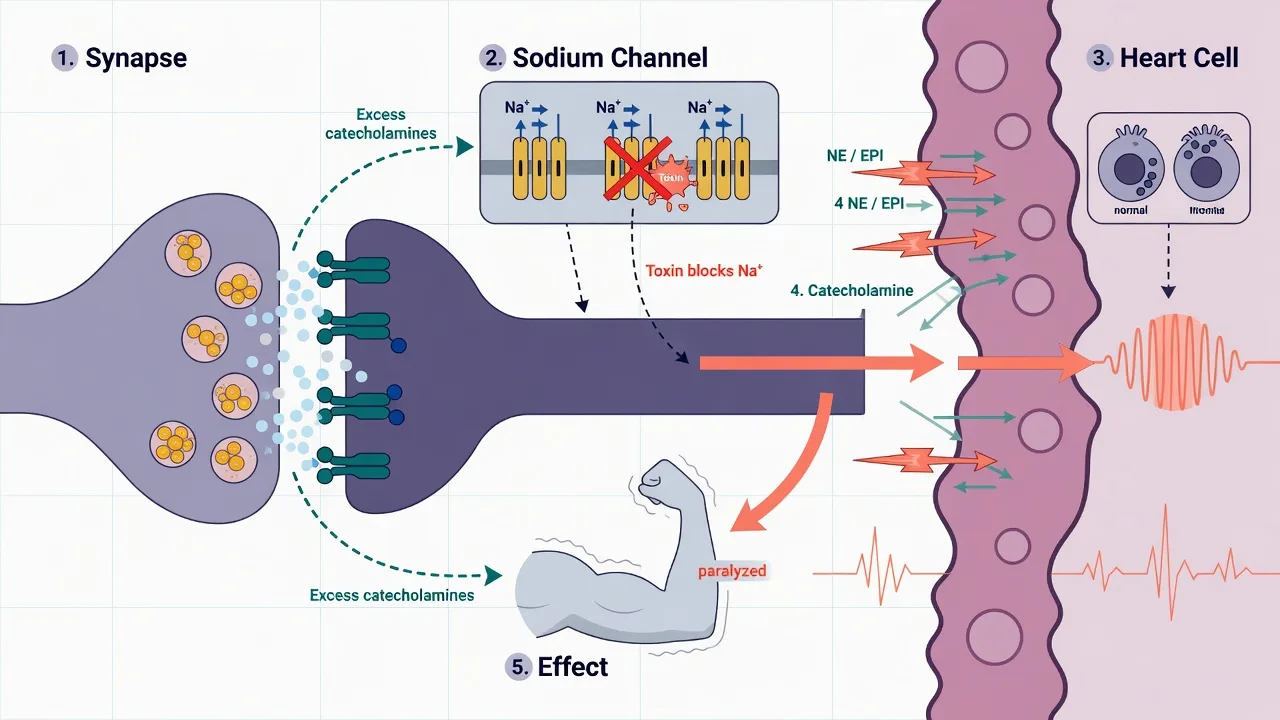
Each syndrome is the product of a single dominant toxin class, and the candidate must link the toxin to the clinical pattern. [1]
The five syndromes and their toxin drivers
Alpha-latrotoxin is a large protein that binds presynaptic nerve terminals and forms calcium-permeable pores (and signals through latrophilin), producing a massive, sustained release of acetylcholine, noradrenaline and neuropeptides. The clinical consequence is sustained, painful contraction of voluntary and smooth muscle — the bite site, then the limb, then the trunk; regional diaphoresis (sweating confined to the bitten limb) is highly characteristic, and an autonomic surge produces hypertension, pilomotor erection and priapism. The mechanism is neuroexcitatory, not flaccid — the patient is rigid and in pain, not paralysed.[1][7]
Robustoxin (from Atrax robustus) and the related delta-hexatoxins from Hadronyche species are small peptide neurotoxins that slow inactivation of voltage-gated sodium channels on autonomic and motor neurons, producing a massive autonomic discharge. The clinical picture is the sum: cholinergic excess (salivation, lacrimation, sweating, bronchorrhoea), adrenergic excess (hypertension then hypotension, piloerection), neuromuscular excitation (fasciculations, then muscle spasms), and a catecholamine-driven pulmonary oedema and cardiomyopathy that can progress to cardiac failure and arrest.[3][4]
[1]Chironex fleckeri venom contains potent pore-forming proteins and haemolysins that act directly on cardiac myocyte membranes, depolarising the myocardium and producing electromechanical dissociation and cardiac standstill within minutes of a major sting. The dermonecrotic component lyses skin cells in linear tracks that mirror the tentacle contact. Irukandji venom, by contrast, acts through a delayed and sustained catecholamine release rather than direct cardiotoxicity, producing hypertension, coronary vasospasm, troponin leak and a stress cardiomyopathy that may be complicated by intracerebral haemorrhage from the hypertension.[5][6]
Tetrodotoxin from the blue-ringed octopus is a potent, heat-stable sodium-channel blocker that prevents action-potential generation in motor and sensory nerves and in skeletal and cardiac muscle. The patient develops a rapid, descending flaccid paralysis with loss of deep tendon reflexes and of spontaneous ventilation, while cognitive function is preserved throughout — they are awake inside a paralysed body. The heart is relatively spared (sodium-channel blockade is less complete on cardiac myocytes) and the patient dies only if not ventilated; with mechanical ventilation for some hours, toxin clears and recovery is complete.[8]
Clinical presentation
Red-back (latrodectism) develops over the first hour. The bite is felt as a sharp or pinching sting, then the pain builds, becoming severe, spreading from the bite site up the limb and into the regional lymph nodes, chest or abdomen. Regional or local diaphoresis confined to the bitten limb is highly characteristic, and is one of the best predictors of a true red-back bite against other spider bites. Systemic features follow — nausea, vomiting, headache, malaise, hypertension, pilomotor erection and priapism. Untreated, the pain persists for one to four days.[1][7]
[1]Funnel-web envenomation is dramatic and rapid, usually within 10 to 30 minutes. The patient is anxious, sweating profusely, fasciculating around the mouth and limbs, salivating and lacrimating; the blood pressure is initially high, then labile and falling; pulmonary oedema develops with cough, frothy sputum and hypoxia; confusion, convulsions and cardiac arrest follow in untreated severe cases. The bitten limb is painful and the bite site may show puncture marks.[3][4]
Box jellyfish (Chironex) sting produces immediate, excruciating pain at the sting site, with characteristic linear, ladder-track, cross-hatched erythematous and then necrotic skin lesions that follow the tentacle contact. In severe envenomation the patient collapses within minutes with cardiovascular collapse and cardiac arrest, especially in children. Irukandji syndrome is distinguished by a symptom-free interval: a minor sting, then 5 to 40 minutes later the onset of severe, distressing pain in the back, abdomen or chest, with profuse sweating, vomiting, restlessness, hypertension and, in severe cases, a rising troponin, ECG changes and cardiomyopathy. Blue-ringed octopus envenomation begins within minutes of the bite as perioral tingling and progressive weakness, descending to a flaccid paralysis with respiratory failure while the patient remains cognitively intact.[5][6][8]
Differential diagnosis
The differential splits along the clinical pattern: a painful, sweating, hypertensive patient (latrodectism or funnel-web), a collapsed coastal patient (box jellyfish or snakebite), and a paralysed patient (blue-ringed octopus or snakebite neurotoxicity). Snakebite is the master mimic and the coagulation profile is the first discriminator — preserved in all five spider and marine syndromes, deranged in snake venom-induced consumption coagulopathy.[7]
Spider / marine envenomation
- Coastal, domestic or marine exposure; characteristic bite or sting site; preserved INR and platelets throughout
- Syndrome-appropriate timing: red-back builds over an hour, funnel-web within minutes, Chironex immediate, Irukandji delayed 20 to 40 min, blue-ringed octopus within minutes
- No VICC, no defibrination — the discriminator from snakebite
- Creature-specific first aid and antivenom where indicated; analgesia-first for latrodectism
Snake bite
- Bush exposure; bite mark often invisible; coagulation profile deranged (INR above 3, D-dimer markedly raised, fibrinogen low, platelets preserved) — the discriminator
- Pressure immobilisation bandage is the universal first aid
- Monovalent or polyvalent snake antivenom; discuss with toxinologist
- Coagulation profile is the single best discriminator in any collapsed or symptomatic envenomated patient
Allergic / anaphylactic reaction
- Rapid onset after a sting or bite; urticaria, angioedema, stridor, wheeze, hypotension; gastrointestinal features
- Coagulation profile normal; no dermonecrosis
- Distinguish from a painful marine sting by the urticarial rash and bronchospasm
- Adrenaline 0.5 mg IM; fluid; oxygen — do not give antivenom
Cellulitis / soft-tissue infection
- Spreading erythema, warmth, systemic fever; develops over hours to days rather than minutes
- No regional diaphoresis, no autonomic surge, no paralysis
- Distinguish jellyfish dermonecrosis (linear ladder tracks) from cellulitis (continuous)
- Antibiotics; mark and measure the border
Acute coronary syndrome (Irukandji mimic)
- Troponin rise and ECG changes after a marine sting may be Irukandji cardiomyopathy, not primary ACS
- Coastal exposure and the characteristic delayed back and abdominal pain syndrome distinguish it
- Treat with opioids, magnesium and antihypertensives, not standard ACS therapy alone
- Echocardiography shows stress (takotsubo-like) cardiomyopathy
Organophosphate / carbamate poisoning (funnel-web mimic)
- Cholinergic syndrome — salivation, lacrimation, sweating, fasciculations, bronchorrhoea — overlaps funnel-web
- Agricultural or chemical exposure; miosis, bradycardia; no bite
- Low red-cell or serum cholinesterase confirms
- Atropine and pralidoxime; decontamination
The discriminator between spider or marine envenomation and snakebite is the coagulation profile: an INR and D-dimer that remain normal across the first hours exclude snake venom-induced consumption coagulopathy and point back to a non-snake cause. The discriminator between a marine sting and an allergic reaction is the skin pattern — ladder-track dermonecrosis or a sting site, not urticaria.[7]
Bedside assessment
The history establishes the circumstances of exposure, the time of the bite or sting, the first aid already applied, the geography and season, and the symptoms since (the timing is diagnostic: red-back builds over an hour, funnel-web strikes within minutes, Chironex is immediate, Irukandji is delayed, blue-ringed octopus paralysis is rapid). The examination documents the bite or sting site (a single painful puncture for a spider, ladder-track dermonecrosis for Chironex), the vital signs including repeated blood pressure, the skin (regional diaphoresis in latrodectism, profuse generalised sweating in funnel-web, piloerection), the neurological state (fasciculations in funnel-web, ascending flaccid paralysis in blue-ringed octopus), the respiratory state (pulmonary oedema in funnel-web, respiratory failure in blue-ringed octopus), and the urine colour and dipstick. The pressure immobilisation bandage on a suspected funnel-web bite is left in place until antivenom is ready.[3][4]
Investigations
Investigations are confirming rather than diagnostic in most of these syndromes. The cornerstone panel is the full blood count, urea and electrolytes, creatinine, creatine kinase and coagulation profile (INR, APTT, fibrinogen, D-dimer) — preserved throughout in spider and marine envenomation, which is itself the discriminator from snakebite. A troponin and electrocardiogram are mandatory in funnel-web, Irukandji and any significant box jellyfish envenomation, because cardiomyopathy and coronary vasospasm are well described and may evolve over hours. A chest X-ray identifies pulmonary oedema in funnel-web and cardiomyopathy in Irukandji. Echocardiography at the bedside confirms a takotsubo-like stress cardiomyopathy in funnel-web and Irukandji, with reversible wall-motion abnormality.[4][6]
For a marine sting, skin scrapings or sticky-tape sampling of the sting site identify nematocysts and help distinguish Carukia barnesi (Irukandji) from Chironex and from other species — the Cairns work confirmed that nematocyst identification from skin scrapings is feasible and that more than one jellyfish species can cause Irukandji syndrome.[6] A group and hold is sent in any severe case. The clinical syndrome, the geography and the timing make the diagnosis; the laboratory confirms the absence of VICC and the presence or absence of cardiomyopathy.
Immediate management and first aid
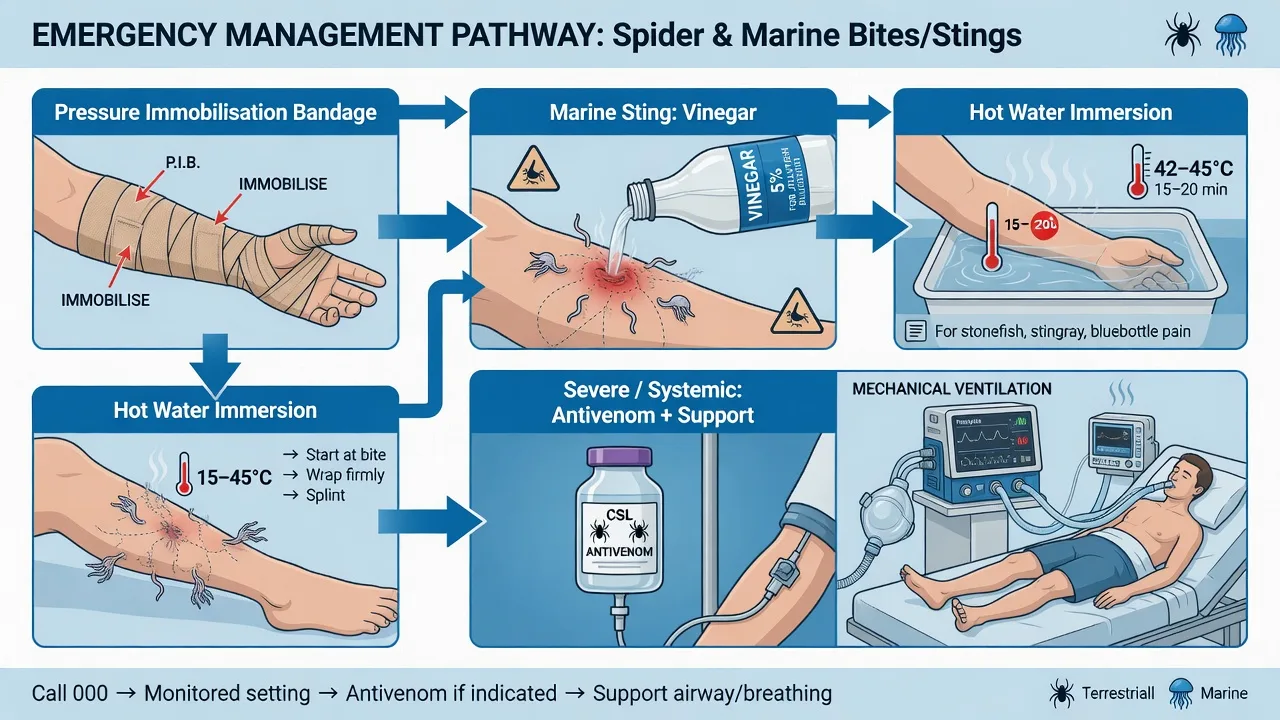
First aid is creature-specific and the candidate must not transpose it. Pressure immobilisation is for funnel-web (and would-be snakebite) only; it has no role in red-back bites (it prolongs local pain) or in any marine sting.[7]
BITES
For funnel-web bite, the pressure immobilisation bandage is applied from the fingers or toes proximally, as for snakebite, and left in place until antivenom is ready; the patient is kept supine and still. For red-back bite, ice or a cold pack and simple analgesia are applied; no bandage. For box jellyfish sting, the tentacles are deactivated with liberal vinegar, then carefully removed with the patient in vinegar (or seawater if vinegar is unavailable, never freshwater); ice relieves the pain. For Irukandji and bluebottle stings, hot water immersion of the affected part at 45 degrees Celsius for 20 minutes is the most effective analgesic — the heat denatures the heat-labile venom proteins.[5][7]
Resuscitation otherwise follows ABCDE. Intravenous access is established; oxygen is given to the unwell patient; the airway is protected early in funnel-web (pulmonary oedema and hypoxia) and in blue-ringed octopus envenomation (respiratory failure from paralysis). The awake but paralysed blue-ringed octopus victim is intubated and ventilated without delay — there is no role for neostigmine (the blockade is at the sodium channel, not the acetylcholine receptor) and there is no antivenom.[8]
Definitive management — antivenom, analgesia and supportive care
The role of antivenom and of specific treatment differs by syndrome, and the candidate must know which syndrome is treated with antivenom and which with analgesia or ventilation alone.[2][3]
Antivenom and specific treatment by syndrome
Latrodectism is treated first with analgesia — oral paracetamol and an opioid (morphine 5 to 10 mg IV, or fentanyl 50 to 100 mcg IV, titrated), and a benzodiazepine for muscle spasm (diazepam 5 to 10 mg oral or IV). Red-back spider antivenom (5000 units per vial, an equine F(ab')2 fragment) is reserved for refractory or severe pain. The RAVE randomised trial found that intravenous antivenom was not clearly superior to intramuscular, and that antivenom may be no better than placebo — efficacy is genuinely contested, and anaphylaxis to the equine protein is well described. Where antivenom is used, the modern practice is two vials intravenously, diluted in 100 mL of normal saline over 15 to 30 minutes in a monitored area, repeated once or twice at intervals if pain is unrelieved; premedication with adrenaline and antihistamine is reasonable given the reaction risk, and the patient is observed for serum sickness over the following two weeks.[1][2]
ANZ practice note — latrodectism. Red-back spider antivenom is equine F(ab')2 (5000 units/vial, CSL). The RAVE study challenged its efficacy; modern ANZ practice leads with analgesia and reserves antivenom for refractory pain, given intravenously in a monitored area because anaphylaxis occurs. Every case is discussed with a clinical toxinologist via the Poisons Information Centre (13 11 26). Funnel-web spider antivenom is the definitive treatment for funnel-web envenomation (two vials IV, repeated to control); no death has been recorded since its introduction in 1981. [1]
Funnel-web spider envenomation is a time-critical, antivenom-responsive emergency. Funnel-web spider antivenom is given as two vials intravenously, repeated every 15 minutes until features are controlled — the systematic review reported a complete response in 97 per cent of expertly identified cases, with a median of three ampoules and a range up to 17 in severe envenomation. Pulmonary oedema is treated with oxygen, continuous positive airway pressure or non-invasive ventilation, and judicious intravenous furosemide; hypotension is treated with intravenous fluid and a vasopressor or inotrope; the catecholamine cardiomyopathy is supported with standard heart-failure therapy and recovers as venom is neutralised. Premedication is not routinely required for funnel-web antivenom (the reaction rate is low), but the antivenom is given in a monitored area with adrenaline drawn up.[3][4]
Box jellyfish envenomation is treated with box-jellyfish (Chironex) antivenom (20 000 units per vial, ovine) — three vials intravenously for a major sting or any cardiac arrest, with ongoing advanced life support. Magnesium sulphate 2 to 4 g intravenously is added in cardiac arrest on the rationale of cardioprotection, although the clinical evidence is limited and the prospective Top End study noted that antivenom was rarely given in time to alter outcome. Pain is controlled with parenteral opioid and ice. The sting site is managed with vinegar first aid, then debridement of necrotic tissue as it evolves.[5]
Irukandji syndrome has no antivenom and no creature-specific antidote. Management is parenteral opioid (morphine 5 to 10 mg IV or fentanyl titrated, often in large and repeated doses), magnesium sulphate 2 to 4 g intravenously for the cardiomyopathy and the hypertension, and an antihypertensive infusion (glyceryl trinitrate) for severe hypertension to reduce the risk of intracerebral haemorrhage. The patient is admitted for serial troponin and echocardiographic monitoring because the cardiomyopathy may evolve over hours and may require inotropic or mechanical circulatory support.[6]
Blue-ringed octopus envenomation has no antivenom and no pharmacological antidote — tetrodotoxin blockade is not reversed by anticholinesterases. Management is endotracheal intubation and mechanical ventilation, continued until spontaneous ventilatory effort returns (typically 4 to 15 hours; the published paediatric case required 17 hours of ventilation). Sedation is given so the awake, paralysed patient does not experience awareness under paralysis. With adequate ventilation the outcome is uniformly full recovery, because tetrodotoxin does not produce permanent neuronal injury.[8]
Subtypes and scenarios
Red-back (latrodectism) is the commonest ANZ spider envenomation and the syndrome to recognise from the building regional pain and the regional diaphoresis. It is managed with analgesia first and antivenom for refractory cases; it does not kill, but it causes persistent and disabling pain if untreated.[1]
Funnel-web spider envenomation is the rare, lethal ANZ spider syndrome. The candidate must recognise the profuse sweating, fasciculations, hypertension and pulmonary oedema within minutes of a possible bite, apply the pressure immobilisation bandage, and give funnel-web antivenom without waiting for deterioration. Children carry a higher venom-to-body-mass ratio and progress faster.[3][4]
Box jellyfish (Chironex) sting is the marine emergency that kills — immediate pain and ladder-track dermonecrosis, with cardiac arrest in minutes in the severe case, most often a child. Vinegar first aid, CPR, and box-jellyfish antivenom plus magnesium are the sequence; stinger nets and season-prevention are the public-health priority.[5]
Irukandji syndrome is the deceptive one — the apparently trivial sting followed 20 to 40 minutes later by severe distressing pain, hypertension and troponin rise. The candidate must connect the marine exposure to the cardiomyopathy and admit for observation, treating with opioid, magnesium and antihypertensive and watching for intracerebral haemorrhage.[6]
Blue-ringed octopus envenomation is the rarest and most mechanical of the five — awake, paralysed, apnoeic — and the management is purely supportive ventilation with sedation. The recognition that the patient is awake but paralysed, and that ventilation alone is curative, is the whole of the exam answer.[8]
Complications and pitfalls
The complications are syndrome-specific. Latrodectism causes persistent pain (days) and, rarely, a systemic illness with hypertension; antivenom anaphylaxis is the iatrogenic complication. Funnel-web causes pulmonary oedema, catecholamine cardiomyopathy, hypotensive cardiac arrest and death if untreated. Box jellyfish causes cardiac arrest, dermonecrosis with secondary infection and scarring, and delayed skin grafting in severe cases. Irukandji causes stress cardiomyopathy, pulmonary oedema, and intracerebral haemorrhage from the severe hypertension. Blue-ringed octopus causes only the consequences of respiratory failure — aspiration, hypoxic brain injury — if ventilation is delayed.[4][6][8]
The pitfalls are well described. The first is applying pressure immobilisation to the wrong bite — it is correct for funnel-web and wrong for red-back, where it prolongs pain and delays presentation. The second is applying freshwater to a jellyfish sting, which triggers further nematocyst discharge; vinegar is the universal inactivator for box jellyfish. The third is underdosing or delaying funnel-web antivenom while awaiting deterioration; the antivenom is safe and the response rate is high. The fourth is over-relying on red-back antivenom — the RAVE evidence questions its efficacy, and anaphylaxis is a real risk. The fifth is missing Irukandji syndrome in the patient with back pain and hypertension after a tropical marine exposure, sending the troponin and treating the cardiomyopathy. The sixth is giving neostigmine for blue-ringed octopus paralysis, which does not act at the acetylcholine receptor and will not help; ventilation is the only treatment.[2][5][8]
Prognosis and disposition
Latrodectism is self-limiting over one to four days; the patient whose pain is controlled on analgesia is discharged with advice on antivenom serum sickness and a short course of oral analgesia. Funnel-web envenomation is admitted to a monitored bed or intensive care, observed for at least 12 hours after the last dose of antivenom and once asymptomatic with normal observations; the recovery is complete if antivenom is given in time. Box jellyfish sting with only local pain is observed for 4 to 6 hours and discharged; a major sting or any cardiac involvement is admitted to intensive care. Irukandji syndrome is admitted for 12 to 24 hours of serial troponin and echocardiographic monitoring because the cardiomyopathy may evolve; discharge follows a stable course and falling troponin. Blue-ringed octopus envenomation is managed in intensive care or a paediatric intensive care unit with mechanical ventilation until recovery, typically within a day, with full neurological recovery.[5][6][8]
Special populations
Children carry a higher venom-to-body-mass ratio and progress faster in every syndrome — the published Chironex fatality was a 3-year-old, and the blue-ringed octopus case was a 4-year-old; the dose of antivenom is the same (it neutralises a fixed quantity of venom), but fluid and opioid doses are weight-based and the airway is protected earlier. Pregnancy complicates the latrodectism hypertension, the funnel-web autonomic surge and the Irukandji cardiomyopathy; antivenom crosses the placenta poorly and the maternal indication governs. The remote or coastal patient benefits from early retrieval coordination, vinegar in the first-aid kit, and a discussion with a clinical toxinologist via the Poisons Information Centre (13 11 26).[5][8]
Evidence and regional guidelines
The ANZ evidence base is built on the prospective cohorts and trials of Isbister and colleagues. The red-back prospective cohort (Isbister and Gray, Medical Journal of Australia 2003) defined latrodectism as a severe, persistent, painful syndrome and questioned the efficacy of intramuscular antivenom. The RAVE randomised trial (Isbister and colleagues, QJM 2008) found intravenous antivenom was not clearly superior to intramuscular and that antivenom may be no better than placebo, reshaping ANZ practice toward analgesia-first management. The funnel-web systematic review (Isbister and colleagues, Medical Journal of Australia 2005) established the species distribution, the severity spectrum and the 97 per cent response rate to funnel-web antivenom. The funnel-web cardiomyopathy case series (Isbister and colleagues, Medical Journal of Australia 2015) confirmed a catecholamine-induced cardiomyopathy as the lethal mechanism. The Top End box jellyfish prospective study (Currie and Jacups, Medical Journal of Australia 2005) defined the epidemiology and clinical course of Chironex fleckeri. The Irukandji skin-scraping study (Huynh and colleagues, Medical Journal of Australia 2003) confirmed nematocyst identification and the cardiac complications of Irukandji syndrome. The Lancet spider-bite review (Isbister and Fan, 2011) sets the broader global context, and the blue-ringed octopus case report (Cavazzoni and colleagues, Clinical Toxicology 2008) documents the paediatric ventilated course and full recovery.[1][2][3][4][5][6][7][8]
Exam pearls
- Pressure immobilisation is for funnel-web only — never for red-back bites, where it prolongs pain, and never for marine stings. The first-aid is the single most testable fact.
- First aid by creature: red-back — ice and analgesia; funnel-web — pressure immobilisation bandage; box jellyfish — vinegar (acetic acid), never freshwater; Irukandji and bluebottle — hot water 45 degrees Celsius; blue-ringed octopus — no specific first aid, anticipate ventilation.
- Antivenom doses: red-back 2 vials IV (efficacy contested, analgesia-first); funnel-web 2 vials IV repeated to control (median 3, up to 17); box jellyfish 3 vials IV plus magnesium 2 to 4 g IV in cardiac arrest.
- The coagulation profile is preserved in every spider and marine syndrome — a deranged INR and raised D-dimer in any envenomated patient points to snakebite, not spider or marine envenomation.
- The funnel-web is the only spider in ANZ that can kill — recognise profuse sweating, fasciculations, hypertension and pulmonary oedema within minutes and give antivenom without waiting for deterioration.
- The blue-ringed octopus victim is awake but paralysed — intubate and ventilate; neostigmine does not help and there is no antivenom; recovery is complete within hours.
- Irukandji syndrome is the deceptive one — a trivial sting, then 20 to 40 minutes later severe pain, hypertension and a rising troponin; treat with opioid, magnesium and antihypertensive, and watch for intracerebral haemorrhage. [1]
Model answer — A 42-year-old man is brought to a rural ED 25 minutes after a Sydney funnel-web spider bite. He is diaphoretic, fasciculating, blood pressure 180/110, with bilateral crackles and oxygen saturation 90 per cent on room air. A pressure immobilisation bandage is in place. Discuss the first aid, the venom syndrome, the immediate management including antivenom, and the disposition.
First aid. The pressure immobilisation bandage is left in place until antivenom is ready — it delays the lymphatic transit of robustoxin and is the correct first aid for funnel-web bite. It is NOT removed to inspect the bite; if removal is needed, it is reapplied immediately and antivenom is ready first. It would be wrong for a red-back bite (it prolongs pain) but it is right here. [1]
Venom syndrome. Funnel-web spider envenomation. Robustoxin slows inactivation of voltage-gated sodium channels on autonomic and motor neurons, producing a massive autonomic and catecholamine surge — cholinergic features (salivation, sweating, lacrimation), adrenergic features (hypertension then hypotension), neuromuscular excitation (fasciculations), and a catecholamine-driven pulmonary oedema and stress cardiomyopathy. The funnel-web is the only ANZ spider that can kill, and the candidate must act immediately. [1]
Immediate management and antivenom. Oxygen by face mask and positive-pressure ventilation for the pulmonary oedema (continuous positive airway pressure or non-invasive ventilation if tolerated; intubation if tiring), intravenous access, bloods including troponin and coagulation profile (preserved, distinguishing from snakebite), electrocardiogram and chest X-ray. Funnel-web spider antivenom two vials intravenously, diluted and given over 15 to 30 minutes in a monitored area with adrenaline drawn up, repeated every 15 minutes until features are controlled (median three ampoules; up to 17 in severe envenomation). Pulmonary oedema is treated with oxygen, positive-pressure ventilation and judicious furosemide; hypertension and hypotension are managed expectantly as the catecholamine surge resolves. Discuss with the toxinologist via the Poisons Information Centre. [1]
Disposition. Intensive care admission for monitoring. Observe for at least 12 hours after the last dose of antivenom and once the patient is asymptomatic with normal observations and a falling troponin. Recovery is complete if antivenom is given in time; no death has been recorded since funnel-web antivenom was introduced in 1981. [1]
SAQ — Brown snake bite with venom-induced consumption coagulopathy
10 minutes · 10 marks
A 32-year-old stockman is brought to a rural ED 40 minutes after a brown snake bite to the lower leg while mustering cattle in central Queensland. A workmate correctly applied a pressure immobilisation bandage at the scene. On arrival the patient feels entirely well. At 90 minutes, with antivenom ready, the bandage is removed for assessment and the bite site inspected. Within 15 minutes he develops headache, nausea, abdominal pain and dark urine. Bloods at two hours: INR unrecordable, APTT unrecordable, fibrinogen less than 0.3 g/L, D-dimer greater than 20 mg/L, platelets 228 x 10^9/L, creatinine 145 micromol/L, CK 4800 U/L. A bite-site swab is sent for venom detection. The Poisons Information Centre is on speakerphone.
SAQ — Box jellyfish (Chironex fleckeri) sting with early cardiac arrest in a child
10 minutes · 10 marks
A 6-year-old girl is pulled screaming from the water at a tropical North Queensland beach in the stinger season. She has ladder-track, cross-hatched, erythematous and weeping dermal lesions across her right thigh where the tentacle contacted. Her father has already doused the sting liberally with vinegar from the beach station. Within 90 seconds she collapses, becomes unresponsive and pulseless, and bystander CPR begins. The paramedics arrive within five minutes and find her in asystole with CPR in progress, the vinegar-soaked tentacles still adherent.
Red flags
[1]References
- [1]Isbister GK, Gray MR. Latrodectism: a prospective cohort study of bites by formally identified redback spiders Med J Aust, 2003.PMID 12864719
- [2]Isbister GK, Brown SG, Miller M, Tankel A, Macdonald E, Stokes B, Ellis R, Nagree Y, Wilkes GJ, James R, Short A, Holdgate A. A randomised controlled trial of intramuscular vs. intravenous antivenom for latrodectism--the RAVE study QJM, 2008.PMID 18400776
- [3]Isbister GK, Gray MR, Balit CR, Raven RJ, Stokes BJ, Porges K, Tankel AS, Turner E, White J, Fisher MM. Funnel-web spider bite: a systematic review of recorded clinical cases Med J Aust, 2005.PMID 15850438
- [4]Isbister GK, Sellors KV, Beckmann U, Chiew AL, Downes MA, Berling I. Catecholamine-induced cardiomyopathy resulting from life-threatening funnel-web spider envenoming Med J Aust, 2015.PMID 26424069
- [5]Currie BJ, Jacups SP. Prospective study of Chironex fleckeri and other box jellyfish stings in the Top End of Australia's Northern Territory Med J Aust, 2005.PMID 16336157
- [6]Huynh TT, Seymour J, Pereira P, Mulcahy R, Cullen P, Carrette T, Little M. Severity of Irukandji syndrome and nematocyst identification from skin scrapings Med J Aust, 2003.PMID 12492390
- [7]Isbister GK, Fan HW. Spider bite Lancet, 2011.PMID 21762981
- [8]Cavazzoni E, Lister B, Sargent P, Schibler A. Blue-ringed octopus (Hapalochlaena sp.) envenomation of a 4-year-old boy: a case report Clin Toxicol (Phila), 2008.PMID 19238736