EM · Endocrine emergencies
Thyroid emergencies — thyroid storm and myxoedema coma
Also known as Thyroid storm · Thyrotoxic crisis · Myxoedema coma · Myxedema coma · Severe decompensated hypothyroidism
Thyroid storm (the thyrotoxic crisis) is the rare, life-threatening decompensation of thyrotoxicosis producing a hypermetabolic state of tachycardia, hyperthermia, agitation, atrial fibrillation and high-output heart failure, graded by the Burch-Wartofsky score. Myxoedema coma is its mirror image: severe decompensated hypothyroidism presenting as hypoventilation, hypothermia, bradycardia, hyponatraemia and coma. Thyroid storm is treated with beta-blockade (propranolol 60 to 80 mg orally every 4 hours or esmolol IV), propylthiouracil 500 mg loading then 250 mg every 4 hours, Lugol iodine 8 drops every 6 hours started at least 4 hours after the PTU, hydrocortisone 100 mg IV every 8 hours, cooling and fluids. Myxoedema coma is treated with levothyroxine 200 to 500 mcg IV loading, hydrocortisone 100 mg IV, and supportive care with ventilation and active rewarming. Both are clinical diagnoses treated empirically before the thyroid function result returns. ACEM-primary, globally tagged.
On this page & tools
Your progress
Saved locally on this device.
5 MCQs with explanations
Target exams
Red flags
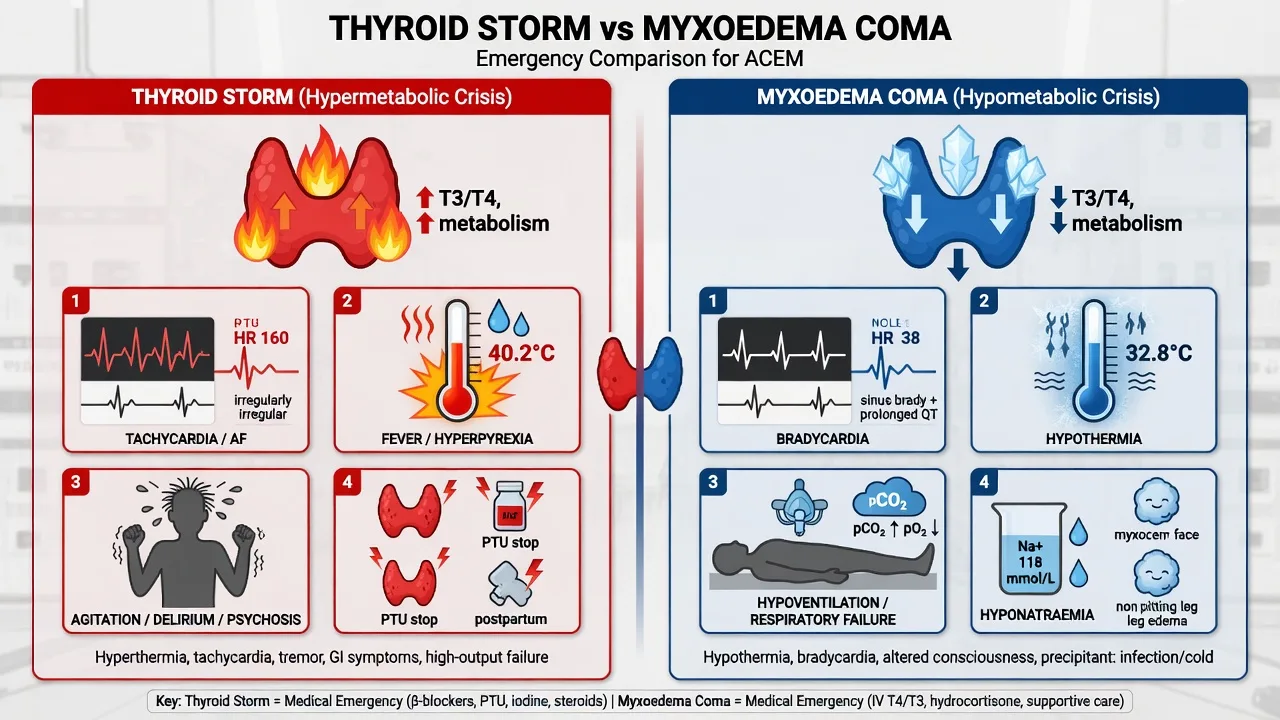
The thyroid emergencies are the two opposite ends of decompensated thyroid disease, and both kill the patient by hours to days when they are missed. Thyroid storm (the thyrotoxic crisis) is the rare, life-threatening escalation of thyrotoxicosis into a hypermetabolic state — tachycardia, hyperthermia, agitation, atrial fibrillation and high-output heart failure — driven by an acute precipitant on top of uncontrolled Graves disease. Myxoedema coma is its mirror image: severe, decompensated hypothyroidism presenting as the tetrad of hypoventilation, hypothermia, bradycardia and coma, almost always with hyponatraemia. Neither diagnosis is confirmed by the thyroid function test at the bedside, because the result takes hours; both are clinical diagnoses, treated empirically and immediately. The Fellowship candidate must recognise each constellation from across the resuscitation bay, reproduce the Burch-Wartofsky score, and execute the drug sequence — beta-blocker then thionamide then iodine then glucocorticoid for storm, levothyroxine and hydrocortisone for coma — without waiting for the laboratory.[1][2][3]
Definition and classification
Thyroid storm and myxoedema coma are the decompensated extremes of the thyroid axis — not simply severe thyrotoxicosis or severe hypothyroidism, but a state in which a precipitant has overwhelmed a chronically disordered thyroid and tipped the patient into multi-organ failure.[3]
Thyroid storm is defined clinically by the presence of thyrotoxicosis plus a systemic decompensation — hyperthermia, marked tachyarrhythmia, congestive cardiac failure, and a disturbance of consciousness — for which no alternative explanation is found. Two scoring systems operationalise the diagnosis: the Burch-Wartofsky point scale (the bedside tool used in the emergency department) and the Japanese Thyroid Association criteria (used predominantly in the Asia-Pacific region, which require a combination of central nervous system signs, fever, tachycardia and heart failure plus a confirmed thyroid function abnormality). A scoring threshold distinguishes storm from impending storm, and both demand the same treatment.[2]
Myxoedema coma is similarly a clinical diagnosis, defined as severe hypothyroidism with hypothermia and an altered conscious level, classically complicated by hypoventilation and hyponatraemia. The term "coma" is a misnomer in some patients — the syndrome includes any severely impaired conscious state from drowsiness through to true coma — but the management is identical. Neither condition has a confirmatory threshold on a single blood test; the syndrome is the diagnosis.[3][4]
Epidemiology and risk factors
Thyroid storm is rare — fewer than 1 in 100 hospital admissions for thyrotoxicosis — but it carries an in-hospital mortality of 8 to 30 per cent, and the untreated mortality approaches 100 per cent. It complicates roughly 1 per cent of all hospitalised thyrotoxic patients, and its incidence is steady despite modern antithyroid therapy, because the patients who decompensate are typically those with long-uncontrolled disease who meet a precipitant.[2][3]
Myxoedema coma is even rarer, with an incidence estimated at less than 1 case per million per year, and it is overwhelmingly a disease of older women presenting in winter. Mortality is high — 20 to 60 per cent — and rises sharply with age, with hypothermia below 32 degrees, and with delay to treatment.[3][4]
The precipitants are the key to both conditions and are the same list, in opposite directions. For thyroid storm: an infection (especially pneumonia or a urinary infection), surgery (particularly thyroid surgery in an unprepared patient), trauma, parturition, a radioactive iodine dose, an iodine load (contrast or amiodarone), withdrawal of antithyroid drug, ketoacidosis, a cerebral or myocardial infarct, or emotional stress. For myxoedema coma: an infection, cold exposure, sedatives and anaesthetics, trauma, stroke, gastrointestinal bleeding, or the withdrawal or non-absorption of levothyroxine. The precipitant is what kills the patient; the hormone deficit or excess is what unmasks it.[1][3]
Pathophysiology
In thyroid storm the gland is producing and releasing supraphysiological thyroid hormone, but the circulating hormone levels in storm overlap with those of uncomplicated thyrotoxicosis — the difference is not the concentration, it is the acute rate of rise combined with heightened tissue responsiveness and a precipitant-driven surge. Triiodothyronine (T3) upregulates the beta-adrenergic receptor and amplifies the cellular response to catecholamines, producing the tachycardia, the tremor, the agitation, the high-output cardiac failure and the hyperthermia from uncoupled oxidative phosphorylation. The gut hypermotility, the jaundice and the proximal myopathy reflect the systemic drive. The adrenal axis is stressed — cortisol clearance rises — so relative adrenal insufficiency commonly accompanies storm.[1][2]
In myxoedema coma the absence of T3 produces the inverse. The metabolic rate falls, the myocardium becomes bradycardic and poorly compliant, the gut becomes atonic, the kidney retains free water (the diluting capacity is lost and antidiuretic hormone is inappropriately high), and the central nervous system depresses to coma. The respiratory centre loses its drive to carbon dioxide, producing a hypercapnic respiratory failure — a type 2 pattern — that, with the hypoventilation, drives a respiratory acidosis which deepens the coma. The hypothermia is central and may be profound. Coexisting autoimmune adrenalitis (Schmidt syndrome) is common enough that empirical glucocorticoid cover is mandatory until cortisol is confirmed.[3][4]
[1]Clinical presentation
Thyroid storm presents as the dramatic escalation of known thyrotoxicosis, or — in the patient with no prior diagnosis — as an undifferentiated febrile agitated tachyarrhythmia. The cardinal features are pyrexia (often 38.5 to 41 degrees, and a marker of severity), tachycardia that is out of proportion to the fever (and frequently atrial fibrillation with a rapid ventricular response), agitation, confusion or coma, heart failure (high-output progressing to a low-output, low-ejection-fraction state), and gastrointestinal features — nausea, vomiting, abdominal pain and occasionally jaundice, the last a poor prognostic sign. The patient is flushed, sweaty, tremulous and warm peripherally. A goitre, a thyroid bruit, exophthalmos or a pretibial myxoedema point to underlying Graves disease.[1][2]
Myxoedema coma presents in the inverse direction. The patient is hypothermic (and hypothermia below 32 degrees is itself a poor prognostic sign), bradycardic, hypoventilating with a slow shallow pattern, and comatose or profoundly lethargic. The skin is dry, coarse, cold and pale, with periorbital puffiness, a macroglossia, delayed relaxation of the ankle reflexes, and an ileus. Hyponatraemia is usually present and may be severe. Hypoglycaemia occurs in a minority. The presentation is often misattributed to sepsis, a cerebrovascular event, or drug overdose, and the thyroid cause is missed until the history reveals levothyroxine use or a prior autoimmune thyroid diagnosis.[3][4]
[1]Differential diagnosis
Thyroid storm enters the differential of any patient with fever, tachycardia and an altered mental state, and several mimics share its hyperadrenergic profile. Myxoedema coma enters the differential of any comatose or hypothermic patient, and shares its features with sepsis and overdose. The distinction is made at the bedside by the thyroid fingerprint and by the score. [1]
Sepsis with delirium
- Fever, tachycardia, agitation and confusion in either condition; sepsis is the commonest PRECIPITANT of thyroid storm, so the two may coexist
- A known thyrotoxic or hypothyroid patient, a goitre, exophthalmos or a bristle of antithyroid drug points to the thyroid diagnosis; a clear infective source and a lactate to sepsis
- Treat both empirically — give empirical antibiotics and fluids alongside the thyroid-specific drugs if the syndrome suggests storm or coma
- In storm the temperature is high but the patient is warm, dry and tremulous with a wide pulse pressure; in septic shock the patient is cool and mottled
Sympathomimetic / stimulant toxicity
- Cocaine, amphetamine, MDMA or theophylline overdose mimic the hyperadrenergic storm — tachycardia, hypertension, hyperthermia, agitation
- Dilated pupils, a history of recreational use, a wide QRS on the ECG and a toxidrome rather than a goitre distinguish it
- Benzodiazepines, cooling and supportive care; beta-blockade is AVOIDED in cocaine toxicity (unopposed alpha effect)
- Storm has a thyroid history and a more sustained fever; stimulant toxicity peaks and wanes with the drug level
Malignant hyperthermia / neuroleptic malignant syndrome
- Hyperthermia, tachycardia, agitation or rigidity — NMS follows a neuroleptic, malignant hyperthermia follows a volatile anaesthetic
- Rigidity and a raised creatine kinase are prominent; the thyroid history and the goitre are absent
- Dantrolene, cooling, benzodiazepines; withdraw the trigger — not the thyroid drug sequence
- NMS evolves over days; storm over hours, with a precipitant
Meningoencephalitis / cerebrovascular event (for myxoedema coma)
- The comatose, hypothermic or bradycardic hypothyroid patient may be misdiagnosed as a stroke or encephalitis
- Focal signs, a neck stiffness, a computed tomography of the brain and a lumbar puncture distinguish the central cause; the dry skin, bradycardia and hyponatraemia point to the thyroid
- Treat empirically with levothyroxine, hydrocortisone and rewarming; investigate the central cause in parallel if a focal sign exists
- The combination of hypothermia, bradycardia, hypoventilation and hyponatraemia is pathognomonic for myxoedema coma
Hypothermic collapse / drug overdose (for myxoedema coma)
- Opioid, alcohol or benzodiazepine overdose with cold exposure mimics the coma; the bradycardia and dry skin of hypothyroidism are absent
- Pinpoint pupils (opioid), a low ethanol level or a positive drug screen distinguish the overdose; the thyroid function is normal
- Naloxone trial, rewarming, supportive ventilation; levothyroxine only if the thyroid syndrome is present
- Myxoedema coma has a delayed reflex relaxation, a macroglossia and a profound hyponatraemia that overdose does not
Investigations and diagnostic targets
The investigations are sent in parallel with — never before — the first specific therapy. A venous blood gas gives an immediate picture of the perfusion, the potassium, the glucose and the acid-base status; in myxoedema coma it reveals the hypercapnic respiratory acidosis that may require intubation. Urea and electrolytes show hyponatraemia in myxoedema coma (and sometimes in storm from vomiting), with hypokalaemia, hypercalcaemia and a raised alanine aminotransferase typical of storm. A bedside glucose is checked and rechecked — hypoglycaemia complicates myxoedema coma and coexisting adrenal insufficiency. Thyroid function tests (TSH, free T4, free T3) and a random cortisol are drawn before the first specific drug but never allowed to delay it. A full blood count, coagulation, blood cultures, urine culture and a chest radiograph hunt the precipitant. An ECG is mandatory — atrial fibrillation with a rapid ventricular response in storm, bradycardia with low voltages and QT prolongation in myxoedema coma. A beta-hCG is checked in any woman of reproductive age, because pregnancy precipitates storm.[2][3]
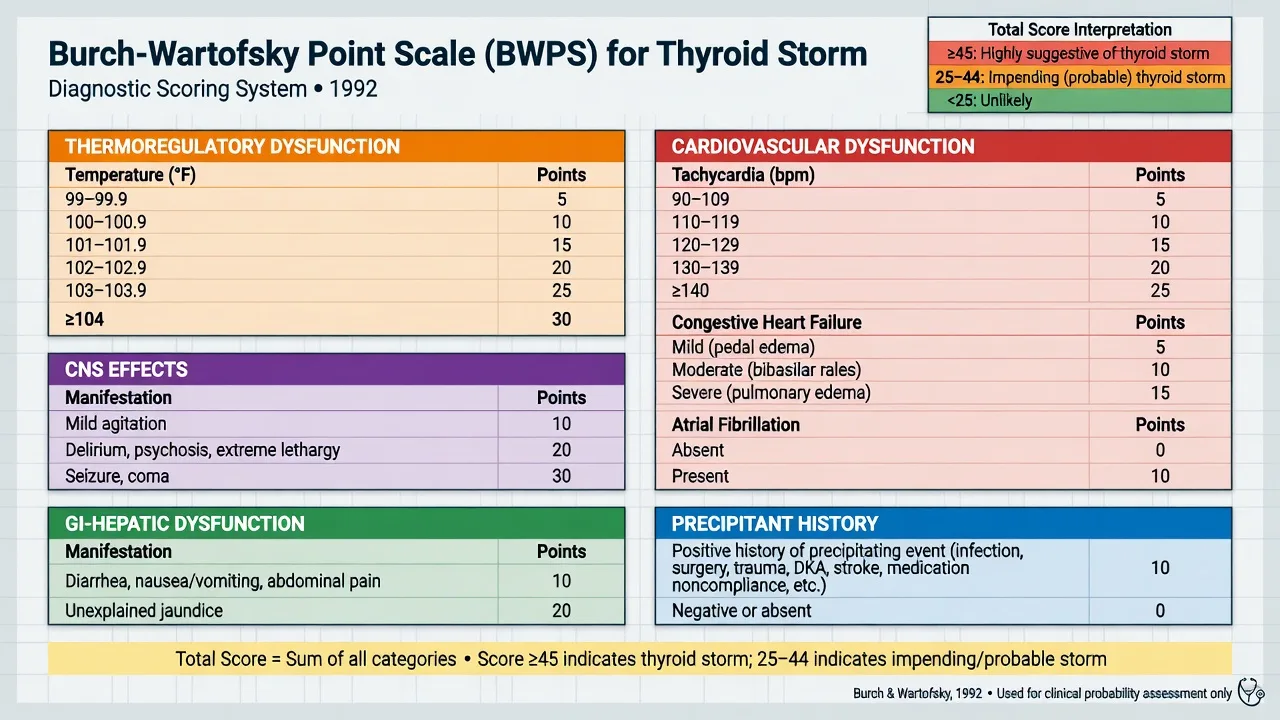
The Burch-Wartofsky point scale is the bedside tool that converts the constellation into a probability. It scores five domains, reproduced in full below, and the sum stratifies the diagnosis. [1]
| Domain | Finding | Points |
|---|---|---|
| Thermoregulation | 37.2 to 37.7 | 5 |
| 37.8 to 38.2 | 10 | |
| 38.3 to 38.8 | 15 | |
| 38.9 to 39.2 | 20 | |
| 39.3 to 39.9 | 25 | |
| 40 or above | 30 | |
| Central nervous system | Absent (mild agitation) | 0 |
| Moderate (delirium, psychosis, extreme lethargy) | 10 | |
| Severe (seizure, coma) | 20 | |
| Gastrointestinal-hepatic | Absent | 0 |
| Moderate (diarrhoea, nausea, vomiting, abdominal pain) | 10 | |
| Severe (jaundice) | 20 | |
| Cardiovascular — tachycardia | 90 to 109 | 5 |
| 110 to 119 | 10 | |
| 120 to 129 | 15 | |
| 130 to 139 | 20 | |
| 140 or above | 25 | |
| Cardiovascular — heart failure | Absent | 0 |
| Mild (pedal oedema) | 5 | |
| Moderate (bibasal crackles) | 10 | |
| Severe (pulmonary oedema) | 15 | |
| Cardiovascular — atrial fibrillation | Absent | 0 |
| Present | 10 | |
| Precipitant history | Negative | 0 |
| Positive | 10 |
The total is read against the threshold: a score at or above 45 is highly suggestive of thyroid storm; 25 to 44 is impending or impending storm warranting treatment; below 25 makes storm unlikely.[2][3]
Thyroid emergencies at a glance
Immediate management and resuscitation of thyroid storm
Resuscitation runs in parallel with the diagnostic sampling and the first specific drug. Secure the airway and give high-flow oxygen to the hypoxaemic or agitated patient; establish two large-bore intravenous cannulae; attach cardiac monitoring (the tachyarrhythmia threatens the rhythm and the output); obtain the venous gas, electrolytes, glucose, full blood count, cultures, thyroid function and cortisol. A urinary catheter tracks the perfusion response. External cooling with ice packs, a cooling blanket and paracetamol is begun immediately — the hyperthermia of storm is refractory to aspirin and non-steroidals, and aspirin is avoided because it displaces T4 and T3 from thyroid-binding globulin and worsens the free hormone load.[2][3]
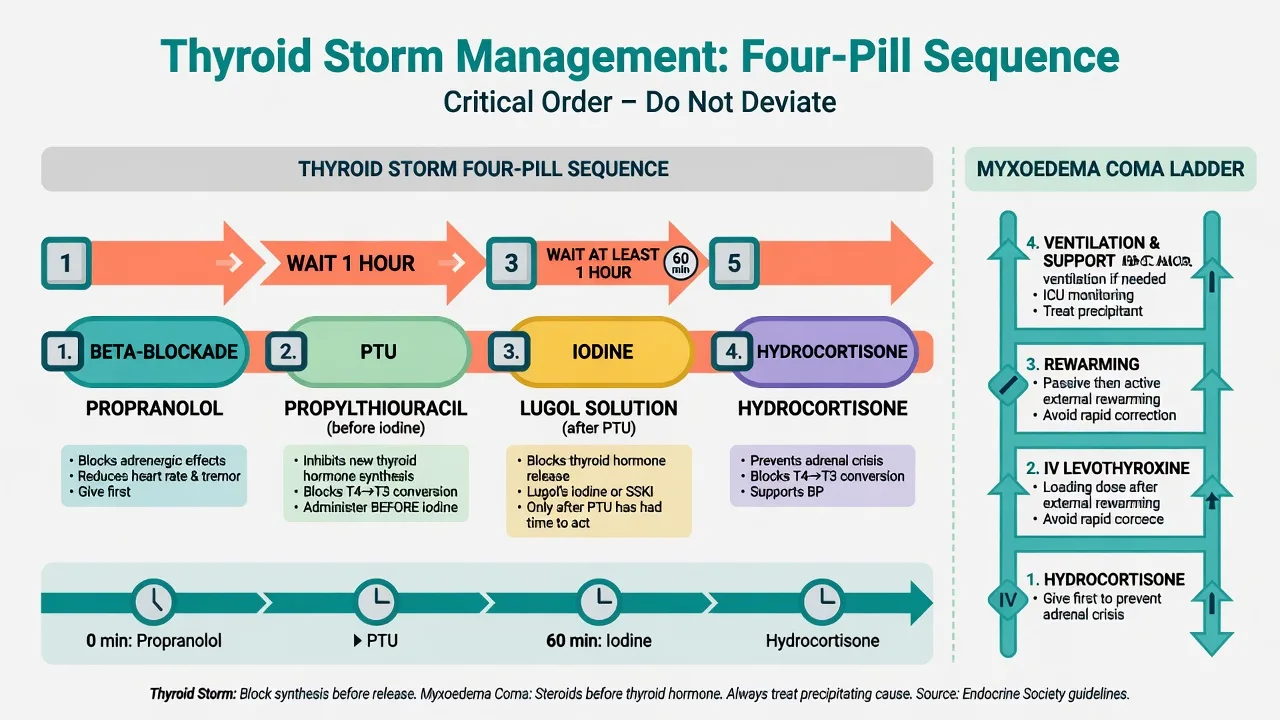
The four-drug sequence is then initiated in a fixed order: beta-blocker, thionamide, iodine, glucocorticoid. The order matters — iodine given before the thionamide provides substrate for new hormone synthesis (the Jod-Basedow phenomenon) and deepens the storm. Each drug blocks a different step of the hormone axis, so together they shut the system down within 24 to 48 hours. [1]
The first 60 minutes of thyroid storm in one breath
Recognise the syndrome — tachycardia, hyperthermia, agitation, atrial fibrillation and heart failure in a patient with known or suspected thyrotoxicosis; score it on Burch-Wartofsky. Start external cooling, paracetamol and intravenous fluids; avoid aspirin. Give propranolol 60 to 80 mg orally every 4 hours (or, in the unstable or asthmatic patient, esmolol 250 to 500 micrograms per kilogram loading then 50 to 100 micrograms per kilogram per minute intravenously). Give propylthiouracil 500 mg as a loading dose then 250 mg every 4 hours (propylthiouracil is preferred over carbimazole because it also blocks the peripheral conversion of T4 to T3). At least 4 hours after the propylthiouracil, give Lugol iodine 8 drops orally every 6 hours (or saturated potassium iodide). Give hydrocortisone 100 mg intravenously every 8 hours — it blocks hormone release, conversion and treats the relative adrenal insufficiency. Send thyroid function and cortisol, find and treat the precipitant, admit to intensive care. [1]
Definitive management of thyroid storm — the four-pill sequence
The definitive therapy blocks each step of the thyroid hormone axis in sequence, and the sequence is non-negotiable. [1]
Beta-blockade is the first drug and the most immediately life-saving, because it controls the tachyarrhythmia and the adrenergic drive. Propranolol 60 to 80 mg orally every 4 hours is the standard, chosen because at these doses it also modestly blocks the peripheral conversion of T4 to T3. In the unstable, the intubated or the rapid-atrial-fibrillation patient, esmolol by intravenous infusion — a loading dose of 250 to 500 micrograms per kilogram over one minute, then 50 to 100 micrograms per kilogram per minute — is preferred because it is titratable and ultra-short-acting. Propranolol and all non-selective beta-blockers are avoided in asthma; a cardioselective agent such as metoprolol is used, or landiolol where available. A rate-related heart failure may worsen as the rate falls, and the very high-output heart may decompensate — a cardiology and intensive-care review is mandatory.[1][2][3]
Thionamide therapy blocks new hormone synthesis. Propylthiouracil 500 mg as an oral loading dose then 250 mg every 4 hours is the first choice in storm because, in addition to blocking organification, it inhibits the type 1 deiodinase and reduces the peripheral conversion of T4 to the active T3 — a property carbimazole lacks. Where propylthiouracil is unavailable, carbimazole (or methimazole) 60 to 80 mg per day in divided doses is the alternative, given orally or via nasogastric tube. Both are given before the iodine, and the iodine is held for at least four hours after the first thionamide dose to prevent a substrate-driven hormone surge.[2][3]
Iodine (the Wolff-Chaikoff effect). Iodine in pharmacological doses acutely suppresses hormone release and synthesis — the Wolff-Chaikoff effect — and is the most rapid way to stop the gland from releasing preformed hormone. Lugol iodine 8 drops orally every 6 hours (equivalently, saturated solution of potassium iodide, 5 drops every 6 hours) is started at least 4 hours after the first propylthiouracil dose. Iodine given before the thionamide provides substrate for new synthesis (Jod-Basedow) and worsens the storm — this ordering is one of the most frequently tested points. Lipiodol and potassium iodate are alternatives where Lugol is unavailable.[3][4]
Glucocorticoid. Hydrocortisone blocks hormone release, further reduces the peripheral T4 to T3 conversion, and covers the relative adrenal insufficiency that accompanies storm from accelerated cortisol clearance. Hydrocortisone 100 mg intravenously every 8 hours is standard, continued for several days and tapered as the patient stabilises.[2][3]
Supportive care. Aggressive fluid replacement corrects the dehydration from vomiting, sweating and the hypermetabolic insensible loss; paracetamol and external cooling control the temperature (aspirin is avoided); thiamine is given to the malnourished or alcoholic patient; and venous thromboembolism prophylaxis is standard. The precipitant — an infection, a diabetic ketoacidosis, a myocardial infarct or the withdrawal of antithyroid drug — is identified and treated in parallel, because it is usually what kills the patient. Definitive cure is by radioactive iodine or thyroidectomy once the patient is stable, but never in the acute phase.[1][4]
The four-pill sequence of thyroid storm
Management of myxoedema coma
Myxoedema coma is treated empirically and immediately with intravenous levothyroxine, hydrocortisone and supportive care. Oral levothyroxine is unreliable in the comatose, hypothermic, hypomotile-gut patient, so the intravenous route is mandatory. [1]
Levothyroxine. The loading dose is levothyroxine 200 to 500 micrograms intravenously as a single stat dose, followed by a daily maintenance of 50 to 100 micrograms intravenously until the gut is functioning. The large loading dose repletes the peripheral pool, and the intravenous route avoids the unreliable gut absorption. In the older patient with ischaemic heart disease, the lower end of the range (200 micrograms) is used to avoid precipitating angina or a tachyarrhythmia; in the younger, larger or more deeply comatose patient the higher end (up to 500 micrograms) is reasonable. An alternative, especially in the smaller or elderly patient, is to add liothyronine (T3) 10 to 20 micrograms intravenously every 8 to 12 hours for its faster onset, accepting the higher arrhythmic risk.[3][4]
Hydrocortisone is given before or with the levothyroxine, never after. Coexisting autoimmune adrenal insufficiency (Schmidt syndrome) is common, and levothyroxine increases cortisol clearance — giving levothyroxine alone can precipitate an acute adrenal crisis. Hydrocortisone 100 mg intravenously as a stat then every 8 hours (or a continuous infusion) is continued until a random cortisol confirms adrenal sufficiency, then tapered.[3]
Supportive care is definitive. The hypoventilation and hypercapnia are the immediate threat to life — the patient is intubated and mechanically ventilated for the type 2 respiratory failure, and this is frequently the first intervention. Active rewarming with a warming blanket, warmed intravenous fluids and warmed humidified gases is begun, but external rewarming is moderated in the profoundly hypothermic patient to avoid a peripheral vasodilatory collapse (rewarming shock). Hypoventilation resolves with thyroid replacement, not before. The hyponatraemia is usually dilutional and corrects with fluid restriction and thyroid replacement; severe symptomatic hyponatraemia is treated with hypertonic saline to the seizure-safe threshold. Hypoglycaemia is corrected with intravenous dextrose. The precipitant — an infection, cold exposure, a sedative, a gastrointestinal bleed — is sought and treated, because, as in storm, it is usually what kills the patient. The patient is admitted to intensive care.[3][4]
The first 60 minutes of myxoedema coma in one breath
Recognise the tetrad — hypothermia, bradycardia, hypoventilation and coma, almost always with hyponatraemia, in an older patient with a thyroid history or a levothyroxine prescription. Intubate and ventilate for the hypercapnic respiratory failure (often the first intervention). Give hydrocortisone 100 mg intravenously as a stat, then give levothyroxine 200 to 500 micrograms intravenously as a loading dose (lower end if ischaemic heart disease). Begin active rewarming with a warming blanket and warmed gases; correct the hypoglycaemia and treat severe hyponatraemia with hypertonic saline to a seizure-safe level. Send thyroid function, cortisol and the septic and precipitant screen; give empirical antibiotics. Admit to intensive care. [1]
Complications and pitfalls
Death from refractory high-output or low-output cardiac failure is the feared outcome in storm; from hypercapnic respiratory arrest or the precipitant in myxoedema coma. The recurring pitfalls are the inverse of the protocol. The first is waiting for the thyroid function result before treating — the single most dangerous error in both conditions, because the result takes hours the patient may not have. The second is giving iodine before the thionamide in storm, which provides substrate and deepens the crisis. The third is giving a non-selective beta-blocker to the asthmatic with storm, precipitating bronchospasm. The fourth is giving levothyroxine without hydrocortisone in myxoedema coma, precipitating an adrenal crisis in the patient with coexisting adrenal insufficiency. The fifth is missing the precipitant — an infection, an infarct, a gastrointestinal bleed or a withdrawal of antithyroid drug — which is usually the actual cause of death. The sixth is using aspirin for the fever of storm, which raises the free hormone load. The seventh is active external rewarming too rapidly in the profoundly hypothermic myxoedema patient, causing a peripheral vasodilatory collapse.[2][3][4]
Prognosis and disposition
Treated promptly, thyroid storm improves over the first 24 to 48 hours as the iodine and thionamide take effect, and the mortality falls from 100 per cent untreated to 8 to 30 per cent; the deaths cluster in patients who present late, with jaundice or multi-organ failure. Myxoedema coma recovers more slowly — the conscious level clears over days, not hours, as the thyroid pool repletes — and the mortality of 20 to 60 per cent is driven by age, hypothermia below 32 degrees, and the precipitant. Both patients are admitted to intensive care. Definitive cure of the underlying thyrotoxicosis (radioactive iodine or thyroidectomy) follows, weeks later, once the patient is stable.[1][3][4]
Special populations
Pregnancy precipitates and complicates storm, and the management is the same with two modifications — propylthiouracil is preferred over carbimazole in the first trimester because carbimazole is teratogenic, and the beta-blocker is limited to the shortest course to avoid fetal bradycardia and growth restriction; obstetric and endocrine involvement is mandatory. The elderly with myxoedema coma are the rule rather than the exception, and the lower levothyroxine loading dose (200 micrograms) is used to avoid precipitating angina. The patient with coexisting ischaemic heart disease is given levothyroxine cautiously and liothyronine avoided, because the sudden rise in metabolic demand can precipitate infarction or a tachyarrhythmia. The amiodarone patient may develop either storm (amiodarone-induced thyrotoxicosis type 1, from the iodine load) or hypothyroidism (type 2, a destructive thyroiditis) — the two are distinguished and treated differently, and the amiodarone history is a high-yield clue in any thyroid emergency.[1][3][4]
Evidence and regional guidelines
The contemporary framework rests on the De Leo and colleagues review of hyperthyroidism in the Lancet (2016), the Chiha and colleagues update on thyroid storm in the Journal of Intensive Care Medicine (2015) — which reproduces and validates the Burch-Wartofsky score — and the paired thyroid emergencies reviews by Ylli and Klubo-Gwiezdzinska (2019, 2012), which set out the drug doses and sequences used worldwide.[1][2][3][4] The Japanese Thyroid Association criteria are used in the Asia-Pacific region as an alternative to the Burch-Wartofsky score and require a combination of central nervous system signs, fever, tachycardia and heart failure with a thyroid function abnormality. The American Thyroid Association and European Thyroid Association guidance aligns on the same four-pill sequence (beta-blocker, thionamide, iodine, glucocorticoid) and the same empirical-treatment-before-results principle.
ANZ practice note. The Australian and New Zealand endocrine and emergency pathways follow the international sequence — propranolol 60 to 80 mg orally every 4 hours (or esmolol in the unstable), propylthiouracil 500 mg loading then 250 mg every 4 hours, Lugol iodine 8 drops every 6 hours at least 4 hours after the propylthiouracil, and hydrocortisone 100 mg intravenously every 8 hours for storm; levothyroxine 200 to 500 micrograms intravenously with hydrocortisone 100 mg intravenously for myxoedema coma. The intensive-care admission is standard for both. Propylthiouracil is preferred over carbimazole in storm because of its additional block of peripheral T4-to-T3 conversion, and is the only thionamide used in the first trimester of pregnancy. [1]
Diagnostic criteria in depth — Burch-Wartofsky and the Japanese Thyroid Association
Two diagnostic frameworks operationalise thyroid storm at the bedside, and the Fellowship candidate is expected to reproduce both and defend the empiric-treatment principle that follows from each. The Burch-Wartofsky Point Scale (BWPS), introduced by Burch and Wartofsky in 1993, is the dominant tool in the Anglo-American and Australasian emergency department; the Japanese Thyroid Association (JTA) criteria are the regional standard in the Asia-Pacific and are increasingly cited in the international literature.[5][10]
The BWPS scores five domains — thermoregulation, central nervous system dysfunction, gastrointestinal-hepatic dysfunction, tachycardia, and the composite cardiovascular domain (atrial fibrillation plus heart failure) — and weights a precipitant history. The threshold at or above 45 is highly suggestive of storm, 25 to 44 is impending storm warranting treatment, and below 25 makes storm unlikely. Crucially, the BWPS is a diagnostic trigger, not a confirmatory test — a score of 45 in a septic, agitated, febrile thyrotoxic patient mandates treatment regardless, and a score of 35 in a floridly thyrotoxic patient with new atrial fibrillation likewise mandates treatment. The score converts an otherwise subjective judgement into a reproducible number, and the number moves the threshold for empirical therapy.[2][5]
The JTA criteria are stricter and staged. Definite thyroid storm requires thyrotoxicosis plus at least one central nervous system symptom (restlessness, delirium, somnolence, psychosis, seizure, coma), a fever above 38 degrees, a tachycardia above 130 or congestive cardiac failure, AND a confirmed thyroid hormone abnormality. Suspected storm drops the confirmatory thyroid function requirement. The JTA framework thus allows treatment to begin on clinical grounds alone while reserving the definite label for the biochemically confirmed case. The 2024 Furukawa prospective multicentre registry confirmed that the JTA criteria, applied at the bedside, predict mortality and validate the four-block therapy sequence — lending prospective, registry-level evidence to what began as expert consensus.[10]
Burch-Wartofsky Point Scale (BWPS)
- The Anglo-American and ANZ standard; a 5-domain point score (temperature, CNS, GI-hepatic, tachycardia, AF + heart failure) plus a precipitant history
- A score of 45 or above is highly suggestive of thyroid storm; 25 to 44 is impending storm that should be treated; below 25 makes storm unlikely
- Does NOT require a thyroid function result — it is purely clinical and designed to trigger empiric treatment at the bedside
- Reproducible across operators and easy to score in the resuscitation bay within minutes
- Introduced by Burch and Wartofsky 1993; reproduced and validated by Chiha 2015 and the Furukawa registry 2024
Japanese Thyroid Association (JTA) criteria
- The Asia-Pacific regional standard; a criteria-based (not point-scored) two-tier definition of suspected and definite storm
- Definite storm requires thyrotoxicosis PLUS CNS signs PLUS fever above 38 PLUS tachycardia above 130 or heart failure PLUS a confirmed thyroid hormone abnormality
- Suspected storm allows treatment to begin on clinical grounds without waiting for the thyroid function result, then upgrades to definite once biochemistry confirms
- Stricter and more specific than the BWPS — fewer false positives, but risks under-treating the impending case
- Prospectively validated as mortality-predictive in the 2024 Furukawa multicentre registry (PMID 38454797)
Why both exist
- Both frameworks exist because no single biochemical test confirms storm — the free T4 and T3 in storm overlap with uncomplicated thyrotoxicosis
- Both converge on the same action: score or criteria positive, treat empirically, do not wait for the result
- Both demand a search for the precipitant as part of the diagnostic workup
- Examiners accept either framework provided the candidate states the empiric-treatment principle explicitly
The temporal drug sequence — why the intervals matter
The four-drug sequence of thyroid storm is fixed in order but flexible in interval, and the order is the non-negotiable part. The logic is pharmacological: each drug blocks a different step of the hormone axis, and giving them out of order either wastes the drug or worsens the disease. The beta-blocker comes first because the immediate threat to life is the tachyarrhythmia and the adrenergic drive — propranolol or esmolol controls the rate within minutes, before any hormone-blocking agent has had time to act. The thionamide (propylthiouracil or methimazole) comes second, blocking new hormone synthesis; it is given after the beta-blocker so that the gland is not still actively secreting while the iodine load is administered. The inorganic iodine (Lugol) comes third, after the thionamide has had time to block organification, because iodine given to a gland still capable of organification provides substrate and drives new hormone synthesis (the Jod-Basedow phenomenon), deepening the storm. The glucocorticoid (hydrocortisone) is given throughout — it blocks hormone release, reduces peripheral T4-to-T3 conversion, and covers the relative adrenal insufficiency that accompanies storm.[2][3][6]
The interval between the thionamide and the iodine is the most frequently examined point and the most variably taught. The original Burch-Wartofsky description and the ATA 2016 guideline place the iodine at least one hour after the thionamide; many intensive-care and endocrine protocols use a four-hour interval; some teaching traditions cite six hours. The precise interval matters less than the principle — the thionamide must precede the iodine so that organification is blocked before substrate arrives. In practice, give the thionamide, wait the interval your local protocol specifies (one to six hours), then start the iodine, and continue both.[5][6]
The temporal four-block sequence of thyroid storm — order is fixed, interval is protocol-driven
- BLOCK ADRENERGIC DRIVE FIRST — the beta-blocker (minute 0). Propranolol 60 to 80 mg orally every 4 hours, OR esmolol 250 to 500 micrograms per kilogram intravenous loading then 50 to 100 micrograms per kilogram per minute in the unstable. Propranolol also modestly blocks T4-to-T3 conversion. This is the only drug that controls the rate within minutes, so it is first. Avoid propranolol in asthma (use a cardioselective agent or landiolol).
- BLOCK SYNTHESIS SECOND — the thionamide (minute 0 to 60). Propylthiouracil 500 mg loading then 250 mg every 4 hours (preferred in storm because it also blocks peripheral T4-to-T3 conversion), OR methimazole/carbimazole 60 to 80 mg per day. Given after or with the beta-blocker; the gland is now blocked from making new hormone.
- BLOCK RELEASE THIRD — inorganic iodine, after the thionamide (1 to 6 hours later). Lugol iodine 8 drops orally every 6 hours, or saturated potassium iodide 5 drops every 6 hours. Acts via the Wolff-Chaikoff effect to stop release of preformed hormone. NEVER before the thionamide — iodine first drives new synthesis (Jod-Basedow) and deepens the storm.
- BLOCK CONVERSION AND COVER THE ADRENAL THROUGHOUT — hydrocortisone 100 mg IV every 8 hours. Reduces peripheral T4-to-T3 conversion, blocks hormone release, and treats the relative adrenal insufficiency from accelerated cortisol clearance. Continue for several days and taper as the patient stabilises.
- SUPPORT AND FIND THE PRECIPITANT IN PARALLEL. External cooling and paracetamol (avoid aspirin — it displaces T4 and T3 from binding globulin), intravenous fluids, venous thromboembolism prophylaxis, treat the infection or infarct or withdrawal that triggered the storm. Definitive cure (radioactive iodine or thyroidectomy) follows once the patient is stable, never in the acute phase.
Refractory and adjunctive therapy in thyroid storm
Most storms respond to the four-block sequence within 24 to 48 hours. A storm that fails to improve — persistent hyperthermia, tachyarrhythmia and agitation beyond 48 hours despite full conventional therapy — is refractory, and several adjuncts exist. The mechanism of each adjunct maps to a step the conventional drugs do not fully block.[3][6]
Cholestyramine is a bile-acid sequestrant that interrupts the enterohepatic recycling of thyroid hormone — a substantial fraction of secreted T4 and T3 is reabsorbed from the gut, and cholestyramine binds it in the lumen and increases faecal clearance. Doses of 4 g orally two to four times daily, added to the thionamide and iodine, accelerate the fall in free T4 and T3 and are now endorsed as a safe adjunct in refractory or severe storm.[6]
Lithium carbonate inhibits hormone release by a mechanism distinct from iodine (it inhibits thyroglobulin-coupled iodination and cAMP-mediated release) and is the iodine substitute in the iodine-allergic or amiodarone-loaded patient. A loading dose of 300 mg orally every 6 hours, titrated to a serum level of 0.6 to 1.0 mmol per litre, blocks release — useful when iodine cannot be given or, paradoxically, when amiodarone-induced type 1 thyrotoxicosis is the driver.[3][9]
Plasmapheresis and plasma exchange physically remove circulating thyroid hormone and are the rescue therapy for the truly refractory storm, for storm in thyroid storm with concomitant hepatic failure or thrombocytopenia, and as a bridge to thyroidectomy or in pregnancy where conventional drugs are limited. Because T4 and T3 are highly protein-bound, plasma exchange can lower the circulating load within hours when pharmacological blockade has failed.[3]
Emergency thyroidectomy is the last resort after 48 to 72 hours of failed maximal medical therapy, or the deliberate choice in the amiodarone type 1 patient whose gland is actively overproducing and who cannot be rendered euthyroid medically. It is performed after the patient has been stabilised as far as possible with the four-block sequence plus plasmapheresis.[3]
Cholestyramine
- Bile-acid sequestrant; binds thyroid hormone in the gut lumen and interrupts enterohepatic recycling, increasing faecal clearance
- 4 g orally 2 to 4 times daily, added to thionamide plus iodine
- Safe, well-tolerated, increasingly endorsed as an adjunct in severe or refractory storm
- Useless without the thionamide (does not block synthesis or release) — it is an adjunct, not a substitute
Lithium carbonate
- Blocks hormone release by inhibiting thyroglobulin coupling and cAMP-mediated release — mechanism distinct from iodine
- 300 mg orally every 6 hours, titrated to serum level 0.6 to 1.0 mmol per litre
- The iodine substitute in iodine allergy or in amiodarone type 1 disease where iodine load is the problem
- Requires level monitoring; neurotoxicity and nephrotoxicity; avoid in renal impairment
Plasmapheresis / plasma exchange
- Physically removes circulating protein-bound T4 and T3 — the rescue therapy when pharmacological blockade fails
- Daily or alternate-day exchanges until the syndrome improves; bridge to thyroidectomy
- Used in refractory storm, storm with hepatic failure or thrombocytopenia, and storm in pregnancy where drugs are limited
- Transient effect (hormone re-equilibrates from the tissue pool); requires large-bore vascular access and is resource-intensive
Emergency thyroidectomy
- The definitive last resort after 48 to 72 hours of failed maximal medical therapy, or for the amiodarone type 1 gland that cannot be controlled medically
- Performed after maximal preoperative blockade (four-block sequence plus plasmapheresis)
- Cures the underlying overproduction definitively
- High perioperative risk in the haemodynamically unstable thyrotoxic patient; requires an experienced endocrine surgeon
Escalation pathway for refractory thyroid storm
- Confirm the conventional sequence is complete and correct. Beta-blocker, thionamide (PTU preferred), iodine at least one hour after the thionamide, hydrocortisone 100 mg every 8 hours, plus cooling, fluids and precipitant treatment. A refractory label is only valid once the four-block sequence has been given in the correct order at adequate dose.
- Add cholestyramine 4 g orally 2 to 4 times daily to interrupt enterohepatic recycling and accelerate the fall in free hormone.
- Consider lithium (if iodine is contraindicated or the driver is amiodarone type 1) at 300 mg every 6 hours titrated to level 0.6 to 1.0 mmol per litre.
- Institute plasma exchange or plasmapheresis for the truly refractory case, hepatic failure, thrombocytopenia, or pregnancy — daily exchanges as a bridge.
- Proceed to emergency thyroidectomy after 48 to 72 hours if maximal medical therapy plus apheresis has failed, with intensive-care and endocrine-surgical coordination.
Amiodarone-induced thyroid emergencies
Amiodarone is an iodine-rich drug (each 200 mg tablet delivers roughly 75 mg of organic iodine — a two-to-three month iodine load per tablet) and a direct cellular toxin, so it can precipitate thyroid storm in either of two mechanisms — and distinguishing them changes the management entirely. Type 1 amiodarone-induced thyrotoxicosis (AIT 1) is iodine-induced overproduction in an underlying multinodular goitre or latent Graves — the gland is actively synthesising and releasing hormone. Type 2 (AIT 2) is a destructive thyroiditis, with release of preformed hormone from a damaged gland and no ongoing synthesis.[9]
AIT 1 is treated with a thionamide (methimazole, often at higher than usual doses because the iodine-loaded gland is refractory) plus perchlorate (to block iodine uptake); AIT 2 is treated with glucocorticoids (prednisolone 40 to 60 mg daily) because the disease is inflammatory and the gland is not synthesising. The distinction is made on colour-flow Doppler ultrasound (increased vascularity in AIT 1, normal or low in AIT 2), interleukin-6 level (markedly raised in AIT 2), and the clinical context (a palpable goitre favours AIT 1). A patient on amiodarone who presents with thyroid storm has, until proven otherwise, AIT 1 if a goitre or increased vascularity is present, and the four-block sequence applies — with the caveat that the iodine block (Lugol) is omitted or replaced by lithium in the amiodarone-loaded patient, because the gland is already iodine-saturated and further iodine is substrate.[3][9]
Type 1 (AIT 1) — iodine-induced overproduction
- Underlying multinodular goitre or latent Graves; the gland actively overproduces hormone from the iodine load
- Colour-flow Doppler: increased gland vascularity; interleukin-6 normal or mildly raised
- Treated with a thionamide (methimazole, high dose) PLUS potassium perchlorate to block iodine uptake
- Iodine (Lugol) is NOT helpful — the gland is already saturated; consider lithium if a release-blocker is needed
- Definitive cure is thyroidectomy in severe or refractory cases
Type 2 (AIT 2) — destructive thyroiditis
- A destructive inflammatory thyroiditis; preformed hormone leaks from a damaged gland, no ongoing synthesis
- Colour-flow Doppler: normal or low vascularity; interleukin-6 markedly raised
- Treated with glucocorticoids (prednisolone 40 to 60 mg daily) — the disease is inflammatory
- Thionamides and iodine are NOT effective — there is no active synthesis to block
- Often self-limiting over weeks to months; may evolve to permanent hypothyroidism
Mixed / indeterminate
- A substantial minority have features of both, or the tests are indeterminate
- Treat empirically with a thionamide PLUS a glucocorticoid until the picture clarifies
- The amiodarone history is the clue in any thyroid storm — ask for it explicitly
Myxoedema coma — prognostic scoring and the rewarming strategy
Myxoedema coma carries a mortality of 20 to 60 per cent, and the outcome is driven by a small number of bedside features that the Fellowship candidate should be able to recite. The prospective series of Dutta and colleagues (2008) confirmed that age, the depth and duration of hypothermia (the worst outcomes cluster below 32 degrees), the severity of the conscious-state depression at presentation, the presence of sepsis as the precipitant, and the delay to levothyroxine independently predict mortality. A bradycardia below 50, a prolonged QT interval with torsades, and a profound hyponatraemia below 125 each add to the risk.[8]
The rewarming strategy is a perennial exam question and the source of common error. The contemporary (ATA 2014) and intensive-care position is slow passive rewarming, not aggressive active rewarming. The profoundly hypothermic myxoedema patient has maximal peripheral vasoconstriction and a contracted intravascular volume; rapid external active rewarming causes peripheral vasodilation before the myocardium has recovered its contractility, producing a rewarming shock with hypotension, a fall in core temperature (afterdrop), and arrhythmia. The correct approach is passive rewarming — warm blankets, a warm room, and warmed intravenous fluids and humidified gases — raising the core temperature by roughly half to one degree per hour, allowing the thyroid hormone replacement to restore myocardial and thermoregulatory function in step with the rewarm. Active external rewarming (forced hot air, warm water immersion) is reserved for the profoundly hypothermic patient below 30 degrees and is applied cautiously and slowly.[3][7]
| Prognostic feature at presentation | Direction of effect |
|---|---|
| Age over 60 | Mortality rises steadily with age; the elderly dominate the case mix |
| Hypothermia below 32 degrees | The single worst bedside sign; mortality approaches the upper end of the range |
| Coma or seizures at presentation | Depth of CNS depression predicts death; a GCS below 8 is grave |
| Sepsis as the precipitant | The commonest and deadliest precipitant; doubles mortality |
| Delay to levothyroxine | Each hour of untreated myxoedema coma adds to mortality; treat empirically |
| Bradycardia below 50 and prolonged QT | Risk of torsades and asystole; the ECG finding of low voltage plus QT prolongation is characteristic |
| Hyponatraemia below 125 | Marker of severity; correct slowly to avoid osmotic demyelination |
Pregnancy and the thyroid emergency
Pregnancy both precipitates and complicates thyroid storm, and two modifications to the standard sequence apply. Propylthiouracil is preferred over methimazole or carbimazole in the first trimester because methimazole and carbimazole are teratogenic (aplasia cutis, choanal atresia, tracheo-oesophageal fistula, methimazole embryopathy); in the second and third trimester the risk falls and methimazole is preferred to avoid the PTU hepatotoxicity. The beta-blocker is limited to the shortest course — propranolol crosses the placenta and can cause fetal bradycardia, hypoglycaemia and growth restriction, so it is used to control the acute storm and weaned as soon as the thionamide takes effect. Radioactive iodine is absolutely contraindicated in pregnancy; definitive cure is surgical, after the patient is rendered biochemically safe. An obstetric and endocrine consultation is mandatory, and the fetal heart rate is monitored throughout. Myxoedema coma in pregnancy is rare but treated identically with intravenous levothyroxine and hydrocortisone — both cross the placenta and treat the fetal hypothyroid state in parallel.[1][6]
[1]Adverse effects and pitfalls of the specific drugs
Each drug in the four-block sequence carries an adverse-effect profile that the Fellowship candidate must know, because the side effect can be the clue to a deterioration or the reason to switch drugs. Propylthiouracil causes an acute hepatitis in roughly one in ten thousand patients (fulminant hepatic failure, the basis of the FDA black-box warning) and, with long use, an ANCA-positive vasculitis — hence the first-trimester-only preference in pregnancy and the switch to methimazole for maintenance. Methimazole and carbimazole cause agranulocytosis (the basis of the warning to stop the drug and check a neutrophil count at any fever or sore throat) and the embryopathy in the first trimester. Non-selective beta-blockers (propranolol) provoke bronchospasm in asthma and mask the hypoglycaemia of coexisting adrenal insufficiency. Inorganic iodine causes sialadenitis and a rebound hyperthyroidism on withdrawal. Hydrocortisone causes hyperglycaemia and immunosuppression, which compounds the precipitant-driven infection. The recurring pitfalls — aspirin for the fever, iodine before the thionamide, propranolol in the asthmatic, levothyroxine without hydrocortisone in myxoedema coma, and active rewarming in the profoundly hypothermic — are the inverse of the protocol and are the single most common source of exam short-answer questions.[2][3][4]
[1]Evidence and landmark trials
The contemporary framework rests on the original point-scale derivation, the two American Thyroid Association guideline documents, the myxoedema coma outcome series, and the most recent prospective registry validation. The references below anchor every dose, threshold and sequence used in this topic.[5][6][7][8][10]
Burch and Wartofsky 1993 — Life-threatening thyrotoxicosis: thyroid storm (the Burch-Wartofsky Point Scale) (PMID 8325286)
Source
Endocrinology and Metabolism Clinics of North America 1993;22(2):263-277 — the seminal review that introduced the Burch-Wartofsky Point Scale, still the global bedside standard
What it established
A five-domain point score (thermoregulation, CNS dysfunction, gastrointestinal-hepatic dysfunction, tachycardia, and atrial fibrillation plus heart failure) weighted for a precipitant history, with the threshold of 45 or above highly suggestive of storm and 25 to 44 impending.
Key contribution
Converted thyroid storm from a diagnosis of exclusion into a prospectively identifiable, scoreable syndrome — providing the framework for empiric treatment before the thyroid function result returns. The single most cited diagnostic instrument in the field.
Ross et al. 2016 — American Thyroid Association Guidelines for Hyperthyroidism and Thyrotoxicosis (PMID 27521067)
Source
Thyroid 2016;26(10):1343-1421 — the ATA Task Force guideline, 124 evidence-based recommendations covering all causes of thyrotoxicosis
What it established
Standardised the four-block management of thyroid storm (beta-blocker, thionamide with PTU preferred, iodine after the thionamide, hydrocortisone), endorsed the BWPS for diagnosis, and formally defined amiodarone-induced thyrotoxicosis types 1 and 2 and their distinct management.
Key contribution
Confirmed that thyroid storm is a clinical diagnosis, that PTU is preferred in storm for its T4-to-T3 block, that hydrocortisone is given to every storm patient, and that cholestyramine and plasmapheresis are valid adjuncts for refractory disease.
Jonklaas et al. 2014 — American Thyroid Association Guidelines for Treatment of Hypothyroidism (PMID 25266247)
Source
Thyroid 2014;24(12):1670-1751 — the ATA Task Force on Thyroid Hormone Replacement guideline
What it established
Standardised the management of myxoedema coma: intravenous levothyroxine 200 to 500 micrograms loading then 50 to 100 micrograms daily, with intravenous hydrocortisone 100 mg every 8 hours given before or with the levothyroxine. Recommended the intravenous route (impaired oral absorption in ileus) and slow passive rewarming.
Key contribution
Established that empiric hydrocortisone is given to ALL myxoedema coma patients (coexisting adrenal insufficiency), that levothyroxine increases cortisol clearance and so can precipitate an adrenal crisis if given alone, and that rapid active rewarming is dangerous (rewarming shock).
Dutta et al. 2008 — Predictors of outcome in myxoedema coma (PMID 18173846)
Source
Critical Care 2008;12(6):R111 — a prospective outcome series from a tertiary referral centre
What it established
Quantified the mortality of myxoedema coma and identified the independent bedside predictors of death: age, the depth of hypothermia (worst below 32 degrees), the severity of the conscious-state depression, sepsis as the precipitant, and the delay to levothyroxine.
Key contribution
Provided the prognostic features exam candidates now recite — confirming that the precipitant (especially sepsis) and the depth of hypothermia, not the laboratory thyroid function value, are what determine survival.
Furukawa et al. 2024 — Prospective multicentre registry on thyroid storm (PMID 38454797)
Source
Journal of Clinical Endocrinology and Metabolism 2024 — a prospective multicentre registry study of thyroid storm across Japanese centres
What it established
Prospectively validated the Japanese Thyroid Association diagnostic criteria as mortality-predictive, and confirmed that the four-block therapy sequence (beta-blocker, thionamide, iodine, glucocorticoid) applied at the bedside improves outcome. The first large prospective registry of storm.
Key contribution
Lent prospective, registry-level evidence to what had been expert consensus, and reinforced the empiric-treatment principle — the criteria-driven early initiation of the four-block sequence is associated with survival benefit.
Exam practice
SAQ — Thyroid storm precipitated by infection
12 minutes · 10 marks
A 45-year-old woman with known Graves disease (non-adherent to carbimazole) presents with two days of fever, agitation, palpitations, vomiting and diarrhoea. She is diaphoretic, tremulous and agitated. T 39.8, HR 156 in atrial fibrillation, BP 168/92, RR 28, GCS 14. She has a diffuse goitre, lid lag and a fine tremor. Free T4 64 pmol/L, TSH under 0.01 mU/L.
SAQ — Myxoedema coma with hypercapnic respiratory failure
12 minutes · 10 marks
A 78-year-old woman is brought in during winter with progressive drowsiness over one week. She is hypothermic at 30.5 degrees, bradycardic at 42, BP 92/60, and has a slow, shallow respiratory rate of 8. She is barely rousable (GCS 8), with a hoarse voice, dry skin, periorbital puffiness and delayed relaxation of the ankle reflexes. ABG: pH 7.28, PaCO2 68 mmHg, PaO2 64, HCO3 28. Na 122 mmol/L, TSH 86 mU/L, free T4 under 5 pmol/L, cortisol 220 nmol/L.
Exam pearls
- Thyroid storm and myxoedema coma are clinical diagnoses — score with Burch-Wartofsky (45 or above suggests storm) and treat empirically, never waiting for the thyroid function result.
- The four-pill sequence for storm: propranolol, then propylthiouracil, then Lugol iodine (4 hours after the PTU), then hydrocortisone. Iodine before the thionamide deepens the storm.
- Propylthiouracil 500 mg loading then 250 mg every 4 hours is preferred over carbimazole because it blocks peripheral T4-to-T3 conversion.
- Myxoedema coma: hydrocortisone 100 mg IV first, then levothyroxine 200 to 500 mcg IV loading — the cortisol must precede the thyroid hormone to avoid an adrenal crisis.
- Intubate the myxoedema coma patient for hypercapnic type 2 respiratory failure — it is frequently the first intervention.
- Avoid aspirin for the fever of storm — it displaces T4 and T3 from binding globulin.
- Find the precipitant — an infection, an iodine load (amiodarone, contrast), a withdrawal of antithyroid drug, or a cerebrovascular or myocardial infarct — it is usually what kills the patient.
- The Burch-Wartofsky thresholds: 45 or above is storm, 25 to 44 is impending and still treated, below 25 is unlikely — the score triggers empiric treatment, never defers it.
- The Japanese Thyroid Association criteria are the Asia-Pacific alternative — definite storm needs CNS signs plus fever, tachycardia above 130, heart failure AND a thyroid function abnormality; suspected storm drops the biochemistry and allows treatment to begin.
- The interval between the thionamide and the iodine ranges 1 to 6 hours across guidelines (1 hour ATA, 4 hours common ICU practice, 6 hours some teaching); the firm rule is thionamide BEFORE iodine so organification is blocked before substrate arrives.
- Propylthiouracil causes an acute hepatitis and ANCA vasculitis; methimazole and carbimazole cause agranulocytosis and a first-trimester embryopathy — switch PTU to methimazole after the first trimester of pregnancy.
- Refractory storm adjuncts: cholestyramine (blocks enterohepatic recycling), lithium (blocks release when iodine is contraindicated or amiodarone-loaded), plasmapheresis (removes circulating hormone), and emergency thyroidectomy as the definitive last resort.
- Amiodarone thyrotoxicosis type 1 (iodine-induced overproduction, vascular goitre) needs a thionamide plus perchlorate; type 2 (destructive thyroiditis, low vascularity) needs glucocorticoids — they are managed oppositely, and Lugol is replaced by lithium in the iodine-saturated type 1 gland.
- Rewarm myxoedema coma SLOWLY and PASSIVELY (warm blankets, warm fluids, humidified gases, half to one degree per hour) — rapid active rewarming causes rewarming shock (peripheral vasodilation, hypotension, afterdrop, arrhythmia) before the hypothyroid myocardium recovers.
- The myxoedema coma prognostic features: age, hypothermia below 32 degrees, coma or seizures at presentation, sepsis as the precipitant, bradycardia below 50 with prolonged QT, and delay to levothyroxine — these, not the TSH value, determine survival.
- In pregnant storm: propylthiouracil in the first trimester (methimazole is teratogenic), methimazole in the second and third (PTU is hepatotoxic), shortest possible beta-blocker (fetal bradycardia), never radioactive iodine — definitive treatment is surgical.
- Aspirin is avoided for the fever of storm because it displaces T4 and T3 from thyroid-binding globulin and raises the free hormone load; use paracetamol and external cooling instead. [1]
Red flags
[1]References
- [1]De Leo S, Lee SY, Braverman LE Hyperthyroidism Lancet, 2016.PMID 27038492
- [2]Chiha M, Samarasinghe S, Kabaker AS Thyroid storm: an updated review J Intensive Care Med, 2015.PMID 23920160
- [3]Ylli D, Klubo-Gwiezdzinska J, Wartofsky L Thyroid emergencies Pol Arch Intern Med, 2019.PMID 31237256
- [4]Klubo-Gwiezdzinska J, Wartofsky L Thyroid emergencies Med Clin North Am, 2012.PMID 22443982
- [5]Burch HB, Wartofsky L Life-threatening thyrotoxicosis. Thyroid storm Endocrinol Metab Clin North Am, 1993.PMID 8325286
- [6]Ross DS, Burch HB, Cooper DS, et al. 2016 American Thyroid Association Guidelines for Diagnosis and Management of Hyperthyroidism and Other Causes of Thyrotoxicosis Thyroid, 2016.PMID 27521067
- [7]Jonklaas J, Bianco AC, Bauer AJ, et al. Guidelines for the treatment of hypothyroidism: prepared by the american thyroid association task force on thyroid hormone replacement Thyroid, 2014.PMID 25266247
- [8]Dutta P, Bhansali A, Masoodi SR, et al. Predictors of outcome in myxoedema coma: a study from a tertiary care centre Crit Care, 2008.PMID 18173846
- [9]Medic F, Bakula M, Alfirevic M, et al. AMIODARONE AND THYROID DYSFUNCTION Acta Clin Croat, 2022.PMID 36818930
- [10]Furukawa Y, Tanaka K, Isozaki O, et al. Prospective Multicenter Registry-Based Study on Thyroid Storm: The Guidelines for Management From Japan Are Useful J Clin Endocrinol Metab, 2024.PMID 38454797