EM · Paediatric fluid and electrolyte management
Paediatric fluid and electrolyte management
Also known as Paediatric fluid management · Maintenance and deficit fluids in children · Oral rehydration therapy · Paediatric dehydration · Holliday-Segar
Paediatric fluid and electrolyte management is four prescriptions held in one hand: maintenance, deficit, ongoing-loss, and the sodium-correction rate. Maintenance is the Holliday-Segar formula (100 mL/kg/day for the first 10 kg plus 50 mL/kg/day for the next 10 kg plus 20 mL/kg/day for each kg above 20), given as an isotonic solution to prevent hospital-acquired hyponatraemia. Dehydration is graded mild 5 per cent, moderate 10 per cent and severe 15 per cent, and the route follows the grade: oral rehydration solution first for mild-to-moderate, intravenous for shock. The shock bolus is 20 mL/kg of isotonic crystalloid, reassessed and repeated to 60 mL/kg, then an inotrope. The sodium is corrected slowly — under 8 mmol/L per 24 hours for hyponatraemia and under 10 to 12 mmol/L per 24 hours for hypernatraemia — to avoid osmotic demyelination and cerebral oedema. Paediatric DKA fluid is distinct: a 10 mL/kg bolus only if genuinely shocked, then 0.9 per cent saline with potassium chloride over 48 hours, with insulin started after the fluid. ACEM-primary, globally tagged.
On this page & tools
Your progress
Saved locally on this device.
Target exams
Red flags
Related topics
- The sick child and paediatric resuscitation
- Fluid resuscitation in the emergency department
- Paediatric sepsis and septic shock (the septic child in the emergency department)
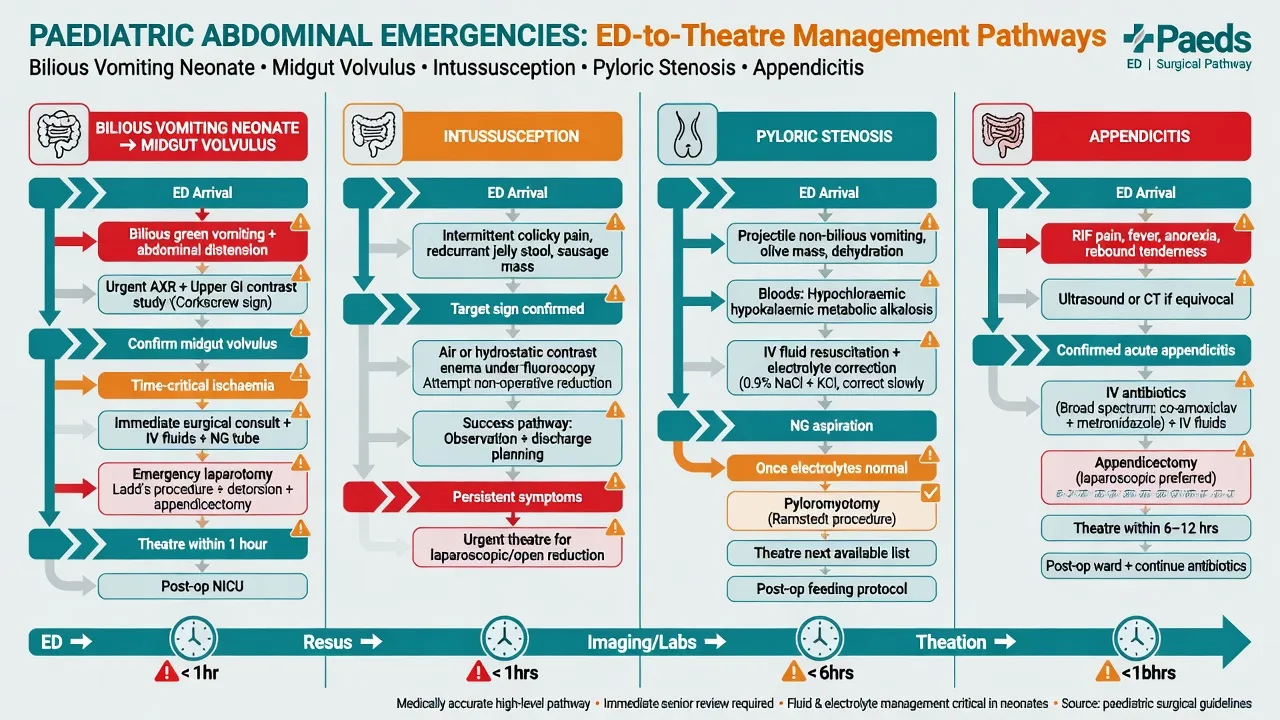
- Paediatric abdominal emergencies — intussusception, volvulus, appendicitis and pyloric stenosis
- DKA, HHS and hypoglycaemia
- Acute kidney injury
- Electrolyte emergencies — potassium and sodium
- Neonatal emergencies (the sick neonate in the emergency department)
Paediatric fluid and electrolyte management is the one Fellowship topic where a single arithmetic error can kill a child. The candidate holds four prescriptions in one hand at the bedside — maintenance, deficit replacement, ongoing-loss replacement, and the sodium-correction rate — each derived from a weight that must be measured or estimated before any fluid is hung. The examinable core is the Holliday-Segar maintenance formula, the dehydration severity grades (mild 5 per cent, moderate 10 per cent, severe 15 per cent), the route choice (oral rehydration first, intravenous for shock), the 20 mL per kilogram shock bolus, the slow sodium-correction rule that protects the brain, and the distinct paediatric DKA fluid pathway. The modern principle, anchored in NICE and the AAP, is that maintenance fluid is isotonic, not the dangerous old hypotonic default, and that sodium is corrected slowly whatever its direction.[1][3][5]
Definition and classification — the four prescriptions
Fluid therapy in a child is not a single prescription but four, each with its own calculation, and the Fellowship candidate must name them at the start of any answer to show the examiner the framework is held. Maintenance fluid is the basal water, sodium and glucose required by the child who cannot meet the need orally — the fasting or NPO child, or the child too young or too ill to drink. Deficit replacement is the volume that restores an existing loss from dehydration, sized by the percentage loss of body weight. Ongoing-loss replacement matches continuing abnormal losses millilitre for millilitre — the loose stool, the vomit, the drain, the fever-driven insensible loss. Resuscitation fluid is the rapid bolus that reverses shock. Conflating them is the commonest bedside error: running a bolus as maintenance, or forgetting that the deficit sits on top of the maintenance, double-counts or under-counts and harms the child.[1]
Dehydration is then classified by severity against the percentage loss of body weight: mild at 5 per cent (50 mL per kilogram deficit), moderate at 10 per cent (100 mL per kilogram), and severe at 15 per cent (150 mL per kilogram). Each grade carries its own clinical phenotype and its own route, set out in the assessment section below. Dehydration is further classified by the serum sodium into isotonic (sodium 135 to 145, the commonest, the viral-gastroenteritis child), hypernatraemic (sodium above 145, free-water loss exceeding salt loss) and hyponatraemic (sodium below 135, salt loss exceeding water loss or dilution), because the sodium value redirects both the fluid choice and the correction rate. [1]
The four numbers that govern paediatric fluids
Epidemiology and risk
Diarrhoeal disease is the commonest cause of paediatric dehydration worldwide and remains a leading cause of death in children under five across resource-limited settings, where oral rehydration solution has prevented millions of deaths since its introduction. In Australasian and UK practice the commonest ED presentation is viral gastroenteritis — rotavirus in the unvaccinated infant, norovirus in the older child — with bacterial gastroenteritis (Campylobacter, Salmonella, Shigella, Escherichia coli) second. The iatrogenic risks now dominate the examinable morbidity in the well-resourced ED: hospital-acquired hyponatraemia from hypotonic maintenance fluid, cerebral oedema from over-rapid hypernatraemia or DKA correction, and osmotic demyelination from over-rapid hyponatraemia correction are all predictable, preventable, and the reason the modern guidance is so prescriptive about fluid composition and rate.[3][5]
Pathophysiology — body water, the sodium-water axis and the adapting brain
The infant differs from the adult in two ways that change fluid management. Total body water is a larger fraction of body weight — about 75 per cent in the neonate against 60 per cent in the adult — and the extracellular compartment, the first compartment lost in dehydration, is proportionally larger. Daily water turnover per kilogram is two to three times the adult rate, so the infant desiccates fast: a day of poor intake plus diarrhoea can move a 5 kg infant from euvolaemia to severe dehydration. The margin for error is small, which is why every fluid volume is weight-based.[1]
The sodium concentration governs the serum osmolality, and the osmolality governs brain-cell volume — and the brain adapts to a change in osmolality over 24 to 48 hours by accumulating or shedding osmoles. A rapid change in osmolality therefore overwhelms the adaptation and shifts water violently into or out of brain cells. Rapidly correcting hypernatraemia drops the osmolality faster than the brain can shed the idiogenic osmoles it has accumulated, so water shifts into brain cells and produces cerebral oedema. Rapidly correcting chronic hyponatraemia raises the osmolality faster than the brain can re-accumulate osmoles, so water shifts out of brain cells and produces the osmotic demyelination syndrome — central pontine myelinolysis. Both are predictable, both are devastating, and both are the reason the correction rate is the single most guarded number in paediatric fluids.[3]
[1]Clinical presentation and the dehydration phenotypes
The clinical grade is assessed from the bedside signs, plotted against the percentage loss. The Fellowship candidate must recognise each grade and the atypical hypernatraemic phenotype, because the grade sets the route and the sodium value sets the rate. [1]
Mild (5%)
- Thirsty, alert, normal perfusion, moist mucous membranes
- Slightly reduced urine output; the infant drinks eagerly
- Deficit 50 mL/kg — oral rehydration first-line, ORS 50 mL/kg over 3 to 4 h plus ongoing losses
- No IV unless oral fails or the child refuses to drink
Moderate (10%)
- Sunken eyes and fontanelle, decreased skin turgor (slow abdominal skinfold recoil), dry mucous membranes
- Tachycardia, reduced urine output, restless or lethargic but rousable; perfusion preserved
- Deficit 100 mL/kg — ORS 100 mL/kg over 3 to 4 h if tolerated (with ondansetron); IV if vomiting persists or ORS refused
- Reassess hourly; convert to maintenance + deficit-over-24h plan once rehydrated
Severe (15%)
- Cold mottled skin, capillary refill 3 seconds or more, weak rapid pulse, deep acidotic breathing, hypotension (a late pre-terminal sign)
- Altered conscious level, oliguria or anuria — this is the shocked child
- Deficit 150 mL/kg — IV resuscitation first: 20 mL/kg isotonic bolus, reassess, repeat to 60 mL/kg, then inotrope if refractory
- Manage as the sick child; admit to PICU, treat the cause (sepsis, DKA) in parallel
Hypernatraemic (Na above 145)
- Looks less dehydrated than the biochemistry — water shifts out of cells preserve the circulating volume; irritable, lethargic, doughy feel
- Often free-water loss: profuse diarrhoea, diabetes insipidus, poor intake, fever
- Free-water deficit = 4 mL/kg for every mmol/L of sodium above 145; correct over 48 hours, sodium fall under 0.5 mmol/L/h
- Danger is on correction — never rapid; recheck sodium every 4 to 6 hours
Differential diagnosis — the dehydration cause
The dehydration cause is sought in parallel with rehydration, because the fluid prescription is modified by it. The viral gastroenteritis child needs only ORS; the DKA child needs the ISPAD fluid pathway; the salt-wasting congenital adrenal hyperplasia neonate needs hydrocortisone before any fluid will hold. The Fellowship candidate generates the cause from the history, the biochemistry and the anion gap, while the rehydration runs. [1]
Viral gastroenteritis
- Rotavirus, norovirus, adenovirus — low-grade fever, vomiting then watery non-bloody diarrhoea
- Isotonic dehydration, normal anion gap, ketones mild
- ORS first-line; ondansetron 0.15 mg/kg single oral dose if vomiting limits ORT
- Discharge once rehydrated with a safety-net
Bacterial gastroenteritis
- Campylobacter, Salmonella, Shigella, E. coli — bloody diarrhoea, high fever, abdominal pain
- Often hyponatraemic (salt loss); watch for haemolytic uraemic syndrome in E. coli O157
- ORS for most; IV antibiotics only for severe systemic illness or specific organisms
- Send a stool culture; notify public health
DKA
- Polyuria, polydipsia, weight loss, abdominal pain, Kussmaul breathing, ketotic breath, altered conscious level
- High anion-gap metabolic acidosis, ketones above 3 mmol/L, glucose above 11 mmol/L
- ISPAD pathway — 10 mL/kg bolus only if shocked, 0.9% saline with KCl over 48 h, insulin 0.05 to 0.1 units/kg/h after the fluid
- Cerebral oedema is the feared fluid-related death
Pyloric stenosis
- Projectile non-bilious vomiting in the 3 to 8-week-old infant, hungry after vomiting
- Hypochloraemic, hypokalaemic metabolic alkalosis — the classic biochemistry
- Correct the chloride, potassium and alkalosis deficit BEFORE surgery with 0.9% saline and KCl
- A chloride above 100 and potassium above 4 signal readiness for theatre
Congenital adrenal hyperplasia
- The salt-wasting neonate (21-hydroxylase deficiency) at 1 to 3 weeks — vomiting, lethargy, ambiguous genitalia in the female
- Hyponatraemia with HYPERkalaemia and hypoglycaemia — the diagnostic pattern
- Hydrocortisone 25 mg IV (infant stress dose) BEFORE fluid alone will hold; 0.9% saline bolus; treat the hypoglycaemia
- A dehydrated neonate with low sodium and high potassium is adrenal crisis until proven otherwise
SIADH / water overload
- Meningitis, pneumonia, bronchiolitis, post-operative — non-osmotic ADH release
- Hyponatraemia with IN-appropriate high urine sodium and osmolality, euvolaemic
- Fluid restrict to 60 to 80% of maintenance; hypertonic saline only if seizing
- The reason isotonic maintenance replaced 0.45% saline
Bedside assessment
Weigh the child first — the weight is the basis of every calculation. If the child is too unwell to stand, use the Broselow tape or the age formula (weight in kilograms equals age plus four, times two, for the child aged one to ten). Where a recent pre-illness weight is available, the difference is the most accurate deficit measure: a usual 10 kg child weighing 9 kg on arrival has a 10 per cent deficit. The hands-on assessment then grades the dehydration from the perfusion signs — capillary refill (normal under 3 seconds), skin turgor (pinch the abdominal skinfold; slow recoil is reduced turgor), mucous membranes, fontanelle in the infant (sunken in dehydration), eye turgor (sunken globes), pulse quality and rate, respiratory pattern (deep sighing acidotic breathing signals DKA or severe acidosis) and the conscious level on AVPU. The blood pressure is interpreted against the age-corrected threshold (systolic below 70 plus twice the age in years in the under-ten) and held normal until late, so shock is recognised from the perfusion signs, not the cuff. [1]
Investigations and diagnostic targets
Investigations run in parallel with rehydration, never before it. The bedside glucose is checked in every dehydrated or decompensating child — hypoglycaemia is common in the starved infant and silent in DKA, and is corrected with 5 mL per kilogram of 10 per cent dextrose. A venous blood gas gives the pH, bicarbonate, base excess, lactate and chloride immediately: the acidotic child has DKA, sepsis or severe dehydration, and the chloride distinguishes a high-anion-gap acidosis (DKA, lactic) from a hyperchloraemic acidosis (iatrogenic, from excessive saline). Sodium is the single most important electrolyte — it directs the route (isotonic, hypo- or hypernatraemic) and the rate (the correction ceiling). Potassium must be known before any potassium is added to a bag, and is depleted in DKA despite a normal or high presenting value. Urea and creatinine gauge the renal perfusion, and urinalysis with ketones confirms ketosis. A full blood count, blood culture, and stool culture are sent as the clinical picture dictates. The anion gap (sodium minus chloride minus bicarbonate, normally 10 to 18) separates the acidotic child into high-gap and normal-gap causes. [1]
The targets during rehydration are tracked on a fluid chart: re-weigh daily, recheck sodium every 4 to 6 hours in the dysnatraemic child, and document input, output, ongoing losses and the clinical grade at least every hour during the acute phase. Resolution of dehydration is the return of normal perfusion, normal mucous membranes, normal urine output (at least 1 mL per kilogram per hour) and a normal conscious level. [1]
Immediate resuscitation — the shocked child
The dehydrated child in shock is managed on the structured sick-child approach: airway, oxygen, intravenous or intra-osseous access within 90 seconds, a bedside glucose, and the first fluid bolus. The shock bolus is 20 mL per kilogram of an isotonic crystalloid (0.9 per cent saline or a balanced solution) given over 5 to 10 minutes, then reassessed against the heart rate, capillary refill, blood pressure, conscious level and liver size before any repeat. The bolus is titrated up to 60 mL per kilogram in the first hour; if shock persists at that ceiling, an inotrope (adrenaline 0.05 to 0.5 micrograms per kilogram per minute, or noradrenaline in the warm vasodilated child) is started and the precipitant — sepsis, DKA, cardiogenic shock — is treated in parallel. Smaller 10 mL per kilogram aliquots are used in the very young infant or where a cardiogenic cause is suspected, to avoid precipitating pulmonary oedema. [1]
[1]The critically important counter-rule is that oral rehydration remains first-line whenever the child is not in shock and can tolerate oral intake — the route choice is set by the grade, not by habit. The bedside glucose is treated; hypoglycaemia in the dehydrated infant is corrected with 5 mL per kilogram of 10 per cent dextrose. [1]
Definitive management — maintenance (Holliday-Segar)
The maintenance prescription answers the question, "How much water and electrolyte does this child need each day to stay even?" The answer is the Holliday-Segar formula, derived from the 1957 observation that the basal metabolic rate — and thus the water generated and lost — scales predictably with body weight.[1] The formula runs in three tiers: 100 mL per kilogram per day for the first 10 kg, plus 50 mL per kilogram per day for the next 10 kg, plus 20 mL per kilogram per day for every kilogram above 20. A 10 kg infant therefore needs 1000 mL per day; a 20 kg child needs 1500 mL per day (1000 for the first 10 kg plus 500 for the second 10 kg); a 30 kg child needs 1750 mL per day (1500 plus 200 for the 10 kg above 20). Divided by 24, the rates are 42 mL per hour, 63 mL per hour and 73 mL per hour respectively.
The composition of the maintenance fluid is now the examinable battleground, and the modern answer is isotonic. A child in pain, stress, post-operative state or respiratory illness releases non-osmotic antidiuretic hormone, which retains free water and drives the sodium down if the maintenance fluid is hypotonic. The historic 0.45 per cent saline in dextrose caused a cluster of fatal hospital-acquired hyponatraemias, and a systematic review and meta-analysis confirmed that isotonic maintenance fluid prevents the hyponatraemia without raising the risk of overload or hypernatraemia.[5] The standard bag is therefore 0.9 per cent saline (or a balanced isotonic crystalloid) in 5 per cent dextrose, with potassium chloride 10 mmol per 500 mL added once the serum potassium is confirmed normal. The single, well-defined exception is the child with proven SIADH or fluid-retaining bronchiolitis, who is fluid-restricted to 60 to 80 per cent of maintenance.
[1]Hourly maintenance — the 4-2-1 rule
The Holliday-Segar daily volume, divided by 24, is the hourly maintenance rate known as the 4-2-1 rule — the bedside shortcut the Fellowship candidate must recite because the pump is set in millilitres per hour, not per day. The tiers mirror the daily formula exactly: 4 mL per kilogram per hour for the first 10 kg, plus 2 mL per kilogram per hour for the next 10 kg (10 to 20 kg), plus 1 mL per kilogram per hour for every kilogram above 20. A 6 kg infant runs at 24 mL per hour (4 × 6); a 12 kg toddler at 44 mL per hour (40 for the first 10 kg plus 2 × 2 for the next 2 kg); a 25 kg child at 65 mL per hour (40 plus 20 plus 5). The rule is Holliday-Segar divided by 24, numerically equivalent, and the candidate who holds one can derive the other.[1]
Holliday-Segar (daily)
- 100 mL/kg/day first 10 kg + 50 mL/kg/day next 10 kg + 20 mL/kg/day each kg above 20
- Used to write the 24-hour fluid order
- 10 kg = 1000 mL/day; 20 kg = 1500 mL/day; 30 kg = 1750 mL/day
- Volume per day — the original 1957 derivation from basal metabolic rate (100 kcal needs 100 mL water)
4-2-1 rule (hourly)
- 4 mL/kg/h first 10 kg + 2 mL/kg/h next 10 kg + 1 mL/kg/h each kg above 20
- Used to set the pump rate in mL/h
- 10 kg = 40 mL/h; 20 kg = 60 mL/h; 30 kg = 70 mL/h
- Holliday-Segar divided by 24 — the two methods are numerically identical
Holliday & Segar — the maintenance need for water (Pediatrics 1957)
Pediatrics
PMID 13431307
Key finding
An observational derivation from the metabolic data of 500 hospitalised children: the basal caloric expenditure scales predictably with body weight, and the water need is 100 mL for every 100 kcal expended. From this, the three-tier maintenance formula — 100 mL/kg for the first 10 kg, 50 mL/kg for the next 10 kg, 20 mL/kg above 20 kg — and the daily sodium (2 to 4 mmol/kg) and potassium (1 to 2 mmol/kg) needs were derived.
Practice change
The single most-cited paediatric fluid paper of the twentieth century — the 4-2-1 maintenance paradigm remains the global standard seven decades later, and underpins every modern guideline including NICE NG29 and the AAP 2018 standard.
Maintenance at a glance — weight worked examples
Electrolyte maintenance — sodium and potassium
The maintenance electrolyte need, also from Holliday and Segar, is sodium 2 to 4 mmol per kilogram per day and potassium 1 to 2 mmol per kilogram per day, delivered in the isotonic maintenance bag. A standard bag of 0.9 per cent saline in 5 per cent dextrose provides about 154 mmol per litre of sodium and no potassium, so the daily sodium target for a 10 kg child (20 to 40 mmol) is comfortably met by 1000 mL of that bag, and the potassium is added separately as 10 mmol of potassium chloride per 500 mL bag (20 mmol per litre) once the serum potassium is confirmed normal. The sodium content of 0.9 per cent saline exceeds the maintenance need, which is acceptable — the kidney excretes the surplus; the danger of the old hypotonic bag is that it supplies too little sodium in the face of non-osmotic ADH, not that isotonic saline supplies too much.[5]
Electrolyte maintenance needs
Worked example — full 24-hour maintenance order for a 14 kg NPO child
Daily volume (Holliday-Segar): 1000 mL (first 10 kg) plus 200 mL (next 4 kg times 50) = 1200 mL per day. Hourly rate (4-2-1): 40 plus 8 = 48 mL per hour. Fluid: 0.9% saline in 5% dextrose with KCl 10 mmol per 500 mL — two and a half 500 mL bags over 24 hours, giving about 25 mmol KCl per day (matches the 1 to 2 mmol/kg/day target of 14 to 28 mmol). Sodium delivered: 1.2 L times 154 mmol/L = about 185 mmol, well above the 28 to 56 mmol need — the surplus excreted by the kidney. Recheck sodium and potassium at 24 hours. If the child is post-operative with non-osmotic ADH, this isotonic prescription is exactly what protects against hospital-acquired hyponatraemia. [1]
Definitive management — deficit replacement and oral rehydration
The deficit prescription answers, "How much extra fluid restores the loss?" and the route follows the grade. Mild-to-moderate dehydration without shock is managed by oral rehydration solution (ORS), the WHO reduced-osmolarity formulation at approximately 245 milliosmoles per kilogram that remains the global standard for oral rehydration therapy. The volumes are 50 mL per kilogram over 3 to 4 hours for mild dehydration and 100 mL per kilogram over 3 to 4 hours for moderate, given in small frequent aliquots (a spoonful every 1 to 2 minutes, or a syringe), with an additional 10 mL per kilogram for each loose stool to replace the ongoing loss. Oral rehydration succeeds in the great majority of children; the commonest reason it fails is vomiting, and a single oral dose of ondansetron 0.15 mg per kilogram reduces vomiting and improves the success of oral rehydration, with a small trade-off in transient diarrhoea.[4]
Severe dehydration, or the moderate dehydration that has failed oral rehydration, is managed intravenously. Once shock is corrected by the bolus, the deficit, the maintenance and the ongoing losses are summed and replaced over 24 hours as an isotonic fluid. A worked example: a 10 kg infant with 10 per cent dehydration has a 1000 mL deficit, plus a 1000 mL maintenance, totalling 2000 mL over 24 hours (about 83 mL per hour), with ongoing stool losses added millilitre for millilitre. The modern approach is an even rate over 24 hours; the older "half the deficit in the first 8 hours" schedule is still acceptable but no longer preferred. [1]
Worked example — 10 kg infant, 10% dehydration, isotonic
Deficit = 10 per cent of 10 kg = 1000 mL. Maintenance (Holliday-Segar) = 100 mL/kg/day for the first 10 kg = 1000 mL/day. Total for the first 24 hours = deficit plus maintenance = 2000 mL, run at approximately 83 mL per hour of an isotonic fluid (0.9% saline or balanced crystalloid in 5% dextrose, with KCl once the potassium is normal), plus 10 mL/kg for each loose stool as ongoing-loss replacement. Reassess hourly — perfusion, mucous membranes, urine output, conscious level — and recheck the sodium at 4 to 6 hours. If the admission sodium were 158 mmol/L, the same deficit is replaced over 48 hours instead, with the sodium allowed to fall at no more than 0.5 mmol/L per hour. [1]
Sodium — the correction rate protects the brain
Sodium disturbance is where the fluid prescription becomes most dangerous, because the rate — not the absolute value — determines whether the child develops cerebral oedema or osmotic demyelination. The Fellowship examiner tests the correction ceiling relentlessly, and the answer is symmetric and slow. [1]
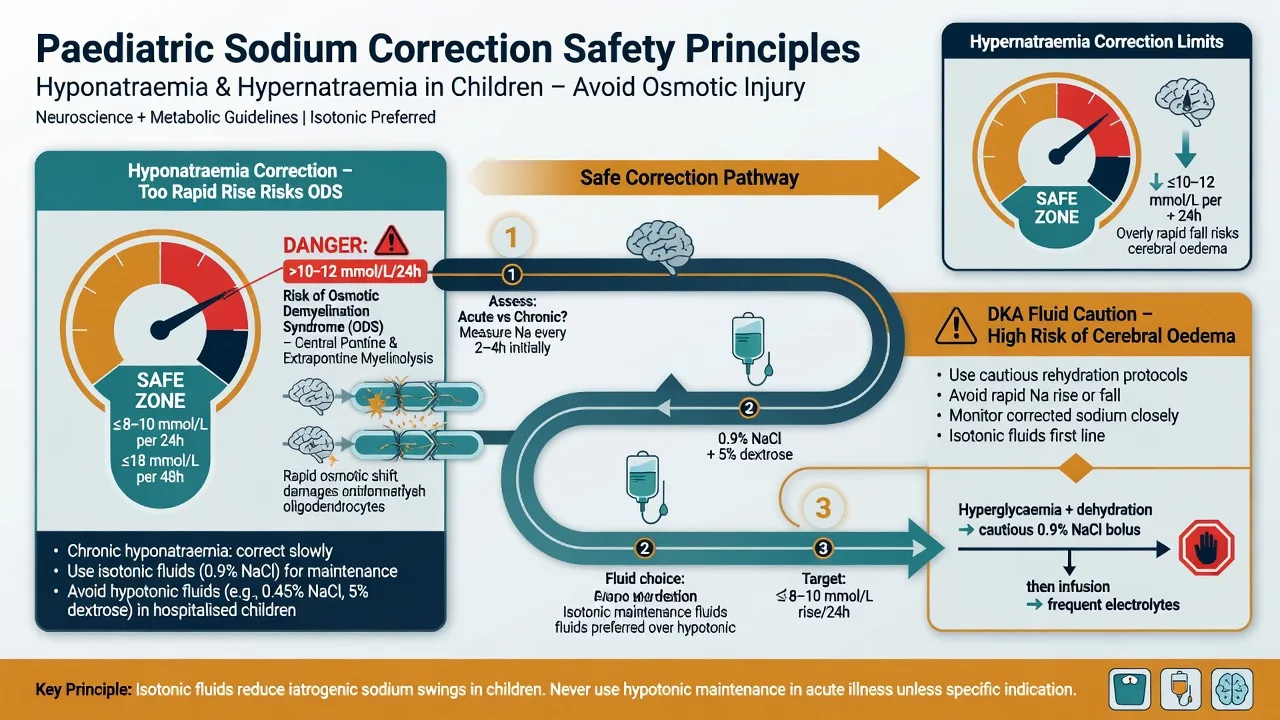
Hyponatraemia (sodium below 135 mmol/L) is corrected at under 8 mmol per litre per 24 hours (no more than about 0.5 mmol per litre per hour). The symptomatic child — seizing, or with a sodium below 120 mmol/L — receives a 3% saline bolus of 2 to 4 mL per kilogram over 10 to 15 minutes to raise the sodium 4 to 6 mmol/L just enough to stop the seizure, and then the correction is slowed to the ceiling. The principle is to relieve the immediate threat (cerebral oedema from the low sodium) and then to correct the rest slowly enough to allow the brain to re-adapt.[3]
Hypernatraemia (sodium above 145 mmol/L) is corrected at under 10 to 12 mmol per litre per 24 hours (no more than about 0.5 mmol per litre per hour), over 48 hours rather than 24. The free-water deficit is estimated as 4 mL per kilogram for every mmol per litre of sodium above 145, added to the maintenance and run slowly. The sodium is rechecked every 4 to 6 hours and the rate adjusted to hold the fall within the ceiling, because a faster fall causes the cerebral oedema that kills the hypernatraemic child.[3]
Sodium-correction targets
Paediatric DKA fluid — the ISPAD pathway
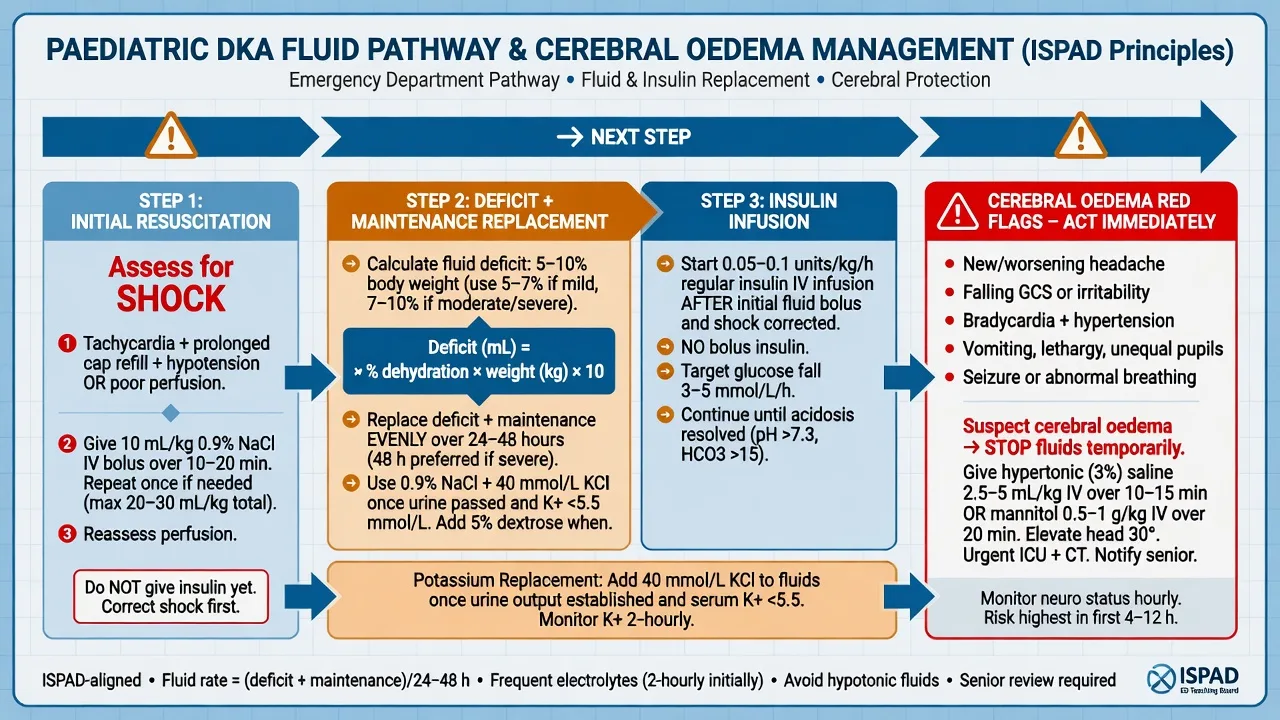
Paediatric DKA fluid differs from adult DKA fluid because the paediatric brain is the highest cerebral-oedema-risk organ in medicine, and cerebral oedema is the feared, often fatal complication. The ISPAD 2022 guideline governs the pathway, and the key differences from the adult are the conservative bolus, the slow deficit replacement over 48 hours, and the insulin started only after the initial fluid.[2]
Resuscitation. A 10 mL per kilogram bolus of 0.9 per cent saline is given only if the child is genuinely shocked — poor perfusion, hypotension, or an altered conscious level from hypovolaemia rather than acidosis. Routine boluses, even in moderate DKA, are avoided because they increase the cerebral-oedema risk. The acidotic, hyperventilating but perfusing child is taken straight to the deficit-replacement phase. [1]
Deficit replacement. The deficit is replaced over 48 hours, not 24, using a two-bag system: one bag of 0.9 per cent saline with potassium chloride, and one bag of 0.45 per cent saline in dextrose, with the relative rates titrated to the sodium — the corrected sodium (add 2 mmol per litre for every 5 mmol per litre of glucose above 5.5) is kept above 135 throughout. Potassium chloride at 40 mmol per litre is added to the bag once the serum potassium is below 5.5 mmol per litre, because the total-body potassium deficit is large and the insulin will drive the potassium down. [1]
Insulin and glucose. The insulin infusion at 0.05 to 0.1 units per kilogram per hour is started only after the initial fluid is running, not at the moment of diagnosis — the insulin given to a hypovolaemic child precipitates cardiovascular collapse. When the glucose falls below 14 mmol per litre, a glucose-containing bag is added alongside the saline so the insulin can continue to suppress the ketones without driving the glucose into hypoglycaemia. Resolution is declared when the ketones are below 0.6 mmol per litre, the pH is above 7.3 and the bicarbonate is at least 18 mmol per litre. [1]
[1] [1]Key trials — the evidence base in five cards
Maitland et al — FEAST: fluid bolus in severe African infection (NEJM 2011)
New England Journal of Medicine
PMID 21615299
Key finding
A multicentre randomised trial of 3141 African children (60 days to 12 years) with severe febrile illness and impaired perfusion, randomised to a fluid bolus (20 mL/kg of 0.9% saline or albumin) versus no bolus (maintenance fluids only). The 48-hour mortality was HIGHER with a bolus — 10.6% saline and 10.5% albumin versus 7.3% no-bolus (relative risk 1.45, p under 0.01).
Practice change
A landmark caution that transformed paediatric resuscitation: fluid boluses were harmful in febrile children with impaired perfusion in a resource-limited setting. The bolus is reserved for the genuinely shocked child, and the dehydrated-but-perfusing child is rehydrated by the deficit-replacement route. The trial is not directly transferable to the shocked child in a well-resourced ED, but it ended reflex bolusing.
Kuppermann et al — FPMS: fluid infusion rates in paediatric DKA (NEJM 2018)
New England Journal of Medicine
PMID 29897851
Key finding
A two-by-two factorial randomised trial of 1255 children with DKA across 13 US paediatric emergency departments, comparing a fast (20 mL/kg in the first hour) versus a slow (10 mL/kg) rehydration rate, AND 0.9% saline versus 0.45% saline. There was no significant difference in the primary outcome of neurologic decline (memory and IQ at 2 to 6 months), and clinically apparent cerebral oedema was rarer than historical estimates in both arms.
Practice change
The fluid rate and the saline tonicity did not demonstrably drive cerebral injury in this cohort. The trial refines but does not discard the ISPAD pathway: it did not include the genuinely shocked child, and ISPAD still advises a bolus only for genuine shock. The fear of fluid as the sole cerebral-oedema driver is moderated, but cautious bolusing and the two-bag system remain standard.
Freedman et al — oral ondansetron in paediatric gastroenteritis (NEJM 2006)
New England Journal of Medicine
PMID 16625009
Key finding
A double-blind randomised placebo-controlled trial of 215 children (6 months to 10 years) with gastroenteritis and mild-to-moderate dehydration, given a single oral dose of ondansetron 0.15 mg/kg or placebo. Ondansetron reduced vomiting, reduced the need for intravenous fluids, and reduced admissions — with a small increase in transient diarrhoea.
Practice change
A single oral dose of ondansetron is the first-line antiemetic that makes oral rehydration succeed in the vomiting child, reducing IV use and admission. It is now embedded in the ORS-first pathway for mild-to-moderate dehydration.
Amer et al — isotonic versus hypotonic maintenance fluids in children (meta-analysis, Pediatric Nephrology 2024)
Pediatric Nephrology
PMID 37365423
Key finding
A systematic review and meta-analysis of randomised trials comparing isotonic versus hypotonic intravenous maintenance fluids in hospitalised children. Isotonic maintenance significantly reduced the incidence of hospital-acquired hyponatraemia, with no increase in fluid overload, hypernatraemia, or adverse events.
Practice change
Confirms and quantifies the NICE NG29 and AAP 2018 mandate to use isotonic maintenance fluid in children. The hypotonic 0.45% saline maintenance bag is retired from routine paediatric use because non-osmotic ADH turns it into hospital-acquired hyponatraemia.
FEAST (2011)
- RCT: 20 mL/kg bolus versus no bolus in 3141 febrile African children with impaired perfusion
- Bolus INCREASED 48-hour mortality (10.6% saline versus 7.3% no-bolus)
- Caveat: resource-limited setting, malaria and anaemia burden, a population distinct from the shocked ANZ/UK child
- Take-home: do NOT bolus the non-shocked febrile child; reserve the 20 mL/kg bolus for genuine shock
FPMS (2018)
- RCT: fast versus slow rehydration, 0.9% versus 0.45% saline, in 1255 children with DKA
- No significant difference in neurologic decline between the four arms
- Caveat: the genuinely shocked child was excluded; cerebral-oedema rate was lower than historic fears
- Take-home: bolus only if genuinely shocked; ISPAD pathway remains standard; the trial moderates but does not remove the cerebral-oedema fear
Dehydration grading reconciled — Gorelick versus WHO/IMCI
Two grading systems coexist, and the Fellowship candidate must recognise both because the Australasian and UK texts use the percentage-loss (Gorelick) system while the global WHO/IMCI system uses a no-dehydration, some-dehydration, severe-dehydration trichotomy. Both arrive at the same disposition: ORS for mild-to-moderate, intravenous for shock. [1]
Gorelick (percentage loss)
- Mild under 5% (50 mL/kg deficit); moderate 5 to 10% (100 mL/kg); severe over 10% (150 mL/kg)
- Used in ANZ and UK (NICE NG29) — the percentage is plotted against the clinical signs
- Signs: sunken fontanelle, dry mucous membranes, reduced skin turgor, capillary refill over 2 s, oliguria, altered conscious level
- Sets the deficit volume and the route — ORS under 10%, intravenous for shock
WHO/IMCI (3-tier)
- No dehydration — not enough signs; some dehydration — two or more of: restless/irritable, sunken eyes, drinks eagerly/thirsty, skin pinch goes back slowly; severe dehydration — two or more of: lethargic/unconscious, sunken eyes, not able to drink/drinks poorly, skin pinch goes back very slowly (over 2 s)
- Severe dehydration = Plan C (intravenous), some dehydration = Plan B (ORS), no dehydration = Plan A (home)
- Used in resource-limited and global practice; the WHO reduced-osmolarity ORS is the therapy
- Equivalent to the Gorelick grades — some dehydration roughly equals moderate, severe equals the shocked or over 10% child
Bedside workflows — the Fellowship viva sequences
Bedside dehydration assessment — the first ten minutes
Weigh the child
Use the scales, the Broselow tape, or the age formula (age in years plus 4, times 2) for 1 to 10 years. The weight underpins every calculation — maintenance, deficit, bolus, drug dose. A pre-illness weight, if known, gives the most accurate deficit (a usual 10 kg child weighing 9 kg has a 10% deficit).
Bedside glucose in every child
Treat hypoglycaemia (glucose under 3 mmol/L or symptomatic) with 5 mL/kg of 10% dextrose — never 50% dextrose in a child. Hypoglycaemia is common in the starved infant and silent in DKA.
Grade the dehydration from clinical signs
Capillary refill (normal under 3 s), skin turgor (pinch the abdominal skinfold — slow recoil is reduced turgor), mucous membranes, fontanelle in the infant (sunken in dehydration), eyes (sunken globes), pulse quality and rate, respiratory pattern (deep sighing acidotic breathing signals DKA), and the conscious level on AVPU.
Plot the grade against the percentage loss
Gorelick: mild under 5%, moderate 5 to 10%, severe over 10%. WHO/IMCI: no, some, or severe dehydration. The grade sets the route — ORS for mild-to-moderate without shock, intravenous for shock.
Send bloods without delaying rehydration
Venous gas (pH, bicarbonate, base excess, lactate, chloride), sodium (the single most important — sets the composition and the rate), potassium (before adding KCl), urea and creatinine, glucose, urinalysis with ketones. Run rehydration in parallel, never after the results.
Check the sodium and set the ceiling
Sodium under 135 mmol/L corrects at under 8 mmol/L per 24 h; over 145 mmol/L at under 10 to 12 mmol/L per 24 h over 48 h. The corrected sodium in DKA must stay above 135 throughout.
Write the four prescriptions
Maintenance (Holliday-Segar or 4-2-1 isotonic), deficit (from the percentage), ongoing losses (10 mL/kg per loose stool, millilitre for millilitre), and resuscitation (20 mL/kg bolus only if shocked). Have a second clinician check the arithmetic before the bag is hung.
Shock resuscitation in the dehydrated child
Structured sick-child approach
Airway, high-flow oxygen, and intravenous or intraosseous access within 90 seconds. Attach monitoring; take the bedside glucose.
Confirm shock from the perfusion signs
Cold mottled skin, capillary refill of 3 s or more, weak rapid pulse, altered AVPU, oliguria. The blood pressure is held normal until late — hypotension is a pre-terminal sign, so shock is recognised from perfusion, not the cuff.
First bolus — 20 mL/kg isotonic crystalloid
0.9% saline or a balanced crystalloid, over 5 to 10 minutes by push or pressure bag. Use 10 mL/kg aliquots if the cause is cardiogenic or the infant is very young, to avoid precipitating pulmonary oedema.
Reassess after every bolus
Heart rate, capillary refill, blood pressure, conscious level, liver size, breath sounds. The reassessment is the trigger for the next bolus — there is no fixed number of boluses.
Repeat to 60 mL/kg in the first hour
Titrate the boluses to the perfusion, up to 60 mL/kg in the first hour. Document each bolus and the reassessment.
Refractory shock — start an inotrope
Adrenaline 0.05 to 0.5 micrograms/kg/min (noradrenaline in the warm vasodilated child), engage the retrieval service, and treat the cause (sepsis, DKA, cardiogenic) in parallel.
Do not bolus the dehydrated-but-perfusing child
FEAST showed boluses were harmful in the febrile non-shocked child. The non-shocked dehydrated child receives deficit replacement, not boluses.
Paediatric DKA fluid pathway (ISPAD 2022)
Confirm DKA and the deficit
Glucose over 11 mmol/L, pH under 7.3, bicarbonate under 18, ketones over 3 mmol/L. Estimate the deficit at 5 to 7% for moderate and 7 to 10% for severe DKA, replaced over 48 hours.
Bolus only if genuinely shocked
10 mL/kg of 0.9% saline only for poor perfusion, hypotension, or hypovolaemic altered conscious level. Never a routine bolus — it raises the cerebral-oedema risk (FPMS, ISPAD 2022).
Two-bag deficit replacement over 48 hours
One bag of 0.9% saline with KCl, one bag of 0.45% saline in dextrose, with the relative rates titrated to keep the corrected sodium (measured sodium plus 2 mmol/L for every 5.5 mmol/L of glucose above 5.5) above 135 throughout.
Add potassium early
KCl 40 mmol/L once the serum potassium is under 5.5 mmol/L. The total-body potassium deficit is large and the insulin will drive it down.
Insulin after the fluid is running
Start the insulin infusion at 0.05 to 0.1 units/kg/hour only AFTER the fluid is running. Insulin given to a hypovolaemic child precipitates cardiovascular collapse.
Add glucose when the glucose falls under 14
A glucose-containing bag is added alongside the saline so the insulin can continue to clear the ketones without driving the glucose into hypoglycaemia.
Watch for cerebral oedema 4 to 12 hours in
Headache, falling conscious level, rising blood pressure and falling heart rate (Cushing response). Reduce the fluid rate, give mannitol 0.5 to 1 g/kg or 3% saline 2 to 4 mL/kg, intubate and hyperventilate, image the brain.
Declare resolution
Ketones under 0.6 mmol/L, pH over 7.3, bicarbonate at least 18 mmol/L. Then convert to subcutaneous insulin with a 30 to 60 minute overlap.
Oral rehydration — the technique that makes it work
Confirm the route is appropriate
The child is not in shock and can tolerate oral intake. Mild-to-moderate dehydration without shock is the ORS territory.
WHO reduced-osmolarity ORS
Approximately 245 milliosmoles per kilogram. Volume: 50 mL/kg over 3 to 4 hours for mild dehydration, 100 mL/kg over 3 to 4 hours for moderate.
Small frequent aliquots
A spoonful or a 5 mL syringe every 1 to 2 minutes — slow continuous intake defeats the gastric emptying limits that large boluses exceed.
Replace ongoing losses
Add 10 mL/kg for each loose stool, millilitre for millilitre. The ongoing loss is charted on the fluid balance.
Single oral ondansetron if vomiting limits ORT
0.15 mg/kg once (maximum 8 mg). Reduces vomiting, IV use and admission (Freedman 2006) — with a small increase in transient diarrhoea.
Reassess hourly
Perfusion, mucous membranes, urine output, conscious level. Escalate to IV only if ORS is refused, vomiting persists, or shock develops.
Convert and discharge with a safety-net
Once rehydrated, convert to maintenance plus deficit-over-24-hours and discharge with clear return precautions — persistent vomiting, reduced urine output, altered conscious level.
Hyponatraemia — the differential that changes the prescription
Not all hyponatraemia in a sick child is dilutional. The Fellowship candidate separates the euvolaemic (SIADH), the hypovolaemic (salt-wasting, adrenal insufficiency, third-space loss) and the hypervolaemic (water overload, renal failure) causes, because the fluid prescription diverges sharply — fluid restriction kills the salt-wasting child, and volume alone will not hold the adrenal-insufficient child until hydrocortisone is given.[3]
SIADH (euvolaemic)
- Meningitis, pneumonia, bronchiolitis, post-operative state — non-osmotic ADH release
- Hyponatraemia with an IN-appropriately high urine sodium and osmolality; euvolaemic on examination
- Fluid restrict to 60 to 80% of maintenance; 3% saline only if seizing
- The reason isotonic maintenance replaced 0.45% saline in the sick child
Cerebral salt wasting (hypovolaemic)
- Brain injury, meningitis, subarachnoid haemorrhage — natriuretic peptide release
- Hyponatraemia with an APPROPRIATELY high urine sodium and osmolality; HYPOvolaemic with polyuria
- Volume REPLACEMENT with 0.9% saline and salt — NOT fluid restriction
- Distinguished from SIADH by the hypovolaemia and the high urine output
Adrenal crisis / CAH (hypovolaemic)
- Salt-wasting 21-hydroxylase deficiency neonate at 1 to 3 weeks: vomiting, lethargy, ambiguous genitalia in the female
- Hyponatraemia with HYPERkalaemia and hypoglycaemia — the diagnostic triad
- Hydrocortisone 25 mg IV (infant stress dose) BEFORE fluid will hold; 0.9% saline bolus; treat the hypoglycaemia
- A dehydrated neonate with low sodium and high potassium is adrenal crisis until proven otherwise
Water overload / renal failure (hypervolaemic)
- Excess hypotonic intake, or oliguric renal failure
- Hyponatraemia with hypervolaemia (oedema, raised JVP)
- Fluid restrict; treat the underlying cause; dialysis if severe and refractory
- Often iatrogenic from hypotonic fluid — preventable with isotonic maintenance
Other electrolyte and metabolic disturbances
Potassium. The maintenance need is 1 to 2 mmol per kilogram per day, given as 10 mmol of potassium chloride per 500 mL maintenance bag once the serum potassium is normal. The DKA child has a large total-body deficit despite a normal or high presenting value, and the potassium is added to the bag at 40 mmol per litre once the level is below 5.5 mmol per litre. Symptomatic hypokalaemia (muscle weakness, ECG changes) is corrected slowly by the intravenous route at no more than 0.5 mmol per kilogram per hour with continuous cardiac monitoring. Hyperkalaemia is managed on the standard calcium-gluconate, insulin-dextrose, salbutamol and bicarbonate pathway, treating the cause. [1]
Calcium, magnesium, phosphate. These are checked and replaced in the prolonged or malnourished dehydration, the refeeding-syndrome child, and the DKA child (phosphate falls as the acidosis corrects). The pyloric-stenosis infant needs the chloride and potassium corrected before surgery. The malnourished child being rehydrated is re-fed slowly to avoid refeeding hypophosphataemia and thiamine depletion. [1]
Subtypes and special scenarios
Hypernatraemic dehydration is the high-stakes scenario: the child looks less dehydrated than the biochemistry, the danger is on correction, and the rule is the 48-hour slow correction with the sodium held to a fall of under 0.5 mmol per litre per hour. The surgical NPO child receives isotonic maintenance at the Holliday-Segar rate, with the deficit corrected separately if preoperative fasting is prolonged. Burns follow the Parkland formula — lactated Ringer's at 3 to 4 mL per kilogram per per cent of total body surface area, half in the first 8 hours from the time of the burn — covered in the burn-management topic. Pyloric stenosis is the chloride-and-potassium-correction-before-surgery scenario. SIADH and bronchiolitis are the fluid-restriction scenarios at 60 to 80 per cent of maintenance. Trauma and sepsis follow the weight-based bolus-and-resuscitation pathway of the sick-child topic, with blood products for haemorrhagic shock. [1]
Complications and pitfalls
The complications of paediatric fluid therapy are the inversions of the rules. Cerebral oedema arises from a too-rapid osmolality drop — hypernatraemia corrected too fast, or DKA over-resuscitated — and presents as headache, falling conscious level, rising blood pressure and falling heart rate. Osmotic demyelination syndrome arises from chronic hyponatraemia corrected faster than the 8 mmol per litre per 24 hours ceiling. Hospital-acquired hyponatraemia arises from hypotonic maintenance in a child with non-osmotic ADH. Pulmonary oedema arises from over-resuscitation, especially in the cardiogenic or bronchiolitic child. Hyperchloraemic acidosis arises from excessive 0.9 per cent saline. [1]
The recurring pitfalls are the failure modes: writing 0.45 per cent saline as maintenance in a stressed child; bolusing the dehydrated-but-perfusing child; giving a routine DKA bolus; correcting the sodium faster than the ceiling in either direction; forgetting to recheck the sodium every 4 to 6 hours in the dysnatraemic child; double-counting the deficit on top of a bolus; failing to add potassium to the maintenance bag once the level is normal; and treating a number rather than the child at the bedside. The arithmetic — the maintenance volume, the deficit, the correction rate — is checked by a second clinician before the bag is hung. [1]
Prognosis and disposition
Mild-to-moderate dehydration managed successfully with oral rehydration is discharged with a safety-net and clear return precautions (persistent vomiting, reduced urine output, altered conscious level). The child needing an intravenous bolus, any child with hypernatraemic or hyponatraemic dehydration, the DKA child, and any infant under three months is admitted. The shocked child, the child with DKA and severe acidosis, and any child with cerebral-oedema risk is admitted to the paediatric intensive-care unit, with the retrieval service engaged early for the peripheral centre. The disposition decision is made after the first hour of structured rehydration, once the grade and the sodium are known and the trajectory is clear. [1]
Special populations
The neonate under 28 days has separate fluid rules — a higher glucose need (10 per cent dextrose), a watch for congenital adrenal hyperplasia in the salt-wasting hyponatraemic-hyperkalaemic neonate, and a lower threshold for sepsis coverage — covered in the neonatal-emergencies topic. The malnourished child is rehydrated slowly and re-fed cautiously to avoid refeeding syndrome. The child with chronic hyponatraemia or hypernatraemia is corrected more slowly than the ceiling if the disturbance is long-standing, because the brain has fully adapted. The child on diuretics, insulin, or adrenal-replacement therapy has the maintenance fluid adjusted to the medication. The post-operative child is on isotonic maintenance with the surgical-loss replacement added. [1]
Evidence and regional guidelines
The contemporary framework is built on five sources. Holliday and Segar's 1957 paper set the maintenance formula that remains in use today, derived from the link between basal metabolic rate and water turnover.[1] NICE guidance (NG29, IV fluids in children) and the AAP 2018 clinical practice guideline mandate isotonic maintenance fluid to prevent hospital-acquired hyponatraemia, endorsed by the 2024 systematic review and meta-analysis that confirmed isotonic maintenance lowers the hyponatraemia risk without raising overload.[5] The ISPAD 2022 clinical practice consensus guidelines (Glaser and colleagues) set the paediatric DKA fluid pathway — the conservative bolus, the 48-hour deficit replacement, the two-bag system, and the insulin-after-fluid rule.[2] Sterns's 2015 New England Journal review of disorders of plasma sodium sets the correction-rate ceilings that protect the brain from cerebral oedema and osmotic demyelination.[3] Freedman's 2006 trial established oral ondansetron as the antiemetic that makes oral rehydration succeed.[4] The WHO reduced-osmolarity ORS remains the global standard for oral rehydration.
ANZ practice note. Australasian practice follows the NICE and AAP isotonic-maintenance principle via the Royal Australasian College of Physicians and state paediatric hospital fluid guidelines: Holliday-Segar volumes, 0.9% saline or a balanced crystalloid in 5% dextrose with KCl, and a strong preference for oral rehydration in mild-to-moderate dehydration. The ISPAD 2022 DKA pathway is the standard in every Australasian paediatric unit. The state paediatric retrieval services retrieve every child in shock, with dysnatraemia, or in DKA to a paediatric intensive-care centre. [1]
SAQ — Maintenance fluids and hospital-acquired hyponatraemia in the post-ictal child
10 minutes · 10 marks
A 4-year-old, 16 kg boy is admitted overnight for observation after a witnessed generalized tonic-clonic seizure that has fully resolved. He is post-ictal, intermittently drowsy (GCS 14), and unable to tolerate oral intake; he is kept nil-by-mouth for a planned MRI in the morning. He is euvolaemic on examination: HR 96, BP 102/64, capillary refill 2 seconds, moist mucous membranes. The nursing staff ask you to write the intravenous maintenance fluid order for the next 24 hours.
SAQ — Severe paediatric diabetic ketoacidosis and the ISPAD 2022 fluid pathway
10 minutes · 10 marks
A 9-year-old, 28 kg girl presents with a three-day history of polyuria, polydipsia, abdominal pain and vomiting. She is drowsy (GCS 13), breathing deeply and rapidly with a Kussmaul pattern (RR 32), with dry mucous membranes and reduced skin turgor. Bedside glucose 28 mmol/L, venous gas pH 7.08, bicarbonate 8 mmol/L, ketones 5.2 mmol/L, sodium 132 mmol/L, potassium 5.0 mmol/L. Capillary refill 3 seconds, BP 92/60, HR 124. A diagnosis of severe diabetic ketoacidosis is made.
Exam pearls
- Maintenance is Holliday-Segar — 100 mL/kg/day for the first 10 kg, 50 for the next 10, 20 above 20 — given as an isotonic solution, never 0.45% saline.
- Dehydration is mild 5%, moderate 10%, severe 15% — the route follows the grade: ORS for mild-to-moderate, IV for shock.
- ORS volumes: 50 mL/kg over 3 to 4 h for mild, 100 mL/kg over 3 to 4 h for moderate, plus 10 mL/kg per loose stool — ondansetron 0.15 mg/kg once if vomiting limits ORT.
- The shock bolus is 20 mL/kg of isotonic crystalloid, reassessed and repeated to 60 mL/kg, then an inotrope — but never bolus the non-shocked dehydrated child (FEAST).
- Correct sodium slowly — under 8 mmol/L/24h for hyponatraemia (3% saline 2 to 4 mL/kg for seizure, then slow), under 10 to 12 mmol/L/24h for hypernatraemia (over 48 h).
- Paediatric DKA fluid: 10 mL/kg bolus only if shocked, 0.9% saline with KCl over 48 h, insulin 0.05 to 0.1 units/kg/h after the fluid, glucose bag below 14 — cerebral oedema is the feared death.
- Weigh the child — every volume, deficit and dose is weight-based. [1]
Red flags
[1]References
- [1]Holliday MA, Segar WE The maintenance need for water in parenteral fluid therapy Pediatrics, 1957.PMID 13431307
- [2]Glaser N, Kuppermann N, Yuen M, et al. ISPAD clinical practice consensus guidelines 2022: Diabetic ketoacidosis and hyperglycemic hyperosmolar state Pediatr Diabetes, 2022.PMID 36250645
- [3]Sterns RH Disorders of plasma sodium--causes, consequences, and correction N Engl J Med, 2015.PMID 25551526
- [4]Freedman SB, Adler M, Seshadri R, et al. Oral ondansetron for gastroenteritis in a pediatric emergency department N Engl J Med, 2006.PMID 16625009
- [5]Amer BE, Abdelmohsen AM, Elbarbary NS, et al. Efficacy and safety of isotonic versus hypotonic intravenous maintenance fluids in hospitalized children: an updated systematic review and meta-analysis of randomized controlled trials Pediatr Nephrol, 2024.PMID 37365423
- [6]Maitland K, Kiguli S, Opoka RO, et al. Mortality after fluid bolus in African children with severe infection N Engl J Med, 2011.PMID 21615299
- [7]Kuppermann N, Ghetti S, Schunk JE, et al. Clinical Trial of Fluid Infusion Rates for Pediatric Diabetic Ketoacidosis N Engl J Med, 2018.PMID 29897851