EM · Teaching, supervision and feedback
Teaching, supervision and feedback in the emergency department
Also known as Bedside teaching · One-minute preceptor · Microskills model of teaching · SNAPPS · Peyton four-stage approach · Pendleton’s rules · R2C2 feedback model · Feedback sandwich · Workplace-based assessment · Mini-CEX · DOPS · Case-based discussion · Entrustable professional activities · Graded supervision · Direct observation
Teaching, supervision and feedback in the emergency department — the clinical teacher’s core toolkit and the Fellowship Scholar domain. Bedside teaching models: the one-minute preceptor and Neher’s five microskills (get a commitment, probe the evidence, teach a general rule, reinforce what was right, correct errors), SNAPPS (Summarise, Narrow the differential, Analyse, Probe, Plan, Select — Wolpaw), and Peyton’s four-stage approach to teaching a practical skill. Feedback: the principles of specific, actionable, timely, behaviour-focused feedback (Ende); Pendleton’s rules; the R2C2 facilitated reflective model (Relationship, Reactions, Content, Coach — Sargeant, Lockyer); the feedback sandwich and why it is deprecated; and the meta-analytic evidence that feedback is among the most powerful influences on performance (Wisniewski, d = 0.48). Supervision: graded autonomy, direct versus indirect observation, and entrustment through entrustable professional activities (ten Cate, Gingerich). Assessment: the workplace-based assessment tools — mini-CEX (Norcini), DOPS, and case-based discussion (Lörwald). The differential of good versus poor teaching, and the pitfalls that erode learning and safety. ACEM-primary, globally tagged.
On this page & tools
Your progress
Saved locally on this device.
Target exams
Red flags
Related topics
- Team-based care and crisis resource management in the emergency department
- Breaking bad news and communication in the emergency department — the SPIKES framework
- Patient disposition and safety-netting in the emergency department
- Medical error and patient safety in the emergency department
- Research, evidence-based medicine and biostatistics — appraising and applying evidence at the bedside
- Procedural sedation in the emergency department
- The Australasian Triage Scale — categories, validity, reliability and the under-triaged patient
The emergency department is a teaching environment as much as it is a clinical one. The trainee who intubates, the registrar who runs the arrest, the junior who clerks the abdominal pain, and the medical student who presents a case are all learning on every shift, and the quality of that learning is determined by the consultant who teaches, supervises, assesses and feeds back. The Fellowship examination treats this as a distinct and examinable domain — the Scholar and Professional roles — and the candidate is expected to deploy structured bedside-teaching models, deliver feedback that changes behaviour, calibrate supervision to competence, and use the workplace-based assessment tools that sample real clinical performance. The emergency department compounds the difficulty: the patients are undifferentiated, the pace is fast, the shift is short-staffed, and the teaching moment must be seized in minutes between the sick and the sicker. The frameworks below exist precisely to make that teaching efficient, evidence-based and safe.[3][4]
Definition and scope — teaching, supervision, feedback and assessment
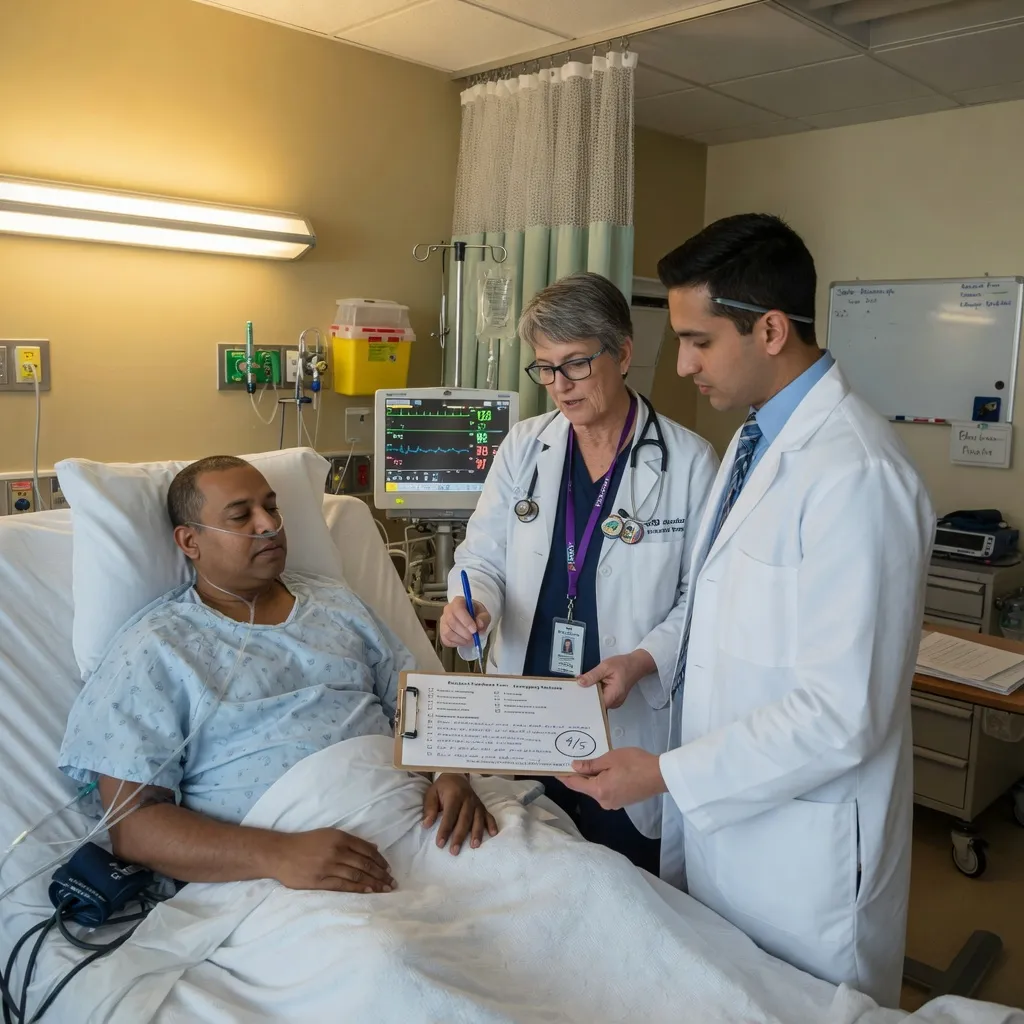
Four distinct activities are often conflated, and the candidate must separate them because each has its own method. Teaching is the deliberate facilitation of learning — the transfer, construction and consolidation of knowledge, skill and professional behaviour at the bedside. Supervision is the oversight of the trainee’s clinical work, calibrated to their competence and graduated toward independence. Feedback is, in Ende’s foundational definition, specific information about a trainee’s observed performance that is used to narrow the gap between present and desired performance — information, not judgement alone.[3] Assessment is the systematic judgement of competence against a standard. The four are linked in a loop: the supervisor observes the trainee’s performance, teaches to a gap, feeds back on what was observed, and assesses progress against an entrustment standard that determines the next level of autonomy. The emergency department is the highest-yield environment in medicine for all four, because the trainee performs the full range of clinical tasks on undifferentiated patients under direct consultant supervision — but only if the supervisor is present, observing, and engaged.[10][11]
Miller’s pyramid organises the trainee’s progression and tells the teacher which tier each tool samples. The base is knows (factual knowledge, tested by examination), then knows how (application, tested by case-based discussion), then shows how (performance in a simulated setting, tested by an OSCE), and the apex is does (performance in real practice). Workplace-based assessment is the only family of tools that samples the does tier, which is why it is the gold standard for judging entrustment and competence — and why direct observation, however underused, is irreplaceable. [1]
Bedside teaching — the three high-yield models
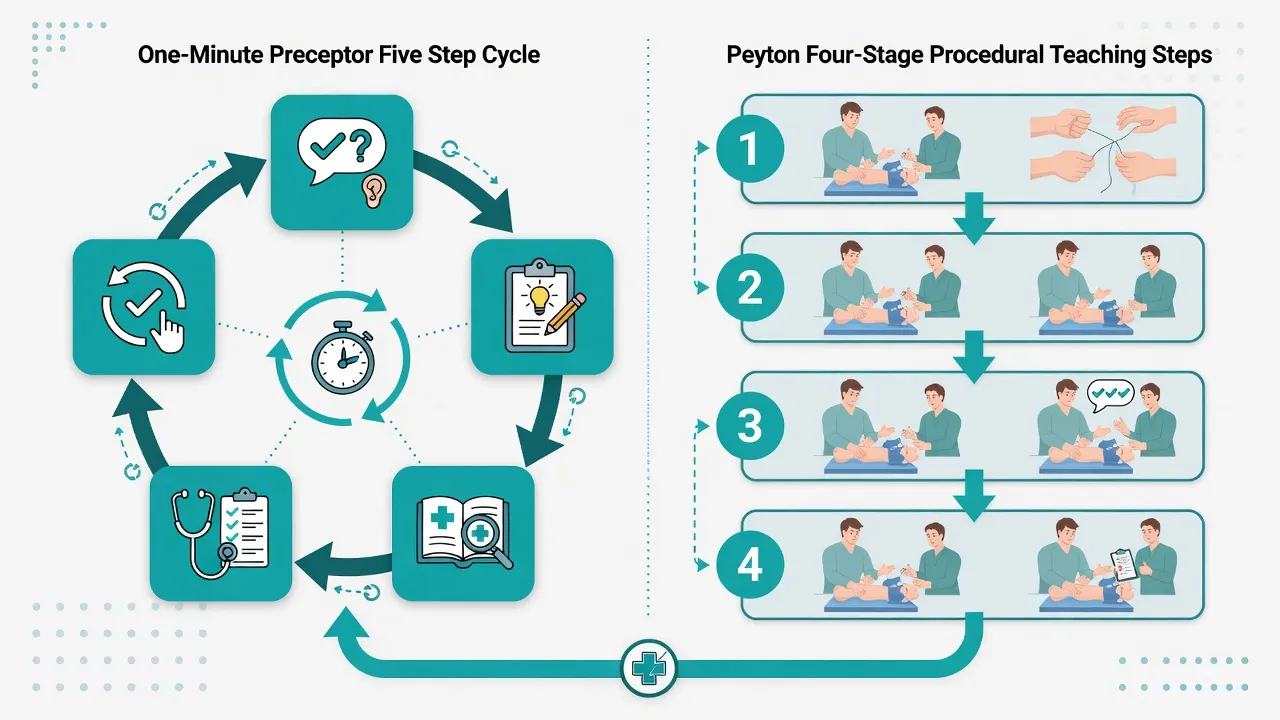
Bedside teaching is the most efficient form of clinical teaching because it places the learner, the patient and the teacher at the same point and it samples real performance. The Fellowship candidate must hold three models in working memory and select the one that fits the moment: the one-minute preceptor for a trainee who has just seen a patient and presents a case; SNAPPS for the learner-centred case discussion; and Peyton’s four-stage approach for teaching a practical skill. Each is brief, structured, and designed to be deployed in the minutes the emergency department allows. [1]
The one-minute preceptor — Neher’s five microskills
The one-minute preceptor, described by Neher and colleagues, is the workhorse model for the post-case teaching encounter in the emergency department: the trainee presents a patient, and the supervisor teaches efficiently by walking through five microskills in sequence.[1] The genius of the model is that it takes the unstructured "what do you think, doctor?" exchange and converts it into a diagnostic exercise that reveals the trainee’s reasoning, corrects it at the point of error, and teaches a transferable rule — all in one to two minutes at the bedside.
Neher’s five microskills — the one-minute preceptor
MICRO
After the presentation, ask the trainee what they think is going on — "What do you think is the diagnosis?" or "What would you like to do next?" This commits the trainee to a position and exposes their clinical reasoning, rather than allowing the safe non-answer "I am not sure, what do you think?"
Ask "What led you to that conclusion?" or "What else did you consider?" This tests the reasoning behind the commitment, distinguishes a lucky guess from a sound inference, and surfaces the gaps for the subsequent teaching
Deliver one concise, generalisable teaching point — the rule the trainee will carry to the next patient. Resist the urge to lecture; one principle, taken away, beats five facts forgotten
Name the specific behaviour that was correct — "Your identification of the evolving STEMI on the ECG was prompt and accurate." Specific reinforcement, not a global "well done", strengthens the behaviour
Identify the specific error or omission and the correction — "You did not consider aortic dissection in the differential of this chest pain; here is how I would weight it." Correction is specific, behavioural, and framed as learning, not blame
The cardinal error in the one-minute preceptor is to skip the first two microskills and jump straight to teaching — which delivers a lecture blind to the trainee’s actual reasoning and misses the gap that the model exists to expose. The commitment and the probe are the diagnostic steps that make the teaching targeted.[1]
SNAPPS — the learner-centred case presentation
SNAPPS, developed by Wolpaw and colleagues for outpatient education and now widely adopted across clinical settings, is the inverse of the one-minute preceptor: it places the structure of the teaching encounter in the trainee’s hands rather than the supervisor’s.[2] The trainee is taught to present the case in a format that explicitly surfaces uncertainty, forces a differential, and invites teaching — so the supervisor’s role is to respond to the learner’s stated needs rather than to interrogate. SNAPPS is ideally suited to the emergency department case presentation because emergency medicine is defined by the undifferentiated problem and the working differential, which is exactly what the format demands.
SNAPPS — the learner-centred presentation (Wolpaw)
SNAPPS
A concise history and findings — the focused presentation, not the exhaustive one
The trainee commits to two or three most likely diagnoses from the broader list — the act of prioritisation that exposes clinical reasoning
The trainee compares and contrasts the contenders — what argues for and against each, what would distinguish them — the highest-yield educational step
The trainee states a specific question on which they want teaching — "I am uncertain when to scan for pulmonary embolism in this patient." The learner owns the agenda
The trainee proposes the immediate plan — investigations, treatment, disposition
The trainee identifies a learning point to read about and report back — closing the loop on self-directed learning
SNAPPS suits the senior trainee who can drive the encounter; the one-minute preceptor suits the junior who needs the supervisor to lead it. The candidate who can name when to deploy each demonstrates the supervisory judgement the examination rewards.[2]
Peyton’s four-stage approach — teaching a practical skill
Peyton’s four-stage approach is the structured method for teaching a practical skill — suturing, central-line insertion, the airway manoeuvre, the splint application — and it appears repeatedly in the Fellowship OSCE "teach a skill" station.[1] The principle is that the learner performs the skill, they do not merely watch it, and the progression from passive observation to active performance is staged so that the motor and cognitive components are separated and rehearsed.
The error is to stop at stage 2 and then hand the skill to the trainee: the trainee who has only watched and heard has not yet supplied the cognitive script themselves, and the first unsupervised attempt is the first real test. Stage 4 — the trainee performing while narrating — is the step that confirms the skill is learned, and it is the step most often omitted.[1]
Feedback — the principles and the models
Feedback is the single highest-yield teaching intervention, and the evidence is now meta-analytic. Wisniewski, Zierer and Hattie’s synthesis of 435 studies with over 61,000 learners found that feedback produces a medium effect on learning (d = 0.48), placing it among the most powerful single interventions in education — but the heterogeneity was large, meaning that how feedback is given determines whether it helps, does nothing, or harms.[8] The principles that separate effective from ineffective feedback, established in Ende’s seminal paper and confirmed across the modern literature, are that feedback must be specific (tied to an observed behaviour, not a global judgement), actionable (the trainee can act on it), timely (delivered soon after the observation, while the behaviour is fresh), behaviour-focused (about what was done, not who the trainee is), and balanced (reinforcing and corrective).[3][4]
Pendleton’s rules
Pendleton’s rules, set out in the consultation-teaching tradition, structure the feedback conversation into four sequential moves designed to build receptivity before criticism.[1] The model opens with the trainee and forces the supervisor to listen before speaking, which is its principal pedagogical value and its principal weakness — the rigid positive-first structure can feel formulaic and can bury the correction the trainee most needs to hear.
Pendleton’s four feedback rules, in order
PEND
The learner states what was good about their own performance first. This surfaces their self-assessment and builds the reflective habit
The supervisor confirms and adds specific positives, grounding them in observed behaviour
The learner identifies their own areas for improvement, again surfacing self-assessment before the supervisor speaks
The supervisor adds the specific corrections, framed as development, and agrees an action plan with the trainee
R2C2 — the facilitated reflective model
R2C2, developed by Sargeant and colleagues and refined for in-the-moment use by Lockyer and colleagues, is the modern, evidence-based feedback model that supersedes the rigid tell-after structure of Pendleton.[5][6] It is built on the recognition that feedback is effective only when the recipient engages with it, accepts it, and acts on it — and that engagement depends on relationship, on the management of the emotional reaction to being assessed, and on coaching for change rather than pronouncing judgement. R2C2 is the model the Fellowship candidate should reach for when the feedback is substantial, the stakes are higher, or the trainee has reacted defensively to feedback before.[7]
R2C2 — Relationship, Reactions, Content, Coach (Sargeant, Lockyer)
R2C2
Set a respectful, learning-focused tone; ask permission to give feedback; explore what the trainee wants from the conversation. Relationship is the substrate on which the rest depends
Invite and accept the trainee’s emotional reaction to the assessment — defensiveness, surprise, disappointment — without judgement. Reactions are surfaced and worked through before the content
Examine the specific observations together — what was seen, what the data show, where the gap lies — as a shared inquiry, not a pronouncement. The trainee contributes to the interpretation
Collaborate on a concrete, specific, achievable action plan for change, and commit to follow-up. The goal is behaviour change, not the delivery of the message
The feedback sandwich — and why it is deprecated
The feedback sandwich — a positive, then the correction, then a positive — was once the dominant model and is still widely used, but it is now deprecated in the medical-education literature.[4] Its problems are well characterised. It primes the trainee to dismiss the correction as the predictable filling between two pieces of praise, so the message that most needs to land is the one least attended to. It erodes credibility, because the trainee learns that the positives are a delivery vehicle rather than genuine observation. And it encourages vague positives — the requirement for a positive at each end pushes the supervisor toward the non-specific "good job" that violates every principle of effective feedback. The modern recommendation is to deliver the specific, behaviour-focused correction directly, surrounded by genuine, specific reinforcement where it is earned — not by a mandatory structural positive.[4][8]
Supervision — graded autonomy, observation and entrustment
Supervision is the oversight of the trainee’s clinical work, and its central principle is that the level of supervision is matched to competence, not to seniority or to convenience. The emergency department is the environment in which supervision is most directly patient-facing: the trainee who is under-supervised on a procedure, or over-supervised on a case they could manage, represents a safety failure and a learning failure respectively. Gingerich and colleagues reframed the old binary of "hands-on" versus "hands-off" supervision into a richer account of supervisory approaches — from the most directive (the supervisor does it with the trainee) through intermediate forms of co-management and monitoring, to entrustment — and they showed that the entrustment decision (the supervisor’s judgement that the trainee may perform a task with a defined level of oversight) is the operative event in every supervision encounter.[10]
Direct observation is the supervisor watching the trainee perform — the airway attempt, the history, the procedural-sedation consent — and it is the only source of valid information about how the trainee actually practises. Indirect supervision is the supervisor being available (in the department, on the end of a phone) while the trainee performs independently, then reviewing the work afterward. The modern evidence is unequivocal that direct observation is underused — trainees are far more often indirectly supervised and retrospectively reviewed than directly observed — and that this gap is the principal reason competence is misjudged and entrustment is mis-calibrated.[10][12]
Entrustable professional activities and the entrustment decision
The entrustable professional activity (EPA), formalised by ten Cate and now embedded in competency-based medical education across the Anglophone world, is the unit of clinical work that a trainee can be entrusted to perform unsupervised once a defined level of competence is reached.[9] An EPA — "manage the undifferentiated febrile adult", "perform a focused ultrasound", "lead a resuscitation" — is described with the knowledge, skills and attitudes it requires, and the entrustment decision assigns a supervision level to it. The entrustment scale runs from level 1 to level 5, and the move up the scale is the trainee’s documented progression toward independence.
The entrustment decision is driven by the supervisor’s judgement of the trainee’s competence on the specific task, the context (acuity, complexity, time of day, backup available), and the trainee’s self-assessment. The examiner expects the candidate to articulate why a given trainee is at a given level — the observed evidence, the workplace-based assessment data, the context — and to distinguish the trainee’s level on a simple case from their level on a complex one. Entrustment is task-specific and context-specific, never global.[9][10]
Assessment — workplace-based assessment in the emergency department
Workplace-based assessment (WPBA) is the family of tools that samples the does tier of Miller’s pyramid — real clinical performance, observed in the real environment. The Fellowship candidate must distinguish the three high-yield instruments, because each samples a different facet of competence and each is examiner-fair game.[11][12]
The mini-CEX (mini Clinical Evaluation Exercise), validated by Norcini and colleagues, is a focused 15- to 20-minute observation of a single clinical encounter — a history, an examination, a clinical decision and a communication — followed by immediate structured feedback and a global rating.[11] It samples clinical reasoning, communication and professionalism in the real encounter. The DOPS (Direct Observation of Procedural Skills) is the analogous instrument for a practical procedure: the supervisor observes the trainee perform a defined procedure against a structured checklist, and provides immediate feedback on the technical and non-technical components. The CBD (Case-Based Discussion, sometimes ACAT — Assessment of Clinical Assessment and Treatment) samples clinical reasoning through a structured discussion of a case the trainee managed, probing the decision-making, the diagnostic logic and the synthesis.[12]
The crucial finding of Lörwald and colleagues' qualitative synthesis is that the educational impact of mini-CEX and DOPS depends not on the rating but on the quality of the dialogue and feedback that follows the observation — the tool assesses nothing and teaches nothing if the observation is not followed by the conversation.[12] The four themes they identified — context (time, usability), users (supervisor and trainee knowledge and attitudes), implementation (observation and feedback), and outcome (educational impact and the trainee’s appraisal of the feedback) — explain why the same instrument produces rich learning in one department and a tick-box exercise in another. The take-home for the candidate is operational: WPBA works only when it is observed, immediate, conversational and specific.[12]
Management — graded supervision, entrustment and the bedside teaching encounter
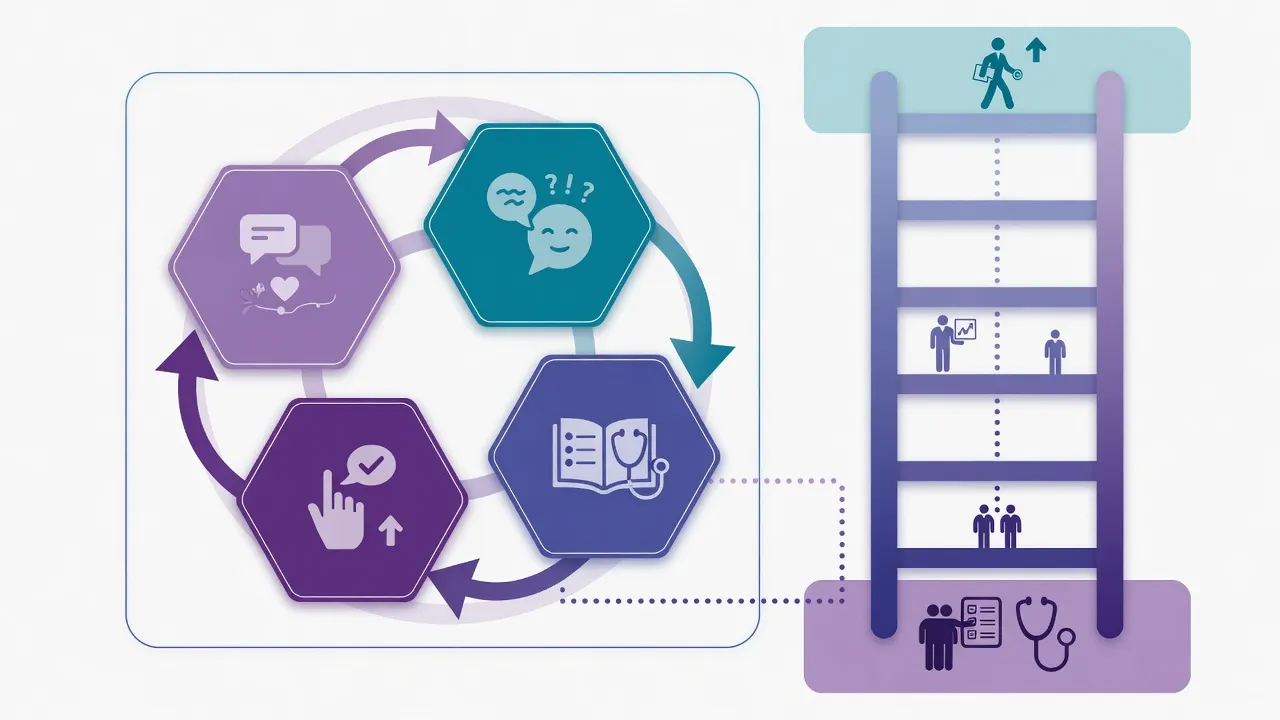
The applied skill the Fellowship examination tests is the integration of these frameworks into a single supervisory encounter in the emergency department. The effective supervisor moves up and down the entrustment ladder by task and by context: the registrar at EPA level 3 on a simple laceration is dropped to level 1 on the difficult airway; the trainee at level 4 on a stable chest infection is dropped to level 2 when the same patient deteriorates. Over-supervision of the competent trainee stalls their progression and frustrates them; under-supervision of the novice exposes the patient to harm. The match is to competence and context, recalibrated on every shift, and the evidence for the match is the direct observation that feeds the entrustment decision.[10][9]
[1]The effective supervisor is explicit about the entrustment level they are applying and why — they tell the trainee "I am going to watch you do this one, because I have not seen you do it before" (level 1, near-total supervision) or "you run this, I am in the department, call me if you need me" (level 3, reactive) — because the named level makes the supervision legible, lets the trainee push for the next level, and prevents the silent drift toward either over- or under-supervision. The move from level 1 (around 100% oversight) toward level 5 (independent, 0% direct supervision) is the documented arc of training, and the supervisor’s job is to advance the trainee deliberately, on evidence, never by default.[9][10]
Model answer — a Fellowship OSCE 'teach a skill and give feedback' station
Differential — good versus poor teaching
When a trainee fails to progress, or reports a poor learning experience, or makes an error traceable to a supervision gap, the supervisor must work through the differential of teaching failure, because each pattern carries a different countermeasure. The patterns below are the high-yield diagnoses the Fellowship candidate must distinguish.[4][10][12]
Effective teaching
- The supervisor is present, observing, and engaged; teaching is structured (one-minute preceptor, SNAPPS, Peyton) and matched to the moment
- Feedback is specific, actionable, timely and behaviour-focused, delivered via Pendleton or R2C2; reinforcement and correction are both specific
- Supervision is graded to competence and context; the entrustment level is named and the trainee is advanced on evidence
- WPBA is observed, immediate, conversational; the teaching loop closes on a documented entrustment level and a concrete next step
The non-specific lecture
- The supervisor teaches from their own knowledge rather than from the trainee's reasoning — they skip the commitment and the probe and deliver facts the trainee may not need
- Feedback is the global "good job" or "needs improvement" with no behaviour named — it carries no actionable information and changes nothing
- Countermeasure: open with the trainee's commitment and probe their reasoning before any teaching; name the specific behaviour in every feedback statement
The absent or hands-off supervisor
- The supervisor is unavailable, on the phone, or in the office; the trainee is left to "sink or swim" on cases beyond their entrustment level
- Autonomy is granted by default rather than by evidence; the patient is exposed to the under-supervised novice and the trainee to the unsupported error
- Countermeasure: name and enforce the entrustment level; the trainee at level 1 or 2 is never unobserved on that task; reactive supervision requires the supervisor to be genuinely reachable
The punitive correction
- Errors are met with public criticism, sarcasm or humiliation rather than specific, framed correction; psychological safety is destroyed
- The trainee stops surfacing uncertainty, stops asking for help, and hides errors — the proximate cause of the catastrophic missed deterioration
- Countermeasure: correct the specific behaviour, not the person; use R2C2 to build relationship and accept the reaction; model fallibility; never correct publicly where it can be done privately
Observation without feedback
- The supervisor watches the trainee perform and then signs the form without the conversation — WPBA becomes a tick-box exercise
- Lörwald showed the educational impact of mini-CEX and DOPS depends entirely on the dialogue that follows the observation; without it, nothing is assessed and nothing is taught
- Countermeasure: treat observation and feedback as a single unit; the encounter is incomplete until the specific, conversational feedback has been given and an entrustment level documented
Common errors and pitfalls
The recurring failures are those the frameworks exist to prevent. The non-specific feedback — "good job", "keep it up" — carries no behaviour-specific information and changes nothing; the correction is specific, actionable and tied to an observed behaviour. The feedback sandwich primes the trainee to dismiss the correction and erodes credibility; it is deprecated, and the specific correction is delivered directly. The absent feedback — the observation that is never followed by the conversation, or the feedback deferred to the end-of-term form months later — teaches nothing because the behaviour is long forgotten; feedback is timely, ideally in the same shift. Over-supervision of the competent trainee frustrates and stalls progression; under-supervision of the novice exposes the patient to harm; the level is matched to competence and context, recalibrated on every shift. Observation without feedback assesses nothing and teaches nothing — observation and feedback are a single unit. The lecture instead of the microskill delivers facts blind to the trainee’s reasoning and misses the gap; the commitment and the probe come first. Peyton stopped at stage 2 hands over a skill the trainee has only watched and heard, not narrated and performed; stage 4 confirms the learning. The halo effect — the trainee who is liked, or who is from one’s own alma mater, is rated above the evidence — corrupts the entrustment decision; the level is set on observed performance, not on regard. The public or humiliating correction destroys psychological safety, suppresses the surfacing of uncertainty, and produces the trainee who hides their errors. The undocumented entrustment level leaves the supervision implicit and inconsistent; the named level makes the supervision legible and the progression deliberate.[3][4][10][12]
Evidence and regional guidelines
The evidence base for teaching, supervision and feedback in medical education is grounded in Ende’s foundational definition of feedback, in Neher’s one-minute preceptor and Wolpaw’s SNAPPS for bedside teaching, and in Peyton’s four-stage approach for skill teaching.[3][1][2][1] The feedback-models literature is synthesised in Orsini and colleagues' review of common models for the clinical educator, which catalogues Pendleton’s rules, the feedback sandwich and R2C2 and confirms the sandwich’s deprecation.[4] The R2C2 model is developed and refined in Sargeant and colleagues' original evidence-based formulation and in Lockyer and colleagues' adaptation to in-the-moment feedback and coaching.[5][6][7] The quantitative case for feedback is made in Wisniewski, Zierer and Hattie’s meta-analysis (d = 0.48).[8] The supervision and entrustment literature is anchored in Gingerich and colleagues' account of supervisory approaches and the entrustment decision, and in ten Cate’s entrustable-professional-activity framework.[10][9] The workplace-based assessment evidence rests on Norcini and colleagues' validation of the mini-CEX and on Lörwald and colleagues' qualitative synthesis of the factors that determine the educational impact of mini-CEX and DOPS.[11][12]
ANZ practice note. The Australasian College for Emergency Medicine (ACEM) Curriculum Framework treats teaching, supervision and assessment as core competencies of the Scholar and Professional roles, and the ACEM Competency-Based Training and Assessment Programme embeds workplace-based assessment, entrustment supervision and structured feedback across the trainee’s progression from the Primary to the Fellowship Examination. Trainees are supervised under a named supervising-consultant model, with documented entrustment levels and structured in-training assessments that draw on mini-CEX, DOPS and case-based discussion. The Medical Board of Australia and the Medical Council of New Zealand require supervisors to be trained in assessment and feedback, and the Australian and New Zealand college curricula align with the competency-based medical education movement that has adopted the entrustable professional activity internationally.[9]
SAQ — The one-minute preceptor applied to the post-case encounter
10 minutes · 10 marks
A junior registrar who has just clerked a 55-year-old man with central chest pain presents the case to you at the bedside. The registrar gives a thorough history but finishes with the phrase, and I am not really sure what to do next, what do you think? You have two minutes to teach.
SAQ — The feedback conversation after a struggling procedure
10 minutes · 10 marks
You directly observed a senior trainee insert an intercostal catheter for a pneumothorax. The tube was placed too low, and the trainee became visibly defensive when you raised it at the bedside. You arrange a feedback conversation in the office ten minutes later.
Exam pearls
- One-minute preceptor = Neher’s five microskills: get a commitment, probe the supporting evidence, teach a general rule, reinforce what was right, correct errors — in that order; the commitment and the probe are the diagnostic steps.
- SNAPPS = Summarise, Narrow the differential, Analyse the differential, Probe the preceptor, Plan management, Select a self-study issue — learner-centred, suits the senior trainee who can drive the encounter.
- Peyton = four stages: demonstrate (normal speed, silent), deconstruct (slow, narrated), demonstrate-while-trainee-narrates, trainee-performs-while-narrating — the practical-skill method; stage 4 confirms learning and is the step most often skipped.
- Feedback principles = specific, actionable, timely, behaviour-focused, balanced — the non-specific "good job" fails all five.
- Pendleton’s rules = four in order: trainee says what went well, supervisor says what went well, trainee says what to improve, supervisor says what to improve — rigid, positive-first.
- R2C2 = Relationship, Reactions, Content, Coach (Sargeant, Lockyer) — the modern evidence-based model; coaching for change, not pronouncing judgement.
- Feedback sandwich = deprecated: positive-negative-positive primes dismissal, erodes credibility, encourages vague positives; deliver the specific correction directly.
- Wisniewski meta-analysis: feedback effect d = 0.48 (435 studies, over 61,000 learners) — powerful, but the how determines the outcome.
- Supervision = matched to competence and context, not seniority: over-supervision stalls, under-supervision harms; the level is recalibrated every shift.
- Entrustment scale = five levels: 1 observe only, 2 direct proactive, 3 reactive (the usual on-shift independence threshold), 4 independent with post-hoc review, 5 fully independent — entrustment is task- and context-specific, never global.
- WPBA samples the "does" tier of Miller’s pyramid: mini-CEX (encounter, reasoning, communication), DOPS (procedure), CBD (clinical reasoning and synthesis) — each samples a different facet.
- Lörwald: the educational impact of mini-CEX and DOPS depends on the dialogue and feedback, not the rating — observation without feedback assesses and teaches nothing. [1]
Red flags
[1]References
- [1]Neher JO, Gordon KC, Meyer B, Stevens N. A five-step microskills model of clinical teaching J Am Board Fam Pract, 1992.PMID 1496899
- [2]Wolpaw TM, Wolpaw DR, Papp KK. SNAPPS: a learner-centered model for outpatient education Acad Med, 2003.PMID 14507619
- [3]Ende J. Feedback in clinical medical education JAMA, 1983.PMID 6876333
- [4]Orsini C, Evans P, Jerez C. Common models and approaches for the clinical educator to plan effective feedback encounters J Educ Eval Health Prof, 2022.PMID 36537186
- [5]Sargeant J, Lockyer J, Mann K, Holmboe E, Silver I, Armson H, Driessen E, MacLeod T, Yen W, Ross K, Power M. Facilitated Reflective Performance Feedback: Developing an Evidence- and Theory-Based Model That Builds Relationship, Explores Reactions and Content, and Coaches for Performance Change (R2C2) Acad Med, 2015.PMID 26200584
- [6]Lockyer J, Sargeant J, Zetkulic M, et al. In-the-Moment Feedback and Coaching: Improving R2C2 for a New Context J Grad Med Educ, 2020.PMID 32089791
- [7]Lockyer J, Sargeant J, Knol J, et al. Application of the R2C2 Model to In-the-Moment Feedback and Coaching Acad Med, 2023.PMID 37797303
- [8]Wisniewski B, Zierer K, Hattie J. The Power of Feedback Revisited: A Meta-Analysis of Educational Feedback Research Front Psychol, 2019.PMID 32038429
- [9]Ten Cate O, Taylor DR. The recommended description of an entrustable professional activity: AMEE Guide No. 140 Med Teach, 2021.PMID 33167763
- [10]Gingerich A, Bogo M, Regehr G. Beyond hands-on and hands-off: supervisory approaches and entrustment on the inpatient ward Med Educ, 2018.PMID 29938831
- [11]Norcini JJ, Blank LL, Duffy FD, Fortna GS. The mini-CEX: a method for assessing clinical skills Ann Intern Med, 2003.PMID 12639081
- [12]Lorwald AC, Lahner FM, Greif R, Berendonk C, Norcini J, Huwendiek S. Factors influencing the educational impact of Mini-CEX and DOPS: A qualitative synthesis Med Teach, 2018.PMID 29188739