EM · Procedural & diagnostic ED skills
Regional nerve blocks in the emergency department
Also known as Regional nerve block · Fascia iliaca block · Femoral nerve block · Wrist block · Digital ring block · Facial nerve block · Field block · LAST (local anaesthetic systemic toxicity)
Regional nerve blocks in the ED — the fascia iliaca and femoral blocks for hip and femoral-shaft fracture analgesia (landmark and ultrasound-guided), the wrist block (median, ulnar, radial at the wrist) and the digital ring block for hand and finger procedures, and the facial blocks (supraorbital/supratrochlear, infraorbital, mental) for facial lacerations. The local anaesthetic agents (lidocaine 1 to 2 per cent, bupivacaine 0.25 per cent, ropivacaine 0.5 per cent) with the maximum safe doses (lidocaine 3 mg/kg plain, 7 mg/kg with adrenaline; bupivacaine 2 mg/kg; ropivacaine 3 mg/kg), ultrasound guidance where available, the recognition and lipid-rescue of local anaesthetic systemic toxicity, and the pitfalls (intravascular injection, nerve injury, compartment syndrome in the anticoagulated, adrenaline in the digit). ACEM-primary, globally tagged.
On this page & tools
Your progress
Saved locally on this device.
Target exams
Red flags
Related topics
- Local anaesthesia and topical agents
- Procedural sedation in the emergency department
- Fracture and dislocation reduction in the ED
- Wound assessment and management
- Consent, capacity and the medico-legal framework in the emergency department
- Focused Assessment with Sonography in Trauma (FAST and E-FAST)
- The primary survey (ABCDE) — the trauma assessment framework
- The sick child and paediatric resuscitation
Regional nerve blocks deposit local anaesthetic around a named nerve or within a fascial plane to anaesthetise a defined sensory and motor territory without loss of consciousness, and they are the ED proceduralist's cleanest tool for site-specific analgesia. The Fellowship candidate must master five named blocks — the fascia iliaca and the femoral for the hip and the femoral-shaft fracture, the wrist block and the digital ring block for hand procedures, and the facial blocks for facial laceration repair — and must hold the pharmacology and the rescue sequence for local anaesthetic systemic toxicity (LAST) at instant recall, because the single event that defines a safe proceduralist is the recognition and lipid-rescue of LAST when a block goes wrong. The Cochrane-level evidence supports the lower-limb blocks for hip-fracture analgesia, the ED randomised trials confirm the opioid-sparing and delirium-sparing benefit of the fascia iliaca block, and ultrasound guidance has made these blocks safer, faster and more effective — but it has not abolished LAST.[1][2][3]
Definition and indications
A regional nerve block is the targeted deposition of local anaesthetic around a peripheral nerve or within a fascial compartment so that the anaesthetic reaches the nerve by diffusion and blocks the voltage-gated sodium channel, abolishing conduction in the sensory and motor fibres of that nerve's distribution. The ED indications fall into three groups. Lower-limb analgesia drives the fascia iliaca and the femoral nerve block: the displaced neck-of-femur fracture in the elderly patient for whom opioids precipitate delirium, the femoral-shaft fracture, and the proximal femoral and pelvic fractures that cause severe pain on movement. Hand and finger procedures drive the wrist block and the digital ring block: the finger laceration, the nail-bed injury and nail trephination, the finger fracture and dislocation reduction, the foreign-body removal, the paronychia drainage, and the tendon repair — procedures where local infiltration distorts the anatomy and a block gives a bloodless, undistorted field. Facial laceration repair drives the facial blocks: the forehead and scalp laceration, the lip laceration, the ear and cheek repair, and the paediatric facial wound where a block avoids distorting the tissue and allows precise cosmetic closure.[4][7] The unifying test is that the pain is confined to a defined nerve territory and the block can reach the nerve; when the pain is multisite, the patient cannot cooperate, or the volume of agent would exceed the safe dose, the block gives way to procedural sedation or general anaesthesia.
Contraindications
There are few absolute contraindications. The first is true allergy to the chosen agent (rare for amides). The second is the refusal or inability to consent in a non-emergency. The third is local infection at the injection site for a deep nerve block, because the needle can seed the infection into a deep compartment. The addition of adrenaline to a block in an end-artery territory — the digit, the tip of the nose, the pinna, the penis — is the classic contraindication taught for the exam, although the modern evidence shows adrenaline-containing lidocaine is safe for the finger in trained hands; the Fellowship answer remains to avoid adrenaline in the digital block.[6] The relative contraindications are patient-specific and demand a risk-benefit judgement. Anticoagulation is the most important for deep blocks (the fascia iliaca, the femoral), because a haematoma in a closed fascial compartment can cause a compartment syndrome; an anticoagulated patient is a relative contraindication to a deep peripheral block and a stronger indication for an ultrasound-guided superficial approach or infiltration. Low body weight, extremes of age, hepatic and cardiac failure lower the LAST threshold, demanding a reduced dose and slower injection. Pre-existing neurological deficit in the limb to be blocked is a relative contraindication, because a new deficit cannot be distinguished from a block complication — document the pre-block neurovascular status and weigh the necessity. Pregnancy raises the plasma peak and reduces the agent requirement.
Relevant anatomy and landmarks
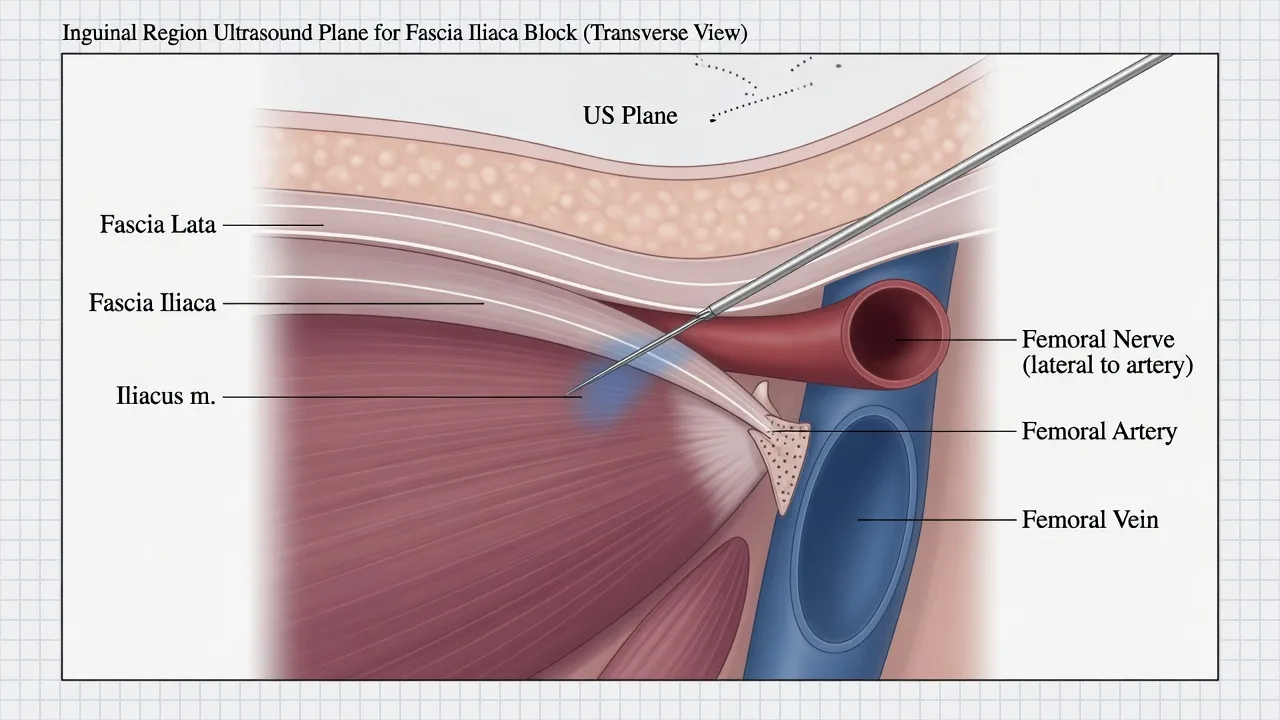
The landmarks are the geography of each named block, and the candidate must draw them on the patient or the examiner. [1]
The forearm (median, radial, ulnar at the wrist) supplies the hand: the median nerve the palmar surface of the thumb, index, middle and radial half of the ring finger; the ulnar nerve the ulnar one and a half digits and the hypothenar motor supply; the radial nerve the dorsolateral hand and the dorsal thumb, index and middle fingers. The fascia iliaca spread anaesthetises the anterior thigh and femoral distribution (the lateral femoral cutaneous adds the lateral thigh), which is the basis of the analgesia for the hip and the femoral-shaft fracture.[5]
Equipment and patient preparation
A regional block needs a defined kit: the chosen agent drawn up in a labelled syringe, a 21- to 23-gauge needle for deep blocks and a 25- to 30-gauge needle for the digital and facial blocks, chlorhexidine skin preparation, sterile drapes and gloves, a nerve stimulator where a deep stimulator-guided block is planned, a high-frequency linear ultrasound probe and sterile cover where ultrasound is used, and resuscitation equipment within arm's reach — oxygen, suction, a bag-valve-mask and a lipid emulsion 20 per cent ampoule available in the department for any block involving bupivacaine, ropivacaine or a large lidocaine volume. Patient preparation captures the weight (for the dose calculation), the allergy, the anticoagulation (a deep block in the anticoagulated patient is reconsidered), the pre-block neurovascular status documented, and the consent with the procedure, the agent and the risks explained (infection, bleeding, nerve injury, LAST, motor block masking a compartment syndrome). The single most important preparation step is the dose calculation stated aloud before drawing up — the weight in kilograms times the agent's maximum, converted to millilitres from the concentration, with the volume remaining declared.[8][9]
The local anaesthetic agents and maximum doses
The agents used for ED nerve blocks are the three amides — lidocaine 1 to 2 per cent, bupivacaine 0.25 per cent (and 0.5 per cent), and ropivacaine 0.5 per cent — chosen for onset, duration and cardiotoxicity profile. The concentrations to know are that 1 per cent is 10 mg per mL, 0.5 per cent is 5 mg per mL, and 0.25 per cent is 2.5 mg per mL. The Fellowship candidate must know the maximum safe dose for each agent because exceeding it is the direct cause of LAST. [1]
The maximum doses of the ED nerve-block agents
Adrenaline (1 in 200,000, 5 micrograms per mL) constricts the local vasculature, slows absorption, raises the lidocaine ceiling from 3 to 7 mg/kg and prolongs duration; it is excluded from the end-artery territories and used cautiously around the penis, the toes and the digit. In the inflamed or acidic tissue the local anaesthetic ionises and is less effective — a reason a block proximal to the inflammation is preferred to infiltration into cellulitic tissue.[8]
Differential diagnosis — deterioration during or after a block
The can't-miss decision point is the patient who becomes unwell during or after a block. LAST must be distinguished from its mimics because only LAST mandates lipid emulsion, and the discriminator is timing, prodrome and the cardiovascular pattern. [1]
Local anaesthetic systemic toxicity (LAST)
- Minutes (or 30+ min) after the block; immediate with intravascular injection
- Prodrome: circumoral tingling, metallic taste, tinnitus, agitation, visual disturbance
- Progression to tonic-clonic seizure, then hypotension, wide-QRS conduction block, ventricular arrhythmia, arrest
- Treat: stop the injection, airway, lipid emulsion 20 per cent 1.5 mL/kg bolus then 0.25 mL/kg/min; bupivacaine arrest is refractory to standard ALS
Vasovagal syncope
- Common with the needle and injection; pallor, diaphoresis, nausea, bradycardia, hypotension
- Brief and self-limiting with supine positioning and leg raise; full recovery in minutes
- No CNS-toxicity prodrome, no metallic taste or tinnitus
- Treat: supine, legs up, oxygen, intravenous fluid; the diagnosis of exclusion in the awake-and-recovering patient
Intravascular adrenaline injection
- Immediate, within seconds; tachycardia, palpitations, hypertension, anxiety
- Caused by an adrenaline-containing solution entering a vessel (or a positive test dose)
- Brief and self-limiting; prevented by aspirating before every aliquot
- Sympathetic excess rather than CNS depression; no seizure unless it progresses to true LAST from the local anaesthetic
Anaphylaxis
- Rapid urticaria, angioedema, bronchospasm, hypotension; can follow any agent, more with the ester or the latex/preservative
- Skin and mucosal change is the discriminator from LAST; no focal CNS prodrome
- Treat: intramuscular adrenaline 0.5 mg, oxygen, fluid, antihistamine, steroid — the standard anaphylaxis algorithm
- True amide allergy is rare; suspect latex or the preservative if the agent is an amide
Coincidental seizure
- Epilepsy-related seizure with no prodromal CNS-toxicity symptoms and no tight tie to the absorption peak
- No cardiovascular collapse, normal ECG, rapid postictal recovery
- Treat the seizure per the status pathway, but review the block timing
- Assume LAST until proven otherwise in the freshly-blocked patient
The discriminating features are the timing (immediate for the intravascular injection or anaphylaxis; minutes for LAST; brief for vasovagal), the prodrome (the metallic taste, tinnitus and circumoral tingling are nearly pathognomonic of LAST), and the cardiovascular pattern (bupivacaine LAST produces refractory conduction block and ventricular arrhythmia that does not respond to standard ALS). When the diagnosis is uncertain after a block, treat as LAST and start lipid early.[8][9]
Stepwise technique — the named blocks
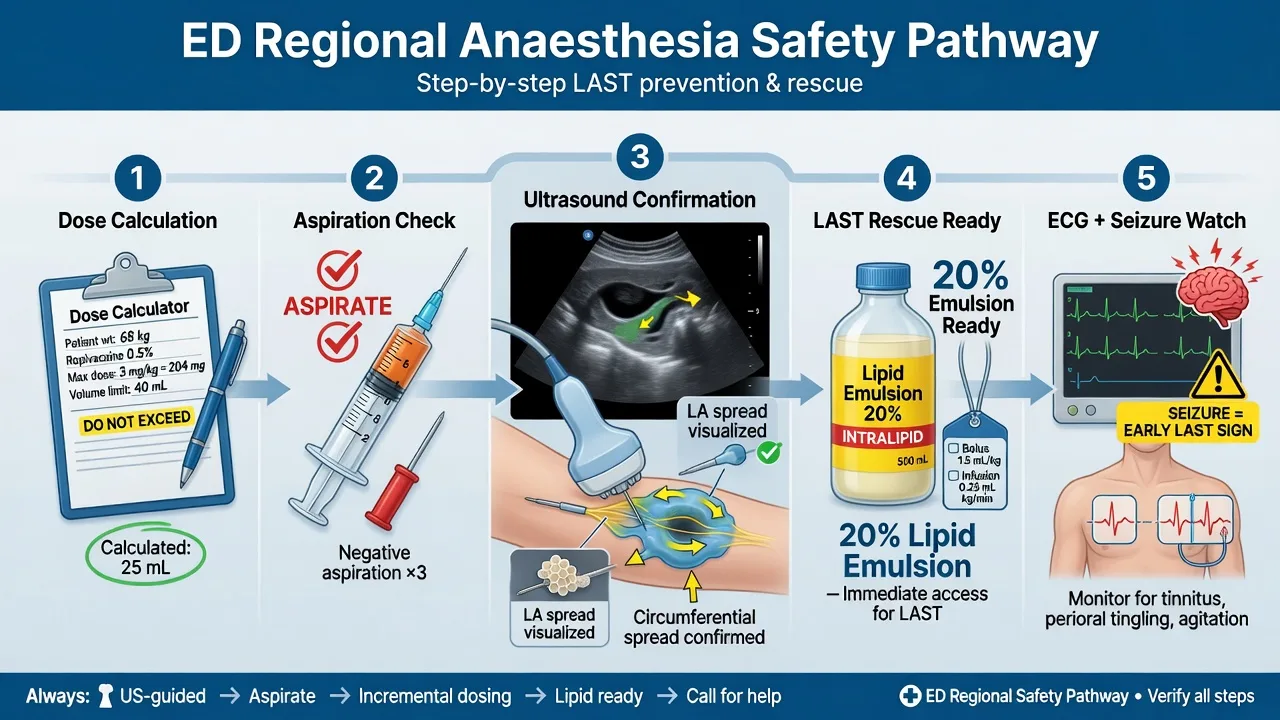
The blocks are run to a sequence so that no step is missed under procedural pressure, and the dose, the aspiration and the slow injection are common to all five. [1]
The common sequence, then the named block
- Calculate the dose aloud — weight in kg times the agent's maximum, converted to millilitres from the concentration; declare the volume and the ceiling remaining.
- Position, consent, prep — position for access and comfort; confirm consent; sterile skin preparation and draping for the deep blocks.
- Identify the landmark — draw it on the skin or position the ultrasound probe to visualise the nerve and the fascial planes.
- Insert and aspirate — advance to the target plane; aspirate before every aliquot; if blood or CSF returns, reposition before any injection.
- Inject slowly — deposit the agent in small aliquots ahead of the advancing needle; stop at any pain, tingling or resistance (intraneural injection).
- Wait for onset — 5 to 10 minutes for the long-acting agents; test the dermatome before proceeding.
- Document — the agent, the concentration, the volume, the milligrams, the landmark or the ultrasound view, the aspiration check, and the onset and the block success. [1]
Fascia iliaca. ASIS-to-pubis line, junction of the lateral third and medial two-thirds, 1 to 2 cm below; two pops (fascia lata, fascia iliaca); 20 to 30 mL of long-acting agent. Ultrasound: in-plane, deposit between fascia lata and fascia iliaca over iliacus, watch the spread lift the fascia iliaca. [1]
Femoral. Inguinal crease, lateral to the artery; nerve stimulator patella-twitch at 0.3 to 0.5 mA, or ultrasound lateral to the artery; 15 to 20 mL. [1]
Wrist. Median 3 to 5 mL between palmaris longus and flexor carpi radialis at the distal crease; ulnar 3 to 5 mL radial to flexor carpi ulnaris plus a subcutaneous wheal for the dorsal branch; radial 5 mL subcutaneous field over the radial styloid. [1]
Digital ring block. Two dorsal web-space punctures toward the proximal phalanx, two volar punctures; 1 to 2 mL each side, no adrenaline, 3 to 5 mL total per digit. [1]
Facial blocks. Supraorbital at the supraorbital notch on the mid-pupillary line (1 to 2 mL) with supratrochlear just medial to it; infraorbital at the foramen 1 cm below the orbital rim (1 to 2 mL); mental at the foramen below the second premolar (1 to 2 mL) — all entered with a 25- to 30-gauge needle, aspirated, and deposited slowly. [1]
The two structural errors are to inject before aspirating (the intravascular bolus that causes immediate LAST) and to exceed the calculated dose by re-drawing more agent. Titration to the effect within the ceiling is the rule, and ultrasound guidance is used wherever it is available — it confirms the nerve, the plane and the spread, and reduces the LAST rate by allowing a smaller, better-placed volume.[2][3]
Complications and pitfalls
Beyond LAST, the complications fall into procedure-related and agent-related groups. LAST is the killer: CNS toxicity (the prodrome of circumoral tingling, metallic taste, tinnitus, agitation, then muscle twitching, seizure, coma) followed by cardiovascular toxicity (hypertension and tachycardia giving way to hypotension, conduction block, ventricular arrhythmia and arrest). The lethal edge of bupivacaine is its tight, slow binding to the cardiac sodium channel — its arrest is refractory to standard ALS and demands lipid. Intravascular injection is the immediate cause of LAST and is prevented by aspiration before every aliquot and incremental injection. Nerve injury from the intraneural injection presents as severe pain on injection and is prevented by stopping at any pain or paraesthesia and by avoiding heavy sedation that masks the patient's report. Haematoma and compartment syndrome complicate the deep block in the anticoagulated patient; the femoral and fascia iliaca blocks bleed into a closed compartment and can compromise the limb, and the motor block of the block can mask the early pain of a compartment syndrome — a tense swollen leg after a block is compartment syndrome until proven otherwise. Infection is rare with sterile technique. Block failure and the wrong limb or nerve are procedural errors prevented by the landmark check and the consent marking. Methaemoglobinaemia from prilocaine (rarely used for blocks) or benzocaine is the cyanosis that does not clear with oxygen, treated with methylene blue 1 to 2 mg/kg intravenously.[8][9]
The pitfalls invert the structure: not calculating the dose aloud (the over-dose); not aspirating (the intravascular injection); adding adrenaline to a digital block (the digit at risk); injecting through cellulitis (the agent fails in the acidic tissue); burning time on escalating inotropes in a bupivacaine arrest instead of starting lipid; treating the LAST arrhythmia with lidocaine (piling a local anaesthetic onto a local-anaesthetic arrest — use amiodarone); misattributing a late seizure to the patient's epilepsy; failing to observe the post-block patient for the delayed LAST window; forgetting that the motor block masks a compartment syndrome; and under-dosing the analgesia out of fear of LAST, leaving the hip-fracture patient in pain and opioid-dependent. The practical tips are the mirror: state the dose, aspirate every aliquot, use ultrasound, have lipid in the department, document the pre-block neurovascular status, and observe the patient for at least 30 to 60 minutes after a large-volume block. [1]
Post-block care and disposition
The patient is observed for at least 30 to 60 minutes after a large-volume fascia iliaca or femoral block to detect the delayed LAST, with the monitoring (ECG, pulse oximetry, blood pressure) for the deep block and the lipid emulsion within reach. The fascia iliaca block gives 8 to 12 hours of analgesia that reduces the opioid requirement and the delirium risk in the elderly hip-fracture patient, and the patient is admitted for the fracture care and the operative fixation; the block is an analgesic bridge, not a definitive treatment, and does not change the disposition of the fracture itself. The hand and facial blocks give 2 to 8 hours of anaesthesia depending on the agent, and the patient is discharged after the procedure with a documented neurovascular check and a written instruction to return if the block has not worn off within the expected window or if the limb becomes painful, swollen or pale. The LAST survivor is observed for the prolonged window because the recurrence is described. The motor block of a lower-limb block mandates a falls-prevention plan — the patient must not mobilise unaided while the quadriceps is weak.[1][3]
Special populations
The elderly hip-fracture patient is the population in whom the fascia iliaca block is most valuable, because the opioids that would otherwise control the pain precipitate delirium, and the block provides 8 to 12 hours of opioid-sparing analgesia; the dose is weight-based and reduced, and ropivacaine is preferred over bupivacaine for the lower cardiotoxicity in the frail, low-weight patient.[2][3] The child is the population in whom the digital ring block, the facial block and the LET-gel-adjuncted wound anaesthesia convert a frightened child into a cooperative one; the weight-based dose is the same per kilogram but the small total mass makes the absolute ceiling low, so the syringe is calculated carefully and the lowest effective concentration chosen. The anticoagulated patient is the one in whom a deep block (fascia iliaca, femoral) is reconsidered for the compartment-syndrome risk of a haematoma, and the ultrasound-guided superficial approach or infiltration is preferred where it will serve. The pregnant patient is blocked with the reduced dose that the raised cardiac output and the increased plasma peak demand, with the amides preferred and the esters used where the rapid hydrolysis is advantageous. The patient with a pre-existing neurological deficit in the limb has the deficit documented before the block, and the block is weighed against the difficulty of attributing a new deficit.
Evidence and regional guidelines
The contemporary framework rests on the Cochrane review of peripheral nerve blocks for hip fractures (Guay 2018), which confirmed the analgesic benefit and the opioid-sparing effect of the fascia iliaca and femoral blocks for the hip-fracture population, the ED randomised trials of ultrasound-guided femoral and fascia iliaca blocks that demonstrated reduced pain and opioid use in the geriatric hip-fracture patient (Beaudoin 2013; Finch 2026), the reviews of the digital nerve block technique (Gottlieb 2022) and the hand neuroanatomy and bedside blockade (Patel 2026), the classic reappraisal of adrenaline in the digital block (Wilhelmi 1998), and the facial-block randomised trial (Tarsia 2005).[1][2][3][4][5][6][7] The LAST prevention and rescue framework is the ASRA third practice advisory (Neal 2018) and the 2020 checklist (Neal 2021), which codified the maximum doses, the aspiration rule, the early recognition and the lipid-emulsion 20 per cent protocol (1.5 mL/kg bolus then 0.25 mL/kg/min), and which noted that ultrasound guidance reduces but does not abolish LAST and has shifted its presentation toward the delayed pattern.[8][9]
ANZ practice note. In Australian and New Zealand EDs the fascia iliaca block under ultrasound guidance is the workhorse for the hip-fracture analgesia, deployed early to opioid-spare and delirium-spare the elderly patient, with ropivacaine 0.5 per cent (3 mg/kg) preferred for its lower cardiotoxicity and bupivacaine 0.25 per cent (2 mg/kg) as the long-acting alternative. Lidocaine 1 to 2 per cent is the short-acting agent for the wrist, the digital ring block and the facial blocks, with adrenaline added for the non-end-artery territories. The ACEM-endorsed approach is the dose declared aloud, the aspiration before every aliquot, the ultrasound wherever available, and the lipid emulsion 20 per cent stocked in every area where bupivacaine or a large lidocaine volume is used. [1]
Exam pearls
- State the maximum dose aloud before drawing up — lidocaine 3 mg/kg plain, 7 mg/kg with adrenaline; bupivacaine 2 mg/kg (3 with adrenaline); ropivacaine 3 mg/kg; 1 per cent is 10 mg/mL, 0.5 per cent is 5 mg/mL, 0.25 per cent is 2.5 mg/mL.
- The fascia iliaca landmark — ASIS-to-pubis line, the junction of the lateral third and the medial two-thirds, 1 to 2 cm below the line; two pops (fascia lata, then fascia iliaca); 20 to 30 mL of long-acting agent.
- Ropivacaine over bupivacaine for the large-volume fascia iliaca block in the frail — less cardiotoxic, similar duration.
- LAST is delayed as often as immediate — ultrasound guidance has shifted the presentation; a seizure or arrest within 30 to 60 minutes of a block is LAST until proven otherwise.
- Bupivacaine arrest is refractory to standard ALS — go straight to lipid emulsion 20 per cent, 1.5 mL/kg bolus then 0.25 mL/kg/min; do not use lidocaine for the arrhythmia.
- No adrenaline in the digital block — the exam answer despite the modern evidence; aspirate before every aliquot; the motor block of a lower-limb block masks a compartment syndrome.
- The wrist block nerve map — median (palmar 3.5 digits, palmaris longus/flexor carpi radialis), ulnar (1.5 digits, flexor carpi ulnaris, dorsal branch), radial (dorsolateral hand, field over radial styloid).
- Facial block foramina lie on the mid-pupillary line — supraorbital, infraorbital, mental. [1]
Exam practice
SAQ — Fascia iliaca block for the displaced neck-of-femur fracture
10 minutes · 10 marks
A 78-year-old woman who weighs 55 kg presents with a displaced neck-of-femur fracture after a fall. She is in the severe pain and has an early delirium. You plan a fascia iliaca block with the ropivacaine 0.5 per cent. The lipid emulsion 20 per cent is in the department.
SAQ — Local anaesthetic systemic toxicity during a digital ring block
10 minutes · 10 marks
A 25-year-old man is having a digital ring block for a finger-laceration repair with the lidocaine. Two minutes after the injection he reports the circumoral tingling and a metallic taste, then has a tonic-clonic seizure and becomes hypotensive.
Red flags
[1]References
- [1]Guay J, Kopp S, Duchesne C, Chou R, Motsch J. Peripheral Nerve Blocks for Hip Fractures: A Cochrane Review Anesth Analg, 2018.PMID 28991122
- [2]Beaudoin FL, Haran JP, Liebmann O. A comparison of ultrasound-guided three-in-one femoral nerve block versus parenteral opioids alone for analgesia in emergency department patients with hip fractures: a randomized controlled trial Acad Emerg Med, 2013.PMID 23758305
- [3]Finch AS, Ehrman R, Maeng D, Frasure SE, Raffel J, Makan N, Marill KA, Hall A, Swadron S, Lewiss RE. Does Point-of-Care Ultrasound-Guided Nerve Block for Geriatric Hip Fracture Analgesia in the Emergency Department Improve Outcomes? J Emerg Med, 2026.PMID 41270324
- [4]Gottlieb M, Schmitz A, Joeng E, Russell FM. Digital Nerve Blocks: A Comprehensive Review of Techniques J Emerg Med, 2022.PMID 36229322
- [5]Patel AU, Chahal S, Surani AA, Surani S. A Review of Hand Neuroanatomy, Anesthesia, and Bedside Blockade Cureus, 2026.PMID 42266292
- [6]Wilhelmi BJ, Blackwell SJ, Miller JH, et al. Epinephrine in digital blocks: revisited Ann Plast Surg, 1998.PMID 9788222
- [7]Tarsia V, Singer AJ, Cassara G, Salama M, Cohn J, Imdad A, Ilyas AM. Percutaneous regional compared with local anaesthesia for facial lacerations: a randomised controlled trial Emerg Med J, 2005.PMID 15611540
- [8]Neal JM, Barrington MJ, Fettiplace MR, Gitman M, Memtsoudis SG, Morwald EE, Rubin DS, Weinberg G. The Third American Society of Regional Anesthesia and Pain Medicine Practice Advisory on Local Anesthetic Systemic Toxicity: Executive Summary 2017 Reg Anesth Pain Med, 2018.PMID 29356773
- [9]Neal JM, Neal EJ, Weinberg GL. American Society of Regional Anesthesia and Pain Medicine Local Anesthetic Systemic Toxicity checklist: 2020 version Reg Anesth Pain Med, 2021.PMID 33148630